


Behavioral intelligence is the capability to combine cognitive intelligence, emotional intelligence, and context to explain existing behaviors, predict future behaviors, and influence behavior. Originally developed in military strategy, it now enables organizations to activate the best version of their people, build dynamic capabilities, and drive measurable performance change.
Example. A sales manager uses a behavioral intelligence platform to identify which observable communication patterns distinguish their top five reps. Within one quarter, coaching sessions focus on those specific signals and conversion rates improve across the wider team.
Behavioral intelligence refers to the capability to combine cognitive intelligence, emotional intelligence, and context to explain, predict, and influence behavior. The concept has a precise definition, a measurable set of dimensions, and direct business implications for sales, service, and leadership performance.
What is behavioral intelligence?
Behavioral intelligence is the capability to combine cognitive intelligence, emotional intelligence, and context to:
In a wider sense, behavioral intelligence enables organizations and individuals to activate the best version of themselves, build dynamic capabilities, and become effective in accomplishing individual and organizational goals.
What makes it different from older psychological models is that behavior is observable, context-dependent, and trainable. You do not need invasive psychological assessments. Behavioral signals can be read and interpreted in real time, from conversation patterns, tone, pacing, and structure.
If you're looking for a scalable, engaging, and effective way to drive behavioral change in your organization, AI-driven coaching like Retorio is the way forward.
Irit Hovich, Senior Director, Global Talent Management, Head of Diversity and Inclusion, TevaWhere behavioral intelligence comes from: a military origin
Like many impactful methodologies, behavioral intelligence is rooted in military strategy. Strategists developed and applied it to discern the root causes of intentions and actions of opposing forces. This type of intelligence was invaluable for special operations teams executing high-stakes missions under uncertainty.
Being able to understand individuals and their behavior in cultural context often made the difference between mission success and mission failure. The core insight, that observable behavioral patterns reveal intention, transferred directly into organizational and commercial settings.
"With the right kinds of intelligence about the actions and behaviors of others, one can not only deconstruct behaviors to derive their root causes, thereby allowing one to understand the intentions, motivations, and plans of others, but one can even predict the future actions that the person will take."
Psychology and Modern Warfare (Springer, 2013)
Research in organizational psychology has since confirmed that behavioral cues are among the most reliable predictors of performance outcomes. A peer-reviewed study published in NCBI demonstrates that observable interpersonal behaviors predict social outcomes far more consistently than self-reported psychological traits.
Behavioral intelligence vs emotional intelligence: what is the difference?
Emotional intelligence (EQ) focuses on a person's awareness and management of their own emotions and their capacity to empathize with others. It is a useful construct, but it is primarily introspective and self-reported, which limits its predictive and scalable application.
Behavioral intelligence goes further. It incorporates EQ as one input alongside cognitive intelligence and contextual awareness, then extends the model to observable, measurable, and trainable behavioral signals. The key distinction: emotional intelligence describes how a person feels. Behavioral intelligence describes what a person does, in which context, with what effect.
For a detailed comparison, see how behavioral intelligence differs from emotional intelligence in our dedicated analysis.
Why behavioral intelligence decides sales performance
Sales performance gaps rarely come from a lack of product knowledge. They come from behavioral patterns that either build or destroy buyer trust in the first few minutes of a conversation. The Warmth and Competence framework shows that buyers form trust judgments within seconds, and those judgments are based on behavioral signals: tone, pacing, eye contact, listening posture, and language choice.
Behavioral intelligence makes those signals visible and actionable. Instead of a manager's subjective impression after a call review, you get a consistent, data-driven read on which behavioral patterns correlate with conversion, and which do not.
Today, 5 out of the 10 most profitable companies in Germany already use Retorio's AI-powered behavioral intelligence to explain, predict, and influence sales performance, service quality, and leadership effectiveness.
As opposed to other psychological measures, behavior can be readily observed, much of it in real time from a conversation. Behavioral intelligence requires no invasive psychological data about people. It can derive explanations and predictions regarding a person's behavioral patterns while respecting privacy, which is why it aligns with GDPR, EU AI Act requirements, and modern data governance expectations.
How Retorio applies behavioral intelligence as a platform
Following its origins in military intelligence, behavioral intelligence has moved into enterprise coaching platforms, powered by cloud computing and advances in machine learning. Retorio, founded as a university spin-off, commercialized this capability for organizations across insurance, pharma, automotive, and financial services.
The platform operates across three application layers:
Spot: Organizations deploy Retorio's behavioral intelligence to quantify their culture and derive performance targets. By identifying behavioral differences between top and bottom performers, they learn which patterns drive corporate outcomes.
Hire: Based on internal behavioral data, organizations learn to predict which candidates align with their performance profile and hire, onboard, and promote talent more effectively.
Develop: Organizations use behavioral data to transfer success patterns. They use Retorio to influence behavior and coach more reps into top-performer territory. For a closer look at what that coaching capability includes, see what a behavioral intelligence platform actually does.
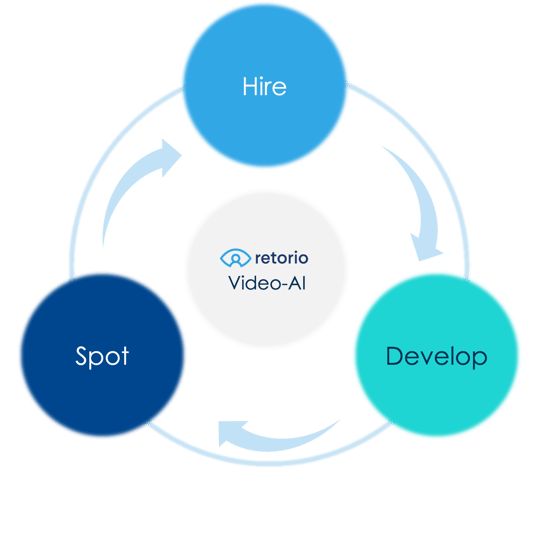
The combination of Spot, Hire, and Develop creates a dynamic data loop that gives organizations increasing control over transformation projects. Each cycle adds more behavioral signal, which sharpens the next round of coaching.
Behavioral intelligence and routine change
Successful performance transformations require sustainable behavior change, including the abandonment of deeply rooted routines. Routine change is one of the least understood dimensions of organizational change. Most individuals and organizations are limited in their ability to reflect on, maintain, and adjust their routines.
Such dynamic capabilities require changes in unconsciously executed behaviors. Behavioral intelligence, combining cognition, emotion, and context, empowers the maintenance of effective routines and the abandonment of ineffective ones.
Yet such fundamental behavioral change cannot be achieved through instruction alone. Overthinking a behavior actually hinders the learning of it. Routine change requires interactive and corrective feedback, delivered at the right moment in the workflow. Research, including Retorio's own published work on feedback timing and routine change, shows that the effects of performance feedback are complex: for lower-level routines, reward or corrective feedback must be provided instantly to be effective.
This is precisely what AI-powered coaching does. Retorio offers scalable role-plays and simulations that deliver instant behavioral feedback, cueing reps toward the specific communication patterns that convert. For context on how this translates into measurable revenue impact, see AI sales coaching and its effect on quota attainment.
What behavioral intelligence is not
Behavioral intelligence is not surveillance. It does not require biometric identification. The platform can analyze communication patterns while masking age, gender, and ethnicity, deriving behavioral insights without linking them to a person's identity.
It is also not a personality test. Personality tests measure stable traits. Behavioral intelligence measures current behavioral patterns in specific contexts, which means it captures something more useful for coaching: what a person is doing right now, and how that differs from what their best-performing peers do in the same situation.
The privacy distinction matters for enterprise adoption. Unlike conventional psychological frameworks and assessments, behavioral intelligence platforms cater directly to GDPR requirements and modern data governance expectations.
Interested in finding out more and seeing Retorio's AI coaching platform in action?

Behavioral intelligence: frequently asked questions
What is behavioral intelligence?
Behavioral intelligence is the capability to combine cognitive intelligence, emotional intelligence, and context in order to explain existing behavior, predict future behavior, and influence it. Unlike trait-based models, it starts from what a person actually does in a specific situation, which makes it observable, measurable, and coachable.
How is behavioral intelligence different from emotional intelligence?
Emotional intelligence describes how a person recognises and manages feeling, largely through self-report. Behavioral intelligence treats that as one input, adds cognitive intelligence and context, and then measures observable behavior. Emotional intelligence describes how someone feels. Behavioral intelligence describes what they do, in which situation, and with what effect.
Is behavioral intelligence the same as behavioral analytics?
No. Behavioral analytics reports what happened in aggregate, usually as clicks, events, or funnel steps. Behavioral intelligence works at the level of a single interaction. It interprets communication patterns such as tone, pacing, structure, and listening, then turns them into feedback a rep or a manager can act on.
How is behavioral intelligence measured?
It is read from observable signals in a real or simulated conversation: tone, pacing, structure, question quality, and listening behavior. Those signals are compared against the patterns that top performers in the same role show, so the output is a like-for-like comparison rather than a fixed label attached to a person.
Is there a behavioral intelligence test?
There is no single standard test, because behavioral intelligence is read inside a conversation rather than from a questionnaire. That is also why the result moves as behavior moves. For the longer answer, see what a behavioral intelligence test actually measures.
Does behavioral intelligence comply with GDPR and the EU AI Act?
It does when it stays with observable behavior instead of identity. Retorio analyses communication patterns without biometric identification and can mask age, gender, and ethnicity. Retorio is GDPR-compliant, EU AI Act-aligned, and ISO 27001 certified, hosted on Google Cloud Platform with EU data residency.
What are the 14 intelligent behaviors?
The phrase comes from Arthur Costa's work on intelligent behaviors in education, published today as the 16 Habits of Mind by Costa and Kallick. Lists circulating with 12 or 14 items are earlier or abridged editions of the same framework, which is why the count varies. The habits that transfer directly to a sales or service conversation are persisting, managing impulsivity, listening with understanding and empathy, questioning and posing problems, and communicating with clarity and precision. The difference from behavioral intelligence is measurement. Habits of Mind is a list of dispositions a person is encouraged to develop. Behavioral intelligence scores what someone actually did in a specific conversation and compares it against the patterns of top performers in the same role.
What are examples of behavioral skills?
Behavioral skills are the observable things a person does in an interaction, as opposed to what they know. In a sales or service conversation the common examples are active listening, asking an open question and staying quiet long enough to get the answer, matching pace and tone to the other person, naming an objection out loud before responding to it, summarising back what you heard before proposing anything, structuring an argument so the other person can follow it, and holding a steady tone when a price or a decision is challenged. Retorio groups these into two families: warmth signals such as listening and acknowledgement, and competence signals such as structure, specificity, and a clear next step. Both are visible in a recording, which is what makes them coachable.
What is mental intelligence?
Mental intelligence is not a formal construct in psychology. People using the phrase usually mean general mental ability, also called cognitive ability, which is the capacity to reason, learn, and solve problems. It is well measured and it predicts how quickly someone picks up a new product or a new process. What it does not predict is how that person behaves in a live conversation with a customer. That is why behavioral intelligence treats cognitive intelligence as one input alongside emotional intelligence and context, rather than as the whole picture.
Written with help from LLMs, edited and checked by Önder Mutluer, Website Manager and Marketing Strategist, and Dr. Patrick Oehler, Co-founder and Co-CEO. Reviewed by Dr. Florian Abicht, Chief AI Officer. How this article was researched, written and checked, and who reviews which topic: Retorio editorial policy.