


AI-based online coaching uses adaptive algorithms to personalize what, when, and how each person practices, replacing one-size-fits-all courses with content that adjusts to individual pace and skill gaps. For organizations it means faster capability building, measurable progress, and coaching that scales without adding instructor time. This guide covers six concrete reasons to adopt it.
Example. A new insurance sales rep at a German insurer completes AI-guided role plays on objection handling before their first customer visit. After three sessions the platform reports a 12-point improvement in Warmth signals. Their manager skips remediation coaching. Time-to-competency drops by six weeks.
It's no secret that online learning is gaining ground; by 2027, the worldwide e-learning market is predicted to be worth $1 trillion. Whether it is graduate students or working adults who are trying to advance their careers, more and more people are switching to online learning platforms to enhance their learning journey.
Organizations must begin to adapt their approach to talent development and seize the opportunities presented by this changing landscape. To stay ahead in this era of rapid technological advancement, talent development professionals need to equip themselves with the skills to guide their teams through continuous learning. One method that is gaining global attention is the use of Artificial Intelligence (AI) in online learning.
This blog post explores six reasons why AI-based online learning is not just beneficial but essential for companies aiming to retain top talent, enhance skill sets, and drive business success. From boosting engagement and providing personalized learning experiences to delivering measurable results and cost-efficiency, AI online learning is a game-changer. It revolutionizes how we perceive training and development in a corporate setting, offering a new perspective on growth and innovation.
What's in this post?
- What is online learning?
- What is an online learning platform?
- Traditional online learning vs AI online learning
- Benefits of AI online learning
- Personalized AI online learning with Retorio
Related readingExplore how AI coaching works for sales and service teams, understand why employees forget 70% of content within 24 hours, and see seven business benefits of AI-driven employee development.
What is online learning?
Online learning has helped 42% of US firms in increasing their revenue.
Online learning, also known as e-learning, is a form of education that takes place over the Internet. It is designed to enable employees and professionals to acquire knowledge and skills through digitally distributed materials and activities.
This mode of learning is highly appealing for its flexibility, accessibility, and adaptability. With online learning, individuals can learn at their own pace, at any time, and from any location, making it an ideal solution for businesses looking to provide training and development opportunities to their employees.
It offers a variety of educational and coaching programs, from formal degree courses to informal coursework, tailored to specific performance objectives. Online learning is a practical tool that businesses can use to build staff capability, boost productivity, and foster a culture of continuous professional development.
What is an online learning platform?
An online learning platform is a comprehensive set of interactive online services that give educators, employees, and administrators the information, tools, and resources needed to manage and deliver capability-building programs at scale. These platforms, often hosted on the cloud, offer a user-friendly interface with features designed to support structured communication, collaboration, and knowledge transfer across distributed teams.
Companies are increasingly harnessing the power of online learning platforms to provide top-notch, standardized training to employees, regardless of their location.
These platforms create a self-paced learning environment that caters to individual learning styles and areas of strengths and improvements, ultimately improving the overall learning experience and boosting retention rates.
Additionally, with the feature of tracking progress and performance metrics, companies can receive real-time insights into their training programs' effectiveness. This data can be instrumental in adjusting the learning content and strategies to further improve the outcomes, and to create more personalized learning content for each individual. Consequently, by adopting online learning platforms, companies not only enrich their employees' learning experience but also gain a competitive edge in the corporate landscape.
Everyone's learning journey is different and moves forward at different paces. Online learning simply allows for the different journeys to take place smoothly, and efficiently.
What is an online course?
An online course is a collection of coaching content delivered through a web browser or mobile application, accessible from any location at any time. It creates a structured environment for practical asynchronous practice, with a heavy emphasis on interactive activities rather than passive consumption.
In an online course, the instructor creates the material but does not necessarily interact live with participants. Courses consist of videos, quizzes, exercises, and activities that help employees build knowledge in specific areas of interest or expertise. Some also offer virtual hands-on labs that allow for real-world application of the skills covered in the course.
Most online courses offer a certificate of completion at the end, which can be used to demonstrate proficiency in a certain subject area and may even open up career advancement opportunities for those who complete them successfully.
Traditional online learning vs AI online learning
While traditional online learning and AI-based online learning have a lot in common, the latter offers enhanced capabilities. AI-based online learning platforms come equipped with advanced technologies that allow them to understand and respond to user interactions quickly and effectively.
AI-enabled systems can detect patterns in how users interact with the platform, create personalized recommendations based on these observations, and adjust the course content according to user requirements. This allows for a more tailored and personalized learning experience, enabling users to make the most of their time and energy when engaging with the course material.
In addition, AI-based e-learning systems use natural language processing (NLP) to assess user knowledge in a particular topic area. It can automatically generate questions based on the employee's previous responses and identify gaps in understanding or areas of improvement that need further attention.
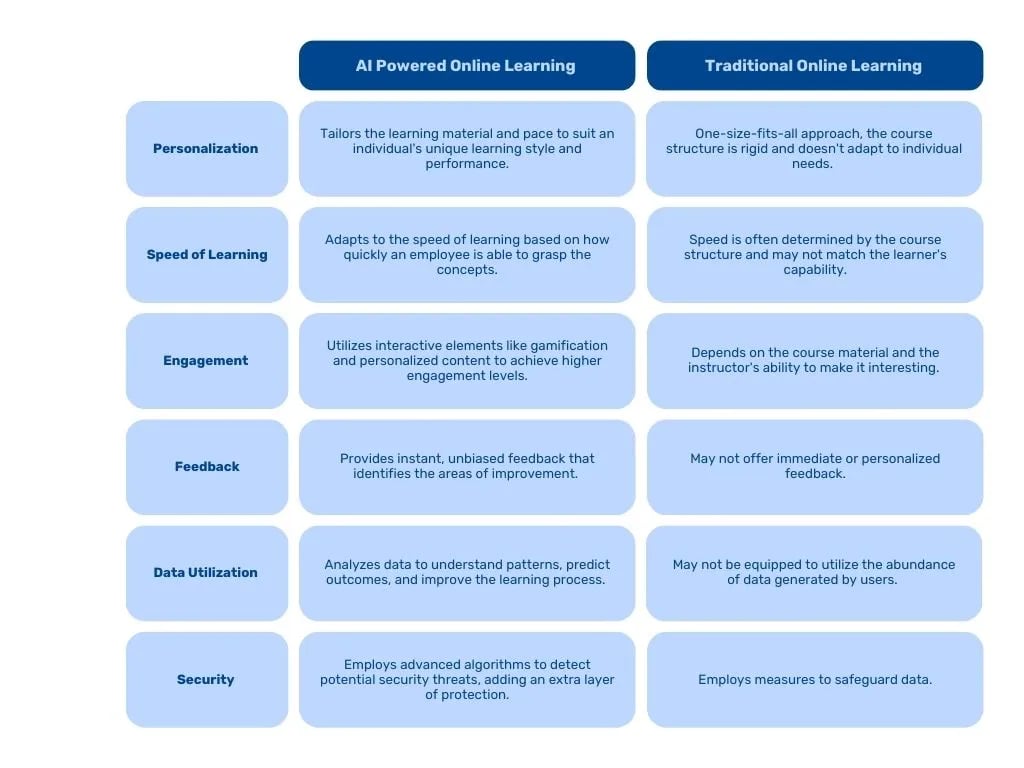
Below is a table showing the differences in AI-powered online learning vs Traditional online learning in terms of personalization, speed of learning, engagement, feedback, data utilization, and security.
Benefits of AI online learning
Elearning has been shown to enhance employee performance by a significant margin of 15-25%.
A manager's most important job is coaching, according to Harvard Business Review's research on leader-as-coach practices. AI-powered platforms give every manager the infrastructure to do that coaching at scale, without adding hours of preparation time. Here are six concrete reasons to adopt AI-based online coaching in your organization:
- Hyper-personalization: AI-powered online learning systems have the ability to tailor content to match the unique learning styles and paces of individual employees. This heightened personalization ensures a customized learning experience that maximizes both engagement and retention.
- Efficiency and Time-Saving: AI technology uses predictive analysis and automation to streamline the coaching process, delivering significant time savings for both managers and employees. This frees up company resources for higher-value work.
- Highly Engaging Content: Incorporating interactive elements like scenario-based role play and dynamic feedback keeps employees engaged and motivated. This level of active practice drives deeper behavioral change than passive consumption of material.
- Instant Feedback and Assessment: AI coaching systems provide real-time feedback based on user performance and identify specific areas for improvement. This immediate signal helps employees adjust their approach and reinforces the skills being coached.
- Scalable Coaching Solutions: AI online coaching platforms can serve an unlimited number of users while maintaining personalized coaching journeys for each individual. This scalability ensures consistent quality regardless of team size or geography.
- Enhanced Security Measures: Advanced algorithms in AI online learning platforms can detect potential security threats, offering an additional layer of protection for sensitive information. This heightened security is particularly crucial in today's digital world, where data breaches can have significant repercussions.
AI online learning for project management
For Project Management companies, AI online learning provides a unique opportunity to enhance their project lifecycle. The first benefit comes in the form of continuous professional development. Project managers can use AI online learning platforms to stay up-to-date with the latest project management methodologies, strategies, and tools, ensuring they can consistently deliver project success.
AI online learning also allows project management organizations to standardize their training materials. Instead of having to rely on disparate resources, organizations can create a centralized, AI-based online learning hub. This hub can ensure all project managers have the same level of understanding about the company’s project management processes and tools.
Furthermore, AI online learning can help in mitigating the risks associated with project management. By taking courses on risk management, project managers can learn how to identify potential risks and develop strategies to manage them effectively. The AI aspects of these platforms can tailor the learning to each individual's experience level, thereby making the learning process more efficient.
AI online learning for web development
AI online learning is a game-changer for web development training. It allows for personalized, flexible, and interactive training at a scale traditional learning methods simply cannot match.
Firstly, AI online learning platforms adapt courses to the individual needs of each developer. By analyzing a developer's existing skill set, an AI system tailors a coaching pathway that builds on strengths and addresses weaknesses. This means developers can focus on mastering the most relevant languages and frameworks, rather than reviewing areas where they are already proficient.
Secondly, AI online learning platforms can provide real-time feedback, allowing developers to correct errors and refine their code as they learn. This immediate response not only makes learning more engaging, it also allows developers to rapidly improve their skills and understand their mistakes.
Thirdly, the scalability of AI online learning means web development training can be delivered to a dispersed team of developers, anywhere, anytime. This opens up opportunities for remote web development teams to receive consistent, high-quality training.
Lastly, AI online learning platforms can simulate real-world coding environments, giving developers the chance to practice their skills in a setting that closely mirrors their actual work. The simulated environment can also introduce challenges and problems that developers are likely to encounter on the job, providing them with valuable practical experience.
Personalized AI coaching with Retorio
Retorio's approach starts from a simple premise: knowing something is not the same as being able to do it under pressure. The gap between knowledge and behavior is where coaching must operate, and that gap is exactly what the platform is built to close.
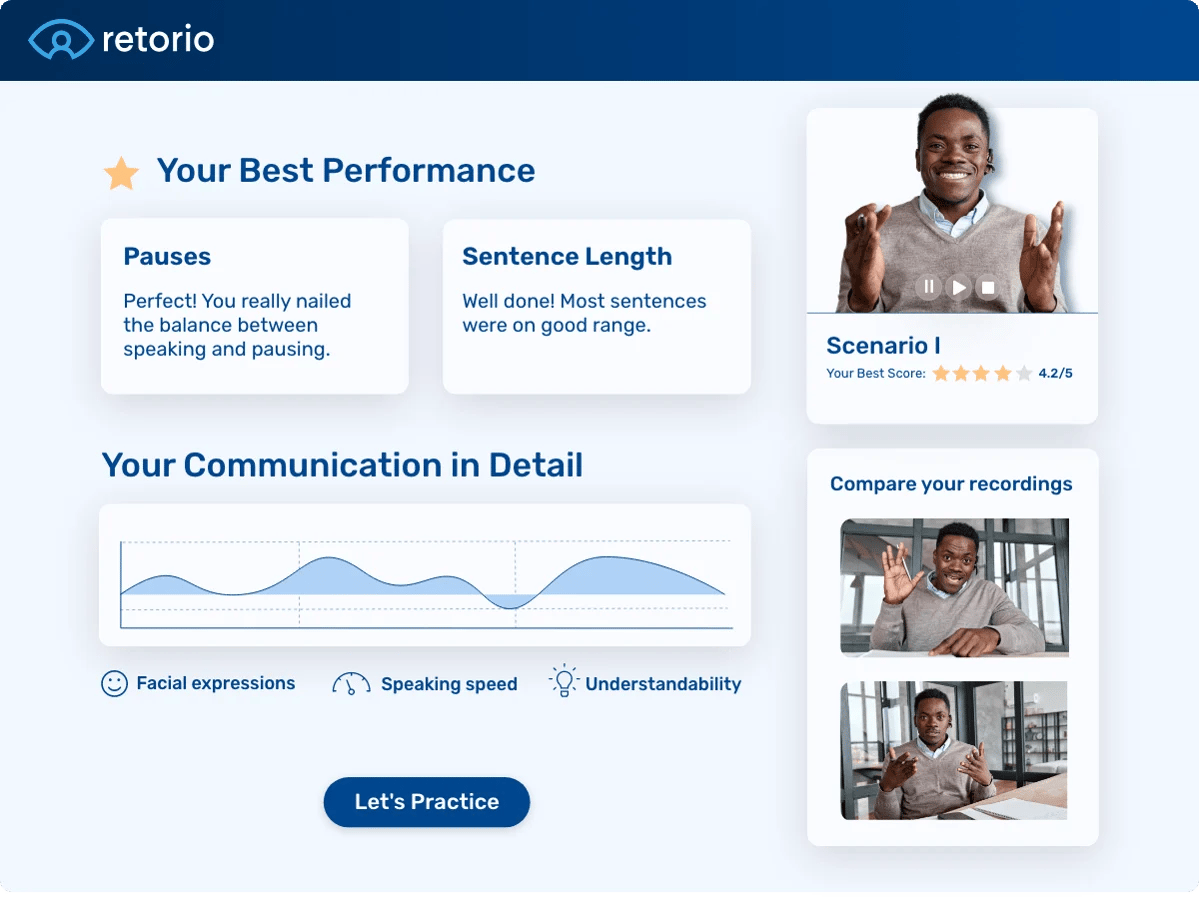
Users practice in a psychologically safe space, with no judgment from colleagues or managers, and receive unbiased, real-time behavioral feedback grounded in the Warmth and Competence framework. This lets employees instantly identify the specific behaviors to improve, rather than receiving vague post-session summaries. Research from HBR's study on feedback effectiveness confirms that specific, behavior-level feedback drives skill development far more reliably than general performance ratings.
Retorio's AI coaching platform places employees into realistic role-play scenarios that mirror the conversations they face daily, from handling objections to navigating difficult service calls. These simulations build behavioral muscle memory, not just theoretical understanding. Users who complete AI role plays regularly show a 2% improvement per session in behavioral consistency scores.
The platform uses AI to deliver personalized coaching content matched to each user's specific gap profile, maximizing the business impact of every practice session. For a deeper look at how this translates to measurable performance gains, see the business case for AI sales coaching.
Retorio also integrates scenario scoring and progress dashboards so managers can track behavioral improvement across their entire team, turning individual coaching sessions into organization-wide capability data.
With Retorio's AI online training platform, learners have access to a comprehensive library of training programs - empowering them with the knowledge and skills necessary to succeed in their professional and personal lives.
See how Retorio's AI coaching platform can build capability across your entire team, not just a handful of top performers.

Frequently Asked Questions
What is AI-based online learning?
AI-based online learning uses artificial intelligence to personalize content, pacing, or feedback for each individual learner, rather than delivering the same fixed curriculum to everyone regardless of their existing skill level.
How does AI-based coaching differ from traditional e-learning for sales teams?
Traditional e-learning delivers static video modules and quizzes. AI-based coaching for sales teams adds realistic role-play practice with objective, behavioral feedback on communication and negotiation skills, which is why Retorio customers see a 38-42% reduction in ramp-time compared to video-only onboarding.
What are the benefits of AI-based learning for enterprise teams?
AI-based learning scales personalized feedback to thousands of employees without adding trainer headcount, and gives managers objective data on skill development instead of relying on self-reported confidence or quiz scores.
How do Sales Enablement leaders measure the ROI of AI-based coaching?
Track outcomes tied to revenue and retention, not just course completion. Retorio customers report a +14.6% increase in quota achievement and a 15x expected ROI in the first year of AI coaching adoption.
Written with help from LLMs, edited and checked by Önder Mutluer, Website Manager and Marketing Strategist, and Dr. Patrick Oehler, Co-founder and Co-CEO. How this article was researched, written and checked, and who reviews which topic: Retorio editorial policy.