


A VP of Sales told me she had been pitched by three AI sales coaching vendors in five weeks. None of them could answer her one question: after a rep finishes the call, what changes in their behavior next Monday morning. This is the question the category is two years late on, and it has a specific answer.
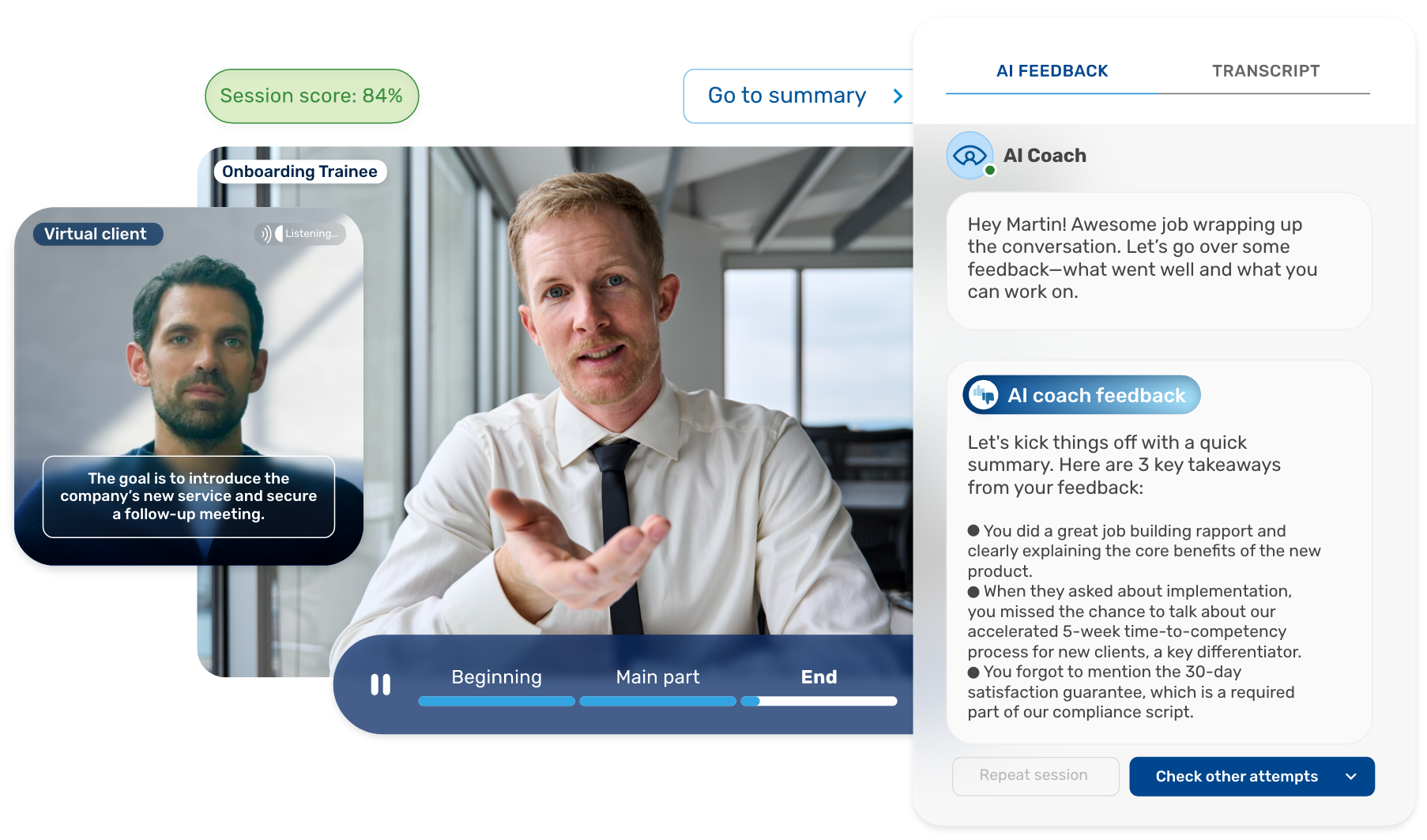
A rep practices against a virtual customer. The coaching layer scores four observable behaviors, picks the next practice, and re-measures. That loop is what moves quota.
Most AI sales coaching pitches describe the wrong layer. They demo a virtual role play, show a transcript or a sentiment chart, and ask for the budget. Role play is the practice mechanic. Coaching is the system that reads the role play, scores observable behaviors against a rubric, picks the next practice for the rep, and re-measures on the next session. Without the closing of that loop you have a role play product, not a coaching system, and quota does not move.
Quick Answer
AI sales coaching is a behavioral observability system that scores four observable rep behaviors on every practice conversation, picks the next practice, and re-measures. It is not a role play tool. The role play is the practice mechanic. Coaching is the closed loop that turns each session into measurable behavior change. Retorio has run this loop across 50+ enterprise clients, and the four signals below predict quota.
Example. A sales manager at a 300-rep B2B team runs the four-signal rubric in week 1. By week 4, objection acknowledgment and close attempts have each moved one tier. By week 12 the cohort quota attainment lifts +14.6% on average, which is the number that survives a CFO review.
Source: Retorio enterprise customer studies, 50+ enterprise clients.
Source: McKinsey, The future of B2B sales is hybrid (2022).
Most AI sales coaching pitches describe the wrong layer
The category is two years old and the pitches still confuse the delivery channel with the coaching itself. The VP of Sales I opened with had been pitched by three vendors in five weeks. All three demoed a virtual role play. None of the three could answer her question. The first vendor showed her a transcript. The second showed her a sentiment chart. The third showed her a leaderboard. She bought none of them. The category has known about the gap between coaching investment and coaching execution for more than a decade, and most vendor pitches still walk past it.
The pitch she did not get, and the one that closes most enterprise budgets, sounds different. It says: here are four observable rep behaviors. We measure them on every practice call. We give the rep the next practice that targets the lowest signal. We re-measure on the next call. We close the loop. Quota lifts because behavior shifted.
That is the layer that matters. Everything above it is delivery.
What AI sales coaching actually is
AI sales coaching is the behavioral observability layer underneath a practice conversation. The conversation itself can take many forms: a video role play with a virtual client, an audio role play, a recorded call review, a written cold email exchange. The form is the wrapper. The coaching is what reads the conversation and turns it into a next action for the rep. Even the first seventeen seconds of a discovery call carry enough behavioral signal to rank what the rep should practice next.
In the Retorio model, the coaching layer scores against the Warmth and Competence framework. Warmth covers the relational behaviors a customer can feel in 30 seconds: acknowledgment, listening cues, pace match, empathy signals. Competence covers the substance behaviors that move a deal: discovery question density, value framing, objection handling, close attempts. Every practice conversation produces a score on both axes plus a rank-ordered list of three behaviors to work on next.
That last part is what makes it a coaching system and not a reporting system. The output is not a dashboard. The output is the next practice the rep should run, generated on the basis of the previous one.
The closed loop, not the role play
The loop closes on every practice call. The dashed arrow shows the return path from Re-measure back to Observe, where the next four-signal score begins.

AI sales coaching vs AI role play: where the line sits
The two terms get used interchangeably, especially by vendors who only do one of them. They are not the same layer. The practical filter: ask the vendor what happens after the rep clicks "end session". If the answer is a transcript and a sentiment chart, that is role play. If the answer is the next practice plus a 30-day per-rep trend the manager sees, that is coaching. Most enterprise budgets are signed off on the second answer. The deeper version of this filter is buyer-moment coaching: does the practice anchor to the actual moments a deal turns, or to a generic script?
| Dimension | AI role play (the wrapper) | AI sales coaching (the loop) |
|---|---|---|
| Primary unit | One practice conversation | A measurable behavior change over weeks |
| After end-session | Transcript, sentiment chart, leaderboard | Score on a rubric + the next practice picked for the rep |
| Manager view | Engagement metrics (sessions, minutes) | Per-rep 30-day trend on each behavior signal |
| Buyer question it survives | "Are reps using it?" | "How does this change quota?" |
| Renewal driver | Adoption | A week-12 cohort lift on quota |
How does AI sales coaching compare to traditional coaching?
| Dimension | Traditional coaching | AI sales coaching |
|---|---|---|
| Frequency | Whenever a manager is free | On demand, unlimited |
| Consistency | Varies by manager | Same rubric for every rep |
| Feedback basis | Impression, memory | Observed behavior, timestamped |
| Scale | Limited by manager time | Flat cost per rep at any size |
| Evidence | Rarely recorded | Auditable certification records |
The 4 behavioral signals that predict quota
Across 50+ enterprise clients, four behaviors track strongest with quota attainment. They are observable on any call, AI or human. A vendor that cannot score them is selling a wrapper, not a coaching system. Scott Edinger's HBR work on the same question, the highest-percentage move to lift revenue, lands on the same conclusion from the manager side: better coaching beats more reps. Related reading on how AI sales coaching differs from AI role play.
Open, non-leading discovery questions per minute of rep talk time in the first half of the call. Reps above 1.2 per minute close at materially higher rates than reps below 0.6.
Percentage of customer objections the rep restates or paraphrases before responding. Reps above 70% hold conversation momentum. Reps below 40% lose the second half of the call.
Ratio of value claims the rep ties back to a specific need surfaced earlier in the same call. Three needs and three tied claims is 1.0. Three needs and seven generic claims is 0.43.
Explicit asks the rep makes for a next concrete action (a meeting, pilot, buying decision, introduction). Coached reps make 2 to 4 per call. Uncoached reps make 0 to 1.
These four are the rubric. A practice conversation that does not produce a score on all four is not measuring coaching. It is measuring engagement.
Reading behavioral signal patterns is not unique to sales coaching. The same observability discipline shows up in deception research, negotiation training, and clinical psychology, anywhere outcomes depend on reading micro-behaviors at scale. The video below shows how Retorio applies this logic inside a live sales coaching session:
Behavior profile, top quartile vs bottom quartile rep
Source: Retorio enterprise customer studies, 50+ enterprise clients, 2024-2026.
After a rep finishes the call, what changes in their behavior next Monday morning. If that question does not have an answer, the vendor is selling a wrapper.
A VP of Sales in vendor cycle, May 2026
What science backs AI sales coaching? Warmth and Competence
What separates a coaching tool from a scoring tool is the model underneath it. Retorio's AI coaching is built on Warmth and Competence, the two dimensions that decades of social-psychology research identify as the primary lens through which people judge one another: is this person trustworthy and on my side (Warmth), and is this person capable and credible (Competence)? Together they account for the large majority of the impression a buyer forms in the first moments of a call.
For a sales force this is decisive. A rep who signals Competence but little Warmth reads as pushy; a rep who signals Warmth but little Competence is liked but not trusted with the decision. Retorio's multimodal AI reads the verbal, paralinguistic, and nonverbal signals that express both, then coaches toward the balance that fits the buyer. This is the difference between "you scored 62" and "you listed three features before asking a question; here is the one to ask next time." The approach traces to Retorio's origins in behavioral science and multimodal analysis at the Technical University of Munich (TUM).
The point of AI sales coaching is not a score. It is whether the rep does something different on the next real call, and whether we can prove the behavior moved.

What changes for the rep in week 1, week 4, week 12
This is the question buyers actually ask, and most vendor demos skip it.
Week 1, the baseline
What happens: Rep runs three practice conversations against a virtual client, including the option to practice multi-stakeholder roleplays when the deal involves a buying committee. The system scores all four signals on each. The rep sees a baseline.
What surprises most reps: Signal 2 (objection acknowledgment) and Signal 4 (close attempts) are usually further from the target than they expected. Discovery density is closer to target than they thought. Value framing is rarely close.
Week 4, two signals shift
What happens: Rep is running practice conversations twice a week. The system has generated 20 scenarios that target the rep's two lowest signals. The manager reviews two scored sessions per week and focuses live coaching on the same two signals.
Measurement: By week 4, two of the four signals have moved at least one tier from the baseline. The other two are still in their starting band. AI role play for sales teams expands this point.
Week 8, four signals trend together
What happens: The two weakest signals from week 1 are now in the target band. The manager's weekly coaching focus rotates to the remaining two signals. Practice volume stabilizes at two sessions per week. For deeper context, see this sales coaching playbook.
Measurement: All four signals show a positive 30-day slope on the per-rep trend chart. This is the leading indicator that week 12 will deliver. If three of four are still flat at this point, escalate the deployment review with the head of enablement.
Week 12, quota lifts
What happens: Rep is in live deals. The same four signals are scored on recorded customer calls (with consent). The signals from the practice conversations carry over at roughly 80% retention.
Measurement: In the Retorio book of business, the cohort quota attainment lifts +14.6% on average, overall sales performance lifts +27%, and ramp time for new hires drops 38% to 42%. The week 12 number is the one that survives a CFO review.
Week 24, renewal-grade outcomes
What happens: The four-signal rubric is now embedded in the manager's weekly cadence and the rep's practice habit. New hires entering the team start on the same loop, which is what makes the cycle compound.
Measurement: Cohort-level quota lift sustains or expands vs week 12 (cohorts that maintain the practice cadence trend toward +18 to +22%). Voluntary turnover inside the coached team drops materially. This is the lagging metric that converts a pilot into a multi-year renewal.
Where most AI sales coaching deployments stall
Across the behavioral dataset, three failure modes account for most deployments that miss their quota lift target. They are predictable, and they have nothing to do with the AI.
None of these are AI problems. They are deployment problems. A coaching vendor who pretends they do not exist is selling a demo, not a deployment.
How to evaluate an AI sales coaching vendor (the 4-question rubric)
Take the rubric into the vendor demo. Ask these four questions. If a vendor cannot answer two of the four with a specific yes plus a screenshot, they are selling a different category.
A vendor who answers all four with specifics is selling coaching. A vendor who pivots to a leaderboard, a content library, or a video editor is selling something else and you can decide whether that is what you need.
Vendor positioning, behavioral depth vs deployment speed
Vendor archetypes anonymized; positions reflect deployment patterns observed across Retorio's competitive evaluation cycle, 2024-2026.
What should you look for in AI sales coaching software?
The rubric above is what to ask a vendor in the room. This is what to check about the software itself, before the room. Most platforms in this category demo well, so these are the criteria that separate software that changes behavior from software that produces dashboards.
Those four sit underneath the four questions in the rubric. A platform can answer every rubric question well and still fail here, usually on scenario authoring or on the compliance brief, and either one stops a rollout after the contract is signed.
Where this lands in the Retorio platform
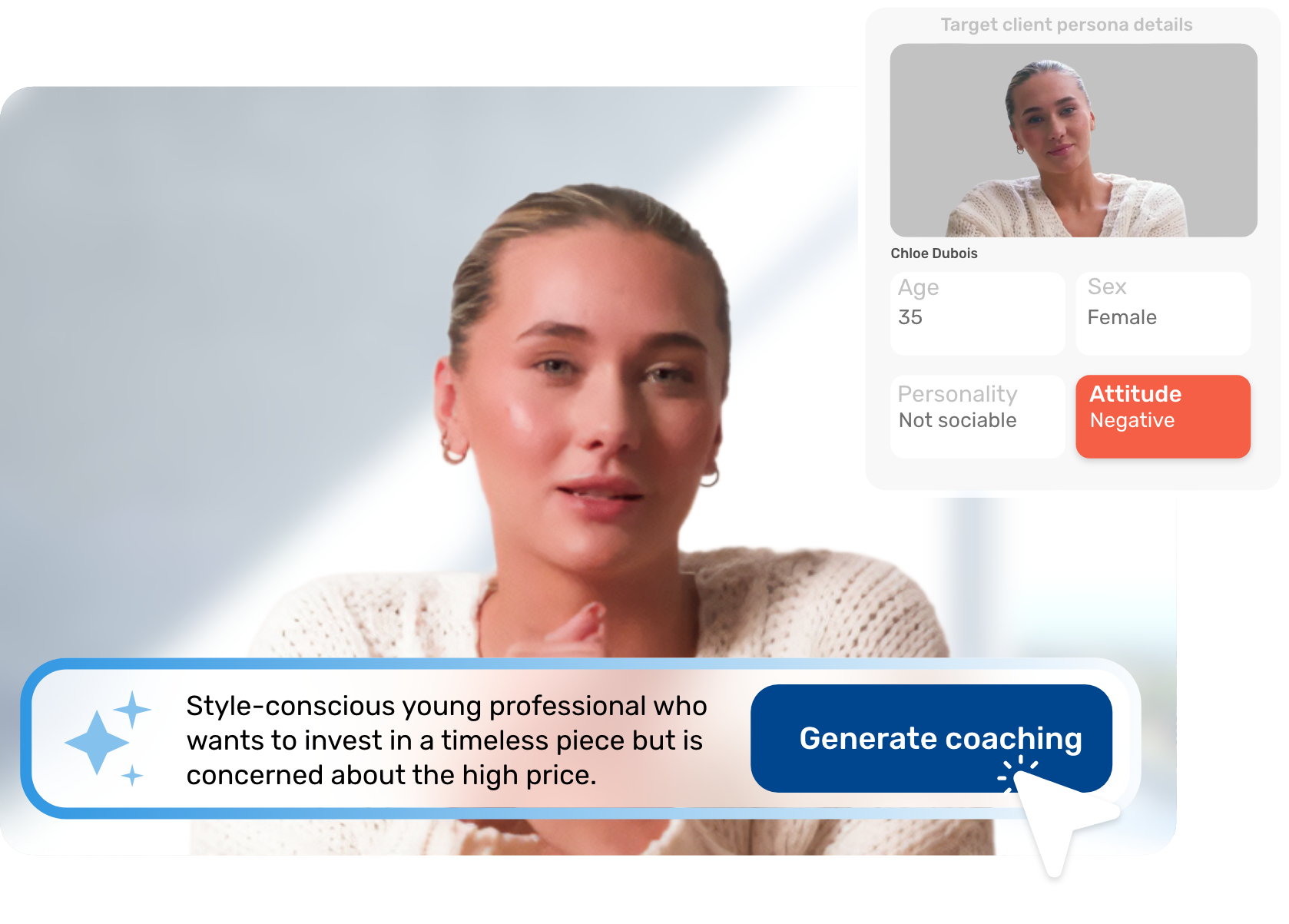
Retorio runs the four-signal rubric on every practice conversation, in 14 languages, across 93 virtual customer personas, with ISO 27001 certification and EU data residency for regulated industries. The platform was built on the Big 5 behavioral research base from McCrae and John (1992) with applied research from TUM, MIT, and the University of Tokyo, which is why the rubric is grounded in a scientific construct (Warmth and Competence) rather than a vendor opinion. The same loop applies on the B2C side, where behavioral signals that change close rates are different from B2B but the closed-loop mechanic is identical.
What this means for your next vendor evaluation
If you are in the middle of a vendor cycle, three takeaways are useful.
First, the category is not role play. It is behavioral observability with a closed practice loop. Filter for the loop, not the wrapper. For deeper context, see AI tools for sales teams.
Second, the right comparison metric is not "how realistic is the avatar" or "how many languages does it support". It is "does the system pick the next practice for the rep, and can the manager see the 30-day trend on the same screen as the rep one-to-one?". Both questions admit a yes/no answer in a demo. Most vendors fail one of them.
Third, the proof of a deployment is the week 12 quota number, not the week 1 engagement number. A vendor who only shows engagement charts is selling a role play product. A vendor who shows a week-12 cohort lift with a measurable signal trail is selling coaching. Pick the second one.
Conclusion
AI sales coaching is not a role play tool or a transcript service or a leaderboard. It is a behavioral observability system that scores four signals on every practice conversation, picks the next practice for the rep, and re-measures. If the system does not close that loop, it is not coaching. Use the four-question rubric to filter vendors and the four-signal rubric to evaluate reps. Then watch week 1, week 4, and week 12 do what they have already done across enterprise deployments.
Walk through the four-signal rubric on one of your real call recordings. Retorio's behavioral science team will run the scoring with you and show what the next practice would be for that rep.
Key Takeaways
FAQ
What is the difference between AI sales coaching and AI sales role play?
Role play is the practice mechanic. Coaching is the system that scores the practice, picks the next practice, and re-measures. A platform that does only the first is a role play product. A platform that closes the loop is coaching.
How long does AI sales coaching take to show results?
In Retorio deployments, two of four behavior signals move by week 4 and quota impact shows by week 12. Ramp time reduction (38% to 42%) shows earlier, by week 6 for new hires.
Can AI sales coaching replace a human sales coach?
No, and the best deployments do not try. AI handles scale (every rep, every week) and consistency (same rubric). Humans handle the higher-bandwidth conversation: deal coaching, career conversations, the calls that need a manager in the room.
What sales roles benefit most from AI sales coaching?
New-hire SDRs and AEs (ramp acceleration), tenured AEs on new products (re-skilling), service teams on complex accounts (CX consistency), and managers building a coaching cadence (rubric standardization across the team).
Is AI sales coaching GDPR-compliant?
Retorio is ISO 27001 certified, GDPR-compliant, EU AI Act aligned, and hosted on GCP with EU data residency. Recorded customer calls require explicit consent under Art. 6 GDPR. Practice conversations with virtual clients do not, because no customer data is processed.
How is AI sales coaching different from a sales call review platform?
A call review platform analyzes calls that already happened. AI sales coaching scores practice conversations before the rep is in front of the customer, and uses that score to pick the next practice. The two are complementary, not substitutes.
All Retorio coaching data is processed on EU infrastructure under ISO 27001 controls, EU AI Act aligned.
Written with help from LLMs, edited and checked by Önder Mutluer, Website Manager and Marketing Strategist, and Dr. Patrick Oehler, Co-founder and Co-CEO. Reviewed by Dr. Florian Abicht, Chief AI Officer. How this article was researched, written and checked, and who reviews which topic: Retorio editorial policy.