


Sales enablement with AI coaching connects an AI coaching platform like Retorio to your CRM so training reaches reps during work, when they need it, instead of in scheduled sessions. The post outlines three steps: create a training in Retorio, configure your CRM (for example HubSpot), and go live so CRM triggers deliver the right coaching automatically.
Source: McKinsey, AI-powered marketing and sales reach new heights with gen AI (2023).
Many coaching initiatives are time-consuming and disconnected from the actual need of the rep. In many cases, too much time passes between when the need arises and when the right support reaches them.
How to build fast and relevant learning initiatives for those who need them?
The example
Using one exemplary CRM system, which is widely used among several companies, I’d like to demonstrate how easy it is to build a relevant coaching environment, where help reaches the rep when they need it, during their work.
We’ll use technology that is already available on the market.
- Hubspot, a widely known CRM system
- Retorio, an AI Coaching platform, helps you to build interactive virtual simulations with instant AI feedback
- Synthesia, which helps you to build virtual human-like avatars

The process
First, providing the learning content when your people need it is important. As most people operate on digital devices in their daily business – that’s the prime place to be. The best way is to directly embed the learning content in the daily (digital) working toolbox.
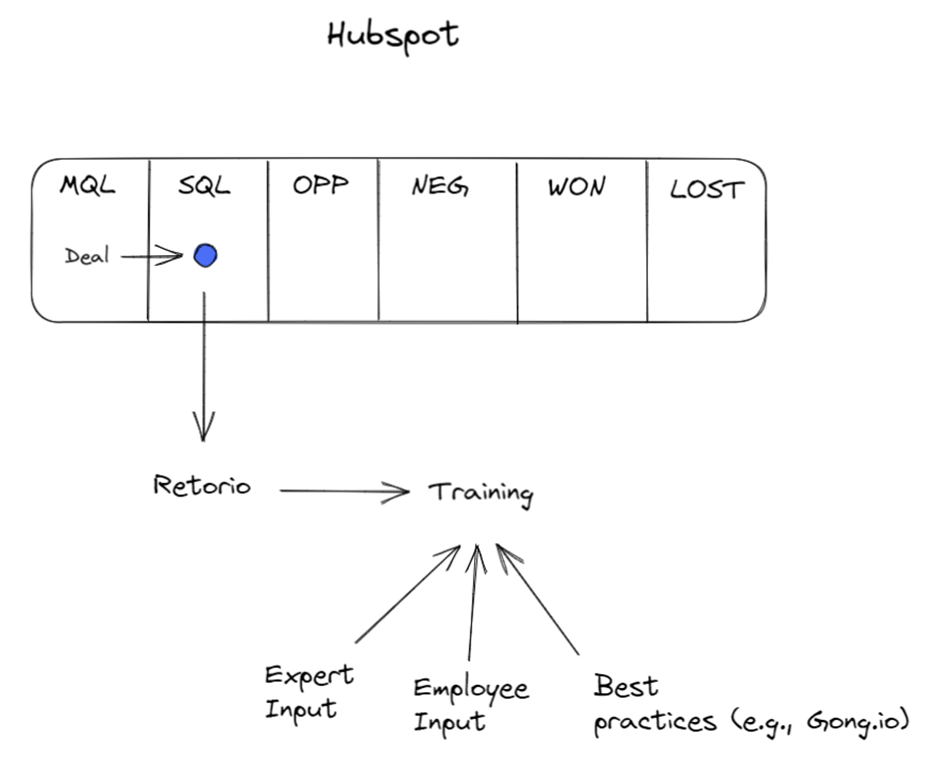
The graphic below depicts how this can look from a typical sales perspective. Once a salesperson moves a deal to the next stage, an automatic trigger pushes the relevant coaching content to the rep.
Content - Why the best content comes from daily operations
To be relevant for people’s daily activities, the best learning content comes from practical experiences, needs, and pains. Thus, your salespeople (or any other function) can provide the best need assessment you can get. Related reading on sales performance coaching.
One way to gather that input is through surveys or win/loss interviews. Another is to use documented best-practice scenarios, for example scripts from your top performers, to build role-plays that reflect actual customer conversations.
You can re-use this content to build training programs that create a virtual role-play database.
Watch the step-by-step approach in action
Step-by-step approach
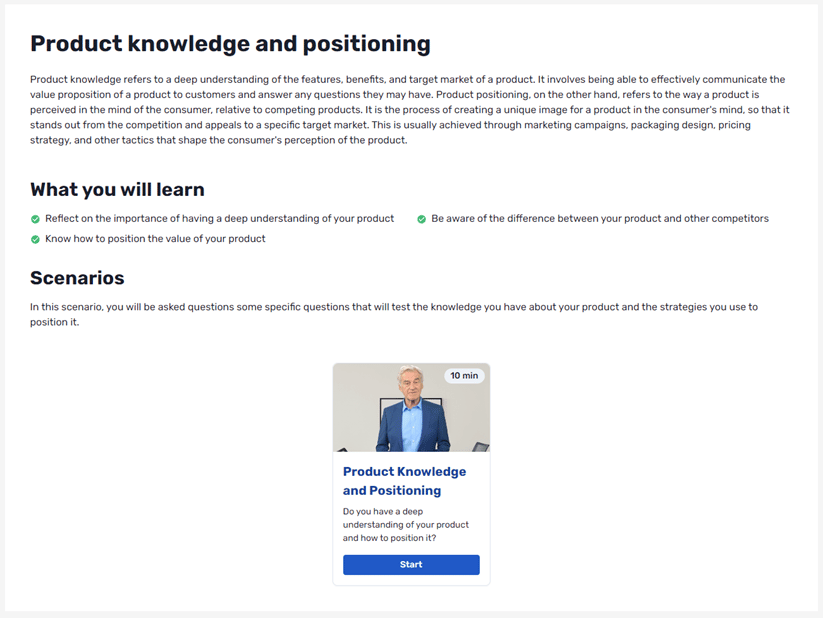
1. Create a training in Retorio
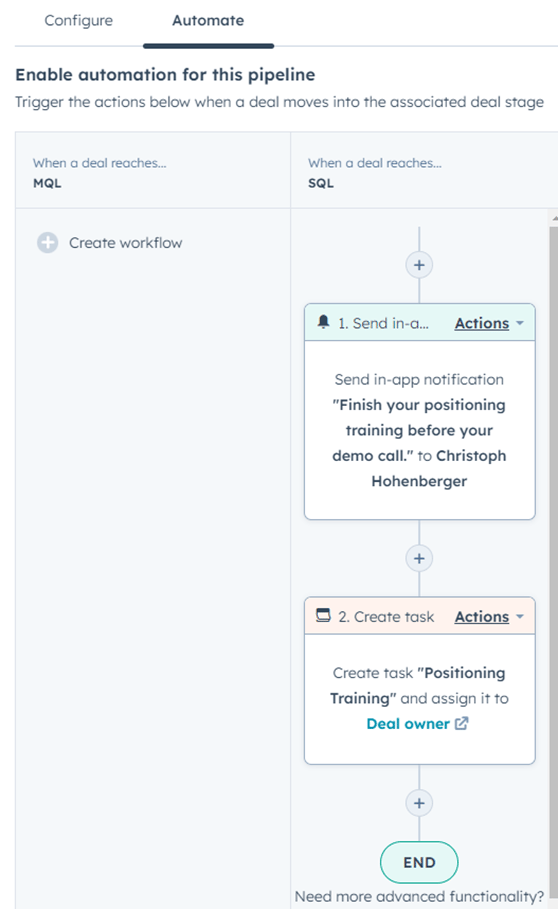
2. Configure your CRM
In most CRM systems (this example shows Hubspot), it is possible to set automated triggers. In this case, the user would get an in-app notification and a task that needs to be completed.
This allows the supervisor to keep track of the learning progress, too.
3. Go-Live
Once a deal is moved to the next stage, you immediately receive a notification.
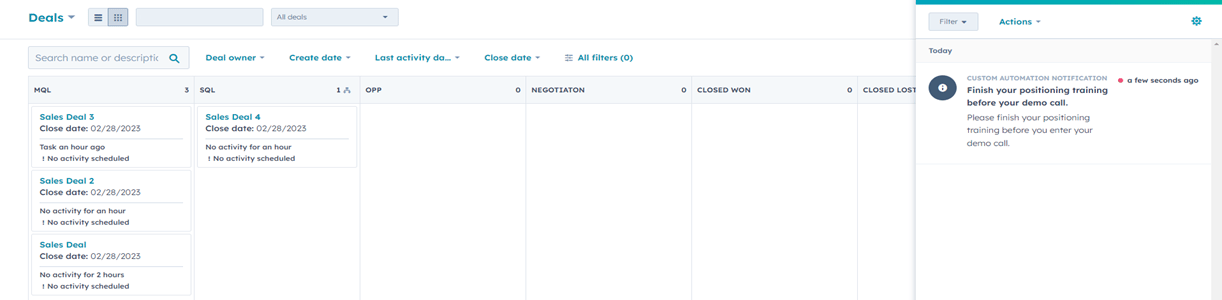
After clicking on the notification, you will end up with a concrete to-do list, and receive the respective training link.
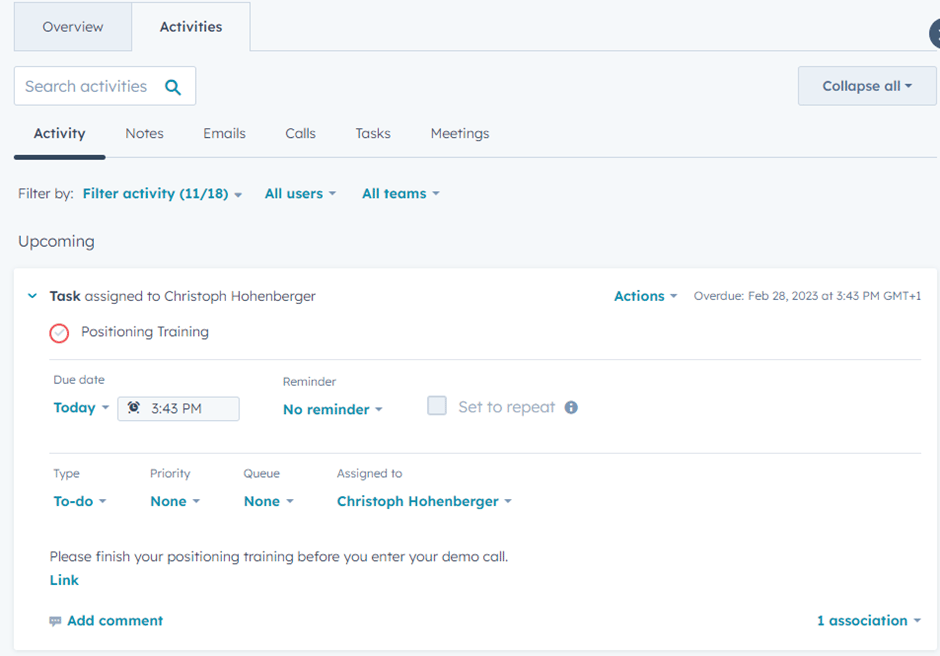
That's it. Quick and easy.
Retorio delivers coaching exactly when the rep needs it. The coaching framework here expands this point.
Why trigger-based coaching outperforms scheduled sessions
Most sales enablement programs still run on a calendar logic: a quarterly kick-off, a monthly e-learning module, an annual two-day workshop. The problem is that deals don't wait for the calendar. A rep who stalls at the pricing conversation on a Tuesday afternoon doesn't benefit from a coaching session scheduled for the following Friday.
Trigger-based coaching flips this model. Instead of pushing content at a fixed time, the CRM detects a specific deal event, a stage advance, a long-standing stall, a first enterprise opportunity, and routes the right role-play or coaching scenario directly to the rep's task list. The rep practices the exact conversation they are about to have, not a generic module from a library.
According to McKinsey's research on AI-enabled sales organizations, teams that embed capability building into daily workflows rather than separating it into standalone sessions see 20-30% higher adoption of new selling behaviors within the first 90 days. The key distinction is context: coaching that arrives at the moment of need is retained and applied, while coaching that arrives out of context is largely forgotten.
This maps directly to what behavioral science calls the spacing effect. Short, repeated practice spaced around real work events builds durable skill far more effectively than a single intensive session. Harvard Business Review's analysis of sales capability building found that organizations reinforcing skills through spaced, job-embedded practice see 3-4x better behavioral transfer compared to those relying on classroom formats alone.
What this means for your enablement stack
Practically, trigger-based coaching requires two things your team already has: a CRM with workflow automation (HubSpot, Salesforce, or Microsoft Dynamics all support this) and a coaching platform that can be called via a URL or webhook. When a rep's deal moves to the "Proposal Sent" stage, the workflow fires. The rep receives a task with a link to a 10-minute role-play simulating a CFO budget-objection conversation. They complete it before the next call. Their manager sees the completion and score in the dashboard without any manual follow-up.
The manager's role shifts from chasing completion rates to reviewing outcomes. Which reps scored below threshold on pricing confidence? Which reps skipped the module before a high-value call? That signal replaces gut-feel coaching decisions with data-driven ones. For more on structuring this kind of enterprise sales coaching program, including how to set thresholds and escalation rules, the linked post covers the full architecture.
The bottom line: sales enablement with AI coaching is not a technology project. It is a process redesign. The technology enables it, but the result, reps who practice the right thing at the right moment, comes from wiring coaching triggers to the deal stages that actually matter to your business.
Want to try out Retorio's AI Coaching platform for yourself?

Frequently Asked Questions
How does Retorio address delays in delivering relevant learning initiatives?
Retorio integrates directly with CRM systems like HubSpot to trigger training the moment a sales rep needs it (e.g., moving a deal to the next stage). This eliminates delays by embedding learning into daily workflows, ensuring timely skill application.
How does Retorio compare to AI sales coaching tools like Salesforce or CoachHub?
Retorio uniquely combines Behavioral Intelligence, CRM-driven triggers, and AI-generated simulations. Unlike generic platforms, it delivers hyper-contextual training tied to real-time sales actions, with measurable ROI via Impact Reporting.
How does Retorio ensure training aligns with real-world sales challenges?
Content is sourced from daily operations, such as top-performer call transcripts and win/loss debriefs, and transformed into simulations via Retorio’s AI Coaching Generator. This ensures training mirrors actual customer interactions and pain points.
What makes Retorio’s CRM integration stand out?
Retorio’s triggers are fully customizable. For example, when a rep stalls a deal in HubSpot, Retorio automatically delivers a negotiation simulation. Competitors often lack this granular, action-based automation. For deeper context, see this sales coaching playbook.
How does Retorio save time for sales enablement teams?
By automating content delivery and feedback, Retorio reduces manual effort by 50%+ vs. traditional methods. Managers focus on high-impact coaching, not administrative tasks.
What industries benefit most from Retorio’s approach?
Retail, SaaS, and B2B sales teams see the fastest ROI. For example, retail reps practice upselling via avatars, while B2B teams refine consultative selling using deal-stage triggers.
Can Retorio scale for global teams with remote reps?
Yes. Retorio’s cloud-based platform supports multilingual training and 24/7 access, making it ideal for distributed teams, unlike in-person coaching tools.
How quickly can we build a custom training module in Retorio?
Most teams launch in 2-3 weeks. Use Retorio’s AI Coaching Generator to turn existing content (e.g., top performer scripts) into simulations in hours, not months.
Written with help from LLMs, edited and checked by Önder Mutluer, Website Manager and Marketing Strategist, and Dr. Patrick Oehler, Co-founder and Co-CEO. Reviewed by Peter Holdenried, Head of Sales. How this article was researched, written and checked, and who reviews which topic: Retorio editorial policy.