


AI coaching improves sales performance by measuring and developing two behavioral dimensions, Warmth and Competence, to drive 10-25% better results across a sales organization. Reps practice in realistic AI role plays against virtual twins of their clients, then get real-time behavioral feedback that builds the human connection turning them into trusted advisors.
Example. An enterprise account executive at a telecom vendor runs three AI role plays against a virtual CFO before a renewal call. Her Warmth score is strong, but her Competence drops when she moves to ROI justification. She sharpens her numbers and delivery, enters the real call confident, and the CFO extends the contract.
Sales performance in the AI age hinges less on activity volume and more on how sales reps show up as humans in an AI-saturated buyer journey. Buyers no longer rely on salespeople for information. They crave authentic human connection.
What’s in this Article?
- Key Takeaways
- What Is Sales Performance in the Age of AI?
- What Good Sales Performance Looks Like Today
- How High Performers Position Themselves as Trusted Advisors
- Why Human Connection Now Drives Sales Performance
- Guide: Implement AI Coaching to Systematically Improve Sales Performance
- Real-World Examples: How AI Coaching Transforms Sales Performance
- How to Integrate AI Coaching Into Your Existing Sales Performance Stack
- FAQ
Key Takeaways
- AI Sales Coaching systematically measures and improves two core behavioral dimensions like Warmth and Competence to drive 10-25% better sales performance across your entire sales organization.
- Implementing AI Sales Coaching gives sales leaders a real-time, behavioral view of sales execution. They monitor how well sales reps follow the playbook, apply methodologies, and demonstrate product and industry knowledge.
- Enterprise clients have achieved concrete outcomes: Ramp-up time cuts from 8 to 5 weeks; 72% reduction in onboarding churn; over €650,000 in training cost savings; and ROI exceeding 10x within the first year.
- This guide walks through the complete implementation framework for AI Sales Coaching: Establishing your benchmark, generating virtual client personas, running AI role plays, coaching Warmth + Competence, and leveraging analytics for continuous improvement.
What Is Sales Performance in the Age of AI?
Sales performance refers to the effectiveness with which individuals and teams convert opportunities into sustainable revenue. It is typically measured through key performance indicators like win rate, quota attainment, pipeline coverage, conversion rates, and customer retention strategies. But in 2025, this definition has expanded beyond traditional sales metrics.
Traditional measurements like average deal size, sales cycle length, monthly sales targets show what happened but not why it happened. A rep might close a deal, but was it through genuine relationship-building or aggressive discounting that erodes margins? This is where behavioral data fills the gap: understanding how reps are perceived in customer interactions provides the missing context.
The AI age has fundamentally shifted the playing field. Connected to ChatGPT and Co., today’s buyers have instant access to more information than any salesperson could ever offer. They’ve already researched your product specs, read reviews, and compared pricing before showing up. Your sales process no longer revolves around information gatekeeping, it centers on trust, relevance, and guidance through complexity.
This reality demands a new framework for understanding sales performance: Warmth + Competence. Warmth reflects empathy, authenticity, and genuine listening. Competence reflects expertise, clarity, and reliability. These two dimensions predict sales success far more accurately than activity metrics alone.
High-performing sellers balance both dimensions while consistently executing the company’s sales playbook, operationalizing key sales methodologies like MEDDIC, SPIN, or Challenger, and integrating product and industry knowledge into every conversation.
What Good Sales Performance Looks Like Today
There’s a critical difference between “busy” sales teams and genuinely high performing sales teams. Busy sales teams make hundreds of calls weekly with modest results. High-performing sales teams convert at strong rates while maintaining healthy, predictable pipelines. The difference is not effort, it is effectiveness.
Here is what good sales performance benchmarks look like in practice:
|
Metric |
Average Performance |
High Performance |
|---|---|---|
|
Pipeline Coverage |
2-3x quarterly quota |
3-4x quarterly quota |
|
B2B Win Rate |
19-20% |
25-30% |
|
Lead-to-Opportunity Conversion |
5-15% |
25-30%+ |
|
Sales Quota Attainment |
30-50% of reps |
70-80%+ of reps |
These quantitative benchmarks connect directly to qualitative behaviors: Consistent discovery rigor, tailored value articulation, clear next steps, and emotionally intelligent handling of objections. Sales professionals, who master these behaviors, do not just hit their sales targets, they exceed them predictably.
High Performers Position Themselves as Trusted Advisors
A trusted advisor in sales is not just someone who sells you something. A trusted advisor is someone you would actually ask for advice, even if helping you does not directly benefit them.
At a high level, a trusted advisor is a salesperson who has earned enough credibility, empathy, and insight, to an extent, where the customer sees them as a partner, not a vendor.
As Adam French (Partner at Antler) expresses it: They perveive "selling as helping people make decisions that improve their situation".
Behavioral science suggests that trusted advisors score high on two dimensions: Perceived Warmth and Competence.
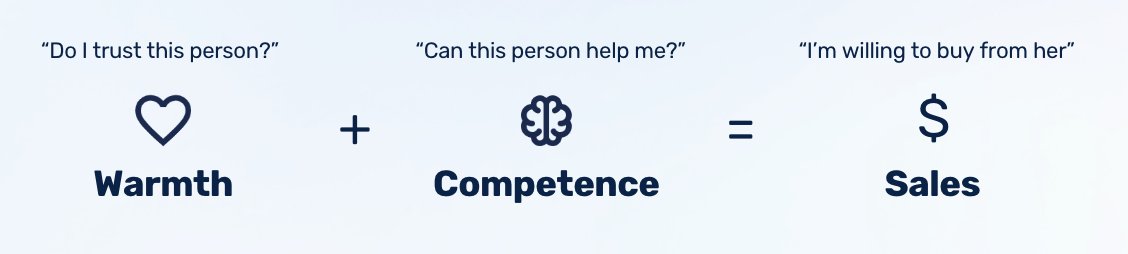
Warmth signals trust, empathy, and genuine intention. If warmth is missing, customers withhold information, or choose to interact with AI instead.
Competence signals expertise, credibility, and problem-solving ability. If competence is missing, customers may enjoy the conversation but won’t see value in buying.
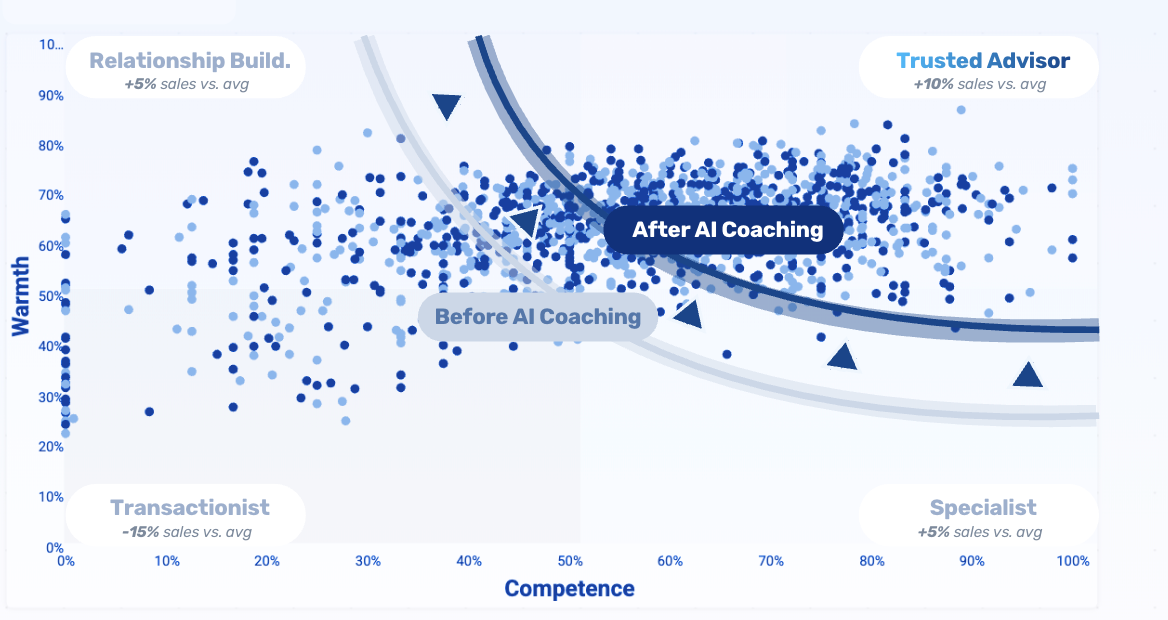
You may visualize Warmth + Competence as a 2x2 matrix:
|
Low Warmth |
High Warmth |
|
|---|---|---|
|
High Competence |
Specialist (knows product, seems cold) |
Trusted Advisor (wins and retains) |
|
Low Competence |
Transactionist (struggles on both) |
Relationship Builder (likeable, lacks depth) |
Sales reps who score high on both Warmth + Competence, and they typically outperform “transactional” sellers by 10–25% on goal achievement. They don't just close deals, they are building relationships that drive customer lifetime value and customer retention.
Retorio’s data reveals something remarkable: Through systematic (AI-powered) coaching, one in five initially low-scoring (“Transactionist”) sales reps can move into the "Trusted Advisor" zone (with regard to a certain topic, product or process step) within their first 10 AI coaching sessions. This single shift materially lifts team performance and accelerates sales performance across the entire sales organization.
Why Human Connection Now Drives Sales Performance
In the AI age, buyers are saturated with AI-personalized outreach, comparison sites, automated recommendations, and endless content. They rarely rely on human sellers for basic information anymore. This creates a fascinating paradox. Related reading on performance coaching.
The more powerful AI becomes for research and automation, the more buyers scrutinize the human side of sales: Trustworthiness, empathy, accountability, and perceived expertise. AI is omnipresent, often manipulative, and fundamentally unaccountable. Buyers now evaluate sales reps not by what they know, AI knows more, but by how they show up as humans.
Consider digitally overloaded buyers in telecommunications, financial services, SaaS, or industrial B2B. They can evaluate ten vendors in a few minutes using customer data platforms and comparison tools. But they still need to feel safe choosing one partner. They need to trust that someone will be there when things go wrong.
Behavioral science research links perceptions of Warmth (being genuinely on the client’s side) and Competence (being able to deliver) directly to willingness to buy, sign larger contracts, and stay loyal. Research published in the Harvard Business Review confirms that warmth is the most important factor in how people evaluate and respond to others, including in commercial settings. Sales reps who score high on both dimensions outperform their peers by 10% to 25%.
Retorio’s Behavioral Intelligence, rooted in cutting-edge research from the Technical University of Munich (TUM), MIT, and the University of Tokyo, makes this “human factor” measurable and coachable at scale. It transforms subjective impressions into data driven insights that sales managers can act on.
Sales Performance Guide: Implement AI Coaching to Systematically Improve Sales Performance
AI coaching represents an always-on, data driven practice and feedback environment where reps interact with realistic virtual clients, receive objective behavioral analysis, and improve in short, repeatable sessions. Unlike traditional sales training delivered in annual workshops, AI coaching embeds learning into the daily routines of sales reps.
AI caoching does not just provide generic conversation intelligence. Retorio’s AI Sales Coaching Platform is an integrated system that:
- 1. Learns your actual sales playbook and documents: Ingesting your specific methodologies, messaging, and brand guidelines
- 2. Creates virtual twins of target customers: Realistic personas that react dynamically to your reps’ behaviors
- 3. Scores reps on Warmth + Competence and execution quality: Providing objective, quantified feedback tied to business outcomes
The business value offered by AI Coaching is substantial. AI coaching compresses ramp-up time, reduces dependence on scarce human coaches, and ensures consistent development across hundreds or thousands of sales reps globally. It transforms sales training from an event into a continuous improvement process.
The implementation of AI Coaching ffollows five interconnected steps:
- Step 1: Establish your Warmth + Competence benchmark
- Step 2: Generate virtual client twins
- Step 3: Run AI role plays for real-time performance analysis
- Step 4: Measure and coach Warmth + Competence
- Step 5: Use analytics to drive continuous sales performance improvement
These five steps fit into existing sales enablement platforms and performance-management frameworks. They complement your sales performance dashboard, revenue operations, and field coaching rather than replacing them.
Step 1: Establish Your Warmth + Competence Benchmark
A generic definition of a good call is not enough to drive sales performance. Each organization, product line, and market segment has its own behavioral success patterns. What works in enterprise software sales differs dramatically from insurance or telecommunications.
Retorio’s Coaching Session Generator analyzes your organizational data to derive a unique benchmark. The AI ingests:
- Sales playbooks and methodology documentation
- Call scripts and email templates
- Onboarding materials
- Product knowledge bases
- Historical call recordings
- Customer feedback and performance data
Sales leaders leveraging the system start by defining clear sales goals, like "increase win rates by 5 points in the mid-market segment by Q4", or "shorten ramp-up from 6 to 4 months for new account executives". These goals inform the benchmark configuration in the system.
The system creates a customized Warmth + Competence benchmark tailored specifically to your organization’s needs. Rather than relying on generic industry trends, it learns what success looks like for your sales strategy with your existing customers.
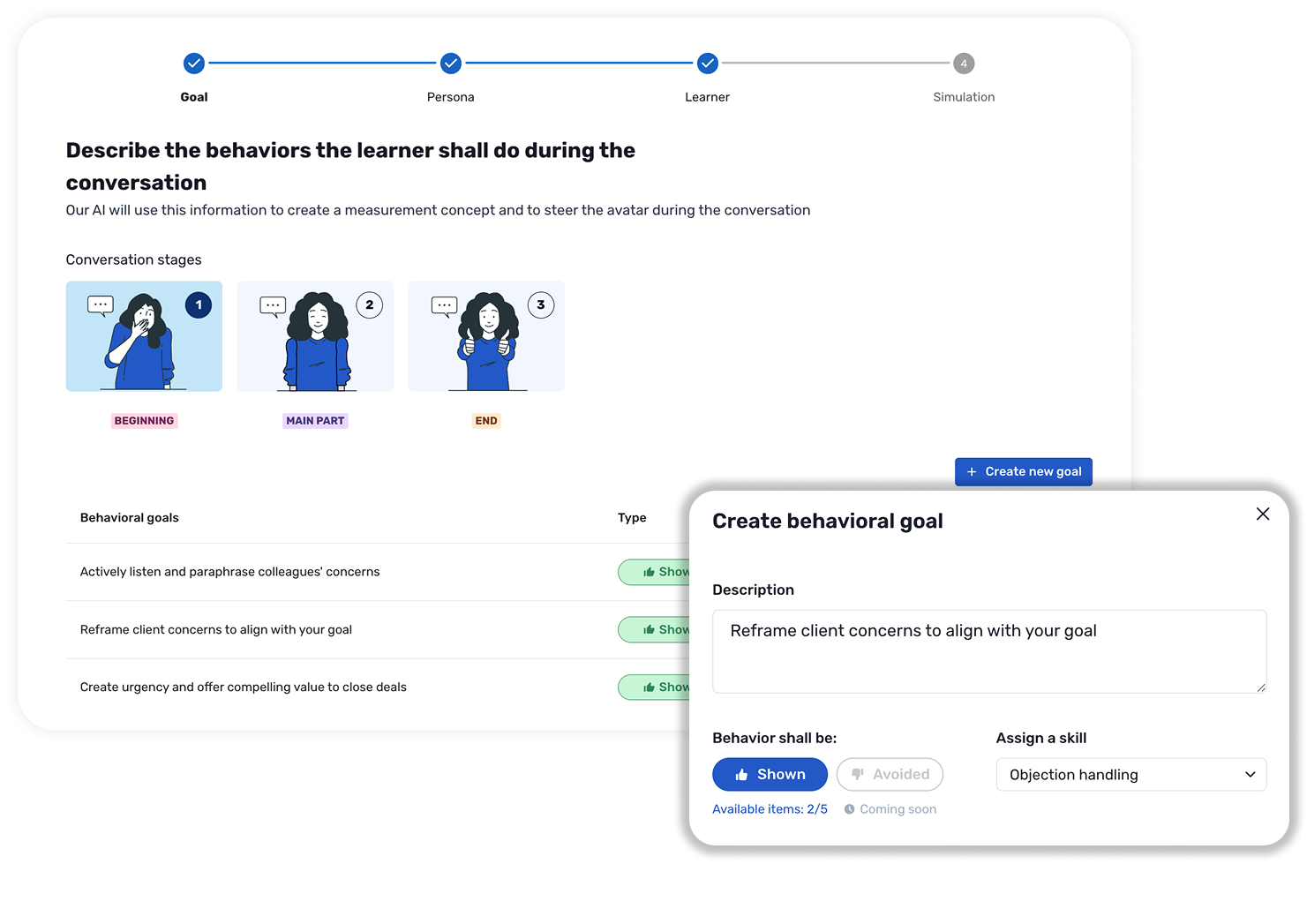
Step 2: Generate Virtual Twins of Your Clients
Generic role plays fail because they rarely reflect real stakeholder complexity, industry context, or typical objections, especially in enterprise or regulated sectors. Practicing with a colleague who does not understand your buyer’s world produces limited value.
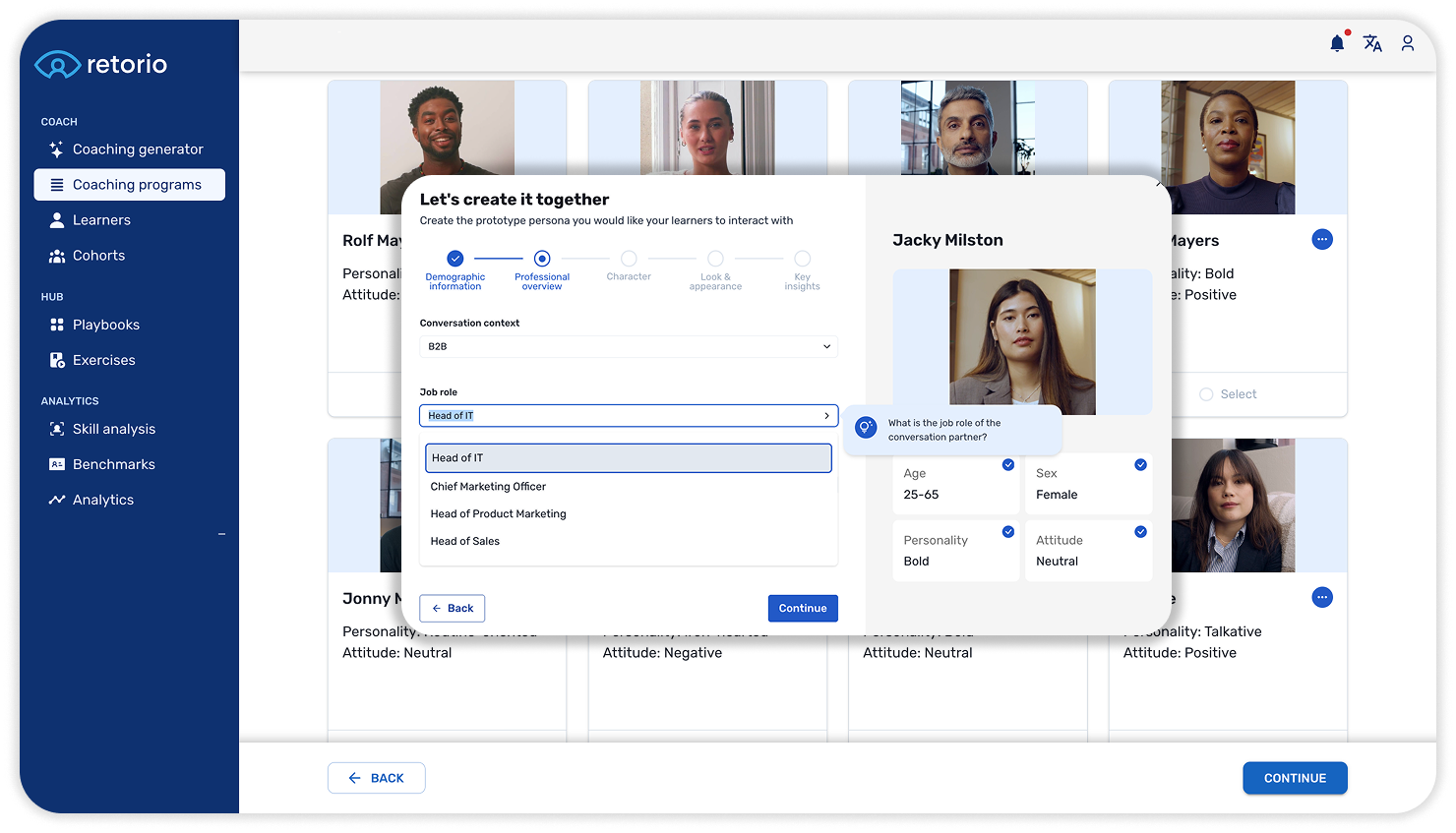
Retorio’s Persona Generator creates “virtual twins” of your common buyer personas. These are not just simple chatbots: They are sophisticated simulations that react dynamically based on behavioral cues.
Example personas might include:
- A risk-averse CFO at a German insurance company who needs extensive ROI justification
- A data-privacy-focused CIO at a European telecom evaluating security implications
- A procurement manager at a global pharmaceutical company focused on compliance
- A time-pressed startup founder looking for quick wins
Each persona contains detailed specifications:
|
Persona Element |
What It Includes |
|---|---|
|
Demographics & background |
Industry, seniority, region, company size |
|
Values & traits |
Detail-oriented, skeptical, relationship-driven, analytical |
|
Needs & pains |
Cutting onboarding costs, reducing churn, speeding time-to-value |
|
Behavioral tendencies |
How they respond to different approaches |
These virtual clients can proactively book simulated video or phone calls with reps, mimicking typical sales funnel stages, from initial discovery to solution presentation; from negotiation to renewal scenarios.
Organizations can create new personas based on thorough market research or choose from Retorio’s persona library tailored to industries like telecommunications, insurance, automotive, semiconductors, and logistics. Every practice session mirrors real buyer behavior.
Step 3: Run Realistic AI Role Plays for Real-Time Performance Analysis
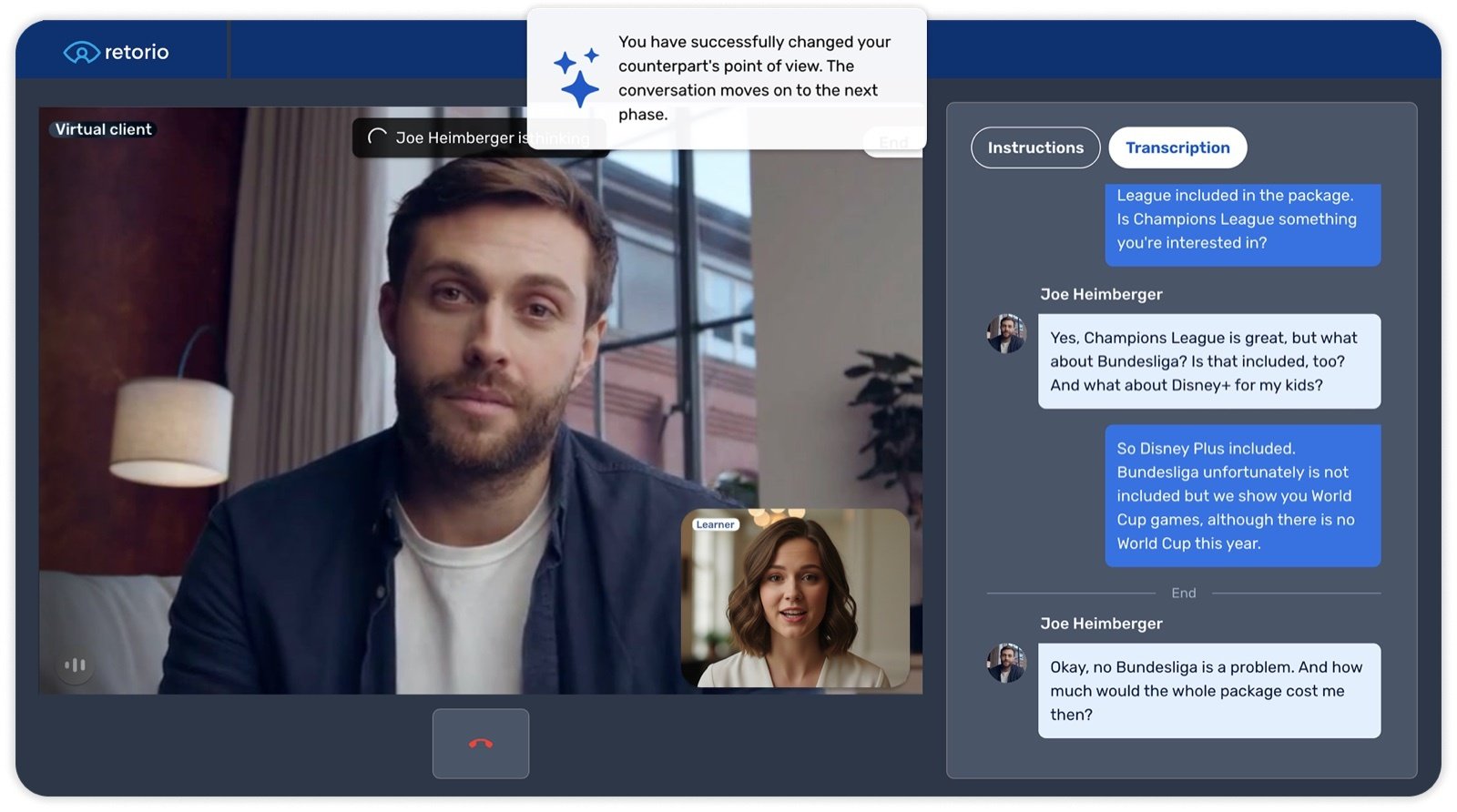
From a sales rep’s point of view, the AI Role Play experience feels remarkably real. The sales reps log into the platform, join a video call with a virtual client, and handle discovery, objections, and next steps exactly as they would in an actual meeting.
During the conversation, Retorio’s AI conducts real-time analysis of both verbal and non-verbal behavior that is described according to several scientifically validated behavioral constructs:
Active listening
- Attention & focus
- Verbal mirroring
Empathy
- Empathetic reactions
- Verbal–nonverbal consistency
Confidence
- Doubt words
- Filler words
- Presence
Persona orientation
- Speaking their language
- Sentence complexity
- Level of detail
- Information density
Applied knowledge
- Sales methodology
- Product knowledge
- Compliance
- ...
The AI evaluates how consistently the sales reps execute the company’s sales methodology. Are they diagnosing needs before pitching? Are they testing for budget and decision processes? Are they summarizing and confirming understanding? These behaviors directly impact sales efficiency and deal velocity. Coaching for insurance agents expands this point.
The system simulates challenging situations that sales reps dread but need to master: Dealing with a skeptical procurement officer demanding discounts; handling a time-pressed executive giving one-word answers; calming down a frustrated existing customer threatening to churn. Safe practice for high-stakes moments accelerates sales performance when it matters most.
Each role play produces an immediate, structured performance report that forms the basis for targeted coaching in the next step.
Step 4: Measure & Coach Warmth + Competence With Guided AI Feedback
The fourth step transforms subjective impressions (“that call felt okay”) into objective, quantified feedback tied directly to business-relevant behaviors and outcomes. Step four is where AI coaching delivers its most tangible value for sales performance management.
Retorio calculates a definitive Warmth + Competence score for each session, comparing the sales rep’s behavior against the organizational benchmark. The system shows exactly where sales reps fall in the W+C quadrant model and tracks movement over time.
Specific microbehaviors evaluated include:
- Listening vs. talking ratio: Are they learning or lecturing?
- Question quality: Open questions that uncover needs vs. closed questions that confirm assumptions
- Empathy statements: Acknowledging customer concerns before solving
- Explanation clarity: Structured, jargon-free communication
- Pitch structure: Logical flow aligned with customer priorities
- Confidence signals: Vocal steadiness, appropriate pacing
- Playbook alignment: Executing proven sales techniques consistently
The AI Sales Coach provides immediately actionable guidance based on sales performance data:
"At this point, you could have nodded your head to confirm that you agree"
“Slow down your speaking pace during pricing discussions to signal confidence.”
“Explicitly summarize customer pain points before proposing next steps.”
The specificity of the feedback separates AI coaching from generic sales training. Instead of vague advice, sales reps receive precise behavioral changes they can implement in their next conversation.
Retorio’s proprietary behavioral intelligence predicts how clients will perceive a rep on Warmth and Competence dimensions. The feedback is not theoretical: It reflects how real customers perceive the sales rep and how they would actually react.
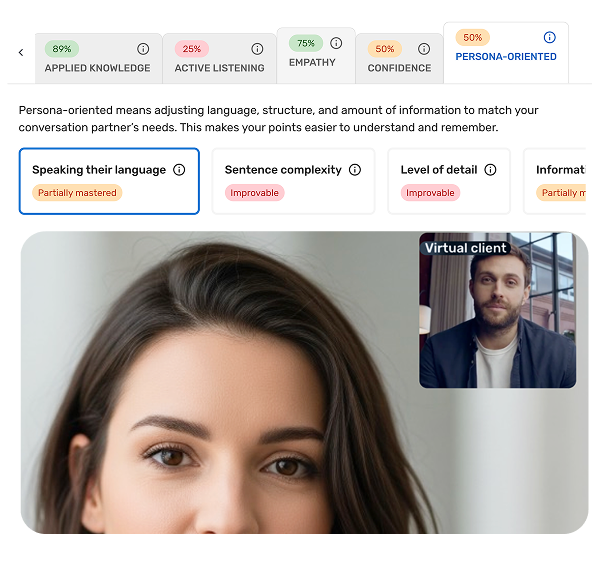
Guided AI Coaching provides sales reps with tactical feedback based on scientifically validated prediction models
Step 5: Use Data-Driven Insights to Drive Continuous Sales Performance Improvement
The real power of AI coaching appears at scale, when sales leaders can see patterns across dozens, hundreds, or thousands of reps and link behaviors to outcomes. Individual coaching is valuable. Systematic performance improvement across the entire sales organization is transformational. According to McKinsey, companies that invest in systematic sales capability building achieve 2x the revenue growth of peers who rely on hiring alone. For a full breakdown of coaching ROI, see the evidence on AI sales coaching benefits.
Retorio’s analytics dashboard provides:
- Individual positioning: Every rep placed on the Warmth + Competence spectrum
- Progress tracking: Movement over time toward the Trusted Advisor quadrant
- Trade-off identification: Reps who are highly competent but perceived as cold, or very warm but vague on solutions
- Cohort comparisons: Teams, regions, or product lines benchmarked against each other
- Skill gap analysis: Specific behaviors limiting team performance
The system identifies “highest-impact, lowest-effort” development opportunities. It might for instance recommend a specific question, a discovery method, or closing technique, that has lifted win rates across similar personas in the past. The valuable insights provided by the AI coach help sales leaders focus coaching resources for maximum revenue growth.
The quantitative impact speaks for itself:
|
Metric |
Average Improvement |
|---|---|
|
Perceived warmth |
+14% in first 10 sessions |
|
Perceived competence |
+15% in first 10 sessions |
|
Sales soal achievement |
+10% across participating reps |
|
Transactionist → trusted advisor |
Ca. 1 in 5 sales reps make the shift |
The insights generated by the AI Coach feed directly into broader sales operations. They inform quarterly coaching themes, tailor sales enablement content, and guide decisions on where to invest human coaching resources. Sales managers gain objective performance data to drive more sales through systematic development rather than guesswork.
Real-World Examples: How AI Coaching Transforms Sales Performance
AI coaching’s impact isn’t theoretical. it’s been proven across large enterprises facing real-world challenges. Two cases demonstrate the breadth of application:
Case Study 1:
NÜRNBERGER Versicherung: Transforming Insurance Sales Onboarding
NÜRNBERGER, a large German insurance company, faces an annual challenge. The sales academy trains approximately 150 largely inexperienced new agents each year. Traditional onboarding struggled with high early-stage turnover and inconsistent skill development.
By integrating Retorio’s AI Sales Coaching, the company created customized virtual customer simulations based on real personas and core insurance products. New agents could practice sales conversations far more frequently than traditional role-play training allowed.
Practice frequency increased dramatically:
- Up to 7x more role plays than traditional methods
- 52 AI evaluations before meeting their first real client
- Faster ramp-up with greater confidence
The business impact was substantial:
|
Metric |
Before |
After |
Improvement |
|---|---|---|---|
|
Onboarding drop-out rate |
18% |
5% |
72% reduction |
|
Training cost savings |
N/A |
€650,000+ |
N/A |
|
ROI |
N/A |
10x+ |
First year |
The Nürnberger case study shows that systematized performance measurement and coaching, applied to the critical onboarding phase, dramatically improves sales talent retention and accelerates time-to-productivity.
Case Study 2:
Vodafone Intelligent Solutions: Scaling Agent Development
Vodafone Intelligent Solutions (VOIS) faced a similar challenge. They need to ramp up 1,800 new customer-care agents annually while overcoming limited coaching capacity and high early-stage failure rates. Human coaches simply couldn’t scale to meet demand.
The company implemented Retorio’s AI coaching with 24/7 access to scalable, realistic call simulations. Within six months, the results were remarkable:
Onboarding quality increased drastically:
- 40,000+ automated coaching sessions delivered
- Trainees practiced at scale with objective behavioral feedback
- Preparation completed long before first customer interaction
Performance impact:
|
Metric |
Improvement |
|---|---|
|
Ramp-up time |
38% reduction (8 to 5 weeks) |
|
Onboarding success rate |
20% increase (A/B tested) |
|
Human coaching effort |
69% reduction |
|
Annual savings |
€800,000 estimated |
Human trainers were freed for higher-value work: complex deal coaching, team performance strategy, and sales efforts that require human judgment, while the AI handled foundational skill development at scale.
How to Integrate AI Coaching Into Your Existing Sales Performance Stack
AI coaching does not require ripping out current systems. It integrates with your CRM, sales enablement platforms, and existing KPI dashboards. The goal is to enhance processes, not to replace them. For deeper context, see sales performance coaching.
Practical rollout sequence:
- Pilot phase: Start with a specific segment (e.g., new business AEs in EMEA, or the Q3 onboarding cohort)
- Measure and refine: Track engagement, satisfaction, and skill improvement against sales performance metrics
- Expand strategically: Roll out to customer-success teams, renewal specialists, or additional regions based on initial impact
- Integrate with compensation: Align sales incentives with demonstrated Warmth + Competence development
Aligning with existing methodologies:
Integrate your sales methodology frameworks like SPIN, Challenger, MEDDIC, or custom approaches. This way, AI feedback reinforces rather than competes with current sales training. The system evaluates whether reps execute your methodology, not a generic one.
Connecting to business KPIs:
Link AI coaching metrics (Warmth + Competence, playbook execution) with hard business outcomes over defined periods:
|
AI Coaching Metric |
Business KPI |
|---|---|
|
Warmth score omprovement |
Customer satisfaction, NPS |
|
Competence score improvement |
Win rate, sales quota attainment |
|
Playbook execution rate |
Sales cycle length, deal velocity |
|
Overall W+C movement |
Sales revenue, driving revenue growth |
Change management checklist:
- ☐ Secure executive sponsorship with clear success metrics
- ☐ Communicate purpose clearly: frame the AI as coach, not surveillance
- ☐ Start with volunteers who become internal champions
- ☐ Celebrate early wins publicly to build momentum
- ☐ Integrate with existing performance conversations
- ☐ Share customer feedback showing real-world improvement
The marketing team and sales organization should align on how AI coaching supports lead generation through better-qualified discovery conversations and stronger customer relationship management.
If you want to go deeper, Retorio offers free discovery calls, trials, and demos to experience AI Sales Coaching in action. Explore where your reps stand on the Warmth + Competence spectrum, and how fast you can move them into the Trusted Advisor zone.

Frequently Asked Questions
How is AI sales coaching different from traditional sales training?
Traditional sales coaching happens in workshops a few times per year. Reps learn concepts, practice briefly, then return to their desks. Retention drops without reinforcement. AI coaching embeds frequent, bite-sized practice and instant behavioral feedback into weekly routines. It measures how reps are perceived by buyers, not just what they know, and captures longitudinal data that makes targeted human coaching far more effective.
Will AI coaching replace human sales managers?
No. AI coaching automates repetitive role plays and foundational feedback so managers can focus on strategic deal coaching and complex negotiations. A manager with ten direct reports might run one role play per rep per month. With AI coaching, each rep practices 20 or more scenarios monthly. Managers then review AI-generated insights and apply human judgment where it matters most.
How long does it take to see measurable improvements in sales performance?
Retorio's data shows the biggest lift during the first ten sessions, typically within 4 to 8 weeks of regular use. Perceived Warmth increases by an average of 14% and Competence by 15% in that window. Enterprise deployments like the NÜRNBERGER and Vodafone VOIS rollouts showed measurable impact on ramp-up time and conversion within the first quarter.
Is AI sales coaching only for new hires, or also for experienced reps?
Both. New hires use it to build foundational skills before their first client meetings. Experienced reps use it to adopt new messaging, prepare for new markets, or refine how executive buyers perceive them. The Warmth + Competence framework is particularly effective for senior sellers who already know the product but want to lift their perceived credibility with C-suite buyers.
How do we ensure AI coaching aligns with our compliance requirements?
Organizations upload brand guidelines, compliance rules, and approved messaging during implementation. AI feedback then reinforces on-brand, compliant behavior. Scenarios can be configured for regional regulations including GDPR in the EU, financial-services guidance, and industry-specific constraints. Retorio is ISO 27001-certified, GDPR-compliant, and EU AI Act-aligned.
Written with help from LLMs, edited and checked by Önder Mutluer, Website Manager and Marketing Strategist, and Dr. Patrick Oehler, Co-founder and Co-CEO. Reviewed by Peter Holdenried, Head of Sales. How this article was researched, written and checked, and who reviews which topic: Retorio editorial policy.