


Effective coaching for employees carries far more strategic weight than it did 10-15 years ago. Companies that want to remain flexible and competitive are actively searching for coaching and development strategies that scale and produce measurable results.
Learning and development experts are in continuous search to find the most innovative approaches to empower employees' skills and boost company efficiency in an era when businesses navigate more and more towards digitalization.

Thanks to this increased pace of digitalization after COVID-19, online coaching as the new training method has enabled learning to become a flexible and dynamic environment that knocks down barriers standing in front of learning and transforms the way employees learn new competencies.
With today's article, you will learn crucial details about online coaching and understand the advantages it holds over traditional training to improve the performance of your employees.
| Key Insights |
|
|
|
Table of contents
What is online coaching?
Online coaching is an innovative form of training that employs a digital platform to provide remote, personalized training and guidance to employees of organizations. Online coaching, as opposed to traditional in-person training, takes advantage of technology to create dynamic and engaging learning experiences. Examples of this kind of technology include interactive modules, scenario-based training, and AI-driven use cases.
This type of coaching is accessible to employees from any location with only an internet connection, which provides flexibility and convenience.
Since online coaching incorporates features like real-time feedback and customized learning routes, it allows for a dynamic and successful approach to skill development, performance enhancement, and continuous learning.
Advantages of online coaching for employees
According to a Deloitte report [1] , employees who work in a company that has an established learning culture have 30-50% more training engagement and retention rate compared to peers who don't.
There are many advantages of online coaching in the modern workplace. These advantages benefit different parts of an operation such as employees, L&D managers, and the company itself overall.
Perhaps the most important advantages happen for the employees. Since employees are the key part of an operation, it is important to make sure they receive the best and regular coaching to improve their performance and overall work motivation.
To understand the benefits of online training for employees, let's take a more detailed look at the individual factors:
Accessibility and flexibility
Online coaching offers unrivaled accessibility and flexibility. The accessibility and flexibility eliminate the hardships associated with traditional face-to-face-based learning. From the comfort of their homes, in quiet places, or even during business trips where they need to learn materials in an emergency, employees can engage in coaching sessions thanks to ease of access. This eliminates the need for commuting or sticking to tight schedules for all parties involved.
This flexibility is especially beneficial for remote workers all around the globe who may be located in different time zones or might have varying work hours.
At the same time, online coaching gives employees the ability to effectively utilize their time by giving them access to training materials and learning sessions at all times. This allows them to balance job obligations with professional development opportunities.
Additionally, because online coaching is flexible, businesses can reach a larger number of employees, such as geographically scattered teams or workers with different kinds of learning inclinations and needs.
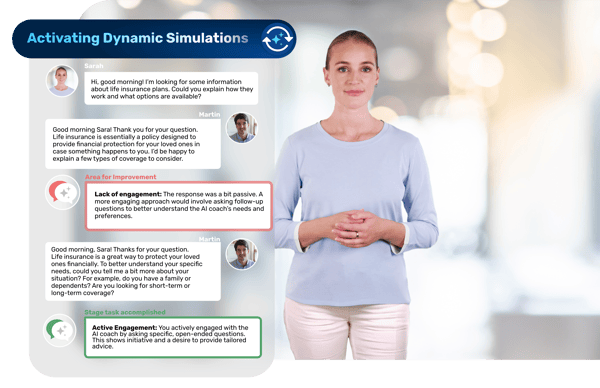 Find out how to implement AI coaching into your L&D program to support employees in reaching higher positions and creating a culture of lifelong learning.
 Personalized learning
Another one of the crucial advantages of online coaching is the ability to deliver personalized learning experiences. Unlike traditional training methods, online coaching can be unique to each employee based on their qualities.
Advanced technologies like Artificial Intelligence allow for the customization of coaching programs to match the skill gaps of each employee. Beyond traditional one-size-fits-all training materials, this personalized approach makes sure employees receive the necessary training that is consistent with their own responsibilities along with their career goals.
Especially, an AI-based online coaching platform can make recommendations for personalized learning routes and adjust the pace and complexity of learning modules in order to optimize learning outcomes. This is done by analyzing behavioral data on individual performance and competency levels.
Continuous feedback and improvement
Online coaching paves the way for a culture of continuous feedback and improvement. Doing so provides employees with real-time insights and guidance to improve their skills and performance at work.
Unlike traditional training methods which offer occasional assessments or delayed feedback, online coaching usually enables feedback and check-ins throughout the learning process.
Employees receive instant feedback on their performance and process. It allows them to make necessary adjustments in the areas where they have learning gaps. They can also support the newly learned skills on time.
This continuous feedback process not only accelerates the development of many different skills but also promotes a mindset of improvement among employees which encourages them to look for constant improvement in their workplace.
What's in it for companies?
Based on research [2] made by International Society for Performance Improvement, coaching can generate a whopping 221% return on investment(ROI).
The advantages of online coaching extend beyond individual employees and benefit the entire organization. Companies consistently look for ways to boost productivity and workforce performance.
Online coaching provides an opportunity for companies to achieve these goals effectively. To understand it better, let's take a look at how companies benefit from online platforms through cost-saving, scaling effectively, and creating customizable learning paths for their employees:
Cost-effective solutions
When we look at it from a cost perspective, online coaching presents a cost-effective alternative to traditional training programs by offering significant savings for companies while delivering high-quality learning experiences to employees.
Through utilizing online platforms for coaching, companies can eliminate expenses related to physical aspects such as printed materials, traveling, and even accommodation.
This reduction in overhead costs means more savings in training budgets which allow companies to allocate resources more efficiently and invest in other strategic steps that promote employee development.
Scalability
Companies usually face the ongoing challenge of scaling training programs to meet the evolving needs of a growing and diverse workforce. One of the benefits online coaching offers is a scalable solution by utilizing digital technologies to deliver training content and coaching sessions to a large number of employees simultaneously without the worry of organizing scary big events.
The scalability provided by online coaching ensures that management and L&D managers can effectively reach and engage employees across different departments and geographic locations without compromising on training quality.
Whether a company is expanding globally or undergoing fast growth, online coaching provides the capacity to scale training sessions efficiently.
In addition, because online coaching is scalable, L&D departments can modify training plans to suit different job responsibilities and skill levels within the company. This promotes a culture and philosophy of ongoing learning and skill development for all employees.
Customizable learning paths
Online coaching enables L&D departments to create highly customizable learning ways that align with organizational goals and strategic priorities. It also aligns with employee needs. Especially with AI-powered platforms, companies can design and deploy customized training materials and assessment methods to specific job levels within the organization.
This customization ensures that employees receive targeted and impactful training that aligns with their specific learning objectives and organizational requirements. Besides this, customizable learnings also benefit individual employee development by taking their career aspirations into account.
In addition, companies can continuously refine and adjust learning paths based on employee feedback and performance metrics in order to ensure that training initiatives remain relevant and effective in driving both employee growth and company success.

How can it assist L&D managers?
According to expert Francis Coetzee [3], a company that makes use of both training and coaching at the same time will experience an 88% increase in productivity, whereas the number is 23% when it is training alone.
The role of Learning and Development managers is crucial in shaping the training and growth strategies within companies. They are usually tasked with important challenges such as optimizing training strategies, improving employee development, and driving performance.
Online coaching emerges as a transformative tool that enables L&D managers to achieve these objectives effectively.
Here are some of the ways online coaching benefits L&D managers:
Improved data-driven approach
The integration of AI and data analytics in online coaching allows for valuable data-driven insights for L&D managers. Such a platform may collect and analyze a number of data related to employee performance, learning patterns, knowledge retention rates, etc.
Managers can then utilize these data-driven insights to gain a comprehensive understanding of the learning behaviors and preferences of their employees. Upon identifying these trends and patterns in the data, managers can make informed decisions regarding training content and the personalization of learning methods.
Data-driven insights also enable L&D managers to estimate the impact of coaching programs, track learning outcomes, and assess the return on investment(ROI) of training initiatives.
This data-driven approach empowers departments to optimize training strategies to allocate resources effectively and continuously improve the quality and relevance of learning materials for employees.
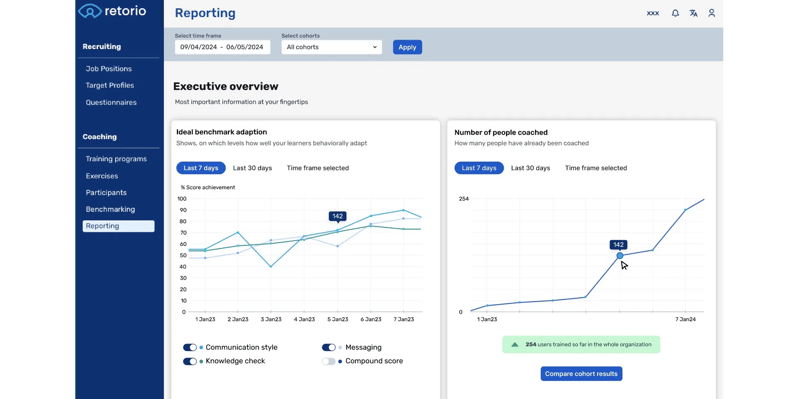 Retorio's AI-powered coaching platform provides the necessary data in order for managers to identify the strengths and weaknesses of employees.
Agile market adaptation
Agile market adaptation is another crucial advantage that online coaching brings to companies to enable quick and swift responses to evolving market trends and business needs.
Unlike traditional training methods that may require lengthy development cycles and stiff content delivery, online coaching offers flexibility and agility in adapting training content as well as learning experiences to align with changing market dynamics.
With this, L&D managers can utilize real-time data analytics and AI-driven insights to understand emerging industry trends and competitive environments. This agile approach allows companies to deploy targeted training initiatives and address evolving business challenges effectively.
When gaining this agility with online coaching, companies can ensure that employees are equipped with the latest knowledge and competencies needed to stay competitive in the dynamic market environment.
Online coaching versus traditional training
Finally, it is important to make a direct comparison between traditional training and online coaching to understand the advantages and disadvantages of each method.
The comparison table below aims to highlight factors such as accessibility, customization, consistency, and scalability which are some of the most crucial keywords in choosing the method of learning and development.
| Criteria | Traditional training | Online coaching |
| Consistency |
When compared to online coaching, traditional training can occasionally be less consistent because of practical issues including inconsistent instructor skills and scheduling conflicts.
|
Employees might be able to take more training material in a calendar year compared to conventional training since online coaching would not require the challenges of traditional training courses.
|
| Personalization |
Traditional training usually employs a one-size-fits-all philosophy which might conflict with the certain requirements of specific employee needs.
|
When it comes to online coaching, it is easier to tailor the necessary training for the particular needs of employees which targets the specific areas that need improvement.
|
| Accessibility |
While they are very valuable in many ways, attending workshops and traditional training can be quite time-consuming and draining. Sadly, this makes the workplace less accessible to employees.
|
Employees might access personalized online coaching with just a mouse click, anywhere. Managers and employees could use the saved time by using online coaching, elsewhere.
|
| Scalability |
The scalability of traditional training may be limited by physical space and other resources. Scheduling more sessions and the requirement for larger spaces are just a few of the logistical requirements that come with scaling traditional training programs. These arrangements can be expensive and time-consuming.
|
Thanks to its digital nature, online coaching is more scalable than traditional training. It allows for the simultaneous training of a large number of participants regardless of geographical locations
|
Best practices for online coaching
A variety of practices are included in finding the best practices for online coaching in order to maximize the online learning environment. These practices include using and utilizing an interactive platform to provide personalized feedback.
As technology continues to evolve, AI coaching is now seen as the next big breakout in learning and development and the best type of practice for online coaching.. By harnessing Behavioral Intelligence, Retorio's AI-powered coaching platform offers advanced data analytics, personalized learning strategies, and real-time performance insights to track the performances of individual employees.

With these performance insights provided by Retorio's AI-powered online coaching, companies can take targeted actions to raise the efficiency of their operations across a competitive market.
For example, our peers at NÜRNBERGER Versicherung expressed their struggles with hardships to motivate their employees to train due to the fact that it would get boring for them.
With Retorio's AI-powered platform, we implemented virtual video simulations for employee immersion in relevant real-time scenarios in order to improve their training morale and performance. After the initial rollout, our partners at NÜRNBERGER Versicherung reported:
- A mentally stable setting where trainees can get unbiased feedback,
-
Increased motivation for training thanks to efficient and fully online training design available for employees on-demand 24/7,
- Higher numbers in sales and new habits of successful sales patterns,
-
Increased L&D effectiveness,
- Overall measurable training improvements backed by data collected by employee performance in training sessions.
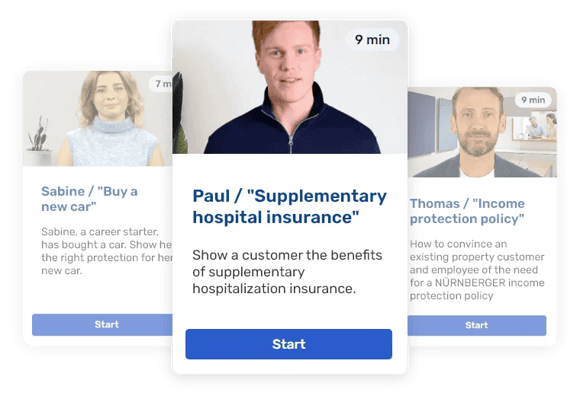
Are you interested in reaping the same benefits of AI-powered online coaching for your company? Retorio is here to do exactly that for your company as well. So click on the link below to start your journey now.

FAQs for online coaching
What should online coaching offer?
Online coaching should offer a comprehensive and personalized learning experience tailored to individual needs and learning styles. This includes access to a range of learning resources such as interactive modules, video tutorials, assessments, and real-time feedback mechanisms.
The coaching should be adaptive, it should allow employees to progress at their own pace and focus on areas of improvement. Additionally, data and analytics should also be integrated into the coaching process to track progress.
Is online coaching a growing industry?
The market for online coaching is expanding quickly. It has grown significantly in recent years due to technological developments such as Artificial Intelligence and a shift towards remote work and learning environments. Many businesses in a variety of industries are noticing more and more the advantages of online coaching for many factors such as employee growth, skill improvement, accessibility, cost advantages, and more.
How does online coaching work?
The sources describe how AI coaching platforms function, which can be considered a form of online coaching. These platforms offer a range of features and benefits compared to traditional coaching methods.
Key aspects of how online coaching works, based on the sources:
- Accessibility and Convenience: Online coaching is available on-demand and fits into reps' schedules, allowing them to access training at any time. It can be done anywhere, even in a hotel room or before an important meeting.
- Personalized and Interactive Learning: AI coaching offers personalized and interactive learning experiences tailored to individual needs.
- Data-Driven Insights: AI coaching improves training effectiveness by delivering targeted, data-driven insights that address specific learning gaps. Machine learning algorithms analyze hundreds of behaviors to provide bias-free feedback.
- Real-Time Feedback: AI coaches provide real-time feedback, which helps reps understand the impact of their behavior and make immediate adjustments.
- Consistent Training Quality: AI coaching provides uniform training, ensuring all reps receive the same level of instruction.
- Comprehensive Monitoring: AI can track and analyze every aspect of a rep's performance in real-time.
- Objective Measurement: AI coaching offers precise, data-driven feedback and quantifiable performance metrics.
- Scalability: Online coaching can simultaneously train multiple reps without additional costs.
- Integration into Workflows: AI coaching can be integrated into digital workflows, such as CRM, HRM, or video call software, to enhance recommendations and track performance improvements.
- Content Generation and Simulation: AI coaching platforms use models to create realistic training content, such as simulated conversations and avatars.
- Behavioral Intelligence: AI coaching analyzes rep interactions to quantify, predict, and prescribe behavior based on video analysis, identifying winning behaviors and building benchmarks.
- Multimodal Models: These models combine voice, speed, and visual input to describe quantifiable behavioral characteristics, predict their impact, and prescribe recommendations.
- Transparency and Explainability: Online coaching platforms offer transparency through timestamps, text-highlighting, and reasoning to help users understand the AI's analysis and the rationale behind recommendations.
- Quality Control: Developers continuously monitor key performance metrics and use distinct validation and test datasets to ensure that the models function effectively.
- Engagement: AI coaching fosters higher levels of interest and participation, with adaptive algorithms and real-time feedback engaging reps more effectively.
- Improvement in KPIs: AI coaching programs can be evaluated through various KPIs, including revenue generation, quota attainment, cost savings, and time-to-market.
- Cost-Effective: AI coaching reduces the need for multiple human trainers, significantly cutting training expenses, while also allowing more employees to be trained within the same budget.
The process of AI coaching involves several key steps:
- Defining Objectives: Determine the specific goals and roles you want to address with coaching.
- Identifying Reps: Select the individuals within the teams who will benefit most from coaching.
- Discovering Learning Gaps: Use surveys, performance reviews, and feedback to identify the areas where reps need the most improvement.
- Pairing Coaches with Reps: Match coaches and reps based on their personalities and learning styles.
- Conducting Coaching Sessions: Facilitate meetings between coaches and reps.
- Evaluating and Providing Feedback: Coaches observe progress and provide tailored feedback to help reps improve.
- Measuring Training Effectiveness: Quantify behavioral changes and track performance improvements over time.
- Demonstrating ROI: Quantify the value of improved skills and increased productivity to demonstrate the return on investment.
- Aligning with Company Goals: Ensure that training aligns with the company's strategic objectives for future business strategy.
What are the benefits of online coaching?
Online coaching, particularly through AI coaching platforms, offers numerous advantages over traditional coaching methods. These benefits span various aspects, including accessibility, personalization, effectiveness, scalability, and cost.
Key benefits of online coaching:
-
Accessibility and Convenience:
- On-demand availability allows reps to access training at any time, fitting it into their schedules without disrupting work.
- Training can be done anywhere, even in a hotel room or before an important meeting.
-
Personalization and Engagement:
- AI coaching provides personalized and interactive learning experiences tailored to individual needs.
- It fosters higher levels of interest and participation through adaptive algorithms and real-time feedback, engaging reps more effectively.
-
Data-Driven Insights and Feedback:
- It improves training effectiveness by delivering targeted, data-driven insights that address specific learning gaps.
- Machine learning algorithms analyze hundreds of behaviors to provide bias-free feedback.
- Real-time feedback helps reps understand the impact of their behavior and make immediate adjustments.
- AI coaching offers precise, data-driven feedback and quantifiable performance metrics.
-
Consistency and Quality:
- AI provides uniform training quality, ensuring all reps receive the same level of instruction.
-
Comprehensive Monitoring and Measurement:
- AI can track and analyze every aspect of a rep's performance in real-time.
- It allows for the quantification of behavioral changes and tracking of performance improvements over time.
-
Scalability and Democratization:
- Online coaching can simultaneously train multiple reps without additional costs, making it easily scalable.
- It democratizes access to coaching, reaching thousands of people at once, unlike traditional coaching efforts that are often limited to executives.
-
Integration into Workflows:
- AI coaching can be integrated into digital workflows, such as CRM, HRM, or video call software, to enhance recommendations and track performance improvements.
-
Content Generation and Simulation:
- AI coaching platforms use models to create realistic training content, such as simulated conversations and avatars.
-
Behavioral Intelligence:
- It analyzes rep interactions to quantify, predict, and prescribe behavior based on video analysis, identifying winning behaviors and building benchmarks.
- Multimodal models combine voice, speed, and visual input to describe quantifiable behavioral characteristics, predict their impact, and prescribe recommendations.
-
Transparency and Explainability:
- Online coaching platforms offer transparency through timestamps, text-highlighting, and reasoning to help users understand the AI's analysis and the rationale behind recommendations.
-
Quality Control:
- Developers continuously monitor key performance metrics and use distinct validation and test datasets to ensure that the models function effectively.
-
Improved KPIs:
- AI coaching programs can be evaluated through various KPIs, including revenue generation, quota attainment, cost savings, and time-to-market.
-
Cost-Effectiveness:
- It reduces the need for multiple human trainers, significantly cutting training expenses.
- It allows more employees to be trained within the same budget.
- AI coaching can reach up to 42 times more people for the same cost as conventional coaching.
By leveraging these advantages, organizations can enhance their training programs, improve employee performance, and achieve better business outcomes.
How does online coaching differ from in-person coaching?
Online coaching, particularly AI-driven platforms, presents several key differences compared to traditional in-person coaching. These differences span across various aspects of coaching, such as accessibility, personalization, scalability, cost, and feedback mechanisms.
-
Accessibility and Convenience:
- Online Coaching: Offers on-demand availability, allowing reps to access training at any time and from any location. It fits into reps' schedules without disrupting work and can be done even in a hotel room or before an important meeting.
- In-Person Coaching: Requires fixed training hours, which may disrupt work schedules. Reps must adhere to the coach's schedule, which may lead to frustration and the need for coordination.
-
Personalization and Engagement:
- Online Coaching: Provides personalized and interactive learning experiences tailored to individual needs, fostering higher levels of interest and participation through adaptive algorithms and real-time feedback.
- In-Person Coaching: May offer personalized experiences, but the extent of personalization can vary depending on the coach's skills and the resources available.
-
Scalability:
- Online Coaching: Easily scalable and can simultaneously train multiple reps without additional costs.
- In-Person Coaching: Limited by the number of available coaches, making it difficult to scale training programs quickly and efficiently.
-
Cost-Effectiveness:
- Online Coaching: Lower costs, as it reduces the need for multiple human trainers, significantly cutting training expenses. More employees can be trained within the same budget, increasing overall workforce competency. AI coaching can reach up to 42 times more people for the same cost as conventional coaching.
- In-Person Coaching: High costs, including expenses for finding, training, and compensating coaches. Higher per-rep costs due to the need for individual or small group coaching sessions.
-
Data-Driven Insights and Feedback:
- Online Coaching: Improves training effectiveness by delivering targeted, data-driven insights that address specific learning gaps. Machine learning algorithms analyze hundreds of behaviors to provide bias-free feedback. Offers comprehensive real-time monitoring and precise, data-driven feedback.
- In-Person Coaching: Limited observation, often subjective feedback. Coaches can't monitor every aspect of a rep's performance comprehensively and may rely on subjective assessments.
-
Consistency and Quality:
- Online Coaching: Provides consistent, high-quality training for all reps.
- In-Person Coaching: Varies depending on the coach's skills, leading to potential inconsistencies in training quality.
-
Bias and Distractions:
- Online Coaching: Impartial, with no bias or fatigue.
- In-Person Coaching: Susceptible to the coach's bias, distractions, and fatigue, which can affect the quality of training.
-
Training Quality:
- Online Coaching: Consistent, high-quality training for all reps.
- In-Person Coaching: Varies depending on the coach's skills. It's hit or miss, as a bad trainer delivers no value and may even discourage reps.
-
Time and Money:
- Online Coaching: No extra cost, no matter how often the rep wants to train.
- In-Person Coaching: Trainers and reps must coordinate their schedules, and the rep must ask for permission to do training, leading to frustration. Extra training days can cost approximately 2000 EUR.
-
Benchmarks:
- Online Coaching: Can establish benchmarks in just 1 hour using a top performer.
- In-Person Coaching: Each coach needs shadowing or similar training, requiring thorough planning, and top performers to be shadowed can't work normally.
-
Monitoring and Feedback:
- Online Coaching: Consistent and actionable feedback, with scenarios that can be repeated at will to achieve improvements.
- In-Person Coaching: Limited quality of feedback can compromise the entire training, potentially resulting in a total loss of time and money.
-
Learning Pace:
- Online Coaching: Self-paced learning.
- In-Person Coaching: Reps must adhere to the coach's schedule.
Is online coaching as effective as in-person coaching?
AI-driven online coaching can be as effective, and in some cases more effective, than traditional in-person coaching.
Benefits of Retorio's AI Coaching
- Quantifiable Impact AI coaching provides measurable results and can link training outcomes to business metrics.
- Improved Behavioral Skills AI coaching can significantly improve behavioral skills. An international FMCG company measured an average 5.6% improvement after 12 coaching sessions, and an expected improvement of 14.6% after 31 sessions.
- Higher Engagement AI coaching has high voluntary participation rates and recommendation rates, significantly above industry standards for e-learning platforms. Voluntary participation rates in AI coaching programs range from 75% (leadership training) to 93% (retail sales setting) with six to twelve coaching average sessions per user per quarter and recommendation rates of 80-91%.
- Closing Skill Gaps AI coaching demonstrates efficacy in reducing both implicit and explicit knowledge gaps.
- Business Impact AI coaching can lead to significant business outcomes, including revenue increases and cost savings. For example, AI coaching has been associated with revenue increases of +5 to 15%.
- Personalized and Safe Coaching Experiences AI coaching turns large-scale training into personalized and psychologically safe coaching experiences.
- Democratized Access AI coaching democratizes access to coaching, enabling thousands of people at once.
- Learning from Experienced People AI coaching learns from experienced people and shares their winning behaviors.
- Data-Driven Recommendations AI coaches provide data-driven recommendations, supported by video footage and evidence.
- Unbiased Recommendations AI coaches focus solely on behavior, disregarding demographics.
- Scalability and Standardization AI coaches offer consistent, high-quality coaching for all, creating an equal environment with personalized insights. Coaching sponsors can ensure quality standards and unify behaviors within their organization.
Efficacy in Specific Scenarios
- AI coaching is particularly effective in scenarios requiring quick learning and measurable improvements, such as onboarding and new product introductions.
- Lower initial scores result in steeper learning curves; coaching can close big gaps between actual and ideal behavior within comparatively short periods.
Comparison to Traditional Coaching
- AI coaching can reach up to 42 times more people for the same cost as conventional coaching.
- AI coaching helps make behavior measurable and describable, building more data-driven learning systems.
- AI coaching integrates into daily routines and can leverage internal databases for realistic simulations and effective feedback.
How can online coaching help enterprise and multinational organizations?
Online coaching, especially AI-driven platforms like Retorio , can significantly benefit enterprise and multinational organizations across their sales, leadership, and service teams by offering scalable, personalized, and data-driven training solutions.
Benefits Across Teams:
- Sales Teams:
- Improved Performance: AI coaching can lead to enhanced sales performance, directly impacting the company's top-line revenue. Enterprises report up to 20% revenue growth within 12 months of scaled adoption.
- Increased quota achievement: Implementing AI-driven coaching for sales teams can lead to a 15 to 20% increase in sales quota achievement.
- Onboarding Success: AI coaching improves onboarding success rates for sales teams.
- Personalized Training: AI can help sales teams with pitching, discovery, solution sales, and simple negotiations.
- Behavioral Improvement: Measurable improvements in sales behaviors can be achieved, with one study showing reps acting 13% more consistently with top performers after 6.68 AI coaching sessions.
- Leadership:
- Scalable Reach: AI coaching offers scalable reach to all reps, enabling quick implementation of different topics for different learning groups.
- Skill Development: AI can strengthen soft skills that are important for leadership roles.
- Targeted training can be offered in areas such as performance management reviews and salary negotiations.
- Service Teams:
- Improved Customer Satisfaction: Effective handling of customer conversations through AI coaching can lead to a 16% increase in customer satisfaction.
- Efficiency: AI coaching reduces required human effort relative to conventional coaching.
- Enhanced NPS: AI coaching implementation is associated with a 3 to 5% improvement in Net Promoter Scores (NPS).
- Targeted Topics: AI coaching can assist service teams with objection handling and upselling.
Key Advantages of AI Coaching:
- Scalability and Cost-Effectiveness: AI coaching can reach up to 42 times more people for the same cost as conventional coaching, making it ideal for large organizations.
- Personalization and Engagement: AI coaching offers personalized and interactive learning experiences that adapt to individual needs, fostering higher engagement levels.
- Data-Driven Insights and Feedback: AI provides data-driven recommendations supported by video footage and evidence, offering unbiased feedback focused solely on behavior.
- Consistency and Quality: AI coaches offer consistent, high-quality coaching for all reps, ensuring an equal environment with personalized insights.
- Integration and Flexibility: AI coaching can be integrated into digital workflows, such as CRM and HRM systems, and quickly adapt to changing coaching needs.
- Measurable Impact: AI coaching provides quantifiable data on training effectiveness, linking training outcomes directly to business performance metrics.
- Efficiency: AI coaching can be implemented rapidly. A global rollout to 5,000 employees can occur in under 6 weeks.
By leveraging these advantages, enterprise and multinational organizations can enhance their training programs, improve employee performance, and achieve better business outcomes across their sales, leadership, and service teams.
Written with help from LLMs, edited and checked by Önder Mutluer, Website Manager and Marketing Strategist, and Dr. Patrick Oehler, Co-founder and Co-CEO. How this article was researched, written and checked, and who reviews which topic: Retorio editorial policy.