


AI coaching for companies extends leadership coaching beyond a few executives to every employee, replacing the "Lone Wolf" CEO model. Platforms like Retorio use AI-driven video role play and behavioral science, giving instant feedback through the Warmth and Competence framework so organizations build coaching as infrastructure and drive measurable performance at scale.
Example. A European insurance company rolls out Retorio to 200 new agents. Each agent completes five AI role plays on objection handling before their first live call. Managers receive a behavioral consistency score per agent. Turnover in the first six months drops by 40% compared to the previous cohort.
Source: McKinsey, AI-powered marketing and sales reach new heights with gen AI (2023).
But as we enter 2026, the market has shifted. In an era of rapid AI, integration and decentralized teams a single brilliant mind at the top is no longer enough. Research shows that democratizing coaching delivers measurable results for organizations, including improved leadership effectiveness and professional growth across all levels. Today’s coach-based approach integrates human expertise with technology, providing personalized coaching to clients at every stage of their career. This means a structured coaching journey that supports leadership effectiveness, professional growth and strategic growth for the future. Coaching now addresses key areas for clients, ensuring measurable outcomes and preparing organizations for long term success. To survive, organizations must move away from “executive-only” development and embrace coaching for companies that reaches every level of the hierarchy.
.png?width=607&height=341&name=Slides_Webinar_AI%20Act.pdf%20(3).png)
Traditionally, executive coaching was reserved for senior leaders and an elite group of executives,
often seen as the gold standard for leadership development.
What's in this post:
What is Business Coaching?
Related readingSee how AI coaching works for sales and service teams and why behavioral practice beats content delivery on retention.
Business coaching is a tailored service designed to help business owners, entrepreneurs and leaders reach their full potential. At its core, business coaching is working closely with an experienced coach in one-on-one coaching sessions where the focus is on your unique business journey and goals. These sessions provide a powerful combination of support, expert guidance and accountability to help you navigate challenges and seize opportunities for sustainable business growth.
For business owners, business coaching is more than just advice; it’s a partnership that helps you develop essential leadership skills, refine your business strategy and build a sustainable business. Whether you’re looking to boost productivity, overcome obstacles or fine tune your business plan, coaching has the tools and insights to empower you and your team. By investing in coaching, entrepreneurs and leaders gain the confidence and skills to drive growth, adapt to change and lead their organizations to long term success.
Why 2026 is the Year of the “Coachable Culture”
The modern workplace is too complex for top down instruction. True agility comes from a “Coachable Culture” where the ability to receive feedback and adapt is a company wide requirement. The hard truth is: If your employees aren’t being coached, your leaders are failing. When you democratize access to a business coaching team, you aren’t just improving individual skills; you are building an organizational nervous system that can react to market changes in real-time. Business coaching success is truly defined by the collective competence of the entire workforce.
The shift toward a collective competence requires a departure from the traditional, manual coaching models that were inherently limited by human hours and high costs. In 2026, a 'Coachable Culture' is no longer a luxury of the few, but a strategic infrastructure powered by AI. By integrating AI coaching for companies, organizations can finally close the feedback loop at scale, ensuring that the same high-caliber leadership coaching once reserved for the boardroom is now available to the frontline. When every team member, from the intern to the department head, has access to a personalized coaching journey, the organization moves in sync. The result is a resilient, self-correcting culture where growth is continuous, insights are data-driven, and success is a shared, measurable outcome rather than an executive outlier.
The AI Revolution: Scaling Performance with AI-powered Coaching
In the past, the biggest barrier to widespread company coaching was scalability. You couldn’t put a human coach next to every employee. AI-powered coaching, led by platforms like Retorio, has changed that equation forever.
By using AI role play and behavioral science, companies can now provide a personalized, coach-based business coaching service at scale. This approach integrates professional coaches with AI to deliver tailored development experiences. This is particularly transformative for:
-
Sales & Service Teams: Instead of waiting for quarterly workshops, customer-facing teams can practice high-stakes conversations in a safe AI-driven environment. Retorio provides instant feedback based on the science-backed Warmth + Competence framework, turning every team member into a “Trusted Advisor.”
-
Leadership Development: New leaders can practice difficult feedback sessions or conflict resolution through AI role play. These sessions support the coaching journey by offering a structured, measurable process for leadership development, structured, repeatable practice before the real conversation, so leaders face their teams with psychological safety and clarity, leading to improved leadership effectiveness.
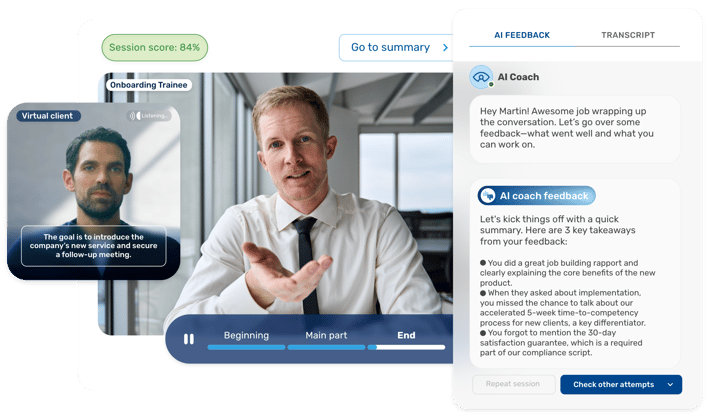 This fusion of technology and human expertise is the secret to
 boosting performance across the board without blowing the budget.
The Modern Operating Model for Coaching at Scale
If the “lone wolf” era is over, the replacement is not simply more coaching, but a fundamentally different coaching model.
Traditional executive coaching was linear, exclusive, and scarce. It relied on limited human capacity, subjective feedback, and long feedback loops. That model cannot support today’s organizations, where performance depends on thousands of daily customer interactions, fast decision cycles, and consistent behavior across teams and regions.
Modern coaching for companies is built on three principles:
1. Access over exclusivity
2. Practice over theory
3. Behavioral data over personal bias
In a modern coaching ecosystem:
-
Human coaches focus on nuanced judgment, emotional intelligence, and context-specific advice.
-
They also provide support in strategic planning, which is essential for business growth and effective operations.
In addition to this, AI-powered coaching changes the game by combining lifelike AI role play and behavior science, so that organizations can create a continuous coaching environment that supports every employee, not just senior leaders.
Instead of asking, “Who deserves coaching?”, high-performing companies now ask, “Where does coaching create the biggest performance leverage?”
The answer is clear: Every role that interacts with customers, colleagues, or critical decisions.
From Learning Content to Behavioral Enablement
One of the biggest misconceptions in corporate learning is that knowledge automatically translates into behavior.
It doesn’t.
Employees often know:
-
the sales methodology
-
the service guidelines
-
the leadership principles
-
the compliance rules
But under pressure, emotional conversations, time constraints, real customers, behavior defaults to habit.
This is the exact gap where coaching must operate.
Scalable business coaching focuses less on what people know and more on what they repeatedly practice. AI-based coaching environments allow employees to rehearse real-world situations:
-
difficult customer conversations
-
objection handling
-
feedback discussions
-
cross-cultural communication
-
compliance-critical moments
This repeated AI role play creates muscle memory, not just understanding.
Coaching for companies in 2026 is no longer an event. It is an always-on behavioral training layer embedded into daily work.
Why Democratized Coaching Drives Measurable Performance
When coaching is available only at the top, performance improvements remain isolated. When coaching is democratized, performance compounds.
Organizations that scale coaching across roles see measurable outcomes such as:
-
Consistent customer experience: Teams respond with the same quality and professionalism, regardless of individual manager quality.
-
Attracting more customers: Democratized coaching helps organizations attract more customers by improving marketing strategies, optimizing customer interactions, and enhancing social media and website engagement.
-
Faster skill adoption: New frameworks, products, and processes move from rollout to execution far more quickly.
-
Reduced dependency on individual leaders: Performance no longer collapses when a strong manager leaves.
-
Higher employee confidence and engagement: Employees feel supported, not evaluated. This is a key driver of retention and internal mobility.
This is why coaching success is no longer measured by executive satisfaction, but by behavioral consistency across the organization. Harvard Business Review's research on leader-as-coach organizations shows that companies where managers actively coach their teams see significantly higher engagement and performance than those relying on annual reviews alone.
For a breakdown of specific revenue and retention numbers, see the documented business benefits of AI sales coaching.
Human × AI: The Only Way Coaching Scales Without Dilution
A common fear is that scaling coaching means lowering quality. In reality, the opposite is true, if technology is used correctly.
In a modern coaching ecosystem, AI handles repetition, AI role play, feedback consistency, and availability; while human coaches focus on reflection, context, mindset, and strategic development. HBR's research on organizational culture confirms that behavioral norms, not stated values, are what actually drive performance, which is precisely what practice-based AI coaching reinforces at scale.
This hybrid model allows companies to:
-
offer personalized coaching journeys at scale
-
ensure objective, bias-free feedback
-
generate data on skill development and behavioral change
-
continuously improve training based on real performance signals
Platforms like Retorio enable this model by turning coaching into a system, not a scarce resource.
Coaching as Infrastructure, Not a Perk
The most important shift companies must make is mental, not technological.
Coaching is no longer:
-
a reward
-
a benefit
-
a leadership luxury
It is performance infrastructure.
Just as companies would never restrict CRM access to executives only, they can no longer restrict coaching to a select few. In high-performing organizations, coaching is embedded:
-
in onboarding
-
in enablement
-
in role transitions
-
in performance improvement
-
in leadership development
When coaching is treated as infrastructure, organizations stop asking whether they can afford it, and start asking whether they can afford not to have it.
Conclusion: Coaching Is No Longer Optional. It Is Organizational Capability.
The end of the “lone wolf” CEO is not about diminishing leadership. It’s about multiplying it.
In 2026, winning organizations are not defined by a handful of exceptional leaders, but by their ability to develop exceptional behavior at scale.
Business coaching success today is collective.
Performance is systemic.
And coaching for companies is the engine that connects learning to real-world results.
While technology provides insight, people provide meaning. Coaching connects both and turns potential into measurable performance.

Frequently Asked Questions
What is AI coaching for companies?
AI coaching for companies uses AI-driven video role play and behavioral science to extend coaching beyond a small group of executives to every employee. Instead of scarce one-to-one sessions, each rep or agent gets personalized practice scenarios, immediate behavioral feedback, and a measurable improvement score, at scale and on demand.
How does AI coaching differ from traditional corporate training programs?
Traditional programs deliver content. AI coaching drives behavioral change. Employees do not just receive information about what to do. They repeatedly practice how to do it, receive objective feedback tied to specific behaviors, and improve over time. That practice-to-behavior loop is what produces observable performance gains on the job.
Can AI coaching replace human coaches entirely?
No. AI handles repetition, availability, and consistency at scale. Human coaches retain the higher-order work: reflection, strategic development, and nuanced context. The two work together. AI expands the volume of practice; human coaches deepen the quality of insight.
What business outcomes should companies expect from democratized coaching?
Organizations using Retorio's platform have documented a 38-42% reduction in ramp time, a 69% reduction in human trainer effort per new hire, and a 72% lower turnover rate in high-performing teams. Specific results depend on adoption depth, team size, and consistency of rollout.
How quickly can companies deploy AI coaching at scale?
Retorio deploys in weeks, not months. The platform integrates with existing onboarding and enablement workflows, so coaching starts during ramp rather than after it. For implementation examples, see how enterprise teams deploy AI coaching software.
How can enterprises scale coaching beyond executives without losing quality?
Enterprises scale coaching successfully by combining AI-powered practice with human coaching expertise. Instead of relying on scarce one-to-one sessions, AI enables realistic AI role play, consistent feedback, and continuous availability across roles and regions. Human coaches then focus on reflection, mindset, and strategic development. This Human × AI model ensures coaching quality while making it accessible to the entire organization.
How does coaching for customer-facing teams translate into measurable business impact?
Coaching for customer-facing teams focuses on the behaviors that directly affect revenue, customer experience, and compliance. By practicing real conversations in realistic scenarios, teams build confidence and consistency. The result is higher-quality customer interactions, faster skill adoption, and more reliable execution, all of which directly impact business performance.
How does AI coaching differ from traditional corporate training programs?
Traditional training delivers content. AI-powered coaching enables behavioral change. Employees don’t just learn what to do; they repeatedly practice how to do it, receive objective feedback, and improve over time. This ensures that training investments result in observable, measurable performance improvements on the job.
How can coaching be embedded into daily work instead of remaining a one-time initiative?
Coaching becomes effective when it is continuous and accessible. AI-powered coaching platforms allow employees to practice and receive feedback whenever needed, during onboarding, role changes, performance improvement, or preparation for critical conversations. This turns coaching from an isolated event into an always-on performance layer within daily workflows.
What makes coaching for companies a strategic capability rather than a leadership perk?
When coaching is available only to a few leaders, impact remains limited. When coaching is scaled across the organization, it creates consistency, resilience, and adaptability. Coaching for companies becomes a strategic capability when it enables employees at every level to act with confidence, clarity, and professionalism, regardless of manager quality or location.
Written with help from LLMs, edited and checked by Önder Mutluer, Website Manager and Marketing Strategist, and Dr. Patrick Oehler, Co-founder and Co-CEO. How this article was researched, written and checked, and who reviews which topic: Retorio editorial policy.