


AI sales training for manufacturing uses AI coaching and role play to close the gap between technical expertise and commercial fluency. Retorio builds Digital Twin buying committees (engineer, CFO, safety officer), captures retiring experts' tribal knowledge, generates scenarios from new datasheets within minutes, and gives behavioral feedback grounded in Warmth and Competence.
Example. A sales engineer at a pump manufacturer uploads a retiring expert's recorded calls into Retorio. That same week, a new rep practices against a digital twin buying committee: the process engineer pushes on uptime, the procurement lead demands a price justification, and the safety officer asks about OSHA compliance. Each session ends with feedback on tone and phrasing, not just technical accuracy.
The "Feature Dump" Trap
Your engineering team loves the new specs.
The Procurement Director hates the price.
If you stay in "engineer mode" and talk torque ratios, you lose the deal. If you pivot to "Total Cost of Ownership," you win. This is the critical gap where AI sales training redefines success.
The industrial sector faces a massive wave of retiring experts. Decades of "tribal knowledge" are leaving the building.
The Solution: AI Sales Training for Manufacturing captures these expert behaviors and scales them instantly to the next generation.
A persistent challenge in industrial sales is the disconnect between technical expertise and commercial fluency. Sales engineers often default to "feature dumping", listing specifications rather than selling value. In a commoditized market, the ability to articulate value is the only competitive advantage.
Capturing "Tribal Knowledge" Before It Retires
Your top performers know exactly how to handle a specific supply chain objection. Retorio allows you to digitize this wisdom. By analyzing the video interactions of your experts, the AI identifies their winning behaviors, their tone, pacing, and phrasing.
You can then use the AI Coaching Generator to turn these insights into role-play scenarios, effectively "cloning" your best sellers for every new hire.
How AI Sales Training for Manufacturing Works
Implementing AI coaching for industrial teams moves training from the classroom to the "Digital Dojo."
Industrial deals involve engineers, safety officers, and procurement. Retorio creates "Digital Twins" of each stakeholder:
When a spec changes, you can't wait for the annual kickoff. Upload the new technical datasheet, and within minutes, the AI generates a training scenario.
This ensures 100% of your sales force is "pitch perfect" within days of a product launch. Related reading on AI-driven training.
The Impact: Data-Driven Manufacturing Sales
Manufacturing organizations using Retorio report significant gains in deal velocity and technical accuracy. Here is the breakdown:
| Metric | AI Coaching Impact |
|---|---|
| Time-to-Competency | 38% reduction in ramp-up time. |
| Cross-Selling Success | Documented gains in units sold per transaction. |
| Training Efficiency | Creation time reduced from months to <40 mins. |
| Global Consistency | 100% adherence to new product messaging. |
| Sales Turnover | Up to 72% reduction in attrition. |
Designing Buyer-True Simulations for Plant & Procurement
Effective AI simulations for manufacturing sales must mirror the complexity of the factory floor. Generic sales tactics fail here; success requires mapping your installed base and technical realities to the specific personas that control the budget. Harvard Business Review's research on B2B purchasing found that what stalls a complex deal is rarely seller persuasion, it is the difficulty of reaching consensus inside a large buying group, which is exactly the condition a simulated committee lets a rep rehearse (Toman, Adamson and Gomez, Harvard Business Review).
Simulation content must reflect real constraints. Work with product managers to ensure the AI's objections align with what your equipment can actually deliver.
Safety norms and regulations differ by region. Retorio allows you to localize scenarios instantly, ensuring a rep in Germany practices DIN standards while a rep in the US practices OSHA compliance, keeping core messaging consistent across borders.
Manufacturing sellers live in airports and parking lots, not at desks. Simulations must be mobile-ready, designed for 15-minute practice blocks before a site visit. Combine these with visual schematics so sellers can refresh technical knowledge while rehearsing the pitch.
Real-World Example: The "Chip Crisis" Negotiation
How does a Senior Buyer at a global car brand practice defending margins when suppliers hold all the cards? Here is a walkthrough of a high-stakes simulation.
Defending the Bottom Line
Context: You are a Senior Procurement Manager for a luxury EV line. Your Tier 1 battery supplier has just demanded a 12% price hike, citing raw material inflation. Your target is to keep the increase under 4%.
Before the call, the buyer logs into Retorio and selects the "Cost Defense: Commodity Inflation" module.
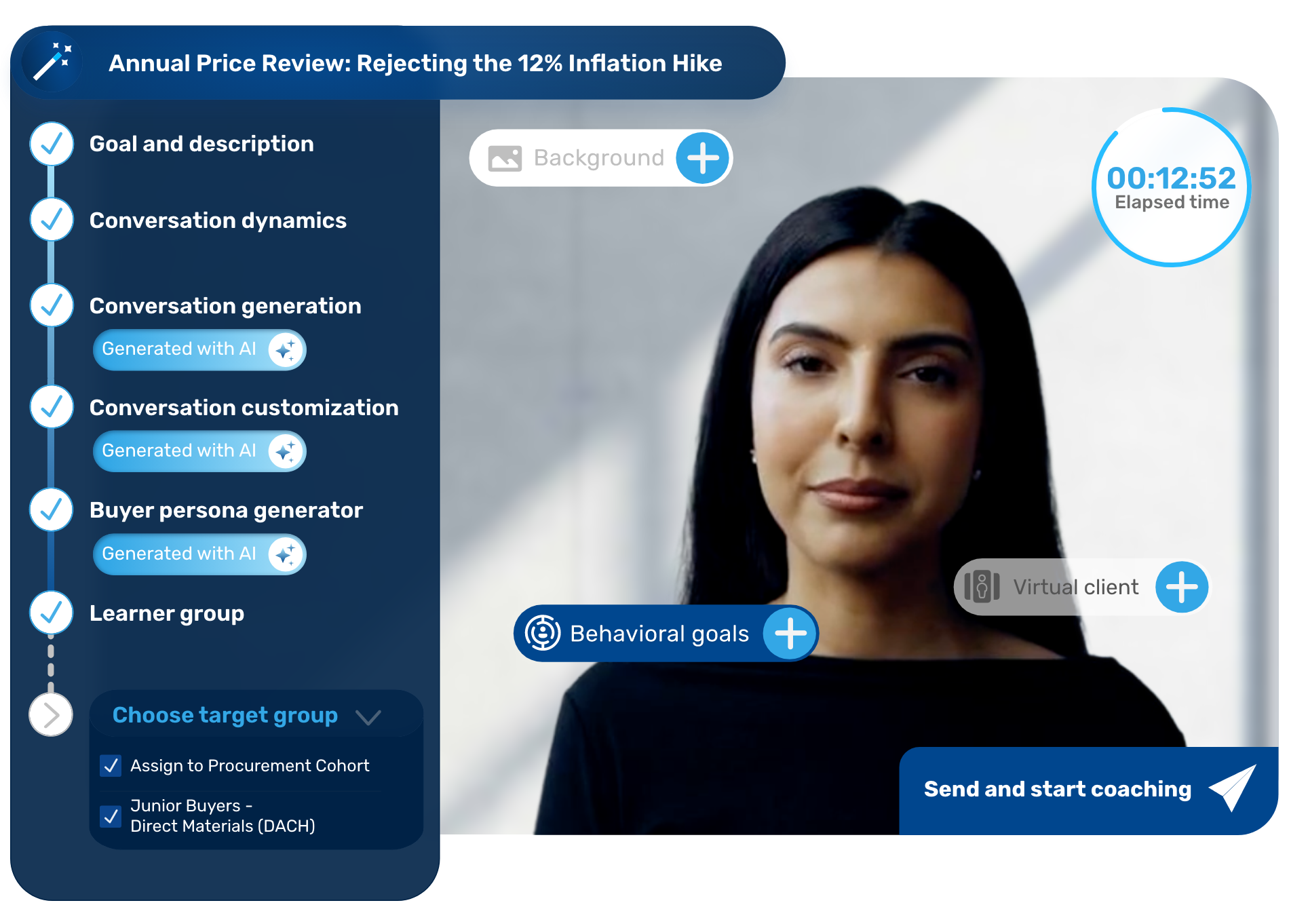
The video launches. A stern Account Executive from the supplier appears on screen:
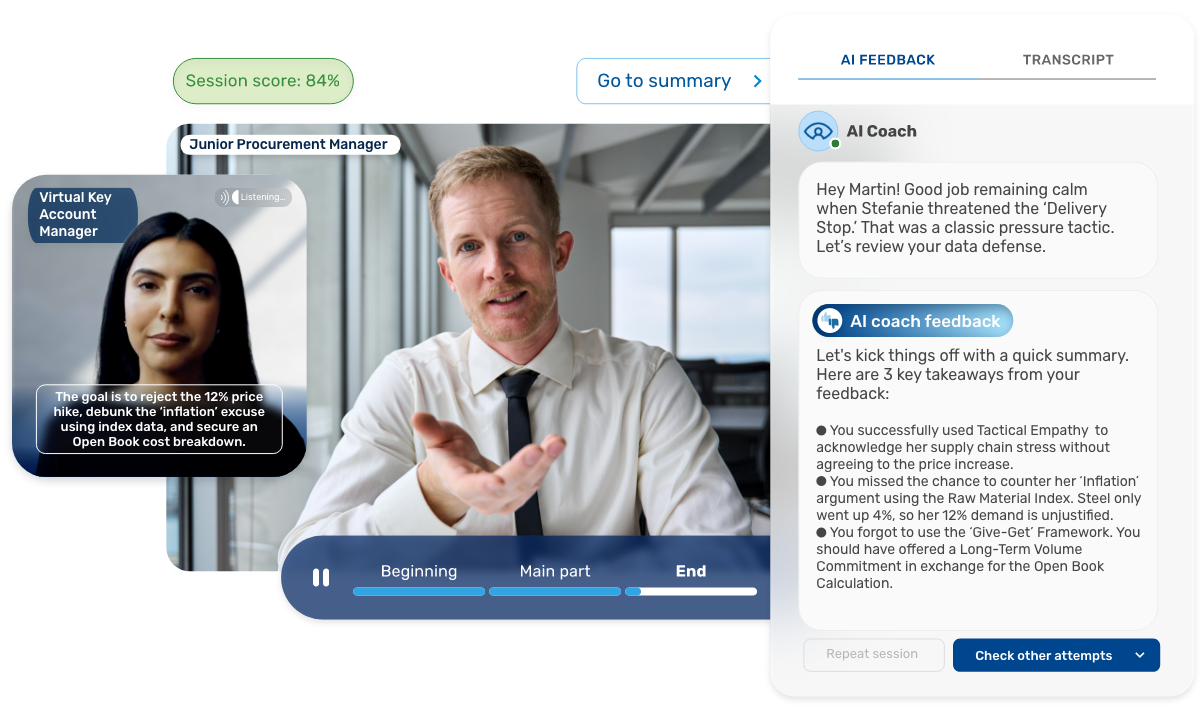
"Lithium prices are up 40% year-on-year. We have no choice but to pass this on. If you can't agree to the +12% adjustment today, we have to allocate your Q4 supply to another OEM." Modern sales training expands this point.
The buyer records their response, attempting to call the bluff without damaging the relationship.
The AI analyzes the buyer's counter-offer.
AI Tip: "Slow down. Acknowledge the constraint, then calmly remind them of our joint R&D partnership for the 2026 model."
After 3 practice rounds, the buyer enters the real negotiation with ice-cold composure. They secure a compromise of +4.5% by trading a longer contract term for price stability, saving the company millions.
Connect AI Practice to Pipeline, Margin, and Adoption
To prove ROI in capital-intensive industries, you must connect practice to hard numbers: pipeline velocity, win rates, and margin preservation. McKinsey's global B2B Pulse survey reports that suppliers combining several buying-experience strengths grow market share fastest, which is a useful reminder that the rehearsed conversation is one input into a wider commercial system (McKinsey B2B Pulse). Start by defining the "Leading Behaviors" that drive these results.
Your reps practice on real customers. Fix that.
Retorio gives every rep unlimited, judgment-free AI role play with instant, specific feedback. ISO 27001 certified, GDPR-compliant, EU AI Act aligned.
Test AI coach in actionUse analytics to build a readiness dashboard. Visualise skill heat maps by segment (e.g., discrete vs. process) to target support. Perhaps mid-market reps need help with technical discovery, while key-account managers need advanced negotiation drills for global frameworks.
Align AI training with Industry 4.0 initiatives. When sellers can confidently link your offers to sustainability and predictive maintenance outcomes, backed by rehearsed narratives, they become credible strategic partners. The same logic extends past the first order: read our guide to after-sales service training for the service and maintenance conversations that decide whether the account renews.
With clear governance and continuous content updates, AI sales training becomes a durable accelerator for manufacturing growth, changing how your organization shows up in industrial buying centers.
The Science of Trust: Warmth & Competence
In the age of AI, the "Human Premium" is the only true differentiator. According to Retorio's 2026 Trends Report, human judgment is driven by two fundamental dimensions that drive how we evaluate others: Warmth and Competence. For deeper context, see sales training.
To win in a complex sales environment, a seller must answer two subconscious questions simultaneously:
"Do I trust you?" (Warmth) and "Can you actually help me?" (Competence).
The Core Question: "Do I trust this person?"
The Core Question: "Can this person help me?"
Comparison Table: The Behavioral Drivers
How do these two traits interact in a sales conversation? Here is the breakdown:
| Feature | Warmth (Connect) | Competence (Clarify) |
|---|---|---|
| The Subconscious Check | "Is this person on my side?" | "Is this person capable?" |
| Sales Outcome | Builds the Relationship | Builds the Solution Value |
| Retorio Metric | Empathy Score, Tone Warmth | Confidence Score, Pacing |
| Failure State | Cold Expert: Competent but untrusted. | Friendly Amateur: Liked but ignored. |
Data from Retorio's platform shows that AI coaching produces measurable gains in perceived Warmth and Competence on average, directly impacting conversion rates.
Overcoming Resistance: "I'm an Engineer, Not a Robot"
Technical sales teams respect data. Retorio appeals to this mindset by providing objective, data-driven feedback. The pattern is easiest to see in objection work, where a scored transcript beats a coach's recollection: see how to use AI role play for objection handling.
Instead of subjective feedback like "be more empathetic," the AI says:
"Your speaking pace increased by 20% when asked about pricing, and your 'Warmth' score dropped to 40%."
This allows engineers to treat communication as a system to be optimized, just like a manufacturing process.
Key Takeaways
FAQ: AI Training for Manufacturing
Retorio's AI Coaching Generator digests complex technical PDFs and spec sheets, creating role-play scenarios that test the rep's ability to explain these details simply and accurately.
Yes. You can configure "Virtual Personas" like a "Price-Focused Procurement Officer" or a "Detail-Oriented Engineer," allowing reps to practice adapting their pitch to the specific audience.
Absolutely. Retorio supports 14 languages, allowing you to roll out a unified sales methodology globally while enabling local teams to practice in their native language.
There is no single agreed list. The version most industrial teams use is Connect, Clarify, Convince and Close. In manufacturing sales the first two carry the most weight: Connect proves you understand the plant’s constraints, and Clarify turns a specification into an operating consequence the buyer can act on. Those two map onto the Warmth and Competence dimensions described above, which is why AI coaching scores tone and clarity separately rather than as one communication grade.
Industrial sales is the sale of capital equipment, components, materials and maintenance contracts to manufacturers, plant operators and their distributors. Three features define it: a long, specification-driven cycle; a buying committee that spans engineering, procurement, safety and finance; and a decision judged on total cost of ownership and uptime rather than list price. The quota is usually carried by sales engineers, not generalist closers.
The best program is the one matched to your product complexity and your buying committee, so the honest answer is a set of criteria rather than a name. For industrial teams four things separate useful from theatrical: reps practise against your actual stakeholder personas, new content ships within days of a specification change, feedback is objective and behavioral rather than one trainer’s opinion, and results are measured against pipeline and margin. Our guide to the best sales training programs for 2026 compares the main approaches against those criteria.
The seven stages usually taught are prospecting, preparation, approach, needs discovery, handling objections, closing and follow-up. Industrial sales adds two realities the classic model leaves out: a spec-in step where your product is written into the customer’s design, and a commissioning and after-sales stage that decides whether the account renews. In our experience practice is thinnest exactly where the money is, at objection handling and spec defense.
Ready to Optimize Your Sales Engineers?
Don't let technical expertise get lost in translation. Start simulating success today.
Test AI coach in actionWritten with help from LLMs, edited and checked by Önder Mutluer, Website Manager and Marketing Strategist, and Dr. Patrick Oehler, Co-founder and Co-CEO. Reviewed by Peter Holdenried, Head of Sales. How this article was researched, written and checked, and who reviews which topic: Retorio editorial policy.