

It is the last Saturday of the month. Two stores in the same dealer group, same brand, same incentive, same launch deck delivered by the same regional trainer six weeks ago. One store is at 112% of target. The other is at 78%. Nobody at either store failed the product quiz.
That opening is a composite, not a case study, and the two figures in it are illustrative. Every dealer group recognises the shape of it. Every dealer group already runs automotive sales training. There is an OEM curriculum, a compliance module, a launch deck for each new model, and a certification the manufacturer counts. The staff sit through it, pass it, and go back to the floor. Then the month closes and the spread between stores is the same spread it was last year. The training happened. The behavior did not move.
This is written for the people who own that spread: the showroom sales manager, the dealer group head of retail sales capability, the commercial excellence lead at an importer or national sales company. Not for someone deciding whether to take a floor job. The question here is narrow and operational: what should automotive sales training actually consist of so that conversations on the floor change, and how do you know whether they did.
Automotive sales training is the coaching a dealer group runs so its sales staff can hold the five conversations that decide a deal: the first ninety seconds, the needs question, the trade-in, the price objection, and the follow-up. Product knowledge is the easy half. The conversation is where stores diverge, and it only changes with repeated practice that someone scores.
Example. A showroom manager at a three-store group reads twenty lost-deal files and finds the same line in most of them. The customer was quoted a monthly payment before anyone asked what they currently drive. Two weeks of scored practice on that single question closed most of the spread between his stores.
What Automotive Sales Training Has to Change
The honest starting point is that the industry has already tried buying its way out of this, and the numbers did not move. McKinsey's analysis of a decade of dealer data found that US auto retailers adopted next-generation core systems, digital sales platforms and AI, and yet vehicle sales per employee stayed between 14 and 16 a year across 2015 to 2024, while selling and administrative costs rose around 8 percent. A decade of new systems, flat output per person.
That rules out one explanation. If the constraint were information supply, ten years of better systems would have shown up somewhere in units per person. It did not. The constraint sits on the other side of the desk: what a salesperson says in the ninety seconds after a customer walks in, and whether anybody has watched them do it and told them something specific.
Most dealer training is built for the first problem. Delivered once at hire or at launch, measured by completion, and assuming that a person who can recite the towing capacity will also ask a good discovery question under pressure on a busy Saturday. Those are unrelated skills. Our longer breakdown of making automotive sales training scale across dealer teams covers the delivery mechanics. This piece is about the part that decides whether it was worth anything.
Two Gaps That Look Identical on a Report
A store that misses target produces one number. Underneath that number are two completely different problems, and they need opposite responses. Sending content at a behavior gap is the most expensive mistake in dealer training, because it is invisible: the content gets delivered, the completion rate looks healthy, and nothing changes.
Which gap are you actually looking at?
The two gaps produce the same monthly report and need opposite responses. Sorting them costs one afternoon.
A cheap test separates them in an afternoon. Pick the five staff whose numbers worry you. Ask each one at the desk to explain the finance options on your best-selling model. Most will do it fine, which rules out the knowledge gap. Then ask each one to handle a live objection with you playing the customer, and watch the first ten seconds. That is the behavior gap, and it is almost always the one you have.
Why the behavior gap never closes on its own
Auto retail has a churn problem that quietly defeats every once-a-year training plan. Using a decade of NADA reports, McKinsey put average dealership staff turnover at roughly 34 percent a year. A third of the people you trained last year are not there this year, and the people who replaced them arrived after the training calendar had already run.
A third of the floor is new every year
That single number reframes the whole question. If a third of your floor turns over annually, then training is not an event you schedule, it is a rate you have to sustain. Whatever you build has to work for a person who starts in week nine of the quarter with no trainer available. The same logic is why sales onboarding and ongoing coaching stopped being separate budgets in most of the groups doing this well.
The Five Showroom Behaviors Worth Coaching
A behavior gap is only coachable if the behavior has a name, an observable, and a measure. "Build rapport" has none of those and cannot be coached. What follows is the short list that separates the top store from the bottom store in most groups. Each one is something a manager can watch for and count.
None of these are new ideas on a showroom floor. What is new is treating them as measurable behaviors with a baseline rather than as advice. A manager who can say "our openings contain a situation question 31 percent of the time, and I want 70" has something to coach toward. A manager who says "we need more rapport" has a slogan.
The staff who close best in my group are not the ones who know the most about the cars. They are the ones who ask a second question before they answer the first one.
Composite of showroom managers in three-store to twelve-store dealer groups. No individual customer is quoted.What Most Dealer Training Covers, and What It Misses
The table below is not vendor against vendor. It is the once-a-year curriculum a dealer group already owns, set against the continuous scored practice the same group could run alongside it. Both have a place. The point is that they answer different questions, and most groups have only bought the first one.
| Element | Once-a-year curriculum | With scored practice |
|---|---|---|
| What it measures | Partial completion and a quiz score | Yes named behaviors in a recorded conversation |
| Who it reaches | Limited whoever was on the roster that week | Yes every new starter in their own first week |
| The manager's role | Limited books the room and chases attendance | Yes reads a scored conversation, picks one thing to fix |
| Time to first feedback | Limited weeks, and often never on a specific line | Yes immediately after the rehearsal, before the real customer |
| Effect of annual turnover | Limited resets toward zero every year | Yes runs at the rate people actually arrive |
Read it by the row that hurts most in your group. If your problem is that the good store and the bad store were given identical content, row one is your row. If your problem is that you hire in March and train in September, row two is.
Source: Retorio on YouTube. A short explanation of why one-to-one sales coaching stops scaling, and what changes when practice is scored.
A Ninety-Day Rollout Across a Dealer Group
The failure mode here is the group-wide launch. A change announced to fourteen stores at once produces fourteen versions of compliance and zero versions of practice. The rollout below moves store by store.
Weeks 1 to 2, get a baseline you can argue with
Pick one store and twenty recent deals, ten won and ten lost. Score every one against the five behaviors above. Do not change anything yet. The output is a single page per behavior with a percentage on it, and that page is the only thing that will survive a conversation with a sceptical general manager.
Measure: a baseline percentage for each of the five behaviors, at one store, before any coaching.
Weeks 3 to 6, coach one behavior, not five
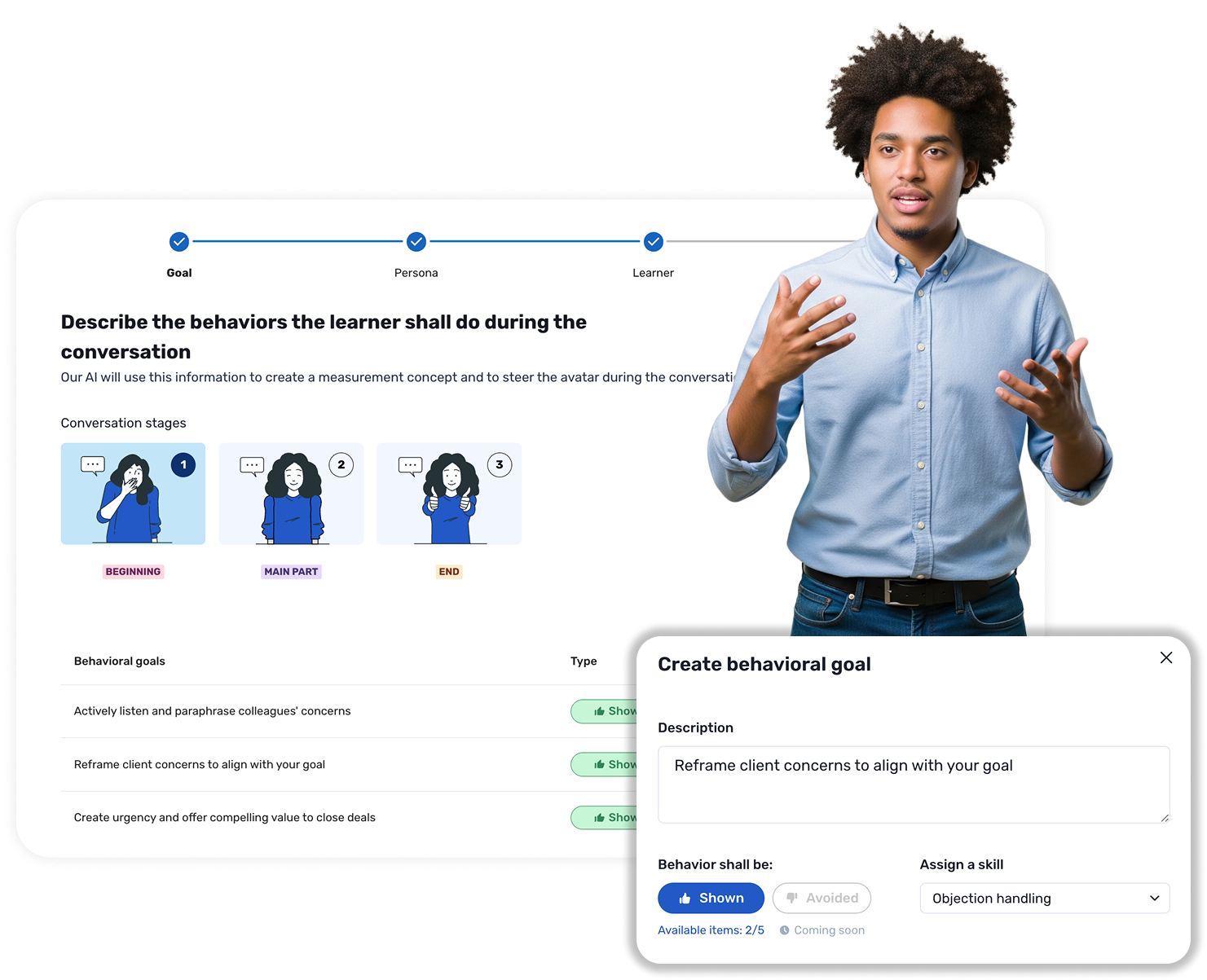
Take the single behavior with the worst baseline and coach only that one. Each salesperson rehearses the same scenario repeatedly against an AI coach, gets a score on the specific behavior, and runs it again. The manager reviews scored conversations rather than sitting in on live ones, which is the change that makes this fit into a Saturday.
Measure: rehearsals completed per person per week, and movement on that one behavior only.
Weeks 7 to 10, take it to the second store
Do not widen the behavior list. Widen the population. The second store gets the same behavior, the same scenario, the same scoring, and the first store's numbers as internal proof. If it does not move the way the first did, you have learned something real about the difference between those two stores.
Measure: the same behavior at two stores, compared, plus time to first deal for anyone who started during the window.
Weeks 11 to 13, connect it to a commercial number
Only now line the behavior data up against gross per unit, close rate, or customer satisfaction, whichever your group is judged on. Expect a correlation, not a proof. The point is to tell you which behavior to coach next quarter, and to give the board something other than a completion rate.
Measure: behavior movement set against one commercial number per store, over a full quarter.
Two things make this survive contact with a real dealership. The first is that the manager's job changes from delivering training to reading a score and picking one thing to fix. That is a smaller job, and it is the only version that gets done on a busy floor. Harvard Business Review's work on sales coaching makes the same point from the other direction: most sales managers overestimate how much time they spend coaching, and when they do coach, the conversation collapses into results and pending deals rather than behavior, while overly general feedback increases resistance instead of openness.
The second is that the same mechanism carries into the service lane, where a large share of dealer profit actually sits. The conversation at the service desk about a declined repair has the same shape as the price objection on the showroom floor, which is why groups that get this working in sales usually extend it to after-sales service training within a year.
What to Measure, and What to Stop Measuring
Completion rate is the metric that makes a training budget look successful while the spread between stores stays exactly where it was. It measures attendance. Every dealer group already has enough attendance data. What is missing is a number that describes what a salesperson does, and a second number that describes what it cost you to get there.
Trainer hours per new hire
That second number is the one that decides whether this survives a budget review. A dealer group does not have 26 hours of a regional trainer's time per new starter when a third of the floor turns over every year. It has whatever is left after the launch calendar. Moving the rehearsal volume away from the trainer and onto scored practice is what makes the arithmetic work at 34 percent churn.
Reduction in ramp-time documented in Retorio enterprise customer studies.
Reduction in human trainer effort, from 26 hours to 8 hours per new hire.
Increase in buyer loyalty at a premium automotive manufacturer coaching its dealer network.
Source: Retorio proof points. The automotive figure comes from an anonymised premium manufacturer deployment across its dealership network.
Four measurements to drop
What replaces them is smaller and less comfortable: five behavior percentages per store, rehearsal volume per person, and one commercial number per store watched over a quarter. It fits on a page. Groups running the same approach outside automotive, for example in enterprise retail sales teams, end up with a near-identical page, because the constraint is the same one: a large distributed floor, high churn, and a manager who cannot be in two conversations at once.
Run one showroom conversation through Retorio's AI coaching, a trade-in objection or a first-ninety-seconds opening, and read the behavioral score it gives back. It takes a few minutes and it uses your scenario, not a demo one.
Key Takeaways
FAQ
What is automotive sales training?
Automotive sales training is the combination of manufacturer product certification, dealership compliance modules, and conversation coaching that prepares showroom and fleet staff to sell. The product and compliance parts are usually already in place. The conversation part, covering the opening, the needs question, the trade-in, the price objection, and the follow-up, is the part that decides the spread between stores.
What is the best way to learn car sales?
Repeated practice on one conversation at a time, with feedback on a specific behavior rather than on the outcome. Product knowledge comes from the manufacturer curriculum and can be learned by reading. Conversation skill only comes from rehearsing the same moment many times and being told something specific about what you did, which is why scored practice beats shadowing a senior colleague for a week.
What training is required to be a car salesman?
In most markets there is no formal qualification required to sell cars. What a dealership requires is a valid driving licence, the manufacturer's product certification for the brands on the floor, and completion of internal compliance modules covering consumer credit and data handling where the dealership arranges finance. Licensing rules differ by country and by state, so confirm the local requirement with the dealer group before assuming.
How long does it take to ramp a new salesperson at a dealership?
It varies widely by brand, store traffic and how much of the first month is spent shadowing rather than selling. What compresses it is rehearsal volume before the first real customer, not a longer induction. Retorio's enterprise customer studies document a 38 to 42 percent reduction in ramp-time where scored practice replaced part of the shadowing period.
How do you train sales staff across multiple dealership locations?
Not by launching at every store at once. Baseline one store against named behaviors, coach the single worst behavior for four weeks, then extend the identical behavior and scenario to a second store and compare. A group-wide launch produces group-wide compliance and no measurable behavior change, because no single number moves far enough to be visible at the first review.
Does AI coaching work for automotive dealerships?
It works where the constraint is rehearsal volume and manager time, which is the usual constraint in a dealer group with high staff churn. An AI coach lets a salesperson run the same trade-in objection ten times and get a behavioral score each time, without occupying a manager. It does not replace the manufacturer product curriculum, and it does not tell you which behavior to coach. That decision stays with the store.