

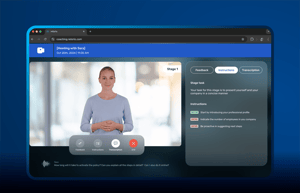
The best AI sales simulation platforms for 2026 fall into seven archetypes: Retorio's AI coaching loop, guided pitch simulation, cold-call simulation, speech coaching, avatar simulation with analytics, service simulation at volume, and video role play with human review. All seven run a believable practice conversation. They separate on one filter: whether the platform scores observable behaviors and routes the rep to the next practice, or stops at a transcript. This comparison ranks them on that filter, drawn from two years of behavioral data across 50+ enterprise clients, where closing that loop cut ramp time by 38% to 42%.
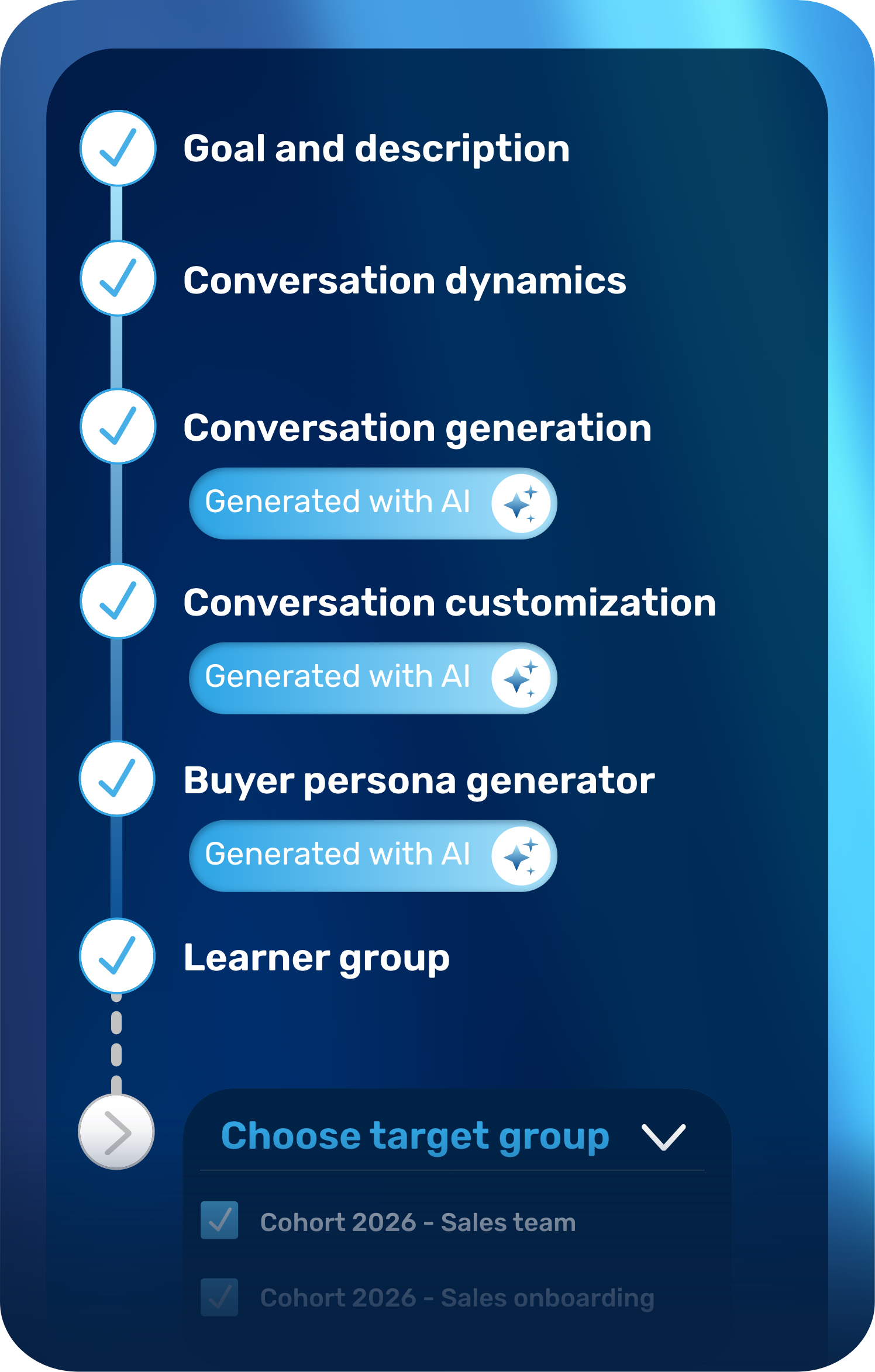
An AI sales simulation platform generates a scenario, runs the practice conversation, scores it, and routes the rep to the next practice. The scoring plus routing is what separates the shortlist below.
Every AI sales simulation platform on the market runs a believable conversation now. A rep talks to a virtual buyer, the buyer objects on price, the rep responds. That capability is table stakes in 2026. The differences that decide a purchase order start after the rep clicks "end session". One platform hands back a transcript and a sentiment chart. Another scores the observable behaviors, picks the rep's next practice, and shows a manager the 30-day trend. Only the second one moves quota, and that is the axis this comparison ranks on.
The best AI sales simulation platforms let a rep practice a full sales conversation against a virtual customer, then score observable behaviors and route the rep to the next practice. In 2026 the enterprise shortlist spans seven archetypes: Retorio's AI coaching loop, guided pitch simulation, cold-call simulation, speech coaching, avatar simulation with analytics, service simulation at volume, and video role play with human review. They separate on one axis: whether the platform closes the loop from practice to measurable behavior change, or stops at a transcript.
Example. A head of enablement at an insurance carrier shortlists three platforms. She asks each one what a manager sees after a rep finishes a practice call. Two show a transcript. One shows a per-rep 30-day trend on discovery and objection handling. She runs the trial with the third.
Source: Retorio enterprise customer studies, 50+ enterprise clients.
What an AI sales simulation platform actually is
An AI sales simulation platform is software that generates a realistic sales conversation for a rep to practice against, measures how the rep performed against a rubric, and routes them to the next practice. The simulation is the wrapper. The measurement plus routing is the coaching. A platform that only does the first is a role play toy that reps abandon by week four. A platform that closes the loop is a coaching system that a CFO can see in a week-12 quota number. Buyers search this same category under several names: AI sales training platforms, AI sales coaching platforms, and AI role play software. The mechanics below apply to all of them.
This distinction is the reason two platforms with identical demo footage can produce opposite outcomes in a real rollout. If you want the deeper mechanics of that loop, we cover it in AI role play versus call coaching in enterprise sales. For this piece, the loop is the filter that ranks the seven platforms below.
The loop that separates a platform from a toy
The dashed arrow is the difference. A platform that stops at Score is a simulation toy. A platform that routes the next practice and re-measures is a coaching system.
The 7 best AI sales simulation platforms for 2026
These seven come up most often in enterprise evaluation cycles. They are named here for comparison context only. Every capability claim below is about what each platform positions itself to do, not a citation of any vendor's own performance data. Read them as archetypes as much as products: pick the one whose primary job matches the outcome you are buying.
Behavioral observability with a closed practice loop, built on the Warmth and Competence framework. Scores observable behaviors on every practice call and routes the next scenario. Best fit for regulated enterprise (insurance, pharma, telecom) that needs measurable behavior change, 14 languages, and EU data residency.
Conversational role play with an avatar coach. Positions strongest on scripted product pitches and certification-style practice. A common shortlist name for teams that want a guided pitch simulation tool.
Cold-call and discovery simulation aimed at SDR and BDR teams. Fast to spin up a dialer-style practice buyer. Best fit for high-volume prospecting motions that need reps repeating the opener until it lands.
Speech and communication coaching. Broad rather than sales-specific, with feedback on filler words, pace, and clarity. A fit for teams that want general presentation coaching more than a scored sales simulation.
Avatar-based simulation with a scoring model, positioned at enterprise scale. A shortlist name for large teams that want simulation plus an analytics layer over rep performance.
Contact-center and service simulation at volume. Positions strongest for high-headcount agent onboarding where throughput and consistency matter more than nuanced deal coaching.
Video role play with peer and manager review workflows. A fit for teams that want humans in the review loop and asynchronous video submissions over a fully automated scoring engine.
How to read this list. Six of the seven do the simulation well. The buying decision is not "who has the best avatar". It is which platform closes the loop from a scored practice to the rep's next practice, and shows a manager the trend. That is what the comparison table below scores.
AI sales simulation platforms compared
The table scores each platform against the criteria that decide an enterprise rollout. Positions reflect how each platform publicly positions itself and how it shows up in evaluation cycles, not any vendor's own performance figures.
| Platform | Primary job | Scores behaviors | Routes next practice | EU data residency | Best fit |
|---|---|---|---|---|---|
| Retorio | AI coaching loop | Yes | Yes | Yes | Regulated enterprise, measurable behavior change |
| Guided pitch simulation tools | Guided pitch simulation tool | Partial | Partial | Verify with vendor | Product-pitch certification |
| Cold-call simulation tools | Cold-call simulation tool | Partial | No | Verify with vendor | High-volume SDR opener practice |
| Speech coaching tools | Speech coaching | No | No | Verify with vendor | General presentation skills |
| Avatar simulation with analytics | Avatar simulation plus analytics | Yes | Partial | Verify with vendor | Large teams wanting performance analytics |
| Service simulation at volume | Service simulation at volume | Partial | No | Verify with vendor | High-headcount contact centers |
| Video role play with human review | Video role play with human review | Human-reviewed | No | Verify with vendor | Teams wanting manager and peer review |
Yes automated and consistently applied. Partial present in a limited or scripted form. No / Verify with vendor not evidenced publicly, or should be confirmed directly with the vendor before a deal is signed. Positions reflect public positioning at the time of writing, not vendor performance data.
The pattern is clear. Every platform simulates. The split is on the loop. If your outcome is a measurable behavior change that survives a week-12 review, filter for the platforms that score and route, then verify the claim in a trial. If your outcome is faster pitch certification or higher call volume, a partial-loop platform may be the right, cheaper fit. Match the tool to the job, and see the deeper comparison logic in top AI sales coaching software for 2026.
Mapped against the seven-point checklist below, the archetypes cover different shares of what an enterprise buyer needs. As an illustration of the pattern, a speech-coaching tool covers roughly 30% of the checklist, a cold-call simulation tool around 55%, a guided pitch simulation tool about 70%, and a closed-loop coaching platform about 95%. These figures illustrate the coverage gap between archetypes, not a benchmark of any named vendor.
Capability coverage, by platform archetype
Illustrative coverage against the evaluation checklist in this article; not a benchmark of any single named vendor.
Previously, practicing a scenario with a manager took 3-5 hours. Now, with Retorio's AI Sales training platform, our agents conduct an AI role play 5 times for each scenario independently.
Ivo Nikolov, Business Analyst at Vodafone
How to evaluate an AI sales simulation platform (7-point checklist)
Take this checklist into every demo. If a platform cannot answer at least five of the seven with a specific yes and a screenshot, it is selling a different category than the one you are buying.
Does it score observable behaviors, not just sentiment?
Why it matters: "The rep sounded confident" is not coachable. Discovery question density, objection acknowledgment rate, and close attempts are observable and repeatable. Ask to see the rubric, not the sentiment gauge.
Does the platform pick the next practice, or the rep?
Why it matters: If the rep picks their own next scenario, they avoid the ones they are worst at. A platform that routes the next practice on the weakest signal is the one that changes behavior.
Can a manager see a per-rep 30-day trend on the one-to-one screen?
Why it matters: If the coaching data lives in a separate dashboard the manager has to remember to open, it does not get used. The trend must live where the conversation happens.
Does it handle the move from practice to real-call scoring?
Why it matters: Practice is only useful if the behavior carries into real deals. Ask how the platform scores real customer calls under consent. If real-call scoring is "coming soon", the loop is not closed.
Can the scenario library be tuned to your selling motion?
Why it matters: A telco service team and a pharma specialty rep have different observable behaviors that predict outcomes. A default library that cannot be tuned scores the wrong things for your motion.
What is the measurable behavior change in the largest deployment?
Why it matters: Ask for a specific number over a specific window. "Reps love it" is adoption. A week-12 cohort quota lift is the metric that survives a CFO review.
What are the compliance credentials?
Why it matters: For regulated industries, verify ISO 27001 certification, GDPR compliance, EU AI Act alignment, and data residency before the pilot, not during procurement. Retorio is ISO 27001 certified, GDPR-compliant, EU AI Act aligned, and hosted on GCP with EU data residency.
Where AI sales simulation deployments stall
Across the behavioral dataset, three failure modes account for most deployments that miss their target. They are predictable, and none of them are about the AI. A useful outside benchmark: McKinsey's research on capability building finds that programs which embed practice into the existing manager rhythm sustain far better than standalone tools, which is exactly the pattern below.
Which platform should you pick
Match the tool to the outcome you are buying. Gartner's research on B2B sales readiness puts the pressure on ramp and consistency: only 23% of B2B sales reps say they are effectively enabled to sell, so the platforms that pay back are the ones that shorten ramp and make coaching repeatable across the team.
If your outcome is measurable behavior change that survives a week-12 review, in a regulated industry, pick the closed-loop platform. That is the archetype Retorio was built for, and it is the one that shows a per-rep trend, routes the next practice, and carries the compliance credentials. The AI role play practice hub covers how that loop runs day to day.
If your outcome is faster pitch certification or higher call volume, a partial-loop simulation tool (a guided pitch simulation tool or a cold-call simulation tool) can be the right, lighter fit. You trade behavior-change depth for speed and cost.
If your outcome is general communication coaching, a speech-coaching tool covers it, but do not expect it to move quota on its own. For a fuller picture of enterprise-grade simulation, see interactive AI sales simulations for enterprise teams.
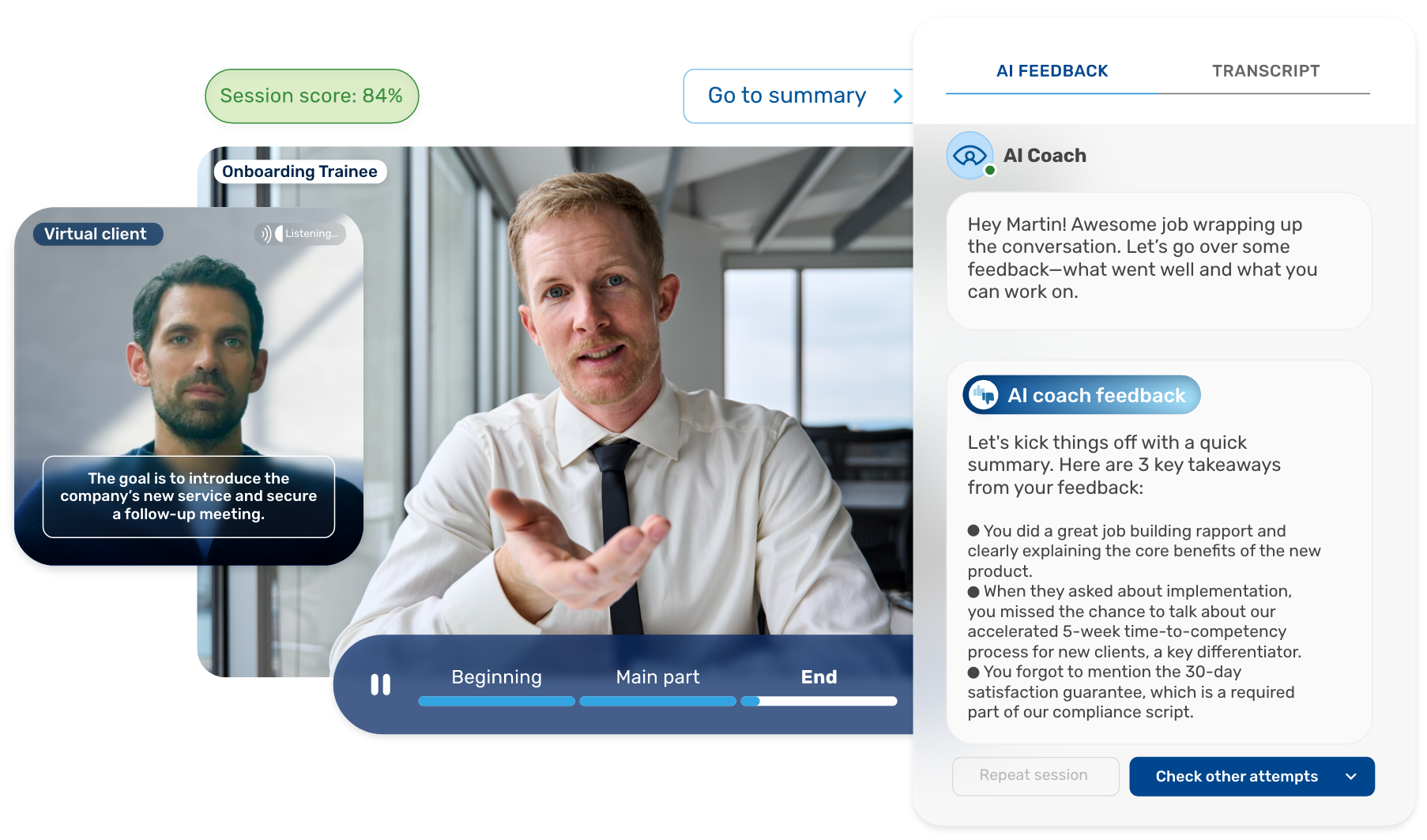
Retorio's AI coach shown in a live sales conversation, the same scored-practice mechanic evaluated across the platforms in this comparison.
Run the seven-point checklist on your own selling motion. Retorio's behavioral science team will build a scored practice scenario for one of your roles and show what the next practice would be for that rep.
Key takeaways
FAQ
What is the best AI sales simulation platform?
There is no single best platform for every team. For measurable behavior change in a regulated enterprise, a closed-loop platform like Retorio fits best. For pitch certification, a guided simulation tool fits. For high-volume cold calling, a cold-call simulation tool fits. Filter by whether the platform scores behaviors and routes the next practice, then match it to your outcome.
What is the difference between AI sales simulation and AI role play?
They describe the same practice mechanic. Simulation and role play both mean a rep practices a conversation against a virtual buyer. The meaningful difference is not the label, it is whether the platform scores that practice and routes the next one. That is the line between a simulation toy and a coaching system.
Do AI sales simulation platforms replace human sales coaches?
No, and the best deployments do not try. The platform handles scale (every rep, every week) and consistency (the same rubric). Managers handle the higher-bandwidth work: deal coaching, career conversations, and the two signals that need a human in the room.
How long before an AI sales simulation platform shows results?
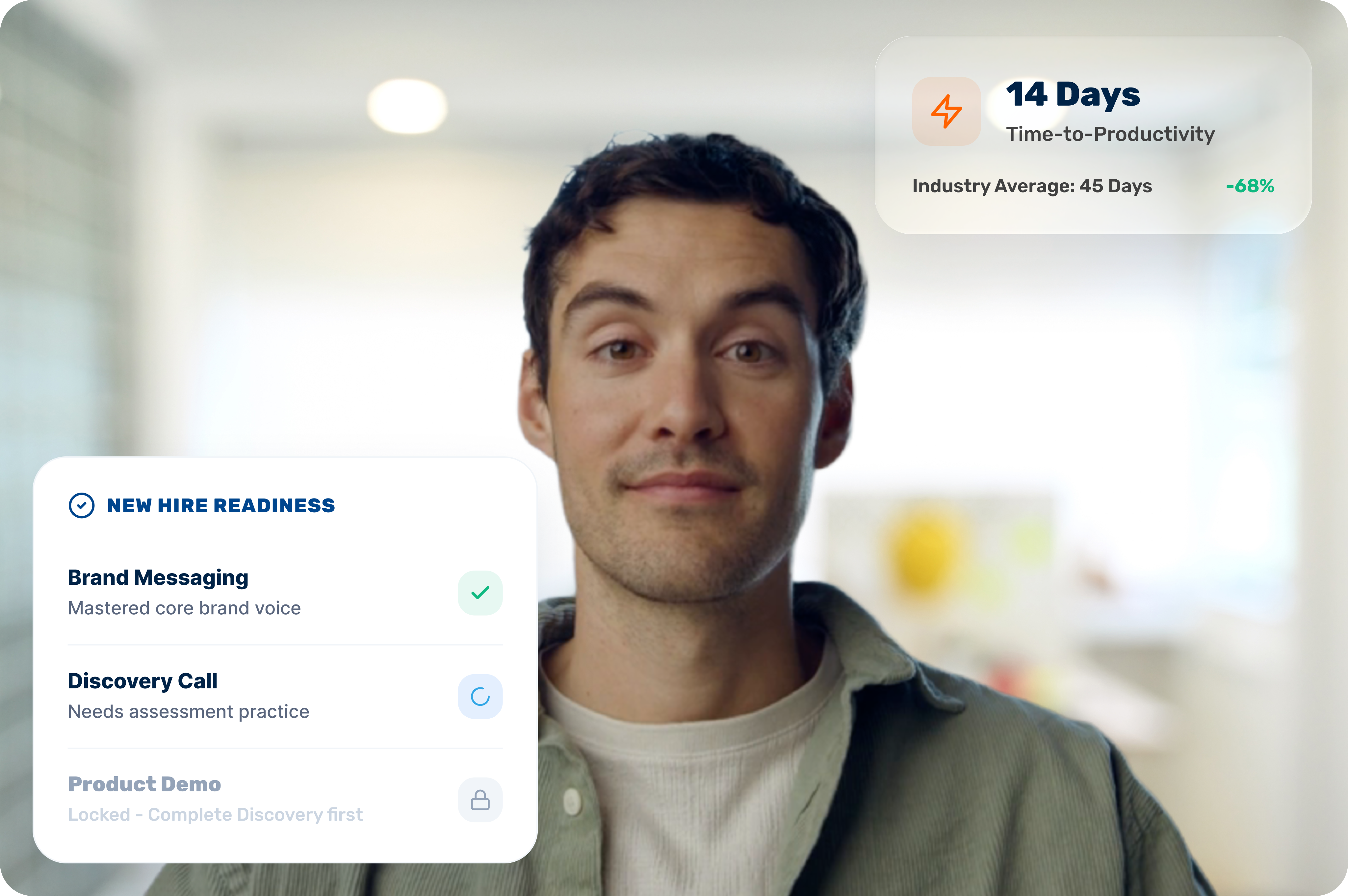
In Retorio deployments, two of four behavior signals move by week 4 and quota impact shows by week 12. Ramp-time reduction of 38% to 42% shows earlier, often by week 6 for new hires. A platform that cannot show a week-12 behavior-change number is showing you adoption, not results.
Which AI sales simulation platform is best for regulated industries?
Regulated industries (insurance, pharma, financial services) need compliance credentials plus tunable scoring for their motion. Retorio is ISO 27001 certified, GDPR-compliant, EU AI Act aligned, and hosted on GCP with EU data residency, and adds compliance signals (MLR for pharma, IDD for insurance) to the rubric. Verify credentials before the pilot, not during procurement.
Are AI sales simulation platforms GDPR-compliant?
It depends on the vendor, so verify each one. Retorio is ISO 27001 certified, GDPR-compliant, EU AI Act aligned, and hosted on GCP with EU data residency. Practice conversations with virtual customers process no real customer data. Recorded real customer calls require explicit consent under Art. 6 GDPR.
How much do AI sales simulation platforms cost?
Vendors rarely publish list prices, and most price on one of three models: a per-seat annual licence, a platform fee plus per-seat tiers, or a per-session usage bundle. Enterprise quotes usually add scenario configuration and an integration fee for the CRM or the learning platform. Ask for the fully loaded first-year number including scenario build, and ask what the price does when you double the seat count in year two.
Written with help from LLMs, edited and checked by Önder Mutluer, Website Manager and Marketing Strategist, and Dr. Patrick Oehler, Co-founder and Co-CEO. Reviewed by Peter Holdenried, Head of Sales. How this article was researched, written and checked, and who reviews which topic: Retorio editorial policy.