


The forgetting curve, first described by Hermann Ebbinghaus over 140 years ago, shows people can lose up to 90% of new knowledge within weeks without reinforcement. AI coaching combats it through spaced repetition and scenario-based practice, testing knowledge until retention holds. One session produces roughly 75% retention; ten sessions add a further 25% knowledge gain. The fix is not more content, it is more practice cycles with behavioral feedback.
Example. A sales rep covers product positioning in a Monday coaching session. Without reinforcement, she will have forgotten 70% of it by Tuesday evening. With three AI practice scenarios spread across the week, she retains the framing well enough to use it in a live deal conversation on Friday.
Source: Ebbinghaus forgetting curve (memory research) (1885).
Hey, remember that show you watched on TV a few weeks back? Or the big news stories from last week? What about those LinkedIn posts you read this morning? Yeah, I bet you don't remember any of that stuff. Why would you?
Unfortunately, your memory doesn't know the difference between important information and background noise. The forgetting curve, a well-established phenomenon in cognitive science, reveals a disconcerting truth: without reinforcement, individuals can lose up to 90% of their newly acquired knowledge within a few short weeks. For sales reps, customer service agents, and any role where knowledge needs to translate to behavior, that is not an abstract statistic. It is a direct cost.
What's in this post?
The curve of forgetting: 90% of knowledge is lost within weeks
This phenomenon, first described by Hermann Ebbinghaus in 1885 through systematic self-experiments on memory retention, poses a significant challenge for organizations trying to build durable capability in their teams. Ebbinghaus demonstrated that memory follows a predictable exponential decay: roughly 50% of new information is lost within the first hour after a single exposure, and up to 70-80% within 24 hours without any form of retrieval practice (Cepeda et al., Psychological Bulletin, 2006).
In the context of enterprise coaching, the forgetting curve presents a direct business risk. Conventional approaches, while valuable for initial knowledge delivery, often fall short in ensuring long-term retention and application. It is difficult to transform an organization if your people keep forgetting most of what is presented to them.
|
-90% loss of knowledge |
20% of retained knowledge is |
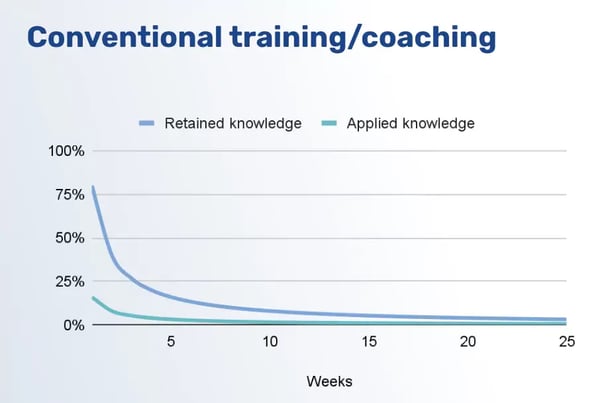
The challenge of retaining knowledge comes alongside the challenge of putting knowledge into practice. According to the Association for Talent Development (ATD), only approximately 10 to 20% of retained knowledge is applied on the job. This means a substantial portion of the time and resources invested in coaching programs is wasted before it reaches the field.
Let's break down this math. If only 10% of the knowledge covered in a conventional session is retained after one week, and only 10-20% of retained knowledge converts to actual behavior on the job, the resulting knowledge transfer rate is roughly 1-2%. Put another way, about 98-99% of a typical coaching session does not produce observable behavioral change. Identifying which 1-2% sticks is practically impossible without behavioral measurement.
This dynamic is well-documented in memory research. The spacing effect, studied extensively since Ebbinghaus and replicated across thousands of subjects, shows that distributing practice over time produces dramatically stronger retention than massing the same amount of practice in a single event (Donovan & Radosevich, Journal of Applied Psychology, 1999). The implication for enterprise coaching is direct: frequency matters more than duration.
Why spaced repetition works: the neuroscience behind it
Spaced repetition is not a new idea. What is new is the ability to apply it at scale, automatically, across large teams. The mechanism behind it is well-understood: each time a memory trace is retrieved before it has fully decayed, the storage strength of that memory increases. Retrieve it again, and it increases further. Over time, the forgetting curve flattens and eventually stabilizes.
The practical implication is counterintuitive. A rep who practices a product scenario three times over three weeks retains far more than a rep who spends three hours on it in a single session. The total time is similar; the retention outcome is not. One-day workshops, however intensive, largely fail on this axis. They deliver volume, not distribution.
There are three conditions that accelerate spaced repetition outcomes in a coaching context:
- Retrieval practice over re-reading. Being tested on material is far more effective than reviewing it. Scenario simulations, where a rep must produce a response rather than recognize a correct answer, produce stronger retention than re-reading a slide deck.
- Interleaving. Mixing topics across practice sessions, rather than blocking by topic, produces better long-term retention, even though it feels harder in the moment.
- Feedback at the behavioral level. Knowing you got something right is not enough. Understanding exactly which behavior drove the outcome, and which missed the mark, gives the rep a specific thing to improve next session.
These three conditions are the foundation of how AI coaching combats the forgetting curve. See also: how AI coaching works in enterprise sales and what capability building actually requires.
How AI coaching combats the curve of forgetting
Behavioral researchers have developed AI coaching methods that build on repetition and reinforcement to help reps retain what they have practiced. Unlike a single coaching event, AI coaching is always available, delivering personalized feedback and scenario-based practice that compounds over sessions.
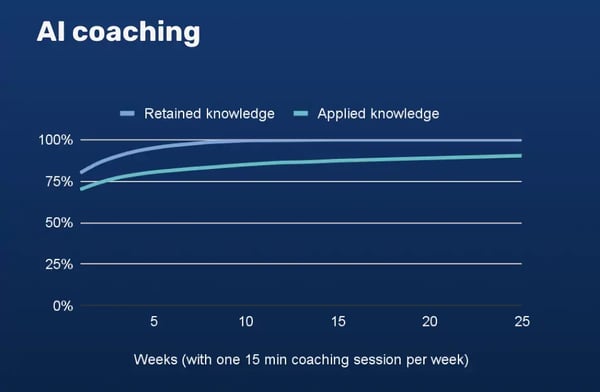
Here is how it works: the AI coach keeps testing a rep's knowledge and presenting new scenarios until the behavior holds. Participation in an AI coaching program is not just about covering material; it also builds the retention of what was practiced. After a single coaching session, a rep retains about 75% of the information that was covered. After 10 coaching sessions, the cumulative gain reaches an additional 25% of knowledge. Instead of forgetting 90% of what was covered, the rep gains 75% retention from the first session and continues to consolidate knowledge with each subsequent session.
But AI coaching is not just about memorizing facts. It is about helping reps apply what they have practiced to real conversations. The AI coach does this by simulating real-world scenarios and delivering behavioral feedback on what actually happened, not a generic score. This way, reps can practice in a controlled environment before taking the behavior into a live customer interaction.
The result: AI coaching makes reps more effective at applying knowledge, not just retaining it. A study by Retorio with 3,301 users found that people who use AI coaching are 8 times more effective at translating what they have practiced into on-the-job behavior.
|
+25% gain of knowledge |
8x more effective in translating |
The real-world impact on enterprise teams
The success of AI coaching in overcoming the forgetting curve shows clearly in enterprise deployment outcomes. A large telecommunications company using AI coaching experienced a 69% reduction in coaching effort per new hire and a 38% decrease in ramp-up time due to faster knowledge transfer. This translates to significant cost savings and faster onboarding, enabling reps to become productive months earlier. For a complete view of what this looks like in practice, see this coaching approach overview.

Across enterprise deployments, Retorio measures a 14% average increase in Warmth and a 15% average increase in Competence within 12 months of AI coaching. Practicing on a spaced cadence helps reps retain and apply positioning techniques instead of losing them to the forgetting curve.
A global energy company saw its leaders progress from 60% to 95% target achievement in just eight coaching sessions. The behavior changes were measurable, not self-reported, because the AI platform scored each session against the defined behavioral standard and showed the trajectory to managers in real time.
You can find more customer examples and case studies here.
Interested in experiencing AI coaching? Retorio offers demos and trials, which you can book here:

Building a reinforcement coaching cycle for your team
Knowing about the forgetting curve is not enough. The practical question is how to design a coaching program that counters it without adding unmanageable overhead for managers. The answer is a reinforcement cycle, not a training event.
The pattern that consistently works is this: define one observable behavior per week, provide 2-3 short practice scenarios on that behavior using an AI platform, measure performance on recorded conversations, and debrief on the delta. That is the week. The following week, add the next behavior. After four weeks, the rep has four measurable behaviors in active use, not on a slide deck.
What this looks like for different roles:
- Sales reps (onboarding context): Week 1 covers product positioning under objection. Week 2 covers discovery questioning. Week 3 covers closing signals. Week 4 covers handoff to implementation. Each behavior is practiced via AI scenario and scored before the rep takes it into a live deal. For more on how this works at scale, see effective onboarding coaching programs.
- Customer service agents: Week 1 covers tone calibration under escalation. Week 2 covers reflection before response. Week 3 covers resolution framing. Week 4 covers de-escalation when the customer rejects the first resolution. Each behavior is scored on real call recordings and AI scenarios in parallel.
- Sales managers (coaching the coaches): The reinforcement cycle works for managers too. The behavior being built is how they debrief a rep after a lost deal, not what they say during the deal itself. See sales coaching techniques that build durable behavior.
The key principle is the same across all three: frequency over volume, behavioral measurement over self-assessment, and compounding practice over isolated events.
Frequently Asked Questions
What is the forgetting curve?
The forgetting curve describes the exponential rate at which newly acquired information is forgotten without reinforcement. First documented by Hermann Ebbinghaus in 1885, it shows that roughly 50% of new information is lost within one hour of a single learning event, 70% within 24 hours, and up to 90% within a week. The decay slows each time the information is actively retrieved and practiced, which is the basis for spaced repetition as a retention strategy.
Who discovered the forgetting curve?
Hermann Ebbinghaus, a German psychologist, first described the forgetting curve in 1885 through systematic self-experiments on memory. He memorized nonsense syllables, then measured how long it took him to relearn them after varying time intervals. The results established that memory follows a predictable exponential decay and that spaced review dramatically reduces the effort required to maintain retention.
How quickly do we forget information?
Within one hour: roughly 50% forgotten. Within 24 hours: 70% forgotten. Within one week: up to 90% forgotten, without any form of retrieval practice or reinforcement. These rates apply to material encountered in a single session without spaced follow-up. Distributing practice across multiple sessions separated by days or weeks substantially flattens the decay curve, a finding replicated across decades of memory research.
Why does the forgetting curve matter for enterprise coaching?
Because the standard corporate training format, a workshop or e-learning module encountered once, maps almost perfectly onto the worst-case forgetting curve scenario: high volume, single exposure, no spaced retrieval practice. The result is that 98-99% of the knowledge covered does not produce lasting behavioral change on the job. The forgetting curve explains why coaching investment consistently underdelivers on measurable business outcomes when it is structured as an event rather than a cycle.
How does AI coaching counteract the forgetting curve?
AI coaching applies the three conditions that research identifies as most effective against the forgetting curve: spaced repetition (practice distributed across multiple sessions over days and weeks), retrieval practice (scenario-based practice where the rep must produce a response, not recognize a correct answer), and behavioral feedback (specific, per-behavior scoring that tells the rep exactly what to improve). The result is that instead of forgetting 90% of a session's content, reps retain roughly 75% after the first session and continue to consolidate knowledge across subsequent sessions.
Written with help from LLMs, edited and checked by Önder Mutluer, Website Manager and Marketing Strategist, and Dr. Patrick Oehler, Co-founder and Co-CEO. How this article was researched, written and checked, and who reviews which topic: Retorio editorial policy.