


Generative AI in sales coaching uses deep learning models to create realistic buyer objections, alternative responses, and AI role play reps practice against. It targets the high-pressure 10 to 20 second window after a prospect objects, scanning thousands of hours of dialogue to spot deal-killing micro-behaviors and suggesting specific phrasing reps drill until it becomes muscle memory.
Example. A software rep hears "the price is too high" and freezes. The AI replays that exact moment, shows where the pause ran three seconds too long, and gives her a tighter response to practice. After a dozen repetitions, the recovery feels automatic before she walks into her next call.
Source: McKinsey, AI-powered marketing and sales reach new heights with gen AI (2023).
Let's be real: Most deals don't actually fall apart during the final demo, and they usually aren't killed by a missing feature in your slide deck.
The real breaking point is much smaller. It's that high-pressure "make or break" moment right after a prospect throws a serious objection your way. You know the ones, they lean in and say:
- "The price is just too high for us."
- "We're actually already locked in with a competitor."
- "The timing isn't right; check back in six months."
In the next 10–20 seconds, the rep either regains control, validates the concern and pivots. Or they stumble, over-explain and slowly lose the deal.
The challenge? Almost no sales organization systematically trains for that specific window of time. Harvard Business Review's research on feedback effectiveness found that most coaching interventions fail to change behavior under pressure precisely because they are delivered too infrequently and too abstractly to transfer into real conversations.
That's exactly why generative AI in sales coaching is shifting from a "nice-to-have" tool to a core competitive differentiator. If you want to see a broader view of how AI is reshaping the discipline, our guide to AI sales coaching covers the full landscape.
What Is Generative Artificial Intelligence?
| Generative AI is a category of artificial intelligence designed to create new content: ranging from text and images to structured conversational AI role play based on patterns learned from massive datasets. Generative AI is powered by deep learning models and machine learning models that learn from existing data to generate original outputs. |
Unlike traditional AI models, which are generally more transparent and interpretable and are primarily analytical (telling you that something happened), generative AI capabilities allow the system to produce something entirely new.
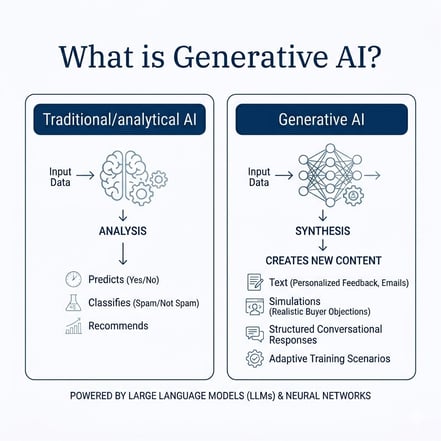
The difference between Traditional/analytical AI vs. Generative AI
Generative artificial intelligence encompasses a range of generative models, including those based on deep learning and machine learning, such as GANs, VAEs, and transformer-based architectures.
In the context of sales enablement, this means the technology doesn't just flag a bad call; it can:
- Generate personalized feedback tailored to a rep's specific personality.
- Recreate realistic buyer objections that mimic your actual customers.
- Rewrite weak responses into high-impact value statements.
- Create adaptive coaching scenarios that get harder as the rep improves.
Deep learning algorithms are used to train these models on large datasets, enabling them to recognize patterns and generate new content.
It moves coaching from a theoretical exercise into an active environment of skill development.
What Type of AI Are Large Language Models in Generative AI?
Technically speaking, generative AI is a subset of deep learning. It is powered by neural networks, specifically Large Language Models (LLMs), that have been trained to understand the nuances of human communication. These LLMs are examples of foundation models, which serve as the basis for many generative AI applications. Very large models, with billions of parameters, are often used in generative AI and require significant computational resources.
For sales coaching, this distinction is vital. Older "AI" tools in sales were often just speech-to-text engines with a keyword tracker. They could tell you if a rep said the word "pricing," but they couldn't tell you if the rep sounded defensive.
Modern generative AI tools recognize patterns in persuasion, tone, timing and structural empathy. These models can be fine-tuned to perform tasks specific to sales coaching, such as objection handling and personalized feedback. They don't just identify what went wrong; they generate a "best-case" alternative and allow the rep to practice it until it becomes muscle memory.
The Structural Problem in Sales Coaching
Despite the rise of sales enablement as a formal discipline, most coaching remains fundamentally broken. Most organizations face four primary constraints:
- The Manager Bottleneck: Sales managers are spread too thin to review more than 1-2% of their team's calls.
- Subjective Quality: Feedback varies wildly depending on a manager's personal style rather than objective data. Leveraging data science and ensuring high data quality can help provide more objective and reliable feedback in sales coaching.
- The "Episodic" Trap: Coaching happens once a month or once a quarter, which is too infrequent to change habits.
- Hard-to-Measure Growth: It is notoriously difficult to quantify if a rep is actually getting "better" at handling objections.
Without a way to scale, coaching remains selective. Top performers get ignored, and middle performers never get the focused attention they need to bridge the gap. Our deep-dive on the proven benefits of AI sales coaching breaks down exactly what changes when you fix this bottleneck.
AI Tools for Sales Coaching
AI tools for sales coaching are redefining how sales teams learn, adapt and excel. Powered by advanced generative AI models and large language models, these tools go far beyond simple call recording or keyword tracking. Instead, they leverage vast amounts of coaching data: from real sales conversations to performance analytics, to deeply understand what drives successful selling. Modern AI models are trained on thousands of hours of sales scripts, objection handling scenarios and customer interactions. This rich training data allows language models to recognize subtle cues in tone, phrasing and timing that separate top performers from the rest. As a result, these AI tools can analyze every sales interaction, identify specific areas for improvement and generate customized coaching plans for each rep.
What sets these generative AI models apart is their ability to adapt to individual styles and sales environments. By continuously learning from new input data, they ensure coaching remains relevant and effective as markets and buyer behaviors evolve. Whether it's real-time feedback during a call or new approaches for handling objections, these language models enable sales teams to develop skills faster and more precisely.
In short, the integration of generative AI models and large language models into sales coaching tools is turning professional development into a scalable, data-driven engine for growth. The Salesforce State of Sales report consistently finds that top-performing sales organizations are far more likely to use AI-assisted coaching and practice tools than their underperforming peers.

lifelike sales scenarios and master every conversation
How Generative AI Changes the 17-Second Objection Window
1. Behavioral Patterns
Generative AI can scan thousands of hours of dialogue to find the micro-behaviors that kill deals. AI systems learn by analyzing data points across thousands of conversations, identifying patterns and relationships that humans might miss. It spots defensive tone shifts, "rambling" (over-talking) when a price is mentioned or missed discovery opportunities. These signals determine a deal's trajectory but are almost invisible to the human ear during a live call.
2. Better Alternatives
Instead of a manager giving vague advice like "Try to be more consultative next time," generative AI provides the "How." AI systems use natural language processing to generate AI-driven content, such as alternative responses and realistic buyer objections, recreating real conversations and improving coaching outcomes. It suggests specific alternative phrasing and tone adjustments based on what has worked for your product and market.
3. AI Role Play Instead of Passive Review
The most advanced generative AI tools go beyond call recording. This AI role play often uses synthetic data to create realistic practice scenarios without exposing customer information. Reps can practice critical conversations with an AI buyer who pushes back, is skeptical or demands a discount. Reps can fail safely, get immediate feedback and try again instantly. For a practical look at how this compares to traditional call coaching, see our analysis of AI role play vs. call coaching in enterprise sales.
A New Standard for Rep-Centered Sales Development
Modern platforms are designed around the rep, not just the manager. When sales coaching incorporates generative AI, it means:
Your reps practice on real customers. Fix that.
Retorio gives every rep unlimited, judgment-free AI role play with instant, specific feedback. ISO 27001 certified, GDPR-compliant, EU AI Act aligned.
Test AI coach in action- Behavioral insights not surface-level metrics.
- Objective feedback not biased by a direct supervisor.
- Continuous progression tracking so a rep can see exactly how their persuasion skills have improved over 30, 60 or 90 days.
Human oversight, risk management and responsible AI practices are essential to ensure generative AI-driven coaching is ethical, accurate and trustworthy.
This turns coaching from a stressful evaluation into a personalized development path.
Why Generative AI in Sales Coaching is Accelerating
Generative AI is spreading fast across industries, with more and more applications in sales coaching, healthcare, finance and enterprise enablement. This is driving innovation in how organizations approach skill development.
It's not just a trend, it's a response to a tougher selling environment. Buyers are more sophisticated and hybrid selling means managers can't just "overhear" a rep's struggles on the office floor.
Generative AI enables the transition from:
- Occasional coaching to continuous skill building. Generative AI solutions deliver personalized, real-time feedback at scale so each sales rep gets targeted support.
- Subjective assessment to behavioral intelligence.
- Generic workshops to personalized AI role play.
To see how leading teams are implementing this in practice, the post on the top sales coaching trends for 2026 shows where the field is heading.
The Competitive Implication
In the next few years your competitive advantage won't just be about your product roadmap. It will be about which organization improves its sales conversations faster. Organizations using generative AI systems, in combination with other AI models, will be better positioned to get ahead.
Improvement compounds. If your entire sales force improves its objection handling by just 10% through systematic AI coaching, your win rates don't just go up, they stabilize. Generative AI in sales coaching makes that compounding effect scale across your entire global team.
Key Takeaways
Sales are won or lost in the 10–20 seconds immediately following a tough objection.
Unlike traditional AI that just analyzes data, generative AI capabilities allow for the creation of realistic AI role play and personalized feedback.
Traditional coaching is episodic and subjective. Generative AI tools provide continuous, objective, and measurable skill development for your sales enablement programs.
AI role play allows reps to fail, learn, and iterate in a low-stakes environment before they ever get on a live call.
This technology doesn't replace leadership; it handles the repetitive drill work so managers can focus on high-level strategy and mentorship.

Frequently Asked Questions
What is the difference between traditional AI and Generative AI in sales coaching?
Traditional AI is primarily analytical; it reviews calls and flags keywords or identifies that an objection occurred. In contrast, generative AI capabilities allow the system to go a step further by creating content . It generates personalized feedback, rewrites scripts, and builds realistic conversational AI role play so reps can practice their response in real-time.
Can Generative AI tools really mimic a difficult buyer?
Yes. Modern generative AI tools are powered by Large Language Models (LLMs) that understand the nuances of persuasion and resistance. They can be programmed with specific "buyer personas": from the skeptical CFO to the technical gatekeeper; allowing reps to practice handling the exact objections they face in their specific market.
How does Generative AI improve Sales Enablement at scale?
The biggest hurdle in sales enablement is the manager bottleneck. Generative AI removes this by providing every rep with an "always-on" coach. It ensures that 100% of reps receive consistent, objective feedback and unlimited practice hours, which is impossible to achieve through manual manager reviews alone.
Will this replace the need for sales managers?
Not at all. The goal of generative AI in sales coaching is to automate the "drills" and basic skill-building. This empowers managers to stop acting like "tape reviewers" and start acting like high-level strategists. It prepares the rep so that when they do sit down with their manager, the conversation is about advanced deal strategy rather than basic communication mistakes.
Is the feedback from Generative AI actually objective?
Because generative AI relies on data-driven patterns of high-performing communication, it reduces the "proximity bias" or personal coaching styles that can vary between managers. It provides a standardized benchmark for what "good" looks like, ensuring that every rep is measured against the same high-quality behavioral signals.
Written with help from LLMs, edited and checked by Önder Mutluer, Website Manager and Marketing Strategist, and Dr. Patrick Oehler, Co-founder and Co-CEO. Reviewed by Peter Holdenried, Head of Sales. How this article was researched, written and checked, and who reviews which topic: Retorio editorial policy.