


A head of enablement I worked with sat through four AI sales simulation demos in a month. Every one looked impressive. Every one showed a rep talking to a lifelike virtual buyer and getting a score. She still could not tell which one would move quota. The reason is simple: she was evaluating the demo, not the measurement underneath it. That is the wrong thing to grade.
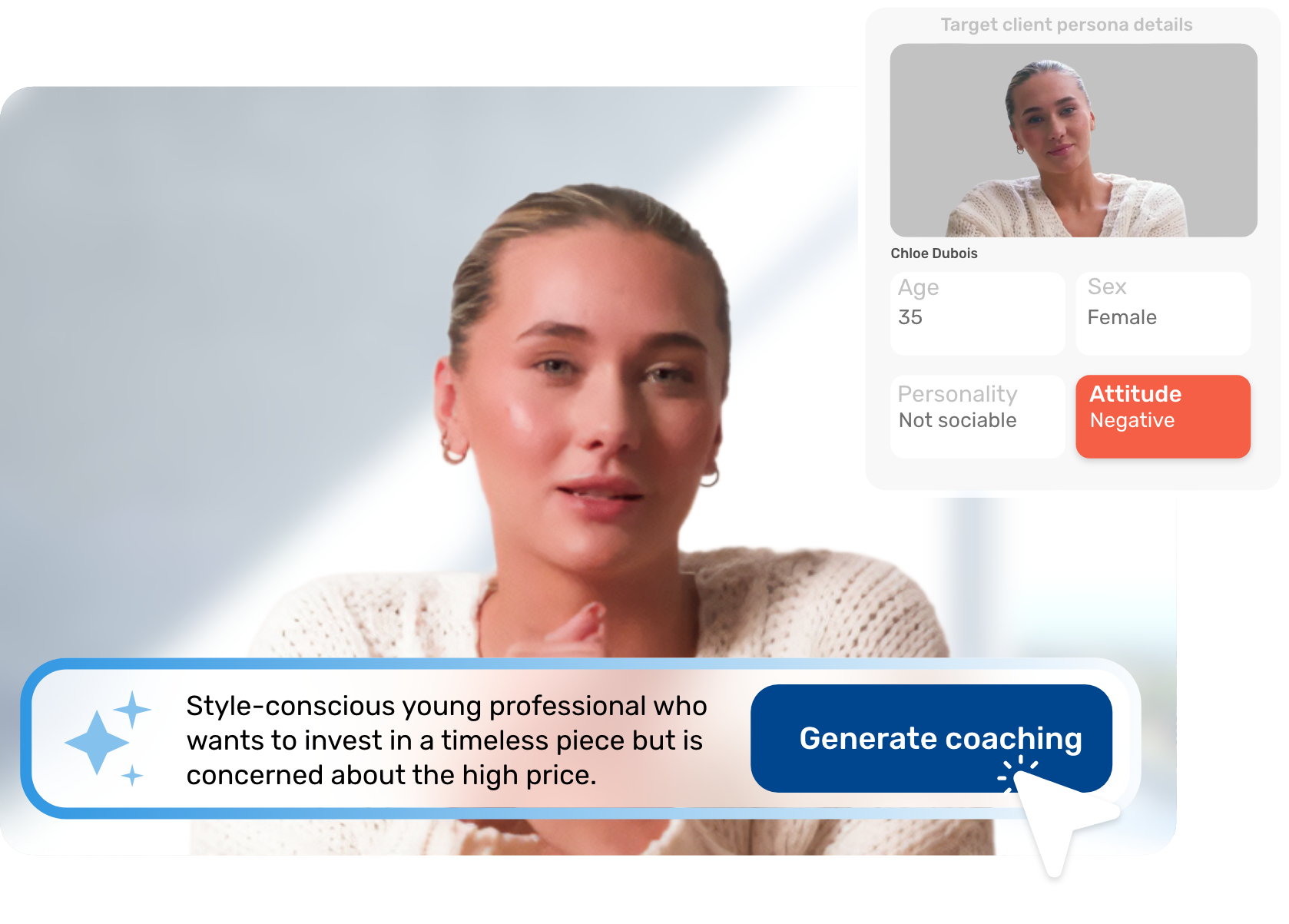
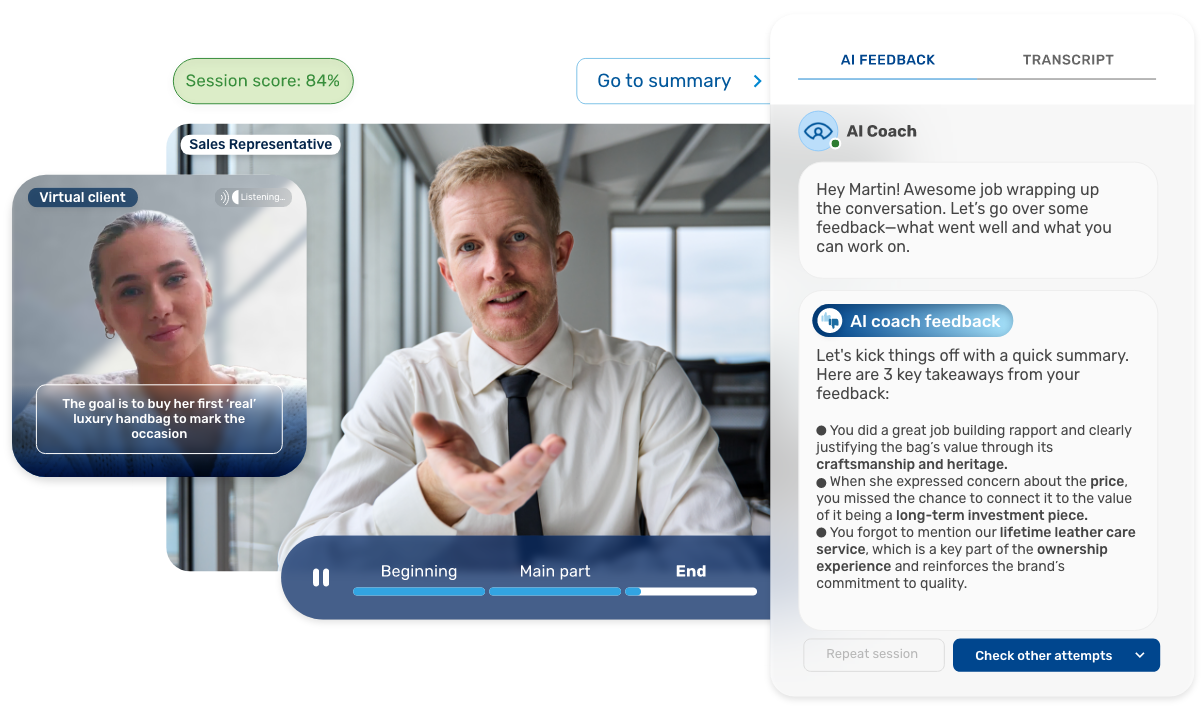
A rep runs an AI role play against a virtual buyer. What you should be grading is not how real the buyer looks. It is what the platform measures on the rep afterward, and what it does with that measurement.
Evaluating an AI sales simulation is not a features problem. It is a measurement problem. Most buyers grade the wrong layer, the realism of the virtual buyer, the size of the persona library, the smoothness of the voice, and end up with a practice product that reps enjoy but that never shows up in a quota review. The platforms that survive a CFO conversation are the ones that measure observable rep behavior against a rubric and feed the next practice back to the rep. This guide gives you a scored 6-criteria rubric, the one question that separates a practice tool from a coaching system, and the specific proof to demand in every demo.
To evaluate an AI sales simulation in 2026, score it on six criteria: what it measures on the rep, whether it closes the loop from score to next practice, the depth and realism of scenarios, manager visibility, security and EU data residency, and the outcome evidence the vendor can show. The single most important question is what changes for the rep after the session ends. If the answer is only a transcript or a sentiment chart, it is a practice tool, not a coaching system, and it rarely moves quota.
Example. A sales manager sits in a demo and asks one question: after my rep finishes this role play, what does the platform tell her to practice next. If the vendor points to a next scenario picked from the rep's weakest behavior, that is coaching. If they point to a leaderboard, keep looking.
Source: Retorio enterprise customer studies, 50+ enterprise clients.
The one question that reframes the whole evaluation
Before you build a scoring sheet, ask every vendor one thing: what changes for the rep after the session ends. It sounds simple. It is the question that sorts the market into two categories.
The first category answers with an artifact. A transcript. A sentiment chart. A talk-ratio number. A leaderboard position. These are all descriptions of what the rep just did. They are useful the way a mirror is useful. They do not tell the rep what to do differently, and they do not track whether the rep improved on the thing that matters.
The second category answers with an action. Here is the rep's score on four or five observable behaviors. Here is the one behavior that is furthest from target. Here is the next AI role play scenario, already picked, that gives the rep more repetition on exactly that behavior. Here is the manager's view of the same score, trended over 30 days. That is a coaching loop, and it is the only structure that reliably shows up in a quota review.
Harvard Business Review's analysis of where companies go wrong with learning and development makes the same point about human training: capability sticks when practice is deliberate, repeated, and tied to measured feedback, not when it is delivered once. An AI sales simulation that only delivers scenarios is a faster way to do the thing that already does not work.
The one filter: does it close the loop?
The 6-criteria evaluation rubric
Once a platform passes the loop filter, grade it against these six criteria. They are ordered by how much they predict a quota outcome, not by how impressive they look in a demo. Take this into the room and score each vendor from 0 to 3 on each line.
Ask for the exact list of observable behaviors it scores, such as discovery question density, objection acknowledgment, value framing, close attempts. A vague "AI feedback" answer scores 0. A named rubric you can inspect scores 3.
Does the score drive the next practice automatically, so the rep gets more repetition on their weakest behavior? A platform that produces a score but leaves the follow-up to a human coach scores 1. Automatic loop scores 3.
Can it generate scenarios for your actual selling motion, your products, your objections, your buyer personas, in your languages? A fixed library of generic scripts scores 1. Dynamic scenarios tuned to your motion score 3.
Can a manager see a per-rep trend on each behavior over 30 and 90 days, not just a count of sessions completed? Engagement metrics score 1. A per-rep behavior trend the manager coaches from scores 3.
Is it ISO 27001 certified, GDPR-compliant, EU AI Act aligned, with EU data residency? For a regulated team this is a gate, not a nice-to-have. No certification scores 0. Documented certification scores 3.
Can the vendor show a named-industry result tied to a behavior change, such as ramp time cut or turnover reduced, not just a testimonial about how much reps liked it? An adoption anecdote scores 1. A quota or ramp outcome scores 3.
A platform that scores 15 or higher out of 18 is a serious candidate. Below 10, you are looking at a practice tool with good production values. The two criteria that matter most, and where most tools quietly fail, are Criterion 1 and Criterion 2. If a vendor cannot name what it measures and show the loop, the other four do not save it.
How the criteria weight against each other
Not every criterion carries equal weight in a real quota outcome. Across the behavioral dataset, what the platform measures and whether it closes the loop explain most of the variance in whether a deployment lifted quota. The chart below shows the relative weight we assign each criterion in our own evaluations, so you can prioritize your demo time. As an illustrative guide, we weight what it measures at roughly 30%, closing the loop at 28%, manager visibility at 18%, and outcome evidence at 12%, with scenario depth and security scored separately as gates. These are our own working weights, not a benchmark of any named platform.
How much each criterion predicts a quota outcome
Practice tool vs coaching system: the comparison
The difference between the two categories is not marketing. It shows up in what each one produces at every step. Use this table to place each vendor before you score them in detail.
| What you check | Practice tool | Coaching system |
|---|---|---|
| Names the behaviors it scores | No | Yes |
| Picks the next practice from the score | No | Yes |
| Per-rep behavior trend for managers | Sessions only | 30 and 90 day trend |
| Scenarios tuned to your motion | Fixed library | Dynamic |
| Outcome evidence in a quota review | Adoption anecdotes | Ramp and quota results |
| Where Retorio sits | : | Scored loop plus EU compliance |
The categories describe what a platform produces, not a scorecard of named competitors. Grade each vendor you shortlist against these rows in their own demo.
Grade the measurement, not the demo. A lifelike virtual buyer is table stakes. What the platform measures on your rep afterward is the whole ballgame.
Retorio Enablement EditorsA 5-step evaluation protocol
Turn the rubric into a repeatable process. Run every shortlisted vendor through the same five steps so you compare like for like and can defend the choice to procurement.
Bring your own scenario
What to do: Do not let the vendor drive the demo with their polished scenario. Hand them one of your real selling situations, a specific product, a specific objection, a specific buyer persona, and ask them to build it live.
What it reveals: Whether the platform generates dynamic scenarios tuned to your motion (Criterion 3) or only runs a fixed library dressed up as custom.
Ask what it measured
What to do: Run one role play, then ask the vendor to show you the exact behaviors it scored and how. Do not accept "the AI evaluates the conversation" as an answer.
What it reveals: Criterion 1. A named, inspectable rubric versus a black box you have to trust on faith.
Ask what happens next
What to do: After the score appears, ask: what does my rep do now. The right answer is a specific next scenario, already selected, that targets the weakest behavior.
What it reveals: Criterion 2, the loop. This is the single step that most often separates the shortlist from the winner.
Sit in the manager's seat
What to do: Ask to see the manager dashboard for a real cohort, not a marketing mock-up. Look for a per-rep trend on each behavior, and check the security and data-residency documentation while you are there.
What it reveals: Criteria 4 and 5. If the manager view is a completion counter, coaching will not happen after the pilot.
Demand outcome evidence
What to do: Ask for a named-industry result tied to a behavior change: ramp time cut, turnover reduced, quota attainment lifted. Ask how it was measured and over what period.
What it reveals: Criterion 6. A vendor with real deployments answers with a number and a method. A vendor without them answers with a testimonial.
Watch: what a scored simulation actually shows
Evaluating a simulation means looking at what the platform scores and what a manager sees afterwards. A walkthrough of the Retorio AI coaching platform, published July 2026.
Source: Retorio (YouTube), July 2026.
Five traps that sink an AI sales simulation evaluation
These are the mistakes that turn a careful evaluation into a bad purchase. Every one of them comes from grading the demo instead of the measurement.
Where this fits in your wider evaluation
Evaluating an AI sales simulation rarely happens in isolation. It is usually part of a broader look at how the team practices and gets coached. If you are comparing named platforms as well as scoring criteria, the market map in our guide to the top AI sales coaching software for 2026 pairs well with this rubric. If your question is more about the practice mechanic itself, the AI role play for sales guide covers how repetition is structured, and our breakdown of interactive AI sales simulations for enterprise teams goes deeper on deployment at scale. If you are weighing scored practice against reviewing recorded calls, our comparison of AI role play versus call coaching in enterprise sales maps that trade-off. MIT Sloan Management Review's work on why learning is central to sustained performance reinforces the same discipline: enablement investment pays back when it is tied to measured capability, not tool adoption.
See what a scored coaching loop looks like
Take the six criteria into a real product. Run your own scenario, see the behaviors it scores, and watch it pick the next practice for the rep. That is the fastest way to tell a coaching system from a practice tool.
Test AI coach in actionKey takeaways
Frequently asked questions
How do I evaluate an AI sales simulation in 2026?
Score it on six criteria: what it measures on the rep, whether it closes the loop from score to next practice, scenario depth and realism, manager visibility, security and EU data residency, and outcome evidence. Grade each vendor 0 to 3 per criterion. The two that matter most are what it measures and whether it closes the loop. A platform scoring 15 or higher out of 18 is a serious candidate.
What is the difference between an AI sales simulation and AI sales coaching?
An AI sales simulation is the practice mechanic, a rep rehearsing against a virtual buyer. AI sales coaching is the loop that reads that practice, scores observable behaviors against a rubric, picks the next practice, and re-measures. A simulation that stops at a transcript is a practice tool. A simulation wrapped in a scored loop is a coaching system, and only the second reliably moves quota.
What should I ask in an AI sales simulation demo?
Ask five things: build one of my real scenarios live, show me exactly which behaviors you scored, tell me what my rep practices next, show me the manager's per-rep trend for a real cohort, and give me a named-industry outcome tied to a behavior change. If a vendor cannot answer the first three with specifics, it is a practice tool.
Does AI sales simulation actually improve quota attainment?
It improves quota when practice is scored and looped, not just delivered. In the Retorio enterprise customer studies across 50+ enterprise clients, scored practice is tied to a documented 38% to 42% reduction in ramp time and, in one telecom deployment, a 69% drop in trainer effort. A simulation that only delivers scenarios without measuring behavior change is a faster way to do what already does not work.
Why does EU data residency matter when evaluating AI sales simulations?
For teams in regulated sectors like insurance and pharma, data residency and certification are a gate, not a preference. A platform that is ISO 27001 certified, GDPR-compliant, EU AI Act aligned, and hosts data in the EU clears procurement. Discovering the absence of these at the contract stage can kill a deal you already spent a quarter evaluating, so check it in the first demo, not the last.
Written with help from LLMs, edited and checked by Önder Mutluer, Website Manager and Marketing Strategist, and Dr. Patrick Oehler, Co-founder and Co-CEO. Reviewed by Peter Holdenried, Head of Sales. How this article was researched, written and checked, and who reviews which topic: Retorio editorial policy.