


AI coaching trains insurance agents through interactive role-play scenarios generated from a carrier's own compliance PDFs and sales scripts, then gives behavioral feedback on every conversation. This replaces classroom seminars and sporadic 1:1 coaching with on-demand practice, cutting agent ramp time by 38-42% while keeping every interaction IDD- and VVG-compliant.
Example. A new property agent finishes her first week and, instead of waiting for a manager to free up, opens a role-play scenario built from the carrier's own objection scripts. She practices with an AI role play of a reluctant homeowner, gets behavioral feedback within seconds, and repeats the scenario twice before her first real call.
Updated July 2026
The Structural Failure of Legacy Training Models
In the insurance sector, the market moves faster than the training department. New IDD requirements, shifting product portfolios, and evolving customer expectations demand an agility that traditional methods cannot provide.
Enablement managers relying on classroom seminars, static e-learning modules, and sporadic 1:1 manager coaching face a "Blind Spot" crisis. They invest heavily in activities that offer no visibility into actual field performance, while the gap between what agents practice and what IDD and VVG require keeps widening.
Effective coaching requires observation and feedback. Sales managers are often too stretched to provide consistent 1:1 coaching to every agent.
New hires receive attention only during their first week, then are left unsupervised until a mistake is made. Onboarding capacity is capped at manager bandwidth.
Most LMS platforms report on activity (Did the agent watch the video?) rather than behavior (Can the agent handle the objection?).
Organizations are flying blind. You have data on course completion, but zero data on sales readiness. Skill gaps surface only when revenue targets are missed.
Creating bespoke training videos or workshops takes weeks or months. By the time content is deployed, regulations or product lines may have changed.
Agents train on outdated scripts. Your sales force is always reacting to the market rather than leading it, and compliance exposure multiplies.
Generic sessions treat a 10-year veteran the same as a fresh graduate. They bore experts and overwhelm newcomers.
Engagement drops, high-potential talent disengages, and attrition spikes, costing the organization significant replacement revenue on top of lost policy premiums.
Traditional coaching operates on faith, not facts. A McKinsey analysis found organizations with strong coaching cultures report 20% revenue growth. Carriers invest heavily with the hope that it sticks, but without mechanisms to measure behavioral change, IDD readiness, or ROI. In a regulated market, that lack of accountability is no longer sustainable. For a full picture of the insurance sales training landscape, see our dedicated guide.
The AI Coaching Advantage
AI coaching offers a compelling alternative to traditional methods. By integrating AI into the coaching process, insurance carriers deliver personalized, interactive practice that produces measurable behavioral change at scale:
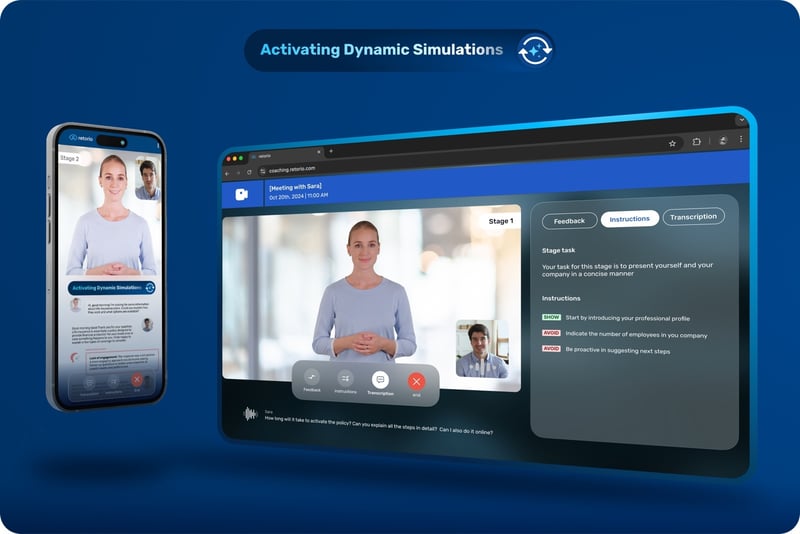
Retorio's no-code scenario generator: upload carrier compliance PDFs and sales scripts to produce IDD-ready role-play sessions in minutes.
Quantified Results: What Insurance Carriers Actually Measure
Proof beats promises. Here are the documented outcomes from Retorio deployments in the insurance vertical, drawn from published enterprise case studies.
Retorio Outcomes: Insurance Vertical
Validated across enterprise deployments. Trusted by 50+ enterprise clients globally, including AXA, Versicherungskammer Bayern, and Nürnberger Versicherung.
Named Proof: DACH Insurance Leaders
New insurance agents coached on IDD-compliant conversations via AI role-play. Agent turnover dropped from 18% to 5%, a 72% reduction. Annual cost savings reached approximately €650,000, driven by lower replacement and onboarding costs.
One of Germany's largest public insurers uses Retorio to coach agents on VVG-compliant advisory conversations. The platform's behavioral analysis flags conversation gaps the traditional certification process cannot surface.
AXA deploys Retorio's AI coaching across sales and service teams to standardize customer conversation quality at enterprise scale, linking AI coaching data directly to performance reviews.
Why AI is the Right Fit for Insurance Coaching
Insurance is regulated, relationship-driven, and high-stakes. Those three characteristics make AI coaching a stronger fit here than in almost any other vertical.
Scenarios are generated from the carrier's own compliance documentation. The AI flags deviations from the required advisory script in real time, so every practice conversation reinforces the regulatory standard, not a generic sales playbook.
New product line? Updated VVG Beratungsprotokoll? Upload the revised documentation and the scenario generator produces updated practice sessions in hours. One carrier trained 5,000 employees in under six weeks after a product portfolio update.
Retorio surfaces individual behavioral scores, empathy signals, and objection-handling gaps, ranked by severity. Managers see exactly where each agent needs coaching, instead of relying on subjective observation or mystery-shopper spot-checks.
With 38-42% faster ramp time and 72% lower turnover documented in the insurance vertical, the question is no longer if AI coaching belongs in your strategy, but how quickly you deploy it before your distribution competitors do.
Closing Skill Gaps with Precision
AI coaching is not just about scale, it is about precision in addressing the specific skill gaps that cost carriers the most: empathy failures at the first objection, product explanation errors on complex covers, and non-compliant advisory language in needs-assessment conversations.
Expected first-year ROI from AI sales coaching at scale
See it run on your own selling motion, buyer personas, and current coaching gap.
From Setup to Success: Your Implementation Roadmap
Implementing AI coaching does not require a massive IT overhaul. Modern platforms are designed for agility, allowing you to move from concept to live coaching in weeks, not months. EU-regulated carriers also benefit from the platform being ISO 27001-certified, GDPR-compliant, and hosted on Google Cloud Platform with EU data residency, removing the data-residency concerns that stall most procurement reviews.
Move beyond generic goals. Define specific behavioral KPIs: "Empathy Score in Claims Handling", "IDD Compliance Rate in Needs-Assessment", "Objection Handling Rate in Life Cover Conversations."
Upload your carrier's compliance PDFs, IDD advisory scripts, and sales playbooks. The AI Coaching Generator creates realistic client personas and IDD-validated practice conversations automatically, with no coding required.
Launch coaching to agents via browser or mobile. They practice privately, failing safely with AI avatars before they risk a relationship with a live policyholder or a compliance breach in a real advisory session.
Move from completion rates to competency rates. Track behavioral scores over time and correlate them with real-world KPIs: policy conversion, advice complaint rates, and first-year agent retention.
With no-code scenario generation, program managers can update practice content in minutes to reflect new IDD requirements or VVG Beratungsprotokoll changes, ensuring the field force is never coaching on outdated regulatory material. For a comparison of platforms, see our guide to AI coaching software for enterprise.
Retorio's AI-Powered Coaching Approach
Retorio is a platform built on scientific rigor and refined for enterprise-regulated environments. Here is the foundation of the difference:
Founded in 2018 as a spin-off from the Technical University of Munich (TUM), Retorio's AI models are built on behavioral research refined at MIT and the University of Tokyo. The scientific foundation is the Big Five behavioral model (McCrae and John, 1992).
The platform analyzes more than 140 verbal, non-verbal, and para-verbal cues: tone, pacing, word choice, body language. This produces a holistic behavioral score, not a quiz result, giving managers data that predicts field performance.
93 AI avatars, 38 voices, and 14 languages mean your agents practice with realistic customer personas before they ever speak to a policyholder. No compliance risk, no relationship damage from a trainee conversation.
ISO 27001-certified. GDPR-compliant. EU AI Act-aligned. Hosted on Google Cloud Platform with EU data residency. All session recordings and behavioral data stay within EU borders, meeting the strictest carrier and supervisory authority requirements.
Transforming Insurance Sales Agent Coaching
In the insurance sector, trust is the product. Integrating AI coaching transforms the outcomes that matter to both the carrier and the regulator.
Tangible Business Benefits
AI identifies hidden weaknesses in empathy, needs-assessment technique, or product explanation, behaviors often missed by human observation, and automatically assigns targeted practice scenarios.
Nürnberger Versicherung realized approximately €650,000 in annual savings while simultaneously boosting performance through better-prepared agents. Lower turnover means lower replacement costs and higher policy renewal rates. For a broader view of what the data shows, see our analysis of the measurable benefits of sales coaching.
In a regulated market, the wrong advice costs the carrier more than the policy is worth. AI scenarios reinforce IDD-compliant advisory language and VVG documentation habits in every practice session, before the stakes are real.
The Evidence Is In.
38-42% faster ramp time. 72% lower turnover. €650,000 in annual savings. These are not projections. They are the documented outcomes AXA, Versicherungskammer Bayern, and Nürnberger Versicherung have shared publicly. The question is whether your carrier wants to measure the same numbers next year.
Frequently Asked Questions
How does AI coaching improve insurance sales agent performance?
AI coaching recreates real-world scenarios such as explaining policy details and overcoming price objections, then gives agents instant behavioral feedback on communication, IDD compliance, and closing technique. Documented outcomes across Retorio's insurance deployments show a 38-42% reduction in ramp time and a +27% increase in sales performance. For the science behind the approach, see our guide to AI sales coaching, and for a full overview of program options, see our guide to insurance sales training.
How does AI coaching handle IDD and VVG compliance in insurance?
Scenarios are generated directly from the carrier's own compliance PDFs and IDD advisory scripts. The AI flags non-compliant language in real time during every practice session, so agents rehearse the correct regulatory script, including VVG Beratungsprotokoll language, before speaking to a real customer. No session data leaves EU-hosted infrastructure.
Can AI coaching reduce insurance agent turnover?
Yes. Nürnberger Versicherung reduced agent turnover from 18% to 5%, a 72% drop, after deploying Retorio for new-agent onboarding. Better-prepared agents close more policies, earn more commission, and stay longer. The carrier also reported approximately €650,000 in annual cost savings from reduced replacement and onboarding spend.
Is Retorio's AI coaching platform compliant with GDPR and the EU AI Act?
Retorio is GDPR-compliant, EU AI Act-aligned, and ISO 27001-certified. The platform is hosted on Google Cloud Platform with EU data residency. All session recordings and behavioral analysis data are processed and stored within the EU, meeting the requirements of German and European insurance supervisory authorities.
Written with help from LLMs, edited and checked by Önder Mutluer, Website Manager and Marketing Strategist, and Dr. Patrick Oehler, Co-founder and Co-CEO. Reviewed by Jan-Henrik Schwarz, Enterprise Account Executive. How this article was researched, written and checked, and who reviews which topic: Retorio editorial policy.