


Warmth and Competence are the two dimensions people use to judge others within seconds: Warmth signals good intentions, Competence signals the ability to deliver. In sales, both shape trust and buying decisions. Retorio's analysis of more than 10,000 sales interactions found reps high in both outperform peers by up to 10% in revenue contribution. Because these behaviors are measurable, AI coaching can build them at scale.
Example. An insurance rep at an enterprise carrier spent two weeks in AI roleplay sessions focused on Warmth signals: pausing before responding, using the customer's own words, and naming concerns aloud before addressing them. In the following quarter her first-call resolution rate rose and customer satisfaction scores moved from the middle of her team to the top three.
Products and prices are converging. Features are visible to anyone. What separates market leaders now is not the product, it is the person delivering the message. Decades of social psychology research show that people size up others on two dimensions almost instantly: Warmth ("Do you have good intentions toward me?") and Competence ("Can you actually deliver?"). Those split-second judgments shape trust, influence, and buying decisions.
Retorio's analysis of more than 10,000 sales interactions puts a number on it: salespeople who score high in Warmth and Competence outperform peers by up to 10% in revenue contribution, information sharing, and customer loyalty. Warmth builds trust and openness. Competence signals capability and reduces perceived risk. Together, they are the psychological foundation of effective sales behavior.
Because these behaviors are measurable, they are coachable. Organizations that build this into their coaching system gain a repeatable edge. This post covers the science behind Warmth & Competence, how it plays out in real sales interactions, and how to apply it at scale with AI coaching.
Key Takeaways
- Warmth and Competence are the universal dimensions of human judgment.
- Salespeople high in Warmth + Competence outperform peers by up to 10%, validated across industries.
- Warmth + Competence behaviors are measurable and coachable, enabling predictable, science-backed sales excellence.
Introduction: When Products Converge, People Differentiate
Products and services are becoming interchangeable. Features are visible, pricing is transparent, and differentiation is fleeting. This shifts competitive advantage from product specifications to human behavior, specifically how salespeople are perceived in the first seconds of an interaction.
Scientific research and Retorio's industry data point to one clear conclusion: Top-performing salespeople excel in both Warmth and Competence.
1. The Psychology Behind Every Customer Interaction
Warmth and Competence: The Two-Factor Model of Human Perception
Two traits explain almost every judgment we make about other people: Warmth and Competence. Fiske, Cuddy, and Glick (2002) showed these sit at the core of how humans evaluate each other socially. The model connects directly to what researchers now call behavioral intelligence, the measurable layer of human behavior that AI can quantify in real time.
The model reduces human judgment to two questions:
- Warmth: "Do you intend to help me or harm me?"
- Competence: "Are you capable of following through?"
These judgments form fast, driven by subtle cues: tone, posture, emotional expression, conversational style. Most buyers have already decided how they feel about a rep before the product conversation begins.
Warmth signals
- Honest, transparent communication - they say what they mean without hidden agendas
- Collaborative language - they use "we" instead of "I" and include others
- Empathetic responses - they show they understand and care about your perspective
Competence signals
- Clear, articulate communication - they explain things well and show they know their stuff
- Quick problem-solving - they can think through challenges and find solutions
- Decisive action - they follow through on what they say they'll do
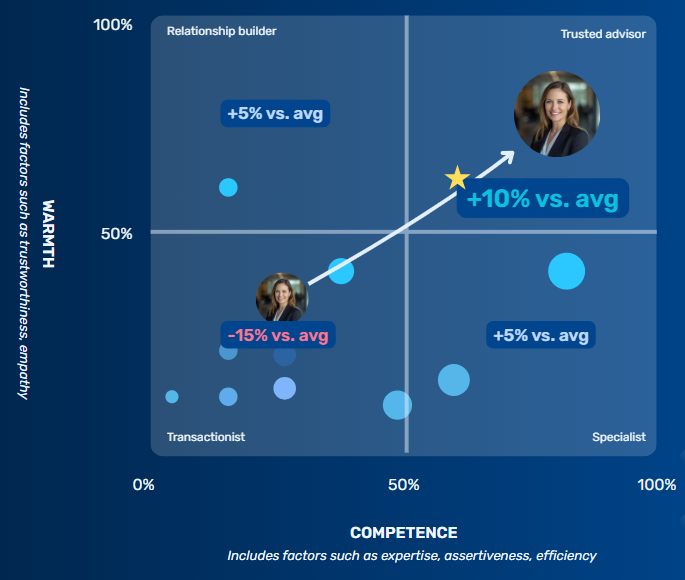
High Warmth + High Competence = Trusted Advisor
2. Why Customers Buy From Warm and Competent Salespeople
2.1 Warmth: The Gateway to Trust
"Warmth gives us the indication if we can trust this person and whether the person has good intentions."
Warmth opens the relationship. It is what makes a buyer willing to tell you the truth. It drives:
- Information sharing
- Customer loyalty
- Forgiveness after mistakes
In sales, what a buyer tells you determines the quality of your solution. Warmth is what makes them tell you the real problem, not the polished version. Reps who signal genuine care get the details a transactional approach never surfaces. That is the intelligence gap between a generic proposal and one that closes.
2.2 Competence: The Signal of Capability
"Competence gives us the indication whether someone seems capable and skilled."
Competence drives:
- Perceived low risk
- Confidence in the solution
- Trust in expertise
A rep who knows the product cold and handles objections without fumbling makes the deal feel safe. Perceived risk is a real lever on deal velocity. Research on leadership trust published in Harvard Business Review shows warmth must come first, but competence is what converts trust into a signed order. Sales conversations follow the same arc.
2.3 The Combined Effect: Up to 10% Revenue Uplift
Across industries, Retorio's data shows:
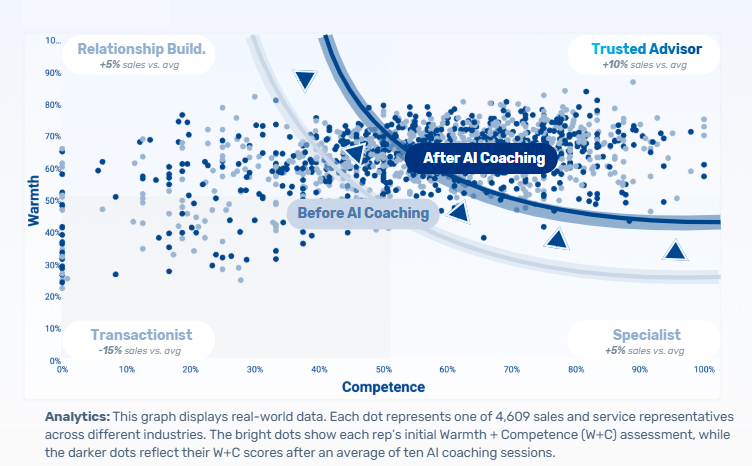
- High W + High C: +10% above average performance
- High W / Lower C: +5%
- High C / Lower W: +5%
- Low W + Low C: -15%
Warmth gets you in. Competence gets you the signature.
"As products and services get more interchangeable and value props more similar your salesforce will become the differentiator and thus your people" Dr. Christoph Hohenberger
3. The Science Behind Warmth & Competence: Evidence From Psychology
Think back to the last first meeting you had with someone new in a business context. Before they finished their first sentence, your brain was already running two silent assessments:
- "Can I trust this person?" and
- "Are they capable of delivering results?"
Those instant judgments shape every interaction that follows.
This is not a modern insight. Human brains evolved to run these checks fast. Thousands of years ago, "friend or foe?" and "strong or weak?" were survival questions (Fiske et al., 2002). The circuitry is still running in every sales meeting.
The 2002 "stereotype content model" formalized it: all judgments about people reduce to (1) warmth and (2) competence (Fiske et al., 2002). Earlier work by Wojciszke's team found those two dimensions accounted for 82% of how people judge others in everyday situations. That is not a partial explanation. That is essentially the whole story.
For sales organizations, the implication is direct. McKinsey research on social skills in the workplace found that roles demanding high social and emotional judgment are among the fastest-growing in economic value, precisely because they resist standardization. Warmth and Competence sit at that cluster's center. The gap between a rep who hits quota and one who exceeds it by 10% is rarely product knowledge. It is the behavioral layer on top. For any enablement leader building a coaching program on this framework, understanding how behavioral intelligence differs from emotional intelligence is a good first step.
4. How Retorio Measures and Coaches Warmth & Competence
Science-backed coaching that moves sales performance by 10% and beyond
Retorio's AI coaching platform is built on the Warmth and Competence framework, grounded in research from the Technical University of Munich (TUM) with contributions from MIT and the University of Tokyo. The platform's work appears in peer-reviewed journals showing how behavioral perception of warmth and competence shapes sales outcomes at scale. The key point: these are not fixed personality traits. They are behavioral patterns, observable, scorable, and developable with the right coaching approach.
Over seven years, Retorio has deployed this coaching approach with enterprise clients across B2C (telecommunications, fashion, automotive, insurance) and B2B (semiconductors, pharmaceuticals, medical technology, logistics) contexts. For a broader view of how AI coaching platforms measure behavioral dimensions, see AI sales coaching and how it works in practice.
4.1 Behavioral cues, not personality, drive perception
Warmth and Competence are not baked-in personality. They show up through behavior: how someone speaks, listens, explains, and structures a conversation. That means they are learnable. A rep scoring low on Warmth in a baseline assessment is not fundamentally cold. More often, they are using filler phrases that read as disinterest, or they are not reflecting the customer's language back to them. Both are fixable in a few focused sessions.
4.2 Retorio's AI makes Warmth & Competence measurable
Retorio's platform:
- Assesses Warmth and Competence across 140+ observable behavioral signals
- Simulates realistic customer conversations with AI personas
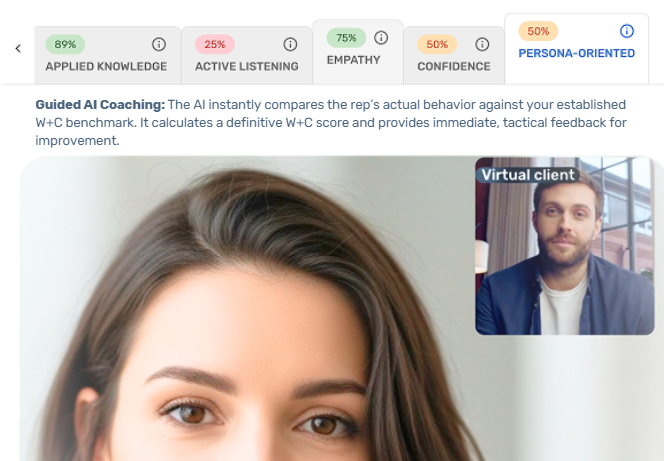
- Delivers personalized coaching feedback after every session
- Tracks behavioral improvement over time with objective scoring
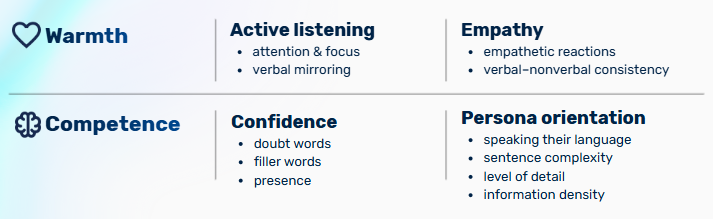
4.3 Retorio coaches salespeople along warmth and competence dimensions
Coaching sessions run scenario-based roleplay matched to the rep's industry and buyer persona. The AI customer pushes back, tests assumptions, and reacts to tone and word choice, not just the substance of the answer. After each session, the rep gets a behavioral breakdown: exactly which cues read as warm or competent, and which did not. That specificity is what separates actionable coaching from generic advice. For a closer look at how AI roleplay compares to traditional approaches, see AI roleplay for sales teams.
5. Applying Warmth & Competence in Sales Organizations
5.1 Assess the Current State
Targeted coaching starts with a baseline. A structured assessment maps where each rep lands on the Warmth–Competence quadrant. Look for:
- Who are the trusted advisors? (High W, High C: the benchmark)
- Who leans too much on empathy without technical depth? (High W, Lower C: warm but unconvincing on complex objections)
- Who is technically strong but emotionally flat? (Lower W, High C: knowledgeable but alienating to risk-averse buyers)
- Who scores low on both dimensions? (Low W, Low C: immediate coaching priority, associated with the -15% revenue contribution in Retorio's data)
A data-driven baseline cuts through manager subjectivity. "She seemed a bit cold in the demo" becomes a scored behavioral profile the rep can actually do something with.
5.2 Coach Using Realistic Simulations
Generic coaching does not shift behavior. Deliberate practice in conditions that feel real does. AI-simulated customer conversations create that environment without live customer risk. In each simulation, the platform tracks:
- Tone: warmth-signaling vs. transactional
- Emotional responsiveness to buyer hesitation
- Information clarity and structural logic
- Conversational flow: who holds the space, who follows
- Objection handling: does the rep acknowledge before countering (Warmth) or immediately rebut (perceived low Warmth)
Research on the measurable benefits of structured sales coaching consistently identifies two predictors of behavioral change: frequency and specificity of feedback. AI simulation delivers both at scale, without scheduling a coach.
5.3 Verify and Track Progress
Behavioral change stalls when it is invisible. When reps can see their scores move session to session, the feedback loop accelerates. Leaders gain visibility they rarely had before, which lets them:
- Identify skill gaps at the team level, not just the individual level
- Detect improvement over time with objective, comparable data
- Ensure consistent messaging and behavioral standards across distributed teams
- Target coaching investment at the reps and skill areas with the highest return
6. Warmth & Competence Across Industries: Practical Examples
Healthcare
Healthcare providers have to balance deep clinical knowledge (Competence) with genuine concern for patient outcomes (Warmth). Research shows provider warmth significantly affects patient satisfaction, treatment adherence, and outcomes (Howe, et al. 2019). Medical sales reps who mirror that clinical empathy, the kind physicians already practice with patients, consistently report stronger HCP relationships and shorter sales cycles.
Service Excellence
Genuine warmth means responding sincerely to a customer's need, even when it costs something in the short term. Service organizations that earn the strongest long-term relationships have one thing in common: they put the customer first (Yang, et al. 2014). That is not an aspiration. It is a measurable behavioral pattern with direct impact on net promoter scores and renewal rates.
Insurance Sales
Insurance is built on vulnerability and trust. Customers need to believe their agent cares about their wellbeing (Warmth) and actually knows their stuff (Competence). The best agents combine technical depth with empathetic communication, giving clients confidence in complex decisions (Bateman, et al. 2015). AI coaching programs targeting this behavioral combination have produced measurable conversion gains across both new business and cross-sell motions.
7. Conclusion
Warmth and Competence are how humans judge intention, trustworthiness, and capability. The science and Retorio's own data say the same thing: salespeople who master both outperform everyone else.
These behaviors are measurable, coachable, and repeatable. Organizations that build Warmth & Competence into their coaching system will field sales teams that outperform even when the product differences narrow to zero. The model works across industries because the psychology is universal. But it only produces results with behavior-specific coaching, not generic skills content. That is what AI platforms built on this framework are designed to deliver.
Frequently Asked Questions
What are Warmth and Competence in the context of sales?
Warmth and Competence are the two dimensions social psychologists use to explain how people judge others. In a sales context, Warmth covers the signals that communicate good intentions toward the buyer: empathy, transparency, collaborative language. Competence covers capability signals: clear explanation, confident problem-solving, reliable follow-through. Buyers run this assessment within seconds, usually before the product conversation starts.
Can Warmth and Competence behaviors actually be measured?
Yes. Retorio's platform analyzes over 140 observable behavioral signals, including vocal tone, word choice, response pacing, and conversational structure, to generate a scored profile for each rep across both dimensions. The shift is from subjective manager impression ("she seemed cold") to session-by-session behavioral data that both reps and managers can act on directly.
How long does it take to improve Warmth or Competence scores?
Faster than most managers expect. Because these are behavioral changes, not personality overhauls, the timeline is shorter. In Retorio deployments, reps doing two to three AI coaching sessions per week typically show measurable improvement within four to six weeks. Specificity is what drives it: feedback tied to exact behavioral moments in a session, not general advice about "being warmer."
Does Warmth and Competence coaching work across industries?
Wherever human interaction drives the buying decision, the framework applies. Retorio has deployed it across pharmaceutical sales, insurance, financial services, telecommunications, and manufacturing. The psychology is universal. The specific cues that read as warm or competent vary by industry and buyer persona, which is why AI simulations are configured to the rep's actual customer context, not a generic scenario.
How does the Warmth and Competence model relate to AI sales coaching?
Traditional sales coaching could not measure Warmth and Competence at scale because the signals are subtle and need simultaneous analysis of tone, language, and pacing. AI coaching platforms built for this framework assess every session automatically, generate behavioral scorecards, and deliver targeted feedback without a human coach in the room. That is what makes consistent, high-frequency coaching economically feasible across large sales teams.
Scientific References
- Abele, A. E., & Wojciszke, B. (2014). Communal and agentic content in social cognition: A dual perspective model. Advances in Experimental Social Psychology, 50, 195-255.
- Bateman, C., & Valentine, S. (2015). The impact of salesperson customer orientation on the evaluation of a salesperson's ethical treatment, trust in the salesperson, and intentions to purchase. Journal of Personal Selling & Sales Management, 35(2), 125-142.
- Fiske, S. T., Cuddy, A. J. C., Glick, P., & Xu, J. (2002). A model of (often mixed) stereotype content: Competence and warmth respectively follow from perceived status and competition. Journal of Personality and Social Psychology, 82(6), 878-902.
- Fiske, S. T. (2018). Stereotype content: Warmth and competence endure. Current Directions in Psychological Science, 27(2), 67-73.
- Gignac, G. E., Harmer, R. J., Jennings, S., & Palmer, B. R. (2012). EI training and sales performance during a corporate merger. Cross cultural management: An international journal, 19(1), 104-116.
- Hohenberger, C., & Grohs, R. (2019). Old and exciting? Sport sponsorship effects on brand age and brand personality. Sport Management Review, 22(4), 567-580.
- Howe, L. C., Leibowitz, K. A., & Crum, A. J. (2019). When your doctor "gets it" and "gets you": The critical role of competence and warmth in the patient–provider interaction. Frontiers in psychiatry, 10, 475.
- Huang, Y., Zhang, M., Gursoy, D., & Shi, S. (2020). An examination of interactive effects of employees' warmth and competence and service failure types on customer's service recovery cooperation intention. International Journal of Contemporary Hospitality Management, 32(7), 2429-2451.
- Kraft-Todd, G. T., Reinero, D. A., Kelley, J. M., Heberlein, A. S., Baer, L., & Riess, H. (2017). Empathic nonverbal behavior increases ratings of both warmth and competence in a medical context. PloS one, 12(5), e0177758.
- Yang, D. J., & Wu, M. J. (2014). Does customer trust play a mediating role between salesperson competence and performance?. International Journal of Management, Economics and Social Sciences, 3(2), 100-121.
- Wojciszke, B., Bazinska, R. & Jaworski, M. (1998). On the dominance of moral categories in impression formation. Personality and Social Psychology Bulletin, 24, 1251-1263.
Written with help from LLMs, edited and checked by Önder Mutluer, Website Manager and Marketing Strategist, and Dr. Patrick Oehler, Co-founder and Co-CEO. Reviewed by Dr. Florian Abicht, Chief AI Officer. How this article was researched, written and checked, and who reviews which topic: Retorio editorial policy.