


Most companies run a leadership training program, see good energy in the room, and then watch nothing change on the team six months later. The content was not the problem. The format was. Managers learn a model in a workshop, return to the same pressure and the same habits, and the new behavior never makes it into a real one-to-one.
A leadership training program is a structured set of coaching interventions that builds specific management behaviors: giving developmental feedback, running effective one-to-ones, resolving conflict, and aligning a team behind a goal. The best programs work because they replace one-off workshops with repeated, realistic practice and measurable feedback. This matters because the manager is the single biggest controllable driver of team performance: Gallup finds managers account for about 70% of the variance in team engagement. A program that only delivers information, and never lets managers practice the behavior under pressure, will not move that number.
If you own leadership development for a commercial organization, sales, customer service, or account management, you are not short on content. You are short on transfer: getting what managers learn in a session to show up in how they actually lead. This guide explains why most leadership training fails to transfer, which behaviors actually move team results, and how AI coaching turns a leadership program into practice that sticks.
What is a leadership training program?
A leadership training program is a structured series of interventions designed to build the specific behaviors a manager needs to lead a team well. In a commercial context, that means the behaviors that show up in real management moments: coaching a rep after a lost deal, giving feedback that changes performance instead of denting morale, running a one-to-one that surfaces the real blocker, and handling conflict without avoiding it. A good program is defined by the behaviors it changes, not the topics it covers.
The distinction between knowledge and behavior is the whole game. A manager can name every step of a feedback model and still freeze, soften the message into uselessness, or turn defensive when a report pushes back. Knowing the model is not the same as being able to use it in the moment. That gap is exactly where most programs quietly fail.
Why most leadership training fails to transfer
Two well-documented forces work against the traditional workshop, and together they explain why so little changes after the room empties.
The forgetting curve. Without active recall and spacing, most of a workshop is gone within days. A program built on a single event is fighting human memory, and losing. Managers do not fail to change because they disagree with the model. They change nothing because, by the time the moment arrives, the model is no longer accessible.
The design flaws McKinsey named. In its widely cited analysis of why leadership-development programs fail, McKinsey points to four recurring mistakes: decoupling the training from real work context, underestimating the mindsets that drive behavior, failing to give managers ownership of their own development, and never measuring whether anything actually changed. A program that ignores all four can look excellent on a feedback form and still produce no business result.
A leadership program should not be judged by what managers know when they leave the room. It should be judged by what their teams do three months later.
The behaviors that actually move team results
Not every leadership behavior carries equal weight. Harvard Business Review's cross-sector research on the competencies leaders rate most important points consistently to the relational and developmental behaviors: showing strong ethics, creating a sense of safety, communicating clearly, and developing people. For managers of commercial teams, that translates into a handful of high-impact moments.
Retorio frames these behaviors through the Warmth and Competence model, the behavioral science finding that people judge others on two axes at once: whether they are capable (competence) and whether they have good intent (warmth). A manager who is all competence and no warmth drives compliance, not commitment. A manager who is all warmth and no competence is liked but not followed. Effective coaching builds both, and makes them visible and measurable.
Telling a rep the truth about performance in a way that changes behavior instead of triggering defensiveness.
Running a conversation that surfaces the real blocker rather than a status update nobody needed.
Turning a lost deal into a behavior change instead of a blame conversation or an awkward silence.
Addressing tension directly and early, before it hardens into disengagement or attrition.
How AI coaching makes leadership development stick
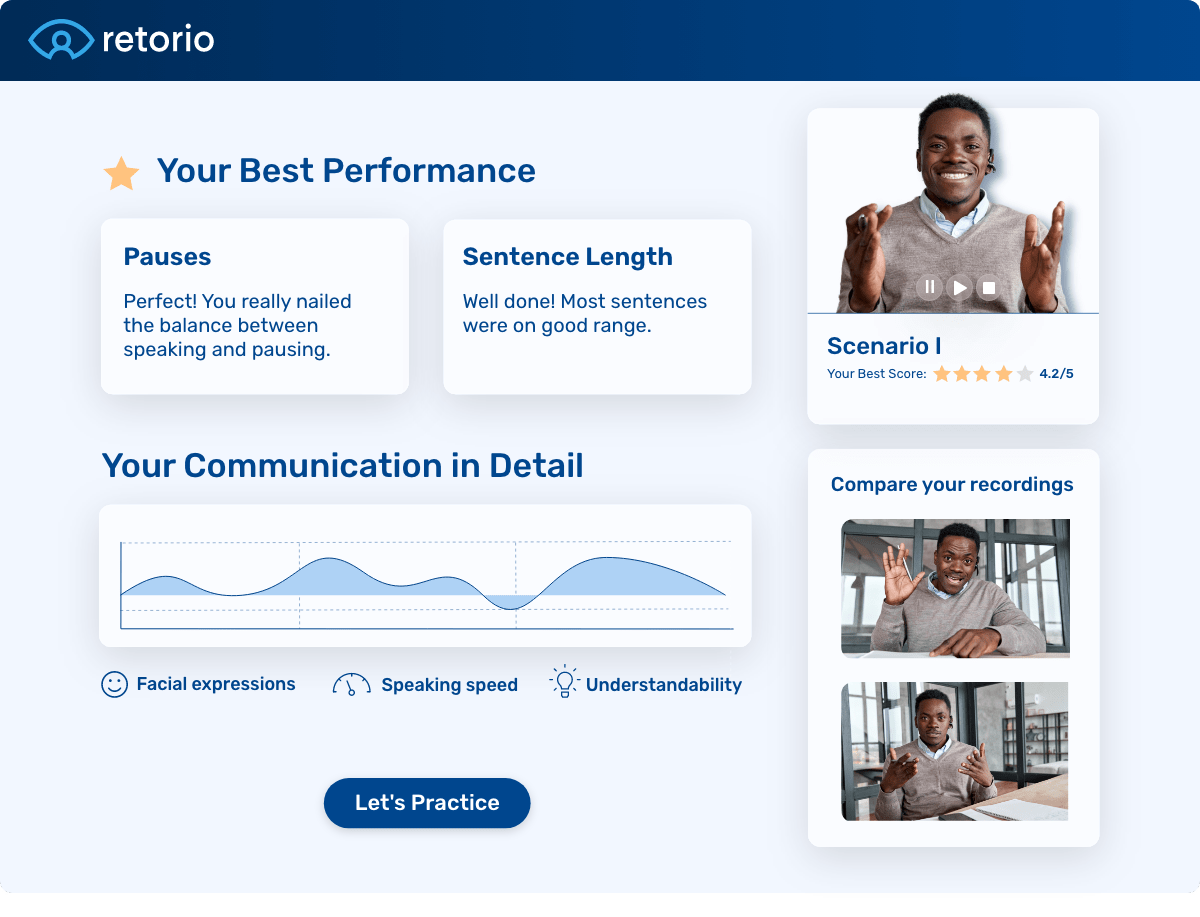
AI coaching addresses the transfer problem directly: it replaces the single workshop with a practice loop a manager can run repeatedly, on their own schedule.
The manager rehearses the exact conversation, a tough feedback session, a one-to-one with a disengaged rep, with an AI counterpart that reacts like a real person.
Feedback covers both what was said and how it read, scored against the Warmth and Competence model, so the manager sees their blind spots.
Spaced, repeated practice is the most reliable way to beat the forgetting curve and move a behavior from known to automatic.
Leaders above the managers see who is practicing and which behaviors are improving, closing the measurement gap McKinsey flagged.

What to look for in a leadership training program
Use this as a buying checklist. A program worth running should:
- ✓ Center on behavior change, with practice built in, not just content delivery.
- ✓ Use realistic scenarios drawn from the manager's actual job, not generic case studies.
- ✓ Space practice over time instead of compressing it into one event.
- ✓ Measure behavior change and business outcomes, not just satisfaction scores.
- ✓ Scale to every manager, not just the high-potential cohort that gets the executive program.
For related depth, see our guides to leadership training online, executive leadership training, the core leadership skills every manager needs, and the broader case for AI coaching.
Frequently asked questions
What is a leadership training program?
It is a structured series of interventions that builds specific management behaviors, such as giving feedback, running one-to-ones, coaching after a loss, and handling conflict. The strongest programs are defined by the behaviors they change, not the topics they cover, and they include repeated practice rather than a single workshop.
Why do most leadership training programs fail?
Two reasons. Memory: without spaced reinforcement, most workshop content is forgotten within days. Design: McKinsey identifies four recurring failures, no real-work context, ignored mindsets, no manager ownership, and no measurement. Programs that hit all four feel good and change nothing.
How does AI coaching improve leadership development?
By turning the program into a practice loop. Managers rehearse real conversations with an AI counterpart, get behavioral feedback scored on warmth and competence, repeat with spacing to beat the forgetting curve, and leaders can measure which behaviors are actually improving.
Which leadership behaviors matter most for commercial teams?
The relational and developmental ones: developmental feedback, effective one-to-ones, coaching after a loss, and productive conflict. Harvard Business Review's competency research consistently ranks these relational behaviors highest, and they map directly to the Warmth and Competence model.
Can a leadership program scale to every manager, not just executives?
Yes. The limit on traditional programs is facilitator time, which is why deep development is usually rationed to a high-potential cohort. AI coaching removes that limit: every manager can practice the same realistic scenarios and get consistent feedback at scale.
Sources
Manager impact on engagement: Gallup, State of the American Manager. Why programs fail: McKinsey. Most important competencies: Harvard Business Review. Forgetting curve: Murre & Dros, 2015.