


Best Sales Training Programs in 2026: Compare, Evaluate, and Choose
A head of enablement once told me she spent six months piloting three programs before realising she had been evaluating the wrong dimension. Her team's completion rates were excellent. Win rates had not moved a point. She was measuring activity, not capability. This guide is the framework she wished she had started with.
The best sales training programs in 2026 combine structured skill development with measurable behavioral change, verified by ongoing data rather than completion rates. The right choice depends on team size, selling motion, and whether you need broad capability building or targeted coaching on a specific gap. AI coaching platforms now outperform traditional formats on behavioral adoption and ramp time at enterprise scale.
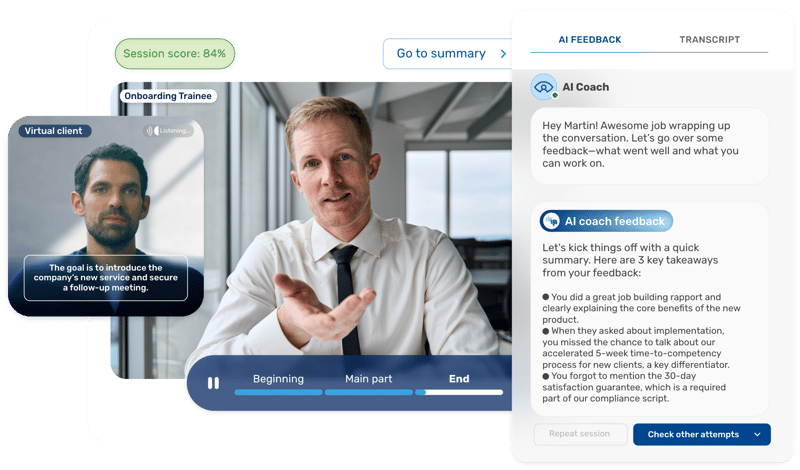
Example. A Head of Sales Enablement at a DACH insurance group runs AI coaching for 120 new agents. After eight weeks, ramp time drops from 12 weeks to 7.5, and first-year attrition falls by half, because every rep gets daily behavioral feedback on real call scenarios, not a quarterly workshop score.
What a Sales Training Program Actually Needs to Do in 2026
The framing that most evaluation guides miss: a sales training program is not a curriculum. It is a change intervention. The measure of success is not what reps can recite after a session, it is what they do differently on a live call three months later.
With that frame, the defining characteristics of effective programs in 2026 are:
"Previously, practicing a scenario with a manager took 3–5 hours. Now, with AI coaching, our agents conduct a role play five times for each scenario independently."
Ivo Nikolov, Business Analyst, Vodafone VOIS, after deploying AI-based coaching across 1,800 new agents annuallyTypes of Sales Training Programs: Format, Fit, and Results Compared
There is no single best format. The right type depends on your team structure, budget, and the specific capability gap you are trying to close. Here is how the main program types compare across what matters most to a buying decision.
| Program type | Format | Best fit | Behavioral ROI track | Scalability |
|---|---|---|---|---|
| AI coaching platform | Asynchronous, scenario-based practice with real-time behavioral scoring | Enterprise teams, distributed reps, high volume, quota-gap recovery | Quantified per-rep behavioral scores and trend data over time | High. Thousands of reps coached simultaneously, no trainer bottleneck |
| Classroom / instructor-led | In-person or virtual cohort, trainer-facilitated | Launch events, culture resets, or moments requiring team alignment | Satisfaction scores. Behavioral change is hard to isolate post-session | Low. Geography-bound and limited by trainer availability |
| E-learning / self-paced | On-demand video, quizzes, SCORM modules | Foundational skills, product knowledge, compliance certifications | Completion and quiz pass-rate only. No behavioral signal | High. Asynchronous, always-on delivery at near-zero marginal cost |
| Blended (live plus digital) | Cohort workshops reinforced with digital practice and check-ins | Mid-market teams needing both culture shift and repeatable practice | Qualitative observations plus some quiz data. Cohort-comparison possible | Medium. Cohort-size limited by facilitator capacity |
| Methodology programs (Challenger, SPIN, MEDDIC, value-based selling) | Curriculum-based, often workshop-led with toolkits and call-card materials | Teams adopting a shared sales motion or qualification framework | Manager observation and deal-stage adoption tracked manually | Medium. Requires ongoing facilitation and reinforcement to stick |
How Training Outcomes Compare by Format
The data below comes from Retorio's enterprise coaching dataset across enterprise deployments and 80+ deployments. It illustrates why program format matters more than content volume when it comes to behavioral change after 90 days.
90-day behavioral improvement rate by program format. Source: Retorio coaching dataset, 50+ enterprise clients, 2024–2026.
How to Evaluate Sales Training Programs: The Questions to Ask Before Signing
Most vendor evaluations fail because they focus on content libraries and features rather than outcomes. These questions are designed to expose the difference between a program that looks good in a demo and one that actually moves quota. Use them before any commercial conversation, not after.
What changes in rep behavior after 90 days, and how do you measure it?
Completion rate and satisfaction score are outputs of the program, not outputs of the rep. Ask for specific behavioral metrics: how many calls do reps record per week, how does discovery quality score change after three months, what observable difference separates the top quartile from the bottom quartile? If the vendor cannot answer this with data from current customers, that is your answer.
How is reinforcement built into the program, not bolted on?
Most programs front-load content and assume managers will handle reinforcement. McKinsey research on next-generation B2B sales capabilities recommends carving out time for peer coaching and weekly check-ins instead of relying on quarterly refreshes. Ask whether practice is scheduled into the product, not optional.
Can you customise scenarios to our actual buying situations?
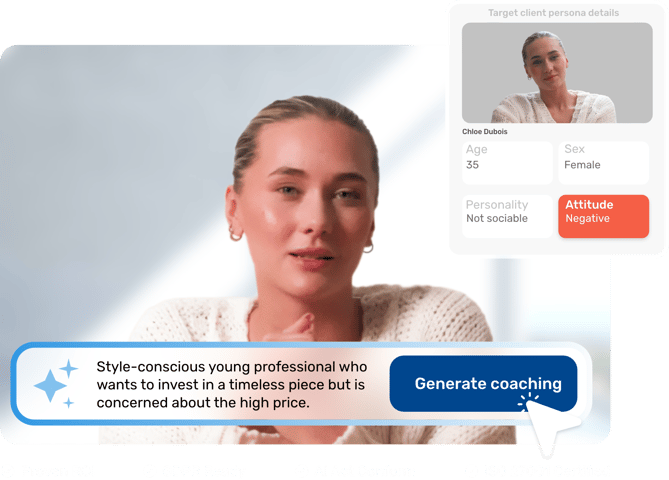
Generic role plays such as "it's too expensive" do not prepare reps for the specific security review stalls, procurement delays, and multi-stakeholder dynamics in your deals. Ask the vendor to show you a scenario built for your industry and buyer persona. The willingness and speed of that response tells you a great deal about the actual customisation depth.
What does your data say about reps who went through this program vs those who did not?
Any serious program provider should have A/B data on ramp time. If they cannot show you a cohort comparison, ask for two reference customers in your industry who will speak to specific ramp and quota data. Anecdotes are a yellow flag. Named customer results with specific numbers are the standard you should hold them to.
What happens to reps at month three, six, and twelve?
Many programs produce strong early engagement numbers that fade once the novelty wears off. Ask the vendor for retention and continued-usage data across cohorts at the three-month and six-month marks. Ask what their contract structure looks like if behavioral improvement targets are not met. Vendors confident in their outcomes accept accountability in the commercial terms.
How to Measure the ROI of a Sales Training Program
The conversation with the CFO or CRO about a new sales training investment comes down to three numbers: current cost of underperformance, projected cost of the program, and expected ROI timeline. Most enablement leaders underestimate the first and overestimate the difficulty of quantifying the third.
When presenting the business case, frame the ROI in terms the business understands. Not "our reps will learn more" but "if we reduce ramp time by 38%, we recover three weeks of selling capacity per new hire across a 40-person team, which at average deal sizes of €40K represents roughly €480K in pipeline acceleration in the first year alone." That is the language that moves a CFO from skeptic to sponsor.
What the Data Says: Real Results from AI Coaching Programs
The shift toward AI-powered sales coaching programs is not driven by novelty. It is driven by outcome data that traditional formats cannot match at scale.
What to Avoid: 5 Signs a Program Will Not Deliver
Sales Training Software: What to Look for in 2026
The core question for evaluating AI-powered sales training software is different from the question for traditional formats. You are not asking "is the content good?" You are asking "does this platform close the behavioral loop?" A closed loop means: a rep practices a scenario, receives a behaviorally specific score, the system surfaces the three highest-impact areas for improvement, the rep practices again.
That loop, at scale, is what separates platforms that drive consistent quota attainment from those that generate activity reports. For a category-level comparison of the leading platforms, see the guide to top AI sales coaching software in 2026 and the broader AI sales coaching guide.
Source: TED, Dan Pink, "The puzzle of motivation." Pink's research on intrinsic motivation directly informs why self-directed practice platforms outperform externally-mandated coaching schedules.
Retorio: AI coaching at Enterprise Scale
Retorio is an AI coaching platform built for enterprise sales, service, and leadership teams. Unlike content libraries or e-learning platforms, Retorio is grounded in the Warmth and Competence behavioral science framework, scoring every rep on observable behaviors that predict commercial outcomes.
Customers include enterprises in insurance, pharma, telecommunications, and automotive. For a full breakdown of provider options, see the B2B sales training programs overview.
See how Retorio performs against your team's specific ramp-time and quota-attainment gap.
Key Takeaways
Frequently Asked Questions
Effectiveness comes from three elements working together: realistic practice against the specific scenarios reps face, immediate behavioral feedback, and a reinforcement cadence that prevents skill decay between sessions. Programs that score high on completion but not behavioral change lack at least one of these three elements.
The five main types are AI coaching platforms (scenario-based practice with behavioral scoring), classroom or instructor-led workshops (cohort-based, in-person or virtual), e-learning or self-paced courses (on-demand modules), blended programs (live sessions reinforced with digital practice), and methodology programs such as Challenger, SPIN, or MEDDIC (selling-motion-specific curricula). Each type differs in scalability, behavioral ROI track, and the capability gaps it closes best.
Sales training programs are typically structured curricula delivered to a group over a defined period. Sales coaching is an ongoing, individualized intervention that identifies specific behavioral gaps for each rep and addresses them through practice and feedback. The best outcomes come from combining both: a shared methodology delivered through a program, reinforced daily through coaching.
Costs range from free, for foundational online courses, to enterprise-level pricing for AI coaching platforms or methodology programs. For enterprise deployments, the relevant question is cost per rep per year vs the behavioral improvement that deployment generates. A program at roughly 800 euros per rep that reduces ramp time by 38% typically pays back within the first quarter for a team with average deal sizes above 30,000 euros.
The best sales training software in 2026 depends on what you are trying to measure. For behavioral change and ramp-time reduction at enterprise scale, AI coaching platforms that score observable behaviors per session consistently outperform content libraries and e-learning suites. Platforms should be evaluated on behavioral metrics, customisation depth, and A/B ramp data, not on content volume or feature lists.
With AI coaching platforms, behavioral scores typically improve within the first 4 to 6 sessions. Ramp-time effects are visible within 8 to 12 weeks for new hires. Pipeline and quota impacts take a full selling cycle to show in aggregate data, typically 90 to 120 days. Programs that claim immediate revenue impact in weeks are describing pipeline acceleration from newly onboarded reps, not behavioral change across the full team.