


AI coaching for pharma sales representatives uses AI-driven role play so reps can rehearse high-stakes HCP conversations without risking a real relationship or a compliance incident. Reps practice against a simulated physician, get behavioral feedback on tone, rapport, and clinical framing, and the platform pulls only from MLR-approved material so nothing off-label ever enters the practice loop. Retorio's enterprise deployments document a 38-42% reduction in ramp time when this kind of structured practice replaces ad hoc manager role play.
Example. A new oncology rep, three weeks in, runs a simulated detail call with a skeptical cardiologist. The AI flags a phrase that drifts toward an off-label claim, she corrects it, repeats the scenario twice, and walks into her first live meeting already knowing where she tends to drift.
Pharma sales reps operate in a narrower window than almost any other B2B seller. Access to HCPs keeps shrinking, every claim they make is subject to MLR (Medical, Legal, Regulatory) review, and the cost of one careless sentence in front of a physician is not a lost deal, it is a compliance incident. Traditional training, a workshop, a PDF, an annual certification, was never built for that pressure. It teaches the content once and hopes the behavior sticks.
AI coaching approaches the problem differently. Instead of teaching content, it lets reps rehearse the conversation itself, repeatedly, against a realistic HCP persona, with feedback on the specific behaviors that determine whether a physician engages or shuts down. This guide covers what that looks like in practice, how the compliance layer works, what the coaching methodology is grounded in, and what to demand from a vendor before you roll it out to a field force.
What AI coaching for pharma sales reps actually is
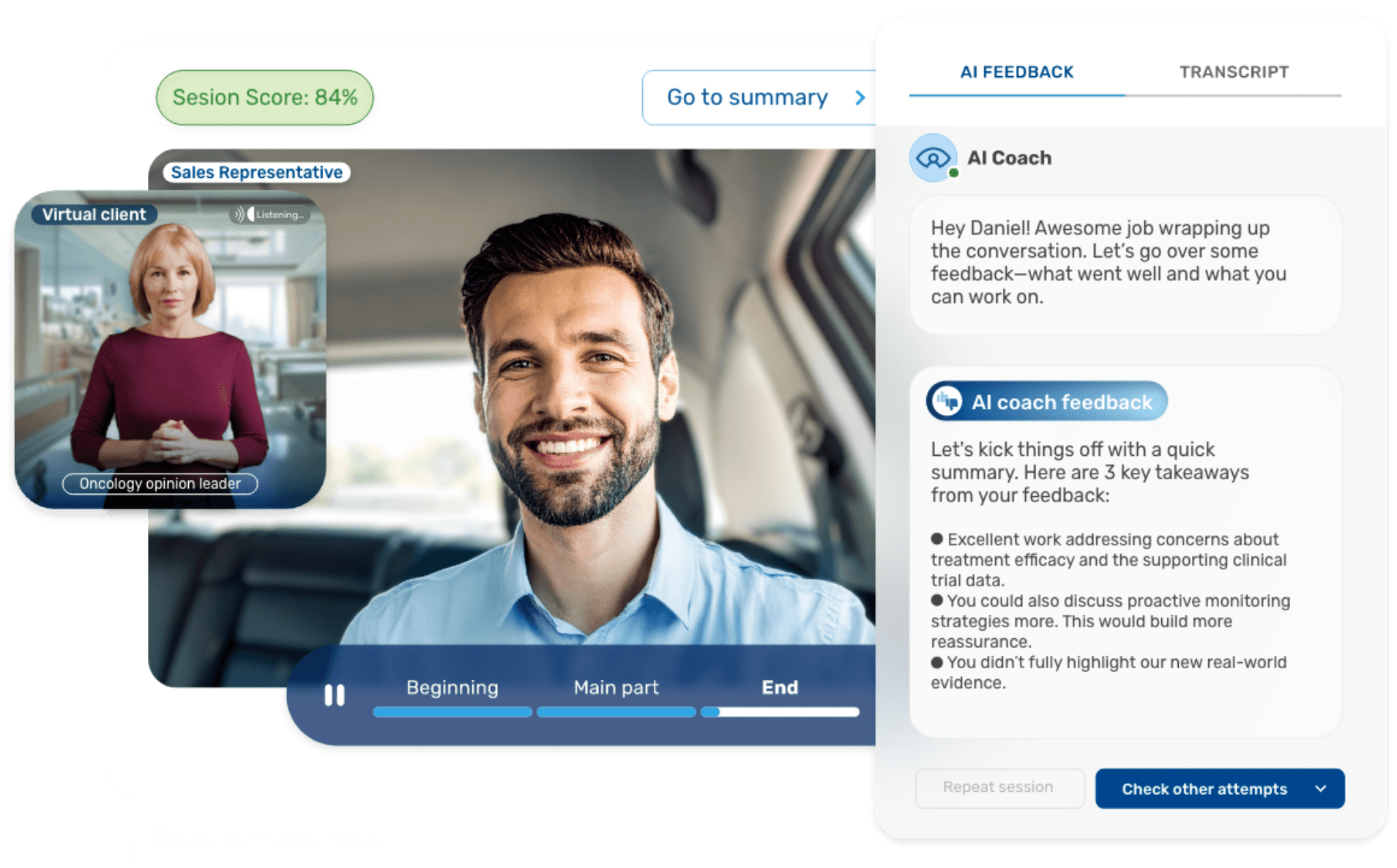
AI coaching in this context is not a chatbot and not an e-learning module with a quiz at the end. It is a role-play environment: the rep has a conversation with a simulated HCP (a physician, a pharmacist, a formulary committee member), the AI persona responds and pushes back the way a real one would, and the platform analyzes the rep's tone, rapport-building, clinical framing, and closing behavior against a scored model. The rep gets feedback on what they did, not just what they said.
Retorio's pharma deployments run on a zero-hallucination architecture: every scenario, every AI response, and every piece of coaching feedback is generated only from MLR-approved source material. Reps practice against real content boundaries, not a generic language model improvising a drug claim. Compliance is not a report generated afterward, it is built into what the rep is allowed to rehearse in the first place.
That distinction matters because most pharma L&D teams already know classroom training does not transfer to the field, and Harvard Business Review's ongoing research on sales performance makes the same point across categories: skill transfer requires repeated, specific, corrective practice, not a single exposure to content.
How it works, from onboarding to the first HCP call
The sequence below is how a new pharma rep typically moves through AI-guided practice before their first unsupervised HCP conversation.
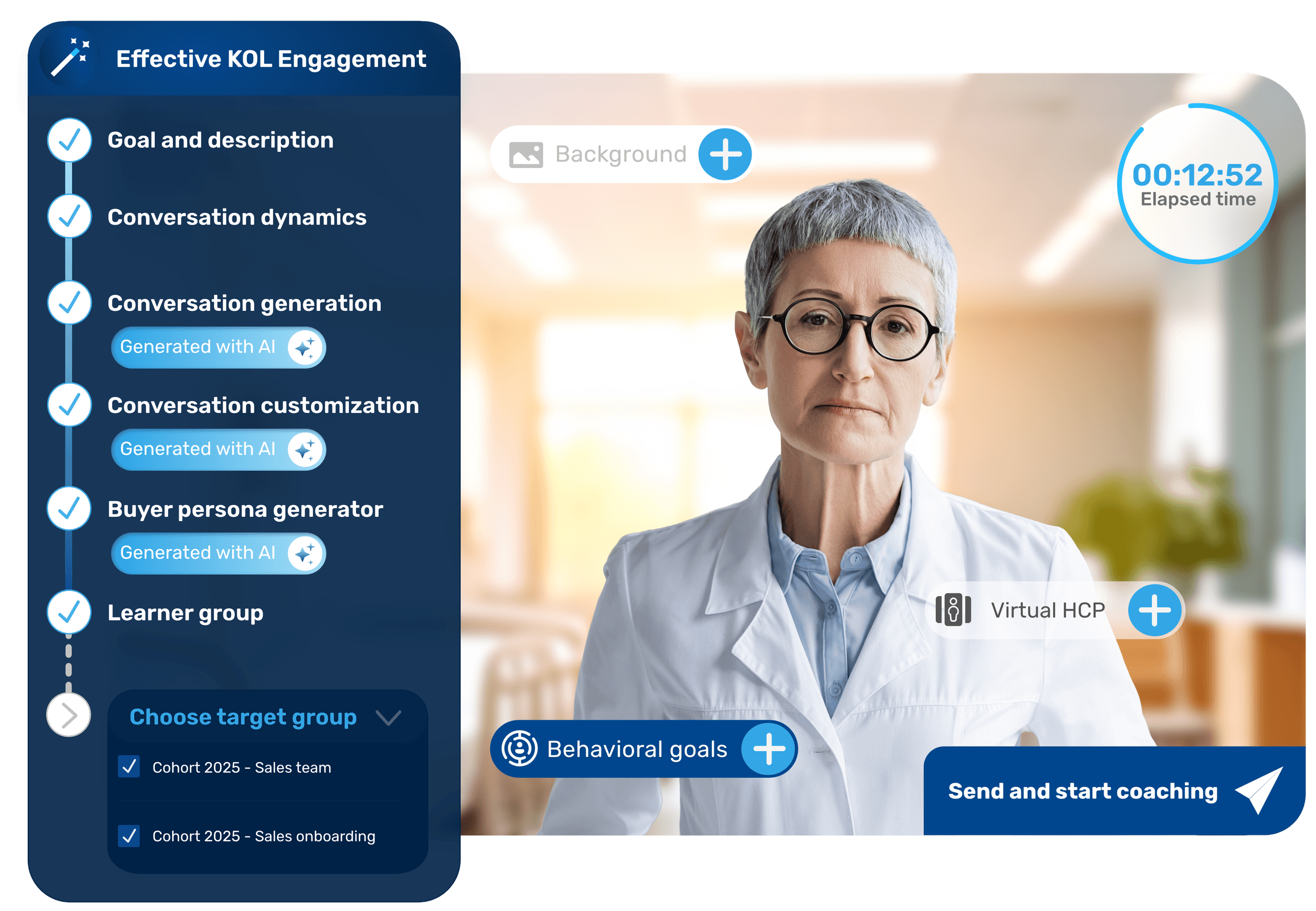
L&D or Sales Enablement uploads the approved clinical deck, label, and objection library. The platform generates HCP personas and scenarios from that content only, no open-ended generation.
Sets the compliance boundary before a single rehearsal happens.
A skeptical cardiologist, a time-pressed GP, a formulary reviewer asking about cost-effectiveness. The AI persona reacts and objects the way that HCP profile actually would.
Reps fail safely, in private, as many times as needed.
The rep gets scored on tone, rapport, clinical framing, and closing behavior, and flagged in real time if language drifts toward an unapproved or off-label claim.
A named behavior to fix beats a generic "improve confidence" note.
Practice is not one-and-done. The rep re-runs the same or a varied scenario until the corrected behavior is consistent, not just present once.
Repetition is what turns a correction into a habit.
Sales Enablement and field managers see scores and completion data across the cohort, so onboarding readiness is a measured fact, not a manager's impression.
Documented enterprise studies show 38-42% faster ramp time when this replaces ad hoc manager role play.
The behavioral science behind the coaching model
The feedback a rep receives is not a vendor's intuition about what makes a good pharma conversation. It is mapped to the Warmth and Competence framework, a body of research on how buyers evaluate the people they interact with: warmth (empathy, acknowledgment, rapport signals) and competence (clinical expertise, precision, directness). An HCP conversation lives or dies on both dimensions at once, a rep who is warm but clinically vague loses credibility, a rep who is precise but cold loses the relationship.
Grounding the feedback model in a named, published framework, rather than an internal rubric a vendor invented, is what lets a rep's manager explain the score without it sounding arbitrary. It also gives Sales Enablement leaders something they can defend internally when a VP asks how the coaching model was built.
Retorio's ability to create personalized AI role play experiences across languages and cultural contexts is highly effective for our global teams.
Irit Hovic, Senior Director, Global Talent Management at Teva PharmaceuticalsWhy unscripted role play is a compliance risk, and what closes the gap
Traditional role play, a manager or peer playing the physician, has no guardrail on what either party says. A well-meaning colleague can improvise a claim that would never survive MLR review, and nobody catches it because the exercise is not being scored against the approved label. That gap is exactly where AI-guided practice earns its place: every scenario is generated from approved material, and every rep response is checked against it live.
What the data shows
Retorio publishes outcome data from enterprise deployments across regulated industries, including pharma, insurance, and telecom. These are the figures on the record, with the attribution that lets you verify them internally.
Source: Retorio enterprise customer outcome data (retorio.com). Vodafone VOIS scope: 1,800 new customer service agents annually; trainer hours before 26, after 8. Ramp-time reduction: multiple enterprise customer studies.
How to evaluate a coaching approach for your pharma field force
Before rolling out AI-guided coaching to a field organization, hold every option to the same six criteria.
| Criterion | Field ride-alongs | e-learning / LMS | AI-guided role play |
|---|---|---|---|
| Practice frequency | Limited by manager travel schedule | Unlimited, but passive (watch, quiz) | Unlimited, active conversation practice |
| MLR / compliance safety | Depends entirely on the manager present | Content is reviewed, but not rehearsed live | Scenarios and responses built only from approved material |
| Feedback specificity | Subjective, varies by manager | None beyond quiz score | Scored on named behaviors, tone, rapport, clinical framing |
| Scale across therapy areas | Slow, one manager at a time | Fast to deploy, slow to change behavior | New scenario same day a label or deck updates |
| Manager time required | High, hours per rep per quarter | Low | Low, manager reviews cohort analytics instead |
Retorio builds pharma coaching scenarios only from your approved clinical content, so every rehearsal stays inside MLR boundaries. ISO 27001 certified, GDPR-compliant, EU AI Act aligned.
Test AI coach in actionWhere this fits in a broader coaching strategy
AI coaching for HCP conversations rarely stands alone. Most L&D teams pair it with broader product training for regulated industries, a review of common pitfalls in pharma rep training to know what to avoid, and the same underlying AI role-play approach used across sales role play more broadly. If you are still evaluating what AI sales coaching actually is before narrowing to the pharma-specific case, that guide is the right starting point.
FAQ
What is AI coaching for pharma sales representatives?
It is AI-driven role play that lets pharma reps rehearse HCP conversations against a simulated physician persona, receive behavioral feedback on tone, rapport, and clinical framing, and get flagged in real time if language drifts toward an off-label claim. Scenarios are built only from MLR-approved material.
How does AI coaching stay compliant with MLR requirements?
The platform generates scenarios and coaching feedback only from content that has already passed MLR review, rather than an open-ended model improvising claims. If a rep's practice response drifts toward unapproved or off-label language, the system flags it during the rehearsal, not after the fact.
Does AI coaching actually reduce onboarding time for new pharma reps?
Documented enterprise studies show a 38-42% reduction in ramp time when structured, scored AI role play replaces ad hoc manager role play. The mechanism is repetition with specific feedback, not a single workshop exposure.
What is the coaching feedback actually based on?
Retorio's feedback model is grounded in the Warmth and Competence framework, which evaluates a rep's rapport-building (warmth) alongside their clinical precision and directness (competence). Both dimensions determine whether an HCP engages or disengages, and scoring against a named framework is what lets a manager explain the feedback credibly.
Can AI coaching support global, multilingual pharma teams?
Yes. Retorio supports 14 languages, so global pharma organizations can roll out consistent, MLR-safe coaching across regions from a single platform, rather than adapting separate materials market by market.
Is AI coaching for pharma sales GDPR and EU AI Act compliant?
Retorio is GDPR-compliant, EU AI Act aligned, and ISO 27001 certified, hosted on Google Cloud Platform with EU data residency. For regulated pharma buyers, confirm these details in writing as part of vendor evaluation, they should never be assumed.
Author: Retorio Sales Team. Retorio is an AI Coaching Platform for enterprise sales and service organizations.
Last updated 2026. Sourced from Retorio enterprise customer outcome data and published behavioral science research.
Written with help from LLMs, edited and checked by Önder Mutluer, Website Manager and Marketing Strategist, and Dr. Patrick Oehler, Co-founder and Co-CEO. Reviewed by Martin Weber, Director Business Development Healthcare & Life Sciences. How this article was researched, written and checked, and who reviews which topic: Retorio editorial policy.