

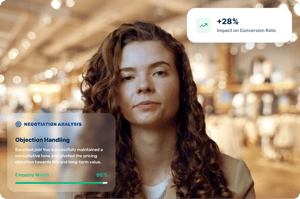
AI sales coaching delivers continuous behavioral feedback that changes how a rep sells across every live conversation. AI role play gives reps discrete practice scenarios to rehearse before a real call. Both belong in an enterprise stack, but only AI sales coaching produces sustained behavior change, because it closes the gap between what a rep practiced and what they do in front of a buyer.
Example. A sales rep rehearses a price objection ten times in AI role play and feels ready. On the live call his pace quickens and the buyer reads it as defensive. AI sales coaching catches that vocal signal, shows him the pattern, and gives him one thing to change next time.
For Sales Enablement and Commercial Excellence leaders
AI sales coaching and AI role play get sold as the same thing. They are not. One prepares a rep for a moment. The other changes how they sell across every moment. Confuse them and you get high practice completion with flat quota. This is the framework you can use to brief a CRO or CFO on which category solves your problem, and how to verify a vendor delivers behavior change rather than rehearsal volume.
The rep who aced every scenario and still lost the deal
A Head of Sales Enablement at a 600-rep insurance group walked me through her dashboard last quarter. Her team had run AI role play for three months. Practice completion sat at 87%. Reps loved it. Scenario scores climbed week over week.
Then she pulled the live-call data. Conversation quality on real objection-handling had not moved. One of her strongest reps, a top performer in every practice scenario, kept stalling at the same point in the buying cycle: the moment a prospect pushed back on price. He knew the rebuttal cold. He could recite it in a simulation. But in a live call his pace quickened, his pitch climbed, and the buyer read it as defensiveness. No one had ever told him that, because the practice tool measured whether he said the right words, not how he came across when it counted.
That gap is the whole argument. AI role play taught him the script. It could not coach the behavior. Those are two different categories of product, and the difference decides whether your numbers move. The behavioral-feedback layer that catches a vocal signal under pressure is what separates AI sales coaching from a practice tool.
The two categories, defined
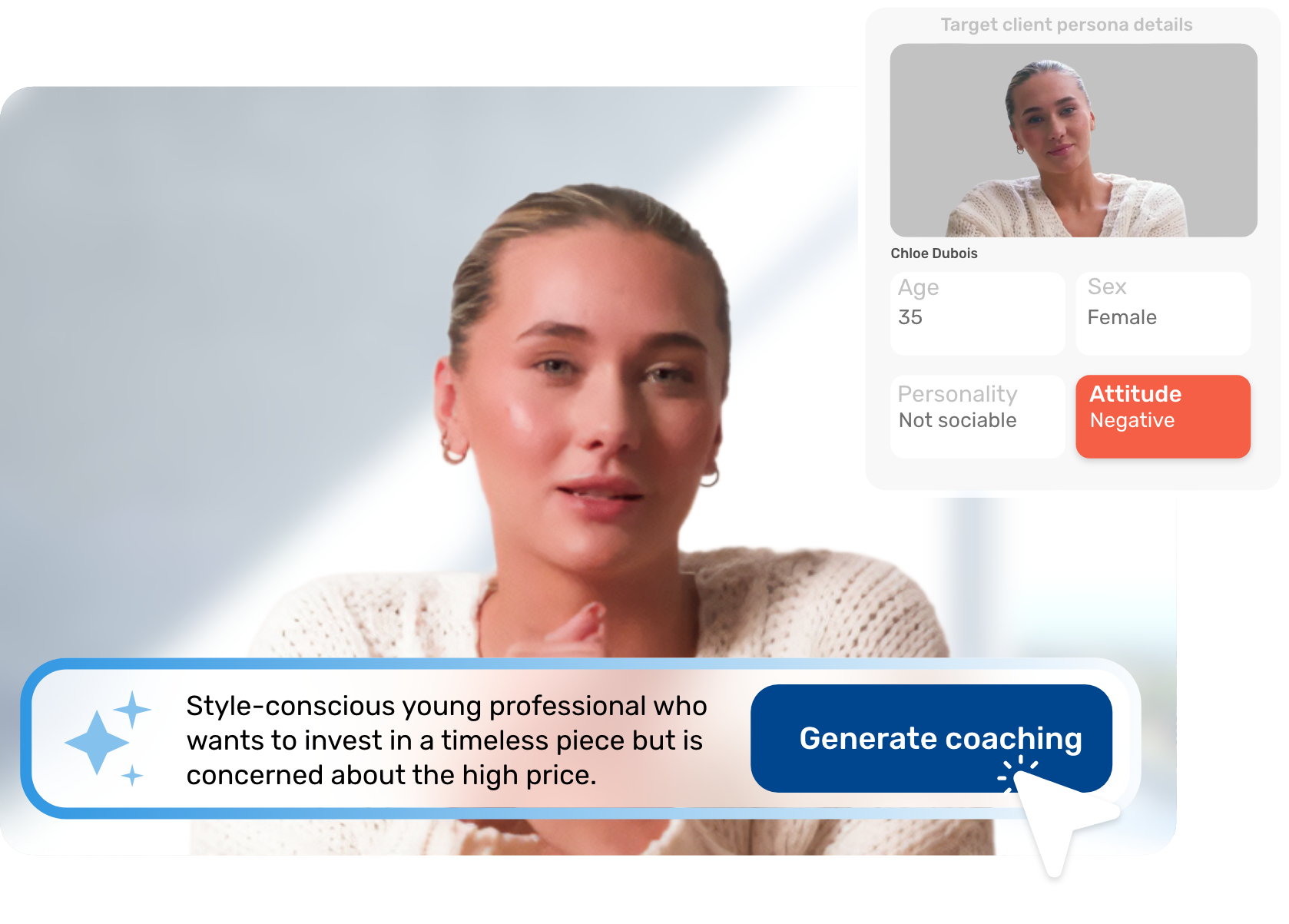
AI sales coaching and AI role play get used interchangeably in vendor decks, which is exactly why enablement leaders end up with the wrong tool for the problem they are trying to solve. Here is the clean separation.
| Dimension | AI role play | AI sales coaching |
|---|---|---|
| What it is | A practice mechanic. The rep talks to an AI persona to rehearse before a real call. | A behavior-change system. It observes conversations and coaches the behaviors that predict outcomes. |
| When to use it | Before a high-stakes moment: a launch, a pricing change, a compliance script. | When you need to change how reps sell over weeks, not just prepare them once. |
| What it produces | Rehearsal volume and rep readiness. | A behavioral trend line and the business outcomes that follow. |
| How success is measured | Completion rate, number of runs, perceived preparedness. | Conversation quality, ramp time, quota attainment, retention. |
| Shape | An event the rep does. | A loop that changes the rep's behavior. |
Role play is something a rep does. Coaching is something that happens to the rep's behavior over weeks. One is an event. The other is a loop. If you want the mechanics of the practice side in depth, our guide to interactive AI sales simulations for enterprise teams covers how the scenarios are built and scaled.
The confusion is understandable, because the two share a surface. Both put a rep in front of an AI persona. Both produce a transcript and a score. From a demo screen they look identical. The difference is what happens with that score. A practice tool stores it as a completion record: the rep ran the scenario, here is how they did, move on. A coaching system treats the score as one data point in a behavioral profile that updates over time, then decides what the rep should work on next. The first is a filing cabinet. The second is a coach with a memory.
That distinction matters most for the buyer who has to justify the spend. A practice tool is easy to defend on activity: completion rates go up, reps run more scenarios, the dashboard looks busy. A coaching system has to be defended on outcomes, which is harder in month one and far more valuable by month six. If your board is asking why last year's enablement budget did not move quota, the honest answer is usually that the team bought activity and expected behavior change. Those are not the same purchase.
When to use each: the decision
Most teams do not need to choose one forever. They need to know which problem they are solving this quarter. The fork below is the fastest way to brief a decision.
Source: Retorio AI coaching deployment patterns across 50+ enterprise clients, 2024-2026.
If your goal is rehearsal before a high-stakes moment, use AI role play. New product launch, a pricing change, a compliance script that has to be word-perfect: reps need volume of practice in a no-risk setting.
If your goal is to change how reps actually sell, use AI sales coaching. Reps who plateau, conversation quality that will not improve, a top-versus-bottom-quartile gap you cannot close with more content: that is a behavior problem, and only coaching with behavioral feedback moves it.
If your goal is sustained ramp and retention at scale, you need both, in sequence. Role play builds the reps. Coaching closes the gap between practice and live performance. The platforms that deliver durable results treat role play as one input into a coaching loop, not as the finished product. McKinsey's research on building durable capability makes the same point: one-off events rarely change behavior, reinforced feedback loops do.
A quick test for which branch you are on: look at where your reps lose deals. If they lose because they were caught flat-footed by a new product or a pricing change they had never rehearsed, that is a readiness gap, and role play fixes it fast. If they lose because the same reps make the same behavioral mistake quarter after quarter, more rehearsal will not help, because the problem is not preparation. It is a habit no one has named and coached. Most enterprise teams have both gaps at once, which is why the answer is rarely one tool. The mistake is buying the readiness tool and assuming it will close the habit gap.
Why coaching is the category that moves the number
Practice without feedback on the right behaviors is just repetition. A rep can run the same scenario fifty times and reinforce the same habit that loses the deal.
The behaviors that predict quota are observable but rarely coached: vocal confidence under pressure, the warmth signals that build trust in discovery, the competence signals that earn authority in objection-handling. Retorio's AI coaching analyzes more than 140 of these cues across verbal, nonverbal, and vocal channels, scored against the Warmth and Competence framework. That is the layer AI role play alone does not have.
Go back to the insurance rep who stalled on price. A practice tool gave him a transcript that showed he used the right rebuttal, so it scored him well. The behavior that lost the deal, his pace climbing and his pitch tightening the moment he felt resistance, never appeared in that score, because the tool was not built to see it. Coaching that reads vocal and nonverbal signals does see it, and more importantly it can hand him one concrete thing to work on: slow the first sentence of every objection response. That is coachable. "Use the right rebuttal" is not, because he already was.
This is why behavior change reads as a trend line rather than a single number. A rep does not fix vocal confidence in one session. They improve it a little each week, and the value compounds: a rep who handles objections with steadier delivery does not just close the deal in front of them, they carry that into every deal after. Warmth and Competence are not soft concepts here. They are the two dimensions that decades of behavioral research show buyers use to decide whether to trust a seller, and they are exactly what a practice tool with a completion checkbox cannot measure.
The outcome shows up in the data. The chart below contrasts what each category is built to deliver. Practice volume is real, and role play is good at it. But behavior change and outcome evidence come from coaching that closes the loop.
Light bars: AI role play strengths. Navy bars: AI sales coaching strengths. Source: Retorio enterprise customer studies, n=100,000+ people coached across 50+ enterprise clients, 2024-2026.
Previously, practicing a scenario with a manager took 3-5 hours. Now, with Retorio's AI Sales training platform, our agents conduct an AI role play 5 times for each scenario independently.
A Business Analyst at VodafoneNotice what they describe: role play gives the volume, and the coaching layer is what turns that volume into ramp-time reduction. At Vodafone VOIS that meant onboarding new agents in 5 weeks instead of 8.
How AI coaching and AI role play work together
This is not an argument that role play is useless. It is an argument that role play is one stage of a coaching loop, and treating it as the whole product is the mistake. If you are weighing this against live-call review, our breakdown of AI role play versus call coaching in enterprise sales goes deeper on the trade-offs.
The loop has four stages. Role play is the practice stage. The other three stages are what make it coaching.
Capture how the rep actually comes across in a real or simulated conversation: pace, warmth signals, competence signals, the vocal confidence that shifts under pressure. This is the layer practice tools skip.
The rep rehearses with an AI persona, as many runs as they need, before a live call. This is the AI role play stage, and it is genuinely valuable here.
Behavioral scoring against the Warmth and Competence framework, not a completion checkbox. The rep sees one specific thing to change, not generic praise.
The coaching focus shifts to the behavior that will move the number next, and the loop repeats. Behavior change is a trend line, not an event.
A platform that delivers all four is what enterprise teams actually need. Retorio positions AI sales coaching as the system and AI role play as the practice mechanic inside it, which is why the same deployment produces both rehearsal volume and measurable behavior change. For a category-level view of how these capabilities show up across vendors, see our guide to the top AI sales coaching software in 2026.
The sequencing matters as much as the components. Run coaching with no practice and reps have nowhere safe to try the new behavior, so the feedback lands as criticism instead of a rep. Run practice with no coaching and reps rehearse in a vacuum, reinforcing whatever they already do. The teams that get durable results put role play and coaching in the same loop: the rep practices, the system scores the behaviors that matter, the rep gets one focus for the next run, and the cycle tightens. Over a quarter that loop is what separates a team where conversation quality climbs from one where practice completion climbs and quota does not.
For a frontline manager this also changes the job. Instead of trying to find time to sit in on enough calls to coach by gut feel, the manager gets a behavioral profile per rep and can spend their coaching hour on the one or two people whose trend line has stalled. Coaching stops being a calendar problem and becomes a targeting problem, which is a problem managers can actually win.
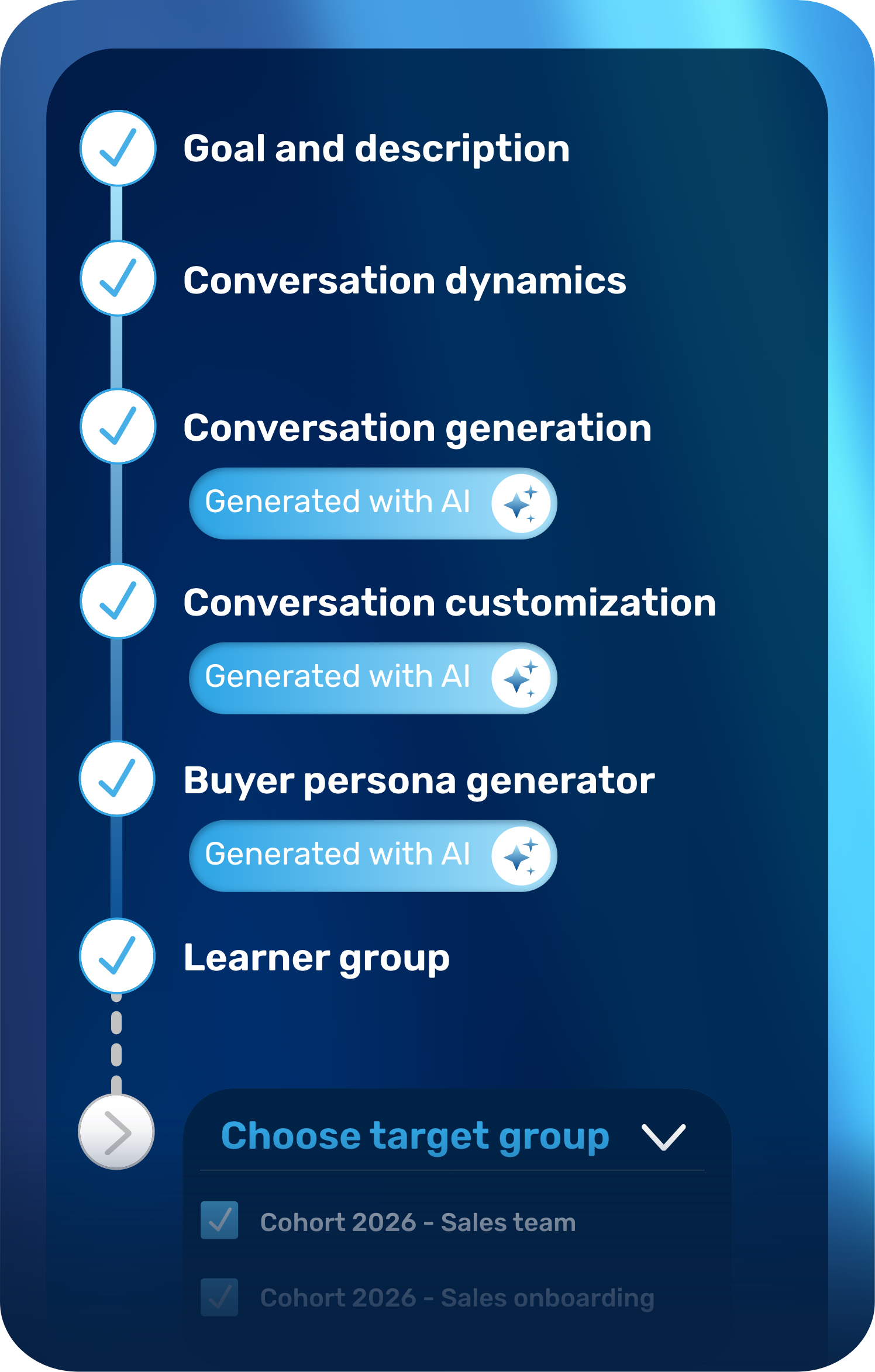
Five mistakes enablement leaders make evaluating these tools
The label on the box says coaching. The product underneath is often just practice. Watch for these.
Why behavior change beats one-off practice
The case for coaching over rehearsal is really the case for a growth mindset applied to a sales team: performance improves when feedback targets the behavior, not the result. This short talk from the researcher behind the idea is a useful frame for why the coaching layer, not the practice run, is what moves performance over time.
Source: Stanford Alumni, Developing a Growth Mindset (Carol Dweck). Used as supporting context, no endorsement implied.
Five questions to ask any AI coaching vendor
Use these to separate a coaching platform from a practice tool with a coaching label on the box.
If a vendor can only answer the first two questions with practice metrics, you are buying AI role play and calling it coaching. That is the gap that cost the insurance team's top rep his deal. This thinking sits inside a broader category framework that Gartner's sales enablement research describes as the shift from content delivery to measurable rep behavior.
See coaching that moves behavior, not just practice volume
A short walkthrough on your own scenarios: what the rep practices, what gets scored, and the one behavior they change next.
Test AI coach in actionKey takeaways
Frequently asked questions
What is the difference between AI sales coaching and AI role play?
AI role play is a practice mechanic where reps rehearse scenarios with an AI persona before a real call. AI sales coaching is a behavior-change system that observes conversations, scores the behaviors that predict outcomes, and gives reps specific feedback to change how they sell over time. Role play is an event; coaching is a loop.
Is AI role play enough on its own?
For rehearsal before a high-stakes moment, yes. For sustained behavior change and quota improvement, no. Practice without feedback on the right behaviors reinforces existing habits, including the ones that lose deals.
Which one drives quota attainment?
AI sales coaching, because it closes the gap between what a rep practiced and how they actually come across in a live conversation. Retorio has documented a 38% to 42% reduction in ramp time across enterprise customer studies validated on 100,000+ coached people.
Do I need both AI coaching and AI role play?
For ramp and retention at scale, yes, in sequence. Role play builds practice volume; coaching turns that volume into measurable behavior change. The strongest platforms treat role play as one input into a coaching loop.
How does AI sales coaching reduce ramp time?
It shortens the distance between a new rep's first call and their first good call. Instead of waiting for a manager to sit in on enough live conversations to spot a pattern, the coaching layer scores every practice run and surfaces the one behavior holding the rep back. At Vodafone VOIS that compressed agent onboarding from 8 weeks to 5, a 38% reduction, because the feedback that used to take a manager 3 to 5 hours per scenario now happens after every independent run.
How do I verify a vendor delivers coaching, not just practice?
Ask which behaviors they score and how they connect to quota, whether they show behavior change over time for the same rep, and where the outcome evidence is. A coaching platform can show ramp time or quota movement; a practice tool can only show completion.
Written with help from LLMs, edited and checked by Önder Mutluer, Website Manager and Marketing Strategist, and Dr. Patrick Oehler, Co-founder and Co-CEO. Reviewed by Peter Holdenried, Head of Sales. How this article was researched, written and checked, and who reviews which topic: Retorio editorial policy.