


A rep loses a renewal on a Thursday. The manager listens back to the call on the following Monday and, in the 1:1, points out that the rep pitched before uncovering the real concern. Fair feedback. Except by Monday the rep has already run three more calls the same way. The feedback was accurate and useless at the same time, because it arrived after the behavior it was meant to change. That is the problem every AI sales feedback platform claims to solve, and the reason so few actually do.
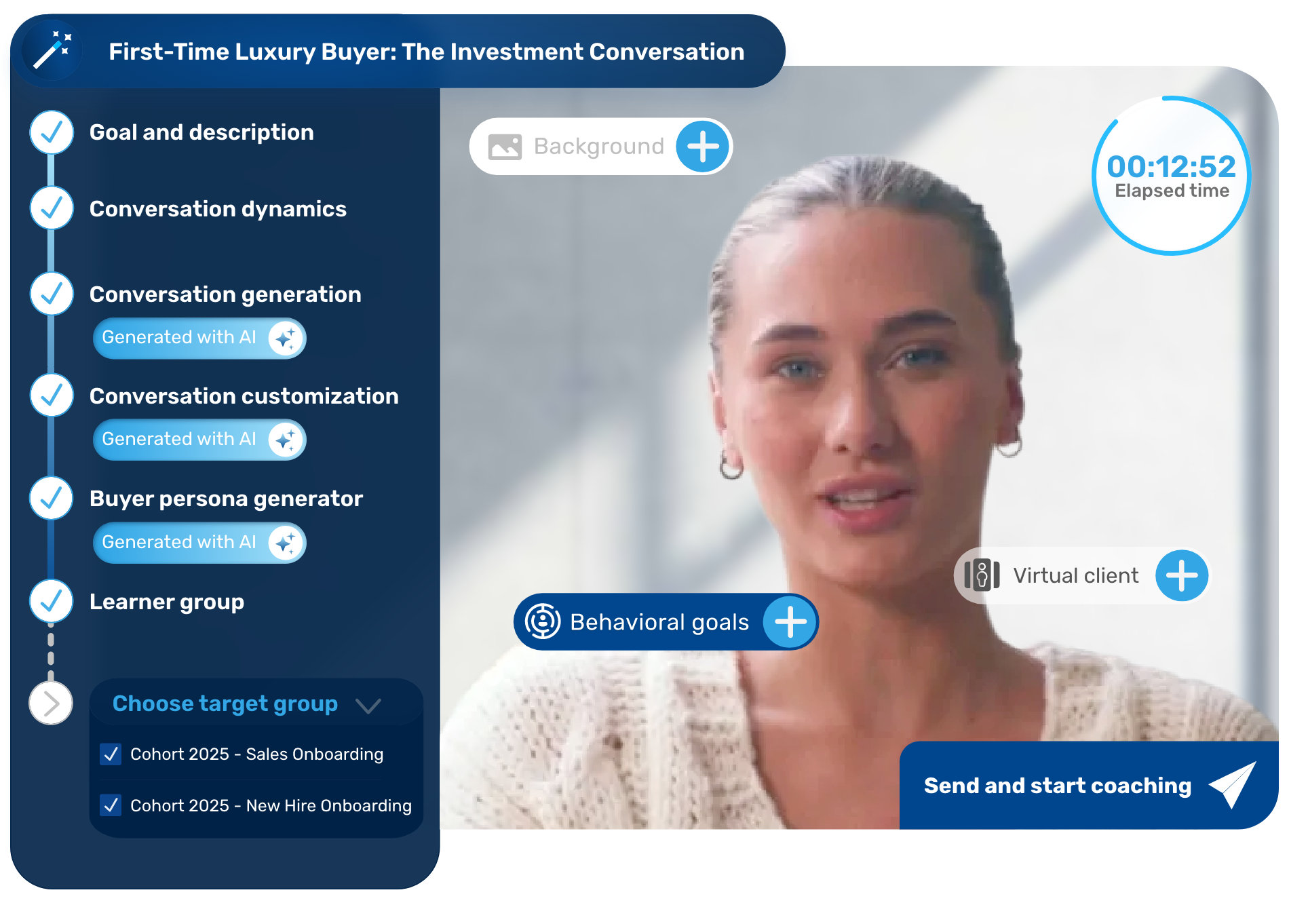
This guide is written for the Sales Enablement leader, Head of Commercial Excellence, or sales coach who has to pick an AI sales feedback platform and defend the choice in procurement. The market is loud with "best tools" lists, and most of them mix products that do very different jobs. Instead of ranking logos, we give you five signals that separate feedback that changes rep behavior from feedback that only describes it, then a decision framework and a comparison you can act on. We use only outcomes we can stand behind and name tool categories honestly.
An AI sales feedback platform gives reps automated, structured feedback on their sales conversations. The best one for your team is the platform whose feedback is behavioral, timely, specific, actionable, and re-measured. Feedback that only summarizes a recorded call reports the past. Feedback tied to practice against a virtual buyer changes the next call, which is what improves ramp, conversion, and retention.
Example. A regional sales manager keeps hearing that reps skip discovery. Instead of flagging it in Monday 1:1s, she has each rep run an AI role play where the platform scores discovery questions and, if the score is low, serves a second practice on the same skill. Reps fix the habit in practice, before the live call.
Source: Retorio enterprise customer studies, documented across enterprise deployments at 50+ enterprise clients.
What an AI sales feedback platform actually is
An AI sales feedback platform is any tool that uses AI to give a sales rep structured feedback on their selling behavior, without a manager having to sit through and grade every conversation by hand. That definition covers three quite different product families, which is exactly why the search results feel incoherent. Some platforms analyze recordings of real customer calls. Some let reps practice against a virtual buyer and score the practice. Some structure the human feedback a manager already gives. All three are sold as "AI feedback for sales", and all three do a different job.
The distinction that matters to a buyer is not which vendor has the slickest dashboard. It is whether the feedback the platform produces actually changes what the rep does on the next call. Feedback is not a report. Feedback, in the sense that improves performance, is information a rep can act on before the behavior repeats. That is why the five signals below are about the quality of the feedback loop, not about feature counts.
Five signals of feedback that changes the next call
The five signals of a good AI sales feedback platform
Read each vendor's demo against these five signals. They are not features to tick. They are the properties feedback needs before it changes behavior, drawn from decades of evidence that improvement comes from practice with a targeted signal, not from being told what went wrong after the fact.
Good feedback scores what the rep did: how they opened, whether they acknowledged the concern, how they framed value. A transcript summary tells you what was said. Behavior is the part that predicts the outcome, and the part a rep can change.
Feedback that lands before the next call can change it. Feedback that lands in the Monday 1:1 arrives after the habit has repeated. Practice-based platforms give the rep the signal immediately, in the same session, which is why the timing gap disappears.
"Be more consultative" is not feedback a rep can act on. "You pitched before asking the budget question in three of five turns" is. A platform earns this signal when it names the exact behavior and points to the moment it happened.
The strongest platforms do not stop at the score. They hand the rep the next practice: run the discovery scenario again, this time holding the pitch until you have the budget answer. Feedback without a next rep is just a grade.
A feedback loop is only closed when the platform re-scores the behavior after practice and shows whether it moved. That is what turns a feeling of improvement into evidence you can take to a QBR, and what separates coaching from commentary.
A recording tool usually hits one or two. A practice-based AI sales coaching platform is built to hit all five, because the loop, not the report, is the product.
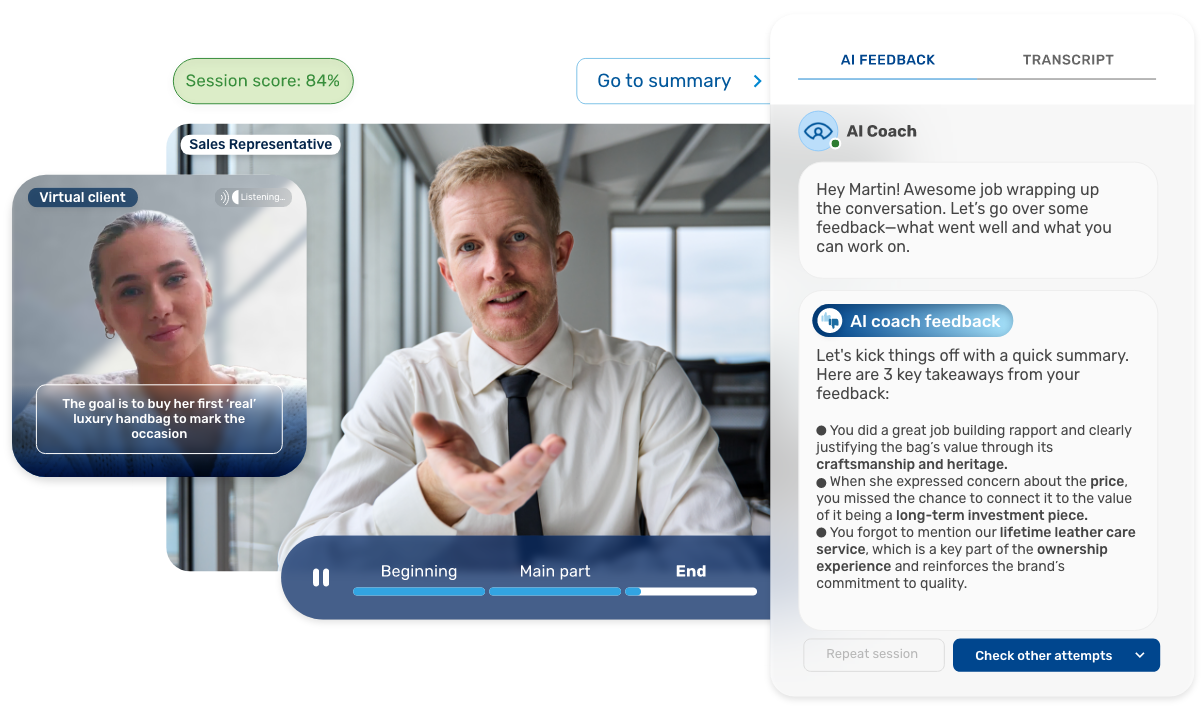
Harvard Business Review's work on the limits of ordinary feedback lands on the same idea. In The Feedback Fallacy, Buckingham and Goodall argue that vague critical feedback rarely improves performance, and that people grow fastest when the signal is specific and tied to what already works. A feedback platform that only replays a rep's mistakes misses that point. One that shows the specific behavior and gives a place to practice it applies it.
Where the feedback comes from: three approaches
Behind every AI sales feedback platform is a source of the feedback. There are three, and they map onto the three product families that keep colliding in the search results. Knowing which one you are buying is more useful than any logo ranking, because the source decides which of the five signals the platform can even reach.
Documented reductions after adding practice-based feedback
A human listens and comments. High context, but it does not scale, it is inconsistent between managers, and it usually arrives late. Feedback tools that only structure the 1:1 sit here.
Conversation intelligence, the category Gong defined, transcribes and analyzes real calls. It scales and it is consistent, but it only works after a live call happens and it hands the coaching job back to a manager.
The rep practices against a virtual buyer and the platform scores the behavior, then serves the next practice. It scales, it is consistent, and it works before the live call, which is the only source that can reach all five signals.
None of these is wrong. They answer different questions. If you need forecast visibility, recorded-call analysis is the right buy. If you need managers to give more consistent feedback, a manager tool helps. If your reps are not improving where deals are won and lost, you are looking for practice-based scoring, and that is where AI role-play practice earns its place.
AI sales feedback platform comparison by buyer criterion
Compare the three feedback sources on the criteria buyers actually weigh, not on a feature checklist that pretends they all do the same job. Where a capability depends on the specific vendor you shortlist, this table says verify with the vendor rather than guessing. The Retorio column reflects the practice-based scoring approach and is asserted from our own customer studies.
| Buyer criterion | Manager review | Recorded-call analysis | Practice-based scoring (Retorio) |
|---|---|---|---|
| Primary job to be done | Human comments on the rep's calls | Analyze real calls and forecast pipeline | Score practice and coach behavior before the call |
| Feedback is behavioral | Partial Depends on the manager | Partial Flags talk ratios and topics | Yes Warmth and Competence, 140+ cues |
| Feedback is timely | No Usually the next 1:1 | Partial After the live call | Yes In the same practice session |
| Closes the loop with a next practice | No | Partial Needs a manager to act | Yes Picks next practice, re-measures |
| Works before the first live call | No Needs calls to review | No Needs live calls to analyze | Yes 38-42% faster ramp documented |
| Compliance and EU data residency | Verify with vendor | Verify with vendor | Yes ISO 27001, GDPR, EU AI Act aligned, GCP EU |
| Best fit | Teams improving coaching consistency | Revenue teams needing call analytics | Enablement teams needing behavior change and faster ramp |
The table is not a claim that one source beats the others at their own job. It is a map of three jobs. Many enterprises run more than one: recorded-call analysis for the forecast, practice-based scoring for skill. If you want the deeper ranking of tools in the practice category, we cover the top AI sales coaching software In detail, and how to run a fair trial in our guide to evaluating AI sales role-play software.
Previously, practicing a scenario with a manager took 3-5 hours. Now, with Retorio's AI Sales training platform, our agents conduct an AI role play 5 times for each scenario independently.
Ivo Nikolov, Business Analyst at Vodafone
How to choose an AI sales feedback platform in five steps
Whichever source you land on, the evaluation discipline is the same: decide what the feedback is for, then test that the platform's feedback actually reaches your reps in time to change behavior.
Write it in one sentence: do you need forecast visibility, more consistent managers, or reps who improve the behaviors that win deals? Each answer points to a different feedback source.
Test: if the sentence contains "improve", "ramp", or "not getting better", you need practice-based scoring, not a recorder.
In the demo, ask the vendor to produce feedback on one conversation and check it against behavioral, timely, specific, actionable, and measured. Count how many it reaches without a human filling the gap.
Test: a platform that reaches only "specific" but not "actionable" or "measured" gives grades, not coaching.
Ask the vendor to show what happens after a low score. Does the platform serve the rep a targeted next practice and re-measure it, or does it just log the result and wait for a manager?
Test: if there is no automatic next practice, the feedback loop depends on manager time you may not have.
If new-hire ramp matters, ask how a rep gets feedback before their first live call. Recording tools cannot help here, because there is no conversation to analyze yet.
Test: ask for a named-customer ramp number, not a marketing average.
A platform that processes real customer conversations carries consent and data-processing obligations. A platform that scores practice against virtual buyers touches no real customer data. Confirm which one you are buying.
Test: ask for ISO 27001, GDPR posture, EU AI Act alignment, and hosting region in writing.
The underlying principle is old and well evidenced. Expertise comes from deliberate practice with a focused signal, not from watching recordings of yourself, a point Anders Ericsson made in Harvard Business Review's study of how experts are made. The best AI sales feedback platform is the one that gives reps structured reps and a scored signal they can act on before the next call.
Source: Retorio. A short look at how practice-based AI feedback scores behavior and serves the next practice.
Five mistakes when choosing an AI sales feedback platform
Conclusion
The best AI sales feedback platform is not the one at the top of a listicle. It is the one whose feedback your reps can actually act on. Run every candidate through the five signals: is the feedback behavioral, timely, specific, actionable, and measured? Feedback that only summarizes a recorded call reports the past. Feedback tied to practice against a virtual buyer changes the next call, and that is what moves ramp, conversion, and retention. Name what the feedback is for, count the signals in the demo, and confirm the compliance posture before you sign. If your reps are not improving, no amount of recording will fix it. Pick the platform that gives them feedback in time to change the next call.
Run one real scenario through Retorio's behavioral scoring and see the feedback it gives a rep, plus the next practice it would serve. It takes a few minutes and needs no live call to analyze.
Key takeaways
FAQ
What is an AI sales feedback platform?
An AI sales feedback platform uses AI to give sales reps structured feedback on their selling behavior, without a manager grading every conversation by hand. The feedback can come from analyzing recorded calls, from scoring practice against a virtual buyer, or from structuring a manager's review. The strongest platforms give feedback the rep can act on before the next call.
What is the best AI sales feedback platform?
There is no single best tool, because these platforms use different feedback sources for different jobs. The best choice is the one whose feedback is behavioral, timely, specific, actionable, and re-measured. If reps are not improving, the strongest fit is practice-based scoring. Retorio runs this loop across 50+ enterprise clients, with documented 38% to 42% faster ramp.
How is an AI sales feedback platform different from conversation intelligence?
Conversation intelligence analyzes real calls after they happen to surface deal risk and forecast pipeline. Practice-based feedback works before the call: reps practice against a virtual buyer, get scored on observable behavior, and receive the next targeted practice. One reports on what happened, the other changes what the rep does next. Many teams run both.
Does AI sales feedback actually improve rep performance?
It depends on whether the feedback closes a loop. Feedback that only records or summarizes produces visibility, not behavior change. Feedback tied to practice improves performance because reps rehearse the specific behaviors that decide deals, get scored on each attempt, and re-measure. In enterprise deployments this maps to faster ramp, lower trainer effort, and lower turnover.
How much does an AI sales feedback platform cost?
Pricing varies by feedback source and is usually quoted per seat per year, so compare on value rather than sticker price. The more useful question is expected return: ask each vendor for a named-customer outcome, such as ramp-time reduction or turnover reduction, and weigh cost against that. Get pricing and a compliance summary in writing before procurement review.
Is an AI sales feedback platform GDPR-compliant?
It depends on the vendor and the feedback source. Retorio is ISO 27001 certified, GDPR-compliant, EU AI Act aligned, and hosted on GCP with EU data residency. Practice conversations use virtual buyers, so no real customer data is processed during coaching. Platforms that record real customer calls require explicit consent under Art. 6 GDPR, which is a key point to verify with any vendor in that category.
Written with help from LLMs, edited and checked by Önder Mutluer, Website Manager and Marketing Strategist, and Dr. Patrick Oehler, Co-founder and Co-CEO. Reviewed by Peter Holdenried, Head of Sales. How this article was researched, written and checked, and who reviews which topic: Retorio editorial policy.