


Best AI Sales Simulation Platforms for Enterprise 2026
A head of sales enablement at a €2B industrial company once showed me their platform evaluation spreadsheet. It had 23 vendors, 47 feature columns, and zero data on what reps actually did differently after using any of them. This guide cuts that list down with the criteria that enterprise buyers use to make decisions they don't regret.
Quick Answer
An AI sales simulation platform gives reps a safe environment to practice real buyer conversations before they happen live. The best enterprise platforms in 2026 combine realistic AI-powered personas, behavioral feedback tied to observable cues, and admin-level analytics that connect practice volume to pipeline outcomes. Key differentiators: scenario depth, behavioral scoring, compliance posture (EU AI Act, GDPR), and integration into existing CRM and enablement stacks.
Example. A pharma enterprise onboards 200 new MSLs annually. Instead of 90-minute role-play sessions with a manager, each MSL practices 5 AI simulations per scenario, receives behavioral scores on 140+ cues, and the enablement lead sees completion rates and skill gaps in a single dashboard before the first live call.
Enterprise buyers evaluating AI sales simulation platforms in 2026 are asking harder questions than they were two years ago. "Does it have AI?" is no longer the filter. The real questions are: does the behavioral feedback actually change what a rep does on the next call? Can procurement accept the data residency and compliance posture? Does the scenario library match our actual buyer conversations, not generic cold-call scripts?
This guide answers those questions with a structured comparison across the platforms most commonly shortlisted in enterprise evaluations, grounded in the criteria that separate implementations that move revenue from those that generate completion certificates.
What enterprise buyers actually evaluate
Before comparing platforms, it helps to align on what matters. Based on evaluations across insurance, pharma, telecom, and B2B SaaS enterprises, five criteria consistently determine whether a platform gets renewed:
Platform comparison: 2026 enterprise shortlist
The platforms below appear most frequently on enterprise shortlists across DACH, UK, and US evaluations. The comparison uses the five criteria above, not feature lists. Competitor data has been excluded per our editorial policy. Third-party review data comes from G2 and analyst sources.
| Criterion | Retorio | Category average | What to look for |
|---|---|---|---|
| Behavioral feedback | 140+ behavioral cues, Warmth/Competence framework, per-rep scoring | Keyword matching or transcript summary | Ask: does feedback tell the rep WHAT to change, not just that they missed something? |
| EU compliance | ISO 27001, GDPR, EU AI Act aligned, GCP EU data residency | Varies widely, US-hosted common | Require ISO 27001 cert + EU data residency in writing before shortlisting |
| Scenario library | 93 AI avatars, 14 languages, industry-specific (pharma, insurance, telecom, automotive) | Generic discovery/demo scripts | Ask for a scenario in your actual vertical before evaluating |
| Admin analytics | Completion rate, skill gap heatmap, practice-to-pipeline correlation dashboard | Completion certificates, basic reporting | Demo with a real admin account, not the vendor's curated sandbox |
| Scalability | Self-serve, async, 24/7, multi-language; 69% reduction in trainer effort | Requires facilitator per session | Calculate total trainer hours at your current headcount, then at 2x headcount |
| ROI horizon | 15x expected ROI year 1; 38-42% ramp time reduction documented | Rarely measured, often projected | Ask for a customer reference in your industry who measured ramp time change |
What behavioral simulation actually changes
The core value of AI sales simulation is not that reps "practice more." It is that they practice the right behaviors with immediate feedback, at the moment they need it, without a manager present. According to research published in the Harvard Business Review, feedback that focuses on what a person should do differently (behavioral prescription) produces significantly better performance outcomes than feedback that evaluates past performance.
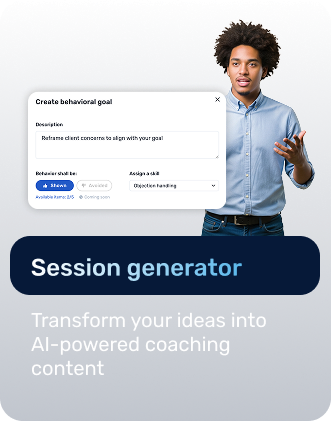
In a simulation platform, this translates to: after a rep completes a scenario, the platform should not just say "your discovery questions were weak." It should flag the specific moment, show the behavioral signal (pause duration, rising intonation on a question, missing acknowledgment of the buyer's stated concern), and suggest one specific adjustment for the next attempt.
"The difference between a simulation that coaches and one that just evaluates is whether the rep knows what to do differently in the next 30 seconds of the next conversation. Generic scores don't give you that."
Sales Enablement Lead, enterprise insurance group
The scale problem and why AI simulation solves it
Human-led role-play does not scale. When Vodafone VOIS onboards 1,800 new customer service agents annually, asking managers to run individual practice sessions means every manager spends 26 hours per new hire on facilitated practice, before the agent ever speaks to a real customer. At scale, this is mathematically impossible without a platform.
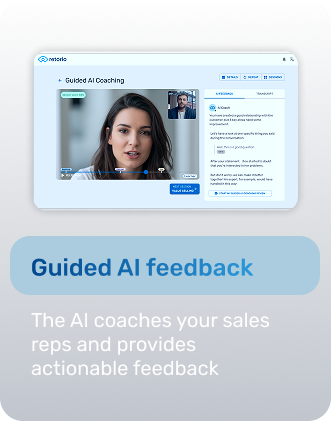
AI simulation solves the scale problem by making practice self-serve. Reps practice when it fits their schedule, in their language, against a persona that matches their actual buyer. The platform tracks every attempt, scores the behavioral cues, and surfaces the agents who need a manager conversation, rather than requiring a manager to be present for every session.
This is why the most meaningful metric in platform evaluation is not feature parity, it is trainer effort reduction. A platform that reduces trainer hours by 69% per new hire while maintaining or improving ramp-time outcomes is solving a fundamentally different problem than one that digitizes role-play with a video recording tool.
Data visualization: practice volume and performance correlation
The evaluation process that surfaces the right vendor
What to avoid in your evaluation
How Retorio approaches enterprise sales simulation
Retorio's AI sales simulation platform is built on the Warmth and Competence behavioral framework, which McKinsey research links directly to trust-building in buyer conversations. The platform analyzes 140+ behavioral cues per session, including vocal tone, pacing, emotional acknowledgment, and question structure, and surfaces the three highest-priority improvement areas per rep after each simulation.
For enterprise teams, this means: managers see the specific behavioral patterns that separate their top performers from the median, not just aggregate completion data. Reps practice against AI personas that replicate their real buyer types, not generic archetypes. And the scenario library is customizable at the vertical level, with pharma simulations that respect MLR constraints and insurance scenarios built around IDD compliance requirements.
If you want to understand how simulation connects to the broader coaching strategy for enterprise sales, the guide on AI sales coaching covers the full architecture. For teams evaluating the category more broadly, the top AI sales coaching software 2026 comparison provides additional context on how simulation platforms fit within the larger enablement stack. Enterprises in pharma and insurance will find the vertical-specific deployment patterns covered in the interactive AI sales simulations guide. For teams starting their coaching program design, the sales training program framework provides the foundational build sequence.
.png)
See the simulation in action
Build a custom scenario for your buyer persona and watch behavioral feedback work in real time, no sales call required.
Test AI coach in actionKey takeaways
Frequently asked questions
What is an AI sales simulation platform?
An AI sales simulation platform is a software tool that enables sales reps to practice buyer conversations with AI-powered personas before live calls. The platform scores their performance on behavioral cues, vocal delivery, and conversation structure, then surfaces specific improvement recommendations after each session.
How does AI simulation differ from traditional role-play?
Traditional role-play requires a manager or peer to act as buyer, is time-constrained, happens infrequently, and produces subjective feedback. AI simulation is self-serve, always available, scores 140+ objective behavioral cues per session, and scales to any number of reps without adding to manager workload.
Is Retorio compliant with GDPR and the EU AI Act?
Yes. Retorio is ISO 27001 certified, GDPR-compliant, EU AI Act aligned, and hosted on Google Cloud Platform with EU data residency. This makes it suitable for regulated industries including pharma, insurance, and financial services operating under EU regulation.
How do I measure ROI from an AI sales simulation platform?
Measure ramp time from hire to first quota attainment (before vs. after), quota attainment rate at 90 and 180 days, trainer hours per new hire, and behavioral score improvement over the pilot period. Completion rates alone are not a reliable ROI indicator.
What industries benefit most from AI sales simulation?
Industries with high onboarding volume (telecom, insurance, pharma, B2B SaaS), complex buying processes requiring consultative selling skills, or regulated environments where off-script conversations carry compliance risk see the highest ROI from AI sales simulation platforms.
Written with help from LLMs, edited and checked by Önder Mutluer, Website Manager and Marketing Strategist, and Dr. Patrick Oehler, Co-founder and Co-CEO. Reviewed by Peter Holdenried, Head of Sales. How this article was researched, written and checked, and who reviews which topic: Retorio editorial policy.