


Hard skills are measurable, job-specific abilities that are easy to define, like coding, languages, and sales. Soft skills are harder-to-measure interpersonal abilities, like communication, teamwork, and adaptability. Employers want both. The post cites research that 85% of job success comes from soft skills. Retorio trains soft skills through AI video simulations and client role-plays.
Example. A sales manager knows the CRM inside out, but when a rep misses quota three weeks running, it is her ability to listen, ask the right questions, and adjust her feedback style that turns things around. The first skill got her the job. The second one makes her team work.
Hard skills and soft skills are terms we often hear when talking about job requirements, training, and work; but what exactly are these things?
What is an example of a hard skill, or a soft skill, and when are they important? Are we born with them? Can they be learned?
And more simply, what is the difference between the two types of skills?
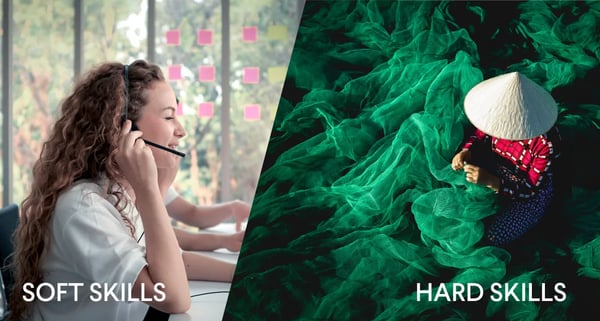
In this article, we'll get straight into answering these burning questions.
What’s in this post?
What are hard and soft skills?
The primary and easy-to-understand difference between hard and soft skills is that hard skills are those measurable skills that can be easily defined and specific.
On the other hand, soft skills are those invisible, harder-to-define skills that tend to be harder to measure - the interpersonal skills that help you get along with your colleagues and bosses, how well you understand and contribute to the company culture, how well you can adapt to new changes, and your sense of creativity, all come under the umbrella of soft skills.
Whereas the job-specific skills you’ve acquired for a role, which could be your ability to speak a foreign language, or how well you can do sales, are all skills that are counted as hard skills.
| Dimension | Hard skills | Soft skills |
|---|---|---|
| What it is | A measurable, job-specific ability | An interpersonal ability that shows up in behaviour |
| How you prove it | Certificate, test, portfolio, degree | Observed behaviour in a real situation |
| How you learn it | Courses, manuals, structured study | Practice, feedback, repetition |
| How fast it transfers | Fast. Teach it once and it sticks | Slower. It needs repetition in context |
| Where it decides the outcome | Getting shortlisted for the role | Earning trust, the deal, the promotion |
| Examples | Coding, a second language, financial modelling | Communication, adaptability, conflict resolution |
Hard skills and soft skills differ less in importance than in how you prove them and how you build them.
Examples of hard and soft skills
Examples of soft skills may include:
Examples of hard skills may include:
Hard and soft skills - which matters in 2022?
It's not an either-or situation; even with the most polished hard skills, without the corresponding soft skills to go with it, you won’t be successful at your job, and vice versa.
See how AI sales coaching works for your team.
Test AI coach in actionEmployers are looking for both hard skills and soft skills, but the value of each differs by the employer and the everyday needs of the workplace.
The importance of each type of hard skill for a job role also depends on the industry and role.
For instance, an engineer who isn’t proficient in programming languages isn’t going to interest employers looking for a skilled engineer. Related reading on coaching-driven training.
But what are the changes we're seeing in the hiring and training scene in terms of skill shift?
Around the early 2000s, job fit was generally based on degree requirements and hard skills, which was particularly pronounced after the Great Recession of 2008 - 2009. Thus, traditional employee training tended to always revolve around training those hard skills.
This trend sometimes referred to as "degree inflation" has seen a tide turn over the following years.
Companies started to consider what capabilities they were truly after, and employers began to realize that it wasn't simply the qualifications and measurable skills they wanted. It was factors such as communication skills, flexibility to adapt to new unfamiliar changes, how well a worker could get along with their team, and whether or not they possessed leadership qualities that grew in importance.
In fact, research conducted by Harvard University, the Carnegie Foundation, and Stanford Research Center has all concluded that 85% of job success comes from having well-developed soft and interpersonal skills, and surprisingly just 15% of job success comes from hard skills.
The same shift shows up at the top of the house. Harvard Business Review’s study of C-suite role requirements concluded that, more than ever, companies need leaders who are good with people, not simply leaders with the deepest technical expertise. And McKinsey’s research on future-of-work skills identified 56 foundational skills, and found that higher proficiency in them already tracks with a higher likelihood of employment, higher income and greater job satisfaction. Most of those 56 are not technical.
Further, a study by Yale University found that employees with emotionally intelligent supervisors were happier, more creative, and more innovative. And in a 2022 market research when 2,000 UK adults were asked "What skills do you think are the most important for a manager at work to possess, if any?", 'leadership skills' were considered the most important soft skill for managers in the workplace to possess, closely followed by verbal communication and teamwork skills. Real coaching examples expands this point. For deeper context, see sales coaching examples.
This then proceeded to encourage job applicants to be aware of developing these soft skills, and adding them to their CVs.
How can you train your soft skills?
So now we know how to identify and differentiate hard and soft skills, but how can we train them? How can we train these important soft skills that are so vital to the 2022 workplace environment?
Soft skill training has picked up a lot of traction over the past few years as employers have recognized its importance, and as a result, more and more companies are turning to various new ways to train these soft skills. Our full guide to soft skills training walks through the formats and where each one breaks down. Organizations have invested in various e-learning platforms as well as increased budgets for training methods, however, both aren't without their limitations.
How can AI help train soft skills?
The revolution of artificial intelligence (AI) is not in its infancy, and recent AI simulation technology is focussing heavily on agent skill mastery and changing the game for training programs.

With Retorio Coaching Platform, you can improve your employees' soft skills by doing online exercises.
Product development teams globally are ceaselessly diving deeper into the capabilities of AI to create solutions to improve soft skills as consumer demands become more complex, varied, and valuable. Training simulations are taking center stage in the call for smarter coaching approaches for customer-facing employers to deliver superior empathetic customer experiences.
These immersive learning strategies are creating ways for employees to solve real work issues that they may face, while in virtual settings. For deeper context, see this sales coaching playbook.
As the use of machine learning and deep learning makes logical progression, development teams are taking on complex approaches and are seeing not just breakthrough results, but products and services in wide use.
With just a piece of software, AI-powered video simulations allow anyone on their own to run the application and train skills at their own pace, in their own space.
That's why video simulations are so widely used by airline pilots, disaster response teams, and other industries where trainees need to create real-life scenarios to improve their capabilities, such as decision-making (which is difficult in traditional, passive, training settings). Even in the medical world, schools are reaping the rewards of integrating video simulation into their learning programs where they lack labor capital and significant space.
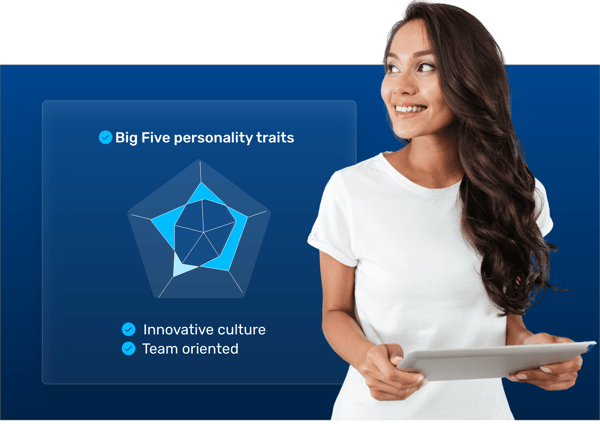
Take, for instance, Retorio, a start-up based in Munich, that helps organizations around the globe take soft skill training to the next level by using advanced AI technology.
By combining video analysis with role-plays of client simulations, Retorio offers interactive training solutions for customer-facing positions, such as sales, consulting, etc where employees can practice training even vital soft skills in a psychologically safe environment, anytime, anywhere.
Want to see how you could use AI to your advantage?
Frequently asked questions
What is the main difference between hard skills and soft skills?
Hard skills are measurable, job-specific abilities you can test, such as coding, a second language, or financial modelling. Soft skills are interpersonal abilities that show up in how you work with people, such as communication, adaptability and conflict resolution. Hard skills usually get you shortlisted. Soft skills usually decide how far you get after that.
What are examples of hard and soft skills?
Common hard skills include coding, copywriting, graphic design, project management, presentation skills and patient care. Common soft skills include communication, teamwork, time management, problem-solving, stress management, critical thinking and openness to criticism. The two lists earlier in this article give 20 examples in total.
Are soft skills more important than hard skills?
Neither one substitutes for the other. The research reported by the National Soft Skills Association attributes 85% of job success to soft and interpersonal skills and 15% to hard skills, but a salesperson with great rapport and no product knowledge still loses the deal. Employers hire for both, and the mix shifts by role and by industry.
Can soft skills be trained, or are you born with them?
They can be trained. A soft skill shows up as observable behaviour: whether you asked an open question, whether you acknowledged the objection before answering it, whether you paused. Behaviour responds to practice and feedback, which is why soft skills improve when reps get repetition and a clear score rather than a lecture.
How do you show hard and soft skills on a CV?
List hard skills as verifiable facts: tools, certifications, languages, measurable results. Show soft skills with evidence instead of adjectives. Rather than writing “excellent communicator”, describe the difficult conversation you handled and what changed because of how you handled it.
How does AI coaching train soft skills?
An AI coach puts a rep into a role play, scores the behaviour it observes across 140+ behavioural cues, and returns feedback in the same session. That removes the scheduling bottleneck of classroom practice: a rep can repeat the same scenario as often as they need, in their own time, and see what moved between attempts.
Soft skills improve with repetition, not with slides.
See what one AI role play and one behavioural score look like for your own team.
Test AI coach in action