


Most soft-skill assessments measure the wrong thing
They rate what a rep knows about listening, empathy, or objection handling. They rarely measure what the rep actually does in a live conversation. AI role-play flips that. It watches the behavior, scores it against a named rubric, and shows the rep what to change before the next real call.
Quick Answer
AI role-play soft skills assessment works by putting a rep into a realistic practice conversation, then scoring their observable communication behaviors, questions asked, objections acknowledged, value framed, and clear next steps, against a defined rubric. It measures what people do, not who they are, and returns coaching feedback rather than a personality label.
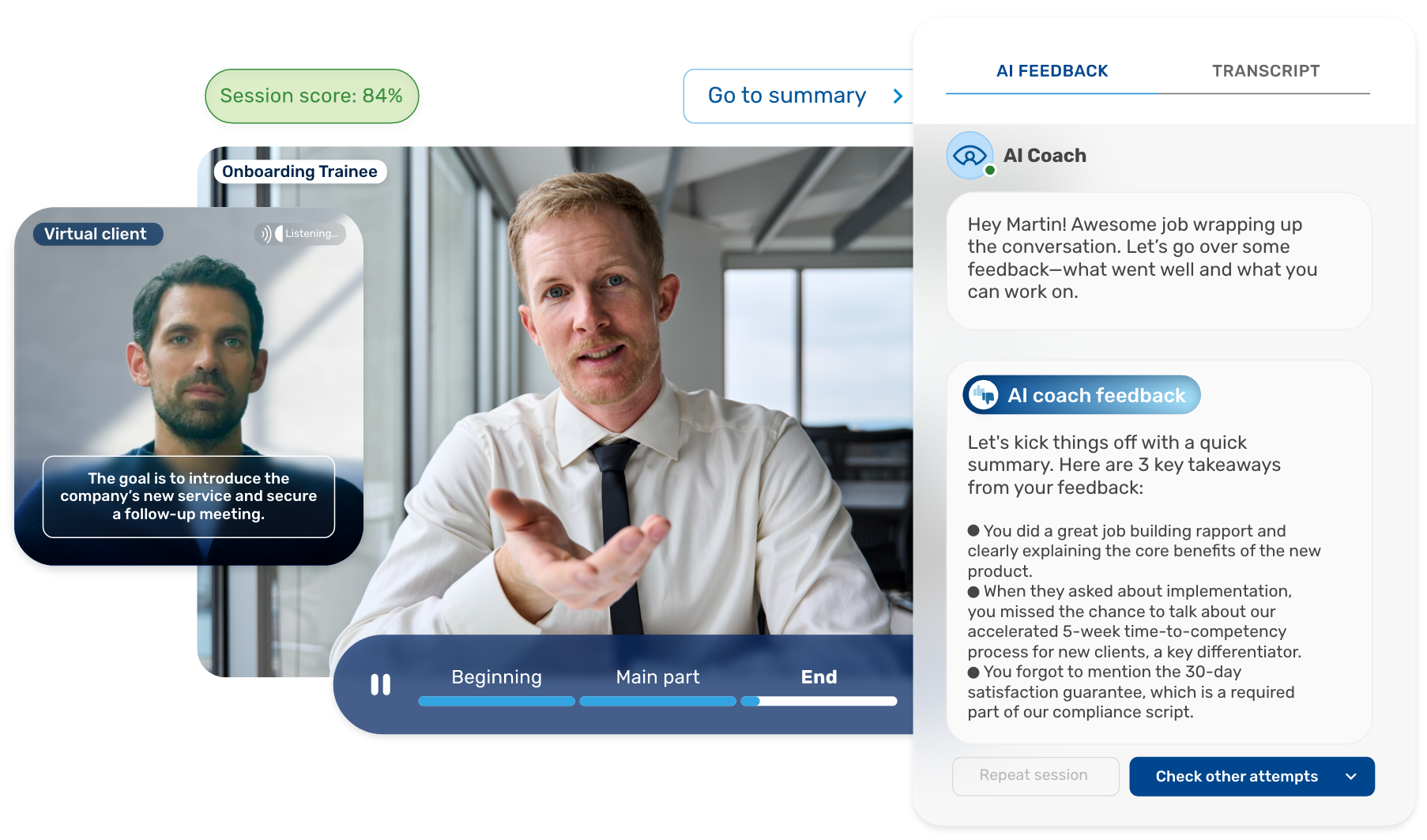
Example. A new insurance agent runs a claims-call role-play. The AI coach flags that she acknowledged only 2 of 5 customer objections and never confirmed a next step. Her rubric shows two weak behaviors to practice. She reruns it twice that afternoon and closes the gap before her first live customer.
Every enablement leader has sat through the same review. A manager says a rep is "great with people" or "needs to work on presence". Both are guesses. Neither survives the question a Head of Commercial Excellence will ask next: what exactly is the rep doing, and how do we know it is getting better?
Soft skills matter more, not less, as buying gets more complex. McKinsey's research on the skills the workforce will need groups communication, interpersonal effectiveness, and adaptability among the foundational skill categories that predict career and revenue outcomes (McKinsey, on future-of-work skills). The problem was never whether soft skills count. It was that nobody could measure them at scale without a room full of trained observers. That is the gap AI role-play closes.
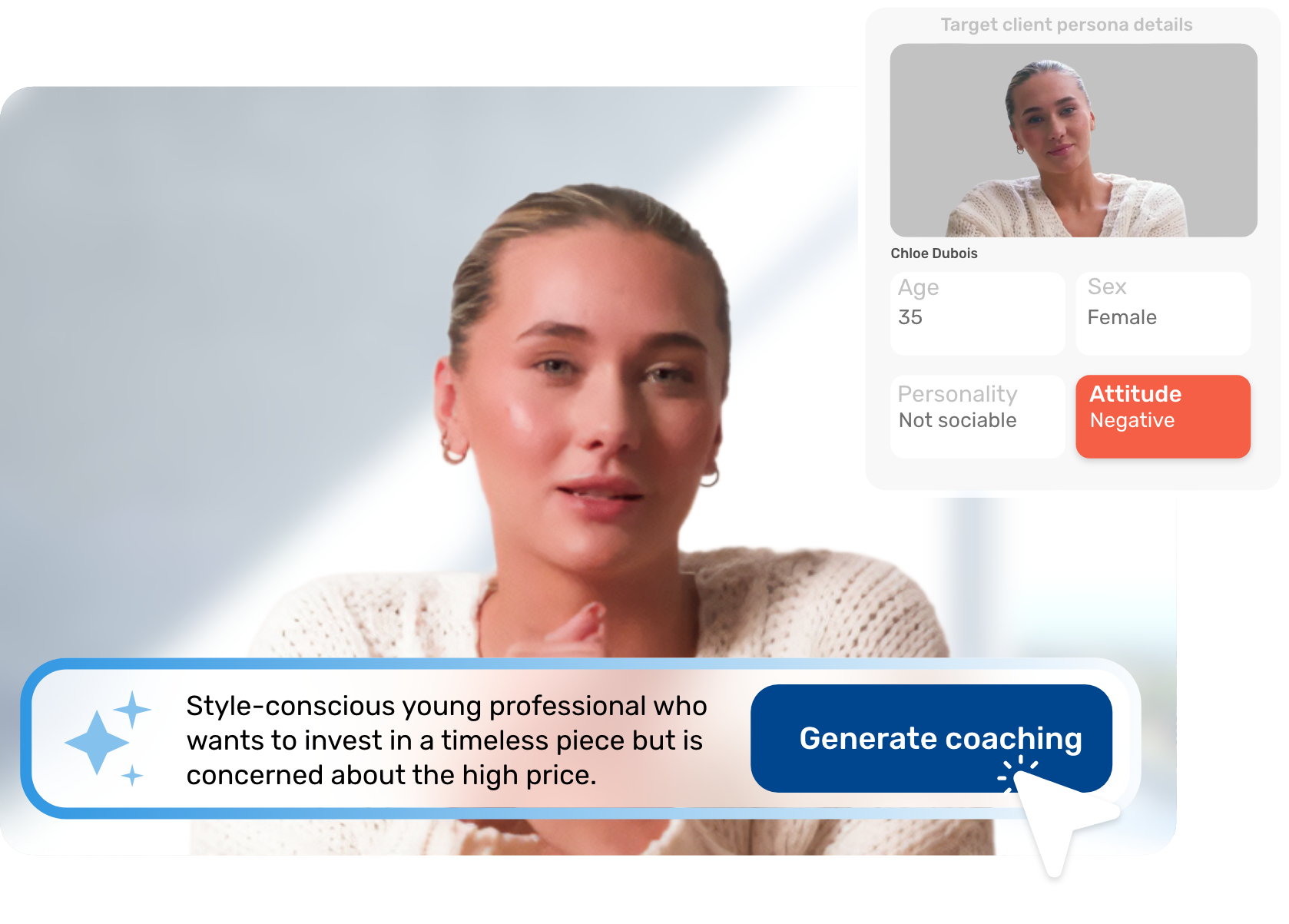
What "assessing soft skills" actually means here
First, the boundary, because it decides whether the whole approach is credible. Retorio does not do personality profiling, emotion detection, or facial recognition. None of those would be defensible under the EU AI Act, and none of them measure job performance anyway. What an AI role-play assesses is observable behavior: the words a rep chooses, the questions they ask, how they respond to a push-back, the pace they match, and whether they land a clear next step.
This is the difference between behavioral signals and inference. A behavioral signal is a thing that happened in the conversation and can be pointed at in the transcript. An inference is a claim about the person's inner state. Assessment that survives scrutiny stays on the first side of that line. Retorio analyzes 140+ behavioral cues across what a rep says, how they say it, and their non-verbal communication, grounded in the Big 5 Model of behavioral science rather than any pop-psychology label.
The boundary is not a marketing choice, it is a legal one. Systems that infer emotion or profile personality in a work context sit in restricted territory under the EU AI Act. Scoring observable communication behaviors and returning coaching feedback does not. This is why a defensible assessment reports "acknowledged 2 of 5 objections" and never "low empathy". The first is a fact about the conversation. The second is a claim about the person.
People coached on the Retorio platform across enterprise deployments.
Companies using AI role-play to assess and coach soft skills across sales, service, and leadership.
Observable communication signals analyzed per conversation, verbal, vocal, and non-verbal.
The mechanism: how a conversation becomes a score
An AI role-play assessment is not a quiz with a conversation skin. It is a measurement loop that runs the same way every time, which is what makes the scores comparable. There are four moves, and every serious assessment runs all four.
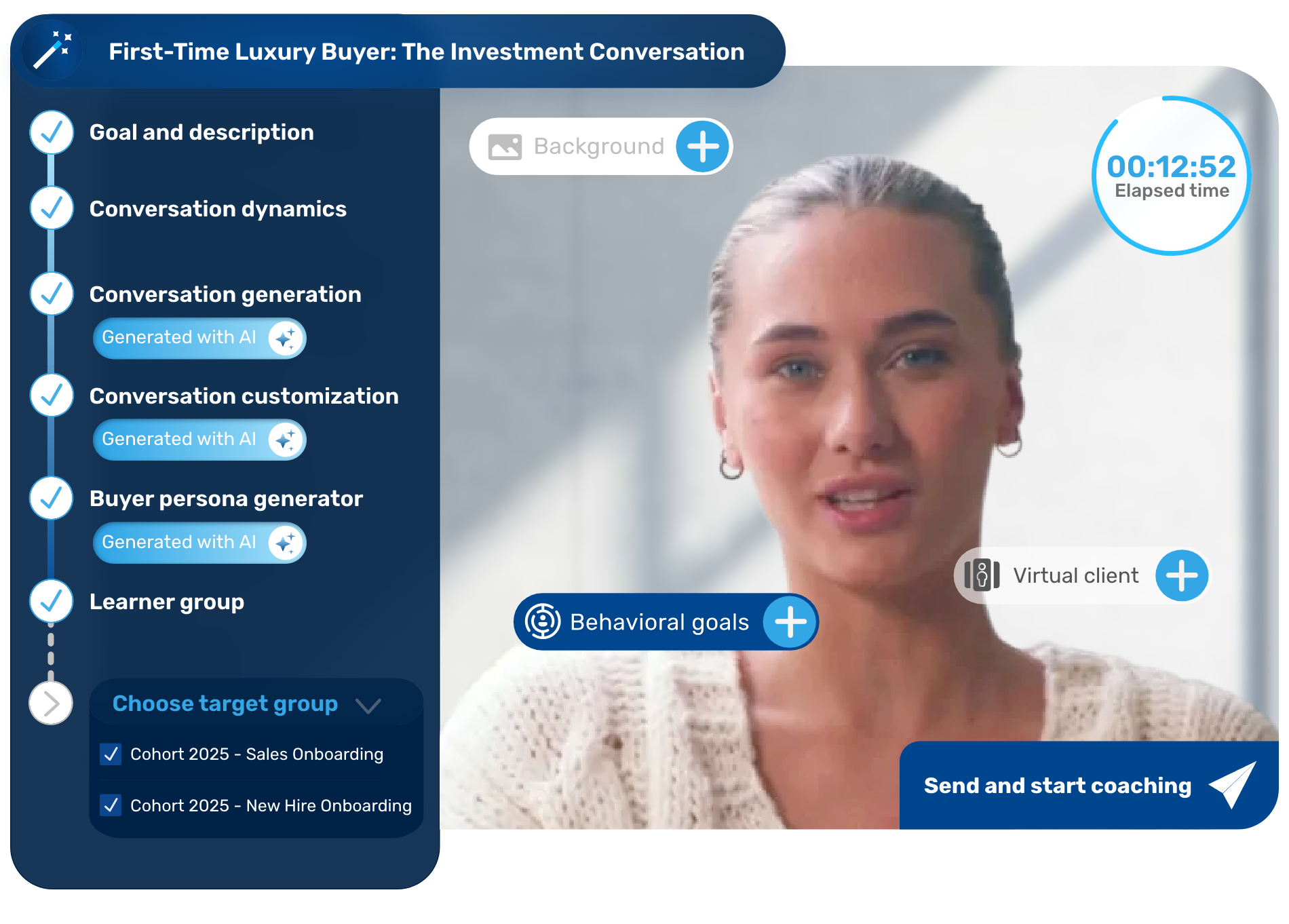
The rep enters a scenario built for their role, an insurance renewal, a discovery call, a service escalation, a difficult manager conversation. They talk to a virtual counterpart that responds in real time. The AI coach records observable behaviors as they happen, maps each one to a soft-skill dimension, and scores that dimension against a rubric with defined tiers. The rep leaves with a profile, not a verdict, and the profile names the two or three behaviors to practice next. That profile is what turns a fuzzy label like "good with people" into something a manager can coach.
Run that loop repeatedly and you get a proficiency progression. A rep does not jump from novice to expert. They climb, one behavior at a time, and the assessment makes each rung visible.
Soft-skill proficiency is a staircase, not a switch
The 6 soft-skill dimensions a role-play can score
A defensible assessment names its dimensions before it scores anyone. Vague categories ("communication", "attitude") cannot be coached because two managers will read them differently. These six are observable on any conversation, they map to behaviors a rep can change, and every one of them shows up in the transcript.
Does the rep restate what the customer said before responding? Open, non-leading questions per minute of talk time is the observable proxy.
Does the rep name the customer's concern in the customer's terms before pivoting to a solution? Measured as acknowledgment language, not tone guessing.
Percentage of push-backs the rep acknowledges and addresses versus talks over. Reps above 70% keep conversation momentum.
Are value points tied to a specific need the customer raised, or generic pitch? Ratio of tied claims to total claims is the score.
How the rep responds to pressure or a hostile turn: recovery time, pace match, and whether they stay on the customer's agenda.
Explicit asks for a concrete next action. Coached reps land 2 to 4 per conversation. Uncoached reps land 0 to 1.
Plotted together, the six dimensions form a profile. That is the single most useful artifact an assessment produces, because it shows where coaching pays back. The chart below overlays a typical profile before a coaching cycle and after twelve weeks of targeted practice.
A soft-skill profile before and after a coaching cycle
How accurate is it? Reading three channels at once
This is the question procurement asks, and it is the right one. A soft-skill score is only useful if it reflects what actually happened. Retorio's analysis runs across three channels of a conversation, and each has a documented accuracy range from enterprise validation. The multimodal approach matters: a rep can say the right words in a flat, disengaged way, and single-channel tools miss that.
Reading accuracy, by conversation channel
Two points keep the numbers honest. First, accuracy is about reading a behavior correctly, not judging a person. The system reports "this rep acknowledged 2 of 5 objections", not "this rep lacks empathy". Second, the read is consistent. A human observer scores differently on a Friday afternoon than a Monday morning. The AI coach applies the same rubric to every conversation, which is what lets a manager compare two reps or one rep across twelve weeks and trust the comparison.
Source: Retorio. A short look at how the AI coach runs a conversation and returns behavioral feedback.
Human assessment vs AI role-play assessment
None of this replaces a good manager. It replaces the parts of assessment that humans do badly at scale: consistency, volume, and the memory to compare a rep to themselves three months ago. The two work together, and the table shows where each earns its place.
| Dimension | Human observation | AI role-play assessment |
|---|---|---|
| Consistency | Varies by observer, mood, and time of day | Same rubric on every conversation |
| Volume | A few coached calls per rep per month | Unlimited practice, scored every time |
| Feedback speed | Days later, if the manager has time | Seconds after the rep ends the session |
| Safe to fail | Reps guard behavior when watched by a boss | Private practice, no live customer at risk |
| Where humans win | Context, judgment, motivation, the hard conversation | Frees the manager to spend time exactly there |
Stop asking whether a rep is good with people. Ask which two behaviors moved this month, and show me the score.
A Head of Sales Enablement, in a vendor evaluation, 2026
What the assessment looks like across week 1, 4, 8, and 12
An assessment that only fires once is a snapshot. The value is in the slope. Here is what an enablement leader actually sees as a rep moves through a coaching cycle.
Week 1, the baseline
What happens: The rep runs three practice conversations. The AI coach scores all six dimensions on each and produces a starting profile.
What surprises most reps: objection handling and confident close usually sit lower than they expected. Active listening is often closer to target than they thought.
Week 4, two dimensions move
What happens: The rep practices twice a week against scenarios that target their two lowest dimensions. The manager reviews two scored sessions and focuses live coaching on the same two.
Measurement: two of the six dimensions have moved at least one tier from the baseline. The rest hold their starting band.
Week 8, the profile fills out
What happens: The two weakest dimensions are now in the target band. Coaching focus rotates to the next two. Practice volume steadies at two sessions a week.
Measurement: all six dimensions show a positive 30-day slope. This is the leading indicator that week 12 will deliver. If half are still flat, escalate the deployment review.
Week 12, the business outcome
What happens: The rep's profile reaches the outer ring on most dimensions. The manager coaches on judgment and context, the parts only a human can.
Measurement: across enterprise deployments, this is where documented ramp-time reductions of 38% to 42% and behavioral improvement that compounds roughly 2% per session show up as quota and retention.
Mistakes that make soft-skill scores meaningless
Plenty of deployments produce numbers that no one trusts. These are the patterns that hollow out an assessment, and they are all avoidable.
How to evaluate a vendor's soft-skill assessment
The research on how expertise actually forms is settled, and it points at one thing: focused repetition against specific feedback, not time served. The Harvard Business Review summary of decades of deliberate-practice research makes the case that expert performance comes from practicing the exact weakness with feedback in the loop (HBR, The Making of an Expert). A soft-skill assessment is only worth buying if it feeds that loop. Use this checklist in the demo.
For the practice layer that feeds these scores, our guide to AI role-play for sales practice covers scenario design in depth. If you are building the broader capability picture, what soft-skill training looks like today and the mechanics of soft-skills development at scale are the natural next reads. And for the scoring engine itself, how a Behavioral Intelligence platform reads observable behaviors explains the science under the rubric.
The takeaway
AI role-play does not decide whether someone is a people person. It measures what they do in a conversation, scores it against a rubric a rep can see and practice, and tracks the slope over weeks. That is the difference between a label and an assessment. It is also the difference between a manager guessing and a Head of Commercial Excellence pointing at a number and coaching it. Soft skills were always the skills that moved revenue. Now they are the skills you can measure.
See how the assessment scores a live conversation
Run an AI role-play, watch the six-dimension profile come back in seconds, and see exactly which behaviors to coach next.
Test AI coach in actionAssess behavior, not personality. AI role-play scores observable communication behaviors against a named rubric. It never infers emotion or personality, which is what keeps it defensible under the EU AI Act.
Six dimensions, one profile. Active listening, empathy, objection handling, clarity, composure, and confident close plot into a profile that shows where coaching pays back.
The slope is the signal. A single score is a snapshot. Assess repeatedly and the 30-day trend per dimension is what predicts the week-12 business outcome.
Buy the loop, not the wrapper. A transcript is not an assessment. Insist on a visible rubric, a per-rep trend view, and a documented compliance posture.
Frequently asked questions
Can AI really assess soft skills, or is that just a claim?
It can assess observable behaviors that soft skills produce in a conversation: questions asked, objections acknowledged, value tied to needs, and clear next steps. It does not assess personality or inner state. The scores reflect what a rep did, are consistent across conversations, and are validated with documented accuracy above 95% for verbal and non-verbal channels and above 80% for vocal analysis.
Is this personality profiling or emotion detection?
No. Retorio does not perform personality profiling, emotion detection, or facial recognition. It analyzes observable communication behaviors, grounded in behavioral science, and returns coaching feedback rather than a label about the person. This distinction is what makes the assessment defensible under GDPR and the EU AI Act.
How is an AI role-play assessment different from a personality test?
A personality test asks what a person tends to be like. An AI role-play assessment measures what a rep actually does in a realistic scenario and scores it against behaviors they can practice and change. One produces a fixed type, the other produces a coachable profile with a next step.
How long before soft-skill scores show real improvement?
In enterprise deployments, two of six dimensions typically move a tier by week 4, and all six show a positive 30-day slope by week 8. Week 12 is where behavioral change shows up as business outcomes, alongside documented ramp-time reductions of 38% to 42%.
Does AI role-play replace human coaches?
No. It handles consistency, volume, and instant feedback, so managers spend their time on judgment, motivation, and the hard conversations that only a human can coach. Teams that pair the two see the strongest results.
Written with help from LLMs, edited and checked by Önder Mutluer, Website Manager and Marketing Strategist, and Dr. Patrick Oehler, Co-founder and Co-CEO. Reviewed by Dr. Florian Abicht, Chief AI Officer. How this article was researched, written and checked, and who reviews which topic: Retorio editorial policy.