


An enterprise sales training program is built in five phases: needs analysis, a competency model of observable behaviors, delivery design matched to skill type, a reinforcement loop that keeps behavior alive after the workshop, and measurement tied to ramp time and quota, not completion rates. Skipping reinforcement is the most common reason programs fail to move a number a CRO cares about.
Example. An enablement leader defines "objection handling" as three observable behaviors instead of a vague trait, builds practice scenarios around them, and has an AI coaching layer score every rep's live attempts for eight weeks. Quota attainment for that cohort moves before the next QBR.
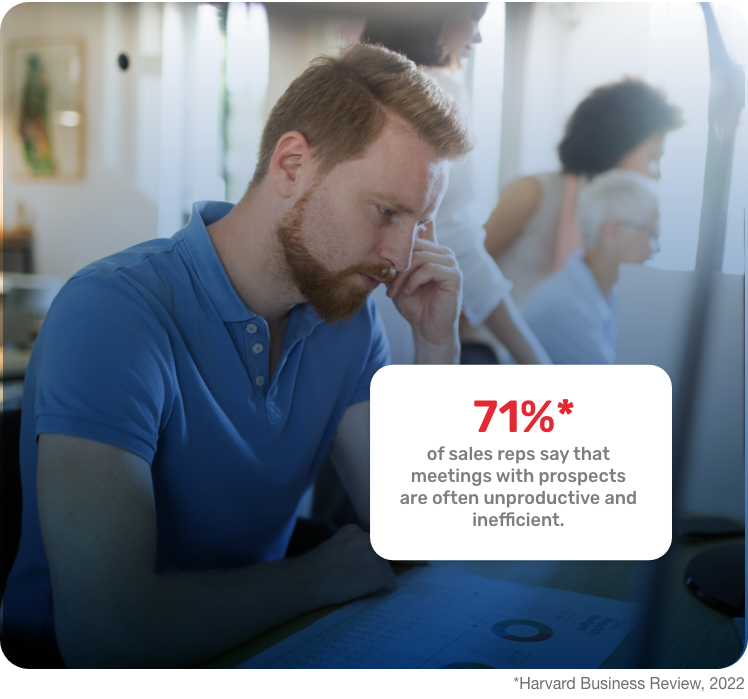
Most enterprise reps report unproductive meetings. A training program that stops at a workshop does not fix that. A program with a reinforcement loop does.
A Head of Sales Capabilities at a 1,400-rep industrial technology company once described her mandate in one sentence: "I have a budget, a deadline, and a CRO who wants to see quota move, not a completion dashboard." That is the honest version of what "build an enterprise sales training program" means in 2026. Nobody is asking for a curriculum. They are asking for a system that changes what reps do on calls and shows up in the numbers within two quarters.
Most programs never get there because they are built backwards: a committee picks a topic, a vendor builds a workshop, reps sit through it, a survey asks if they liked it, and the program is declared done. Nothing in that sequence touches behavior. This guide is the sequence that does: needs analysis, competency model, delivery design, a reinforcement loop built around AI coaching, and measurement a CRO will actually trust.
Build, buy, or both: the decision before Phase 1
Search for an enterprise sales training program and most of what comes back is a program you can buy: an outside curriculum, a sales school, a certification track. Those can work. What none of them can do is decide which behavior gap is costing you revenue, or run the reinforcement loop inside your CRM and your manager cadence after the invoice clears. So the first decision is not which vendor. It is which parts of the program you own and which parts you rent.
Most sales enablement teams land in the third option below. The content layer is straightforward to buy and slow to build. The competency model and the reinforcement loop are the reverse: quick to build once you have your own call data, and close to useless when they arrive as a generic template.
Choose it when you need shared language and a credible curriculum quickly, or the gap is product and process knowledge rather than conversational behavior.
What it will not do is name your gap, score your reps against your own competency model, or keep the behavior alive after the last session.
Choose it when your sales process is specific enough that generic scenarios ring false to reps, and one named person owns the program after launch.
What it will not do is move fast. Expect 10 to 14 weeks before the first cohort, plus manager hours you probably have not budgeted.
Choose it when you want the curriculum off the shelf but the competency model, the practice scenarios, and the measurement tied to your own pipeline.
What it will not do is absolve you of Phase 2. A bought curriculum mapped to a competency model nobody defined is still just a workshop.
Whichever option you land in, Phases 1, 2, and 5 stay yours: the gap, the model, and the measurement. An outside vendor can deliver Phase 3, and an AI coaching layer can carry most of Phase 4, but nobody outside your organization can tell your CRO which behavior moved the number.
Phase 1: Needs analysis that names a specific revenue gap
Skip the generic skills survey. A needs analysis has one job: name the specific behavior gap costing a specific amount of revenue, in a specific segment of the sales process. "Reps need better discovery skills" is not a finding. "AEs in the mid-market segment average 0.6 discovery questions per minute in the first 10 minutes of a call, versus 1.1 for top-quartile reps in the same segment, and deals below the top-quartile pace close 18% less often" is a finding you can build a program against and defend in a budget review.
Three inputs make this specific instead of generic:
The output is a one-page brief: the gap, the segment it affects, the revenue or ramp-time cost, and the source data. That brief anchors every later phase. If a proposed piece of content, delivery format, or coaching mechanism does not trace back to it, it does not belong in the program.
Phase 2: A competency model built on observable behaviors, not traits
A competency model is the single artifact every later phase points back to. Get this wrong and everything downstream is inconsistent: content reflects whoever wrote the last deck, coaching feedback varies manager to manager, and there is no defensible answer to "is this rep ready for the enterprise segment."
The model has to be built on observable behaviors, not traits. "Confident" is a trait. "Opens the call by stating the agenda and asking the buyer to confirm it before proceeding" is an observable behavior. You can score the second one consistently, whether the scorer is a manager or an AI coaching platform, and a trait cannot be coached the same way twice.
| Sales stage | Vague competency (avoid) | Observable behavior (use) |
|---|---|---|
| Discovery | "Good listener" | Asks at least one open clarifying question after every buyer statement longer than two sentences |
| Objection handling | "Handles pushback well" | Acknowledges the objection in the buyer's own language before offering a counter-position |
| Value framing | "Sells value, not features" | Ties every feature mentioned to a business outcome the buyer stated earlier in the same call |
| Closing | "Confident closer" | States a specific next step with a date and a named owner before the call ends |
Build the model in three tiers so it can flex across segments: a core tier every rep needs regardless of segment, a segment tier specific to enterprise, mid-market, or a vertical, and a proficiency tier (developing, proficient, expert) so the same competency has a visible bar to clear. A common failure here is building a model with 25 to 40 competencies. Cap it at 10 to 14 core behaviors per role. A model too large to memorize does not get used by managers in the field, and an unused model is worse than none, because it creates false confidence that the gap is covered.
A competency model with 40 items is a document. A competency model with 12 items is a rubric a manager can actually use on the next call.
Retorio Capability Building practice, on enterprise competency model design
Phase 3: Delivery design, matching format to the skill type
The most common delivery mistake is using one format for every competency. Classroom training works for shared context: product knowledge, process changes, a new competitive landscape. It does not work for behavior change, because hearing about a behavior does not install it. Behavioral competencies, the ones on your model from Phase 2, need repeated practice with feedback, not a lecture.
Product knowledge, compliance and regulatory content, competitive positioning, new process rollouts, anything where the goal is shared understanding rather than a changed behavior in the moment.
Discovery questioning, objection handling, value framing, negotiation, and any competency from your model that only shows up under live conversational pressure.
Enterprise programs typically need three delivery layers working together: a short knowledge layer (classroom or e-learning, capped at what is strictly necessary since it is the layer reps disengage from fastest), a practice layer where reps rehearse the specific behaviors from the competency model against scenarios built from real sales situations, and a live-application layer where managers observe and coach on real deals. The practice layer is where AI role play earns its place: it gives every rep unlimited repetitions on the exact scenarios the competency model calls for, without consuming a manager's calendar for every attempt.
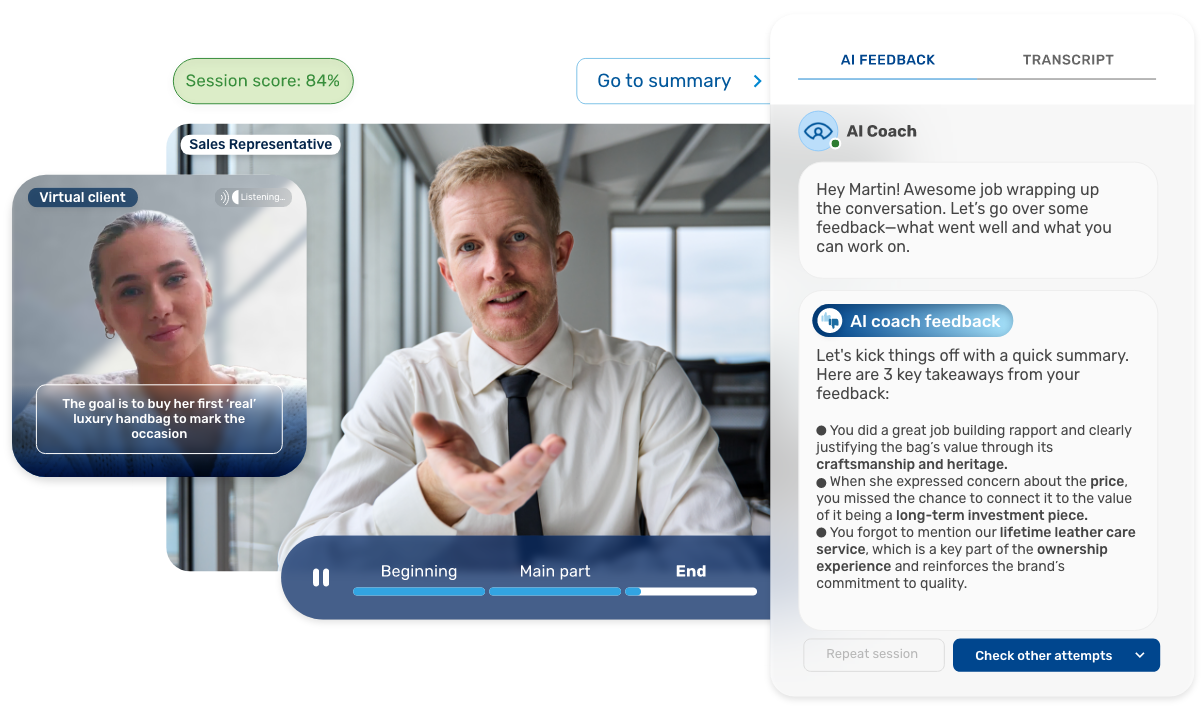
Phase 4: The reinforcement loop, where most programs quietly die
Behavior decays fast without reinforcement. The forgetting curve research on skill retention is old and well replicated: without deliberate reinforcement, most of what a person learns in a single session is gone within weeks. A program that ends at the workshop is, functionally, a program that spent budget to produce a temporary bump in a survey score.
The reinforcement loop keeps the competency alive after the workshop. It has four steps and needs to run continuously, not as a one-time follow-up session six weeks later.
Every practice conversation or live call is scored against the competency model from Phase 2, not against a generic checklist. This is the step most programs skip because manual observation does not scale past a handful of reps.
Where AI coaching fits: an AI coaching layer observes every practice session for every rep, consistently, at a volume no manager calendar can match.
The observation produces a specific score against specific behaviors, ranked so the rep and manager both know which one or two behaviors matter most right now, not a wall of 12 metrics with no priority.
Manager role: reviews the ranked score before a 1:1, so the coaching conversation starts from data instead of a generic "how did that call go".
The rep gets a targeted practice scenario built around the lowest-scoring behavior, not a repeat of the same generic module. Practice that targets the actual gap changes behavior faster than practice that repeats material the rep already has.
Cadence: weekly for new hires in ramp, biweekly for tenured reps maintaining a competency.
The next practice or the next live call re-scores the same behavior. If it moved, the loop advances to the next-lowest behavior. If it did not, the manager gets involved directly instead of the loop repeating on its own indefinitely.
Escalation rule: a behavior that has not moved after three practice cycles becomes a manager coaching item, not another automated attempt.
The capacity question arrives immediately: who has time to observe every rep on every practice call? That is precisely the part of the loop that stops being a manager calendar problem once an AI coaching layer runs the observe and score steps. Across Retorio's enterprise deployments the loop moves the cost of sales onboarding rather than adding to it.
less human trainer effort per new hire, from 26 hours down to 8, because the observe and score steps stop needing a manager in the room
reduction in overall onboarding time, which is the number that decides whether a new cohort sells in this quarter or the next one
behavioral improvement recorded after every single AI role play session, which is what makes scheduling repetition worth the calendar space
This loop is what separates a coaching system from a training curriculum. A curriculum delivers content once. A coaching loop keeps measuring and adjusting until the behavior sticks. Retorio's enterprise deployments run this exact four-step loop, and the documented result is a 38 to 42% reduction in ramp time when it runs from a new hire's first week, because reinforcement starts before bad habits form instead of correcting them later.
The reinforcement loop that keeps a competency alive
The loop runs continuously for the length of the program, not as a one-time follow-up. Source: Retorio enterprise customer studies, 50+ enterprise clients, 2024-2026.
The programs that hold up under CRO scrutiny are the ones where reinforcement was designed in from week one, not bolted on after the workshop when the completion numbers looked good but quota did not move.

Phase 5: Measurement that ties to quota, not to completion
A completion rate tells you reps clicked through a module. It does not tell a CRO anything they will act on. The measurement layer needs to answer three questions a revenue leader actually asks: did ramp time improve, did the trained cohort outperform a comparable baseline on quota, and did the competencies from Phase 2 show up in deals that closed.
| Metric | What it actually measures | Why it matters to a CRO |
|---|---|---|
| Completion rate | Whether reps clicked through the content | Operational signal only, not a business outcome. Report it, do not lead with it. |
| Ramp time to first full quarter at quota | How fast a new hire reaches full productivity | Directly reduces the cost of every new hire and shortens payback on recruiting spend |
| Quota attainment, trained cohort vs. baseline | Whether the trained behaviors translate into revenue outcomes | The single number that justifies the program budget in the next planning cycle |
| Win rate on deals where the competency applied | Whether the specific behavior from the model shows up where it should | Connects the competency model directly to deal outcomes, not just aggregate performance |
Set a baseline cohort before the program launches. Without a baseline, every result after launch is a story instead of a comparison. Retorio's enterprise data across this measurement structure shows the pattern below for cohorts running the full loop for a full quarter, figures worth defending against your own baseline rather than taking at face value from any vendor, ours included.
Outcome lift for cohorts running the full reinforcement loop
Source: Retorio enterprise customer outcome data, 50+ enterprise clients, cohorts running the full reinforcement loop for a full quarter.
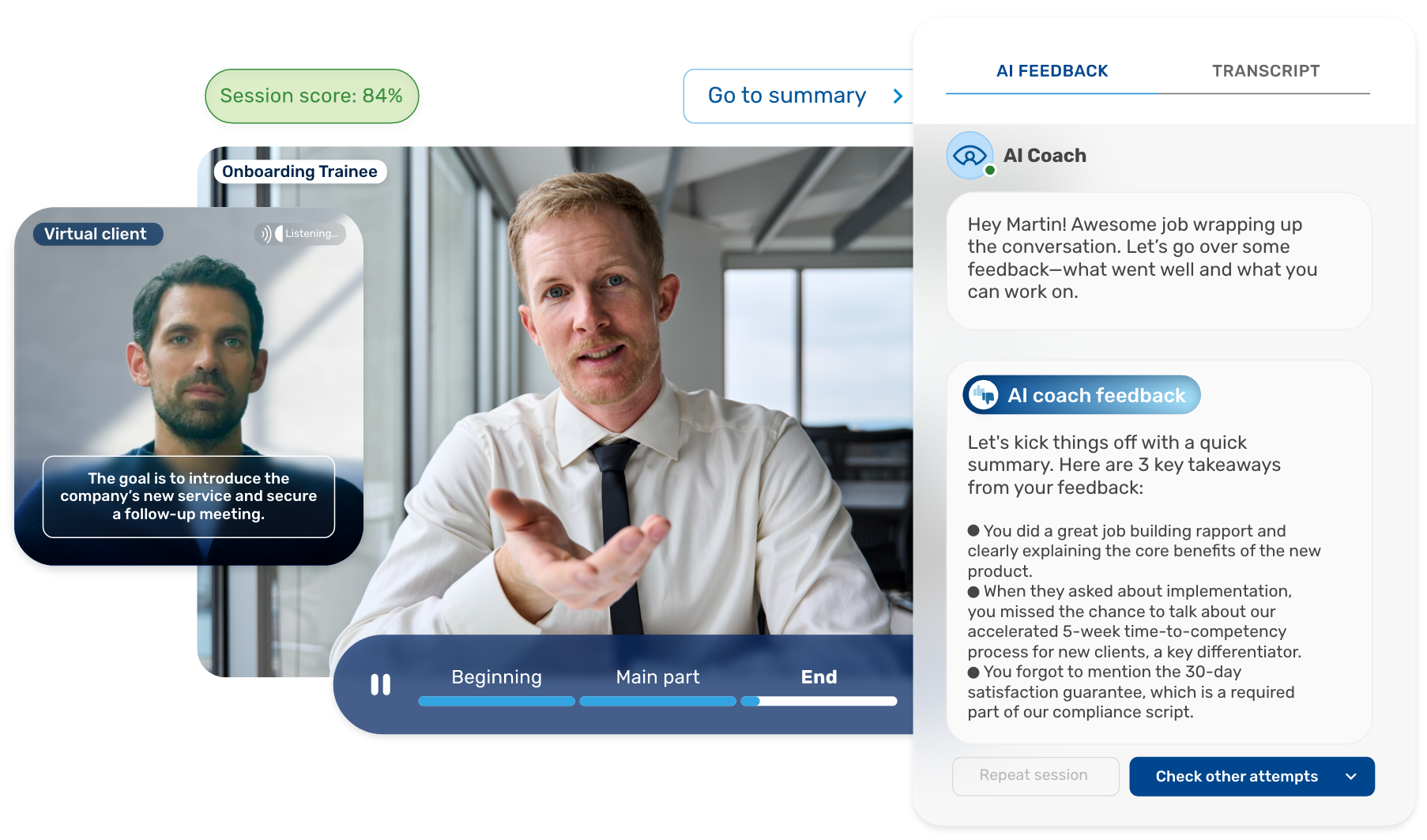
Bring your own competency model, your own scenarios, and your own baseline cohort. See what a closed AI coaching loop looks like against your ramp time and quota numbers, not a generic demo script.
Test AI coach in actionConclusion
A program built the way most organizations build it, pick a topic, hire a vendor, run a workshop, survey the room, produces exactly what that sequence is designed to produce: a completion rate. A program built through these five phases produces something a CRO will fund again next year, because the number moved and everyone can see how.
The phase most programs skip is reinforcement, and it determines whether anything from Phases 1 through 3 survives past week six. If you build only one new capability into your next program, build the closed loop: observe, score, practice, re-measure. That loop, run by a manager, an AI coaching layer, or both together, is the difference between a training event and a system that changes what reps actually do on the next call.
FAQ
How long does it take to build an enterprise sales training program?
A full build, needs analysis through a live reinforcement loop, typically runs 10 to 14 weeks for one go-to-market segment: 3 to 4 weeks for needs analysis and the competency model, 4 to 5 weeks for delivery design, and 3 to 5 weeks to instrument the coaching loop before the first cohort graduates. Rolling to additional segments is faster, usually 4 to 6 weeks each.
What is a sales competency model and why does it matter?
A sales competency model is a set of observable behaviors, not soft traits, mapped to each sales stage and tied to a proficiency scale. It is the single artifact content, coaching, and measurement all point back to. Without it, content reflects whoever built the last deck and coaching feedback is inconsistent across managers.
How do you measure the ROI of an enterprise sales training program?
Tie the program to three numbers a CRO already tracks: ramp time to first full quarter at quota, quota attainment for the trained cohort versus a baseline, and win rate on deals where the trained competencies applied. Completion and satisfaction scores are useful signals, not ROI. Retorio's enterprise data shows a 38-42% reduction in ramp time and a 14.6% lift in quota attainment when reinforcement starts on day one.
Why do most sales training programs fail to change behavior?
Most programs stop at delivery: a rep sits through a workshop, scores well on a quiz, and the program is considered done. Behavior decays within weeks without repeated practice and specific feedback. The fix is a reinforcement loop, where a manager or an AI coaching layer tracks whether the behavior shows up in real conversations.
Should AI coaching replace sales managers in a training program?
No. AI coaching handles what does not scale for a manager: unlimited practice repetitions, consistent scoring every time, and a real-time view of which competencies lag across the team. Managers handle deal-specific coaching, career conversations, and readiness calls. Programs that work assign each part of the loop to whichever layer does it best.
Should you build an enterprise sales training program in-house or buy one?
Buy the content layer when you need shared language quickly or when the gap is product and process knowledge. Build the competency model, the reinforcement loop, and the measurement in-house, because all three depend on your sales process, your own call data, and your pipeline. Most sales enablement teams end up in the middle: an outside curriculum mapped to a competency model they defined themselves, with an AI coaching layer running practice and scoring against it.
Source: Retorio (youtube.com/@retorioofficial). A short look at the AI coaching layer referenced in the reinforcement loop above.
For the reinforcement layer specifically, this breakdown of the four behavioral signals AI sales coaching tracks goes deeper into what "score against the competency model" looks like in practice. Teams rolling this out in phases often start with a phased rollout plan for AI sales training to sequence the segments from Phase 1. If you are still finalizing the base curriculum, this overview of sales training program design covers content-layer decisions in more depth, and for the vendor evaluation in Phase 3, this comparison of corporate sales training programs is a useful reference.
Outside Retorio's own data, two sources are worth reading first: McKinsey's research on sales transformation programs covers why large-scale sales change efforts fail to stick past year one, and Harvard Business Review's analysis of why sales training does not work makes the case for reinforcement over one-time delivery, independent of any vendor, including Retorio.
Written with help from LLMs, edited and checked by Önder Mutluer, Website Manager and Marketing Strategist, and Dr. Patrick Oehler, Co-founder and Co-CEO. Reviewed by Peter Holdenried, Head of Sales. How this article was researched, written and checked, and who reviews which topic: Retorio editorial policy.