


Map AI sales training to real buyer moments by building practice journeys around the actual conversations reps face, not your internal product catalog or org chart. Retorio's AI coaching generates role-plays from your battle cards, CRM data, and buyer personas, giving behavioral feedback on Warmth and Competence so reps practice before the deal, not on the prospect.
Example. A new enterprise rep uploads a battle card for a skeptical procurement officer into Retorio. She runs the negotiation role-play three times before her first real call, gets feedback on where her tone lost confidence, and adjusts. She walks into the live deal having already made her mistakes in practice, not in front of the prospect.
You are staring at your CRM dashboard at the end of the quarter. Your pipeline looks healthy on paper, but deals that seemed like guaranteed wins are stalling at the final negotiation phase. You check your Learning Management System (LMS), and your reps have a 100% completion rate on the latest product modules.
So, where is the disconnect?
The painful truth is that your training mirrors your internal product catalog, not the messy, unpredictable reality of the customer's world. When your reps face a skeptical buying committee, they default to reciting features instead of solving problems. By mapping AI sales training to real buyer moments, you eliminate this friction, transforming your enablement strategy from a passive cost center into a dynamic revenue engine.
The enterprise sales landscape of 2026 is unforgiving. Generative AI is rapidly automating routine, transactional buying, leaving human sellers to navigate only the most complex, high-stakes, and emotionally nuanced deals. This shift demands the "Human Premium", the ability to filter information, build trust, and guide consensus.
Yet, traditional training relies on "just-in-case" content dumps that cause severe cognitive overload. To survive, organizations must deploy AI Coaching Platforms to create "just-in-time" practice environments. It is time to stop practicing on your prospects and start practicing in a digital dojo.
The Agitation: The Cost of Contextless Enablement
Most enterprise sales enablement programs suffer from a fundamental flaw: they train reps on what the product does, rather than how to guide the buyer through a decision. This disconnect carries massive financial consequences.
When reps are trained out of context during an annual kickoff, they forget up to 90% of the material within a week.
Because reps are trained to push products, they fail to demonstrate active listening when buyers express anxiety about implementation risks or ROI.
It takes months for a new hire to experience enough real-world buyer interactions to become competent, costing you valuable quota capacity.
When reps lack a safe environment to practice contextual scenarios, they freeze. They resort to "feature dumping," which immediately alienates the modern B2B buyer.
Why AI Sales Training Needs to Mirror Real Buyer Journeys, Not Internal Org Charts
For decades, training curriculums have been designed around internal organizational structures. Marketing builds a deck for Product A, Product B, and Product C. The sales team is then trained to pitch Product A, Product B, and Product C.
Your buyers do not care about your org chart. They care about their pain points, their internal politics, and their moments of friction. Mapping AI sales training to real buyer moments requires a paradigm shift: you must train the interaction, not just the information.
If a buyer is in the "Awareness" phase, a rep pushing a hard close will destroy trust. Conversely, if a buyer is in the "Decision" phase, a rep who stays stuck in high-level discovery will lose the deal to a more decisive competitor. Retorio’s AI coaching technology allows you to build training curriculums that perfectly mirror these specific, chronological buyer moments, ensuring your reps deploy the right skills at the precise moment they are needed.
Designing AI Sales Training Journeys Around Critical Buyer Conversations
How do you practically align your training to the customer's reality? You design interactive, video-based AI simulations that recreate the highest-stakes moments of the sales cycle. Retorio’s AI Coaching Generator allows you to upload your existing battle cards, CRM data, and buyer personas to instantly generate these specific role-plays.
Modern buyers are drowning in data. They have read the peer reviews and the analyst reports. The rep's job in the discovery phase is not to provide more data, but to act as a "Sense Maker", an information filter.
You can design an AI simulation where a "Confused Prospect" avatar asks conflicting questions. The rep must practice active listening and strategic communication to help the AI avatar organize and interpret their own problems.
B2B deals are won and lost by consensus. Retorio allows you to create "Digital Twins" of diverse stakeholders. In one AI training journey, a rep must first pitch a "Visionary CMO" (focusing on big-picture impact) and then immediately defend the technical requirements to an "Analytical IT Director."
The AI evaluates the rep's Behavioral Intelligence, measuring how well they adapt their vocabulary and tone to different audiences.
The negotiation phase is where deals often stall. Reps must exhibit a delicate balance of Warmth and Competence. If they are too aggressive, they break rapport; if they lack confidence, they lose margin.
By practicing this specific buyer moment with a "Skeptical Procurement Officer" avatar, reps can safely rehearse their objection handling. The AI coach provides immediate, timestamped feedback on their facial expressions, pacing, and word choice.
Anatomy of a Complex Sale: A 10-Step Cybersecurity Buyer Journey
To truly understand why "just-in-case" training fails, we must look at the reality of the modern B2B buyer. Let’s map a real-world enterprise deal in the Cybersecurity sector, specifically, a Fortune 500 Healthcare Network looking to purchase a Zero-Trust Network Access (ZTNA) platform.
Notice how the buyer's emotional state changes at every step, and how an AI Coaching Simulation prepares the seller for that exact moment.
The Buyer's Reality: A major ransomware attack hits a competitor. The hospital's Board mandates the CISO to upgrade their legacy VPNs immediately. Panic and urgency are high.
The Buyer's Reality: The IT Director is tasked with researching solutions. They read 15 whitepapers, Gartner Magic Quadrants, and Reddit threads. They are drowning in conflicting technical jargon. For deeper context, see sales training.
The Buyer's Reality: The IT Director takes a call with your Account Executive (AE). They don't want a demo; they want someone to help organize the chaos in their head.
The Buyer's Reality: The AE is invited to pitch the CISO and the CIO. The executives care about avoiding headlines and reducing cyber insurance premiums, not API endpoints.
The Buyer's Reality: The CISO hands the evaluation to the Lead Network Engineers. They are hostile and skeptical, trying to "break" the vendor's claims during a 2-hour architecture review.
The Buyer's Reality: IT loves the product, but they need Legal and Finance to agree. The internal champion (the IT Director) is struggling to build a business case for the CFO.
The Buyer's Reality: The hospital's strict Compliance Office flags a potential HIPAA data residency issue. The deal halts. Tension spikes.
The Buyer's Reality: The CFO hands the contract to Procurement. Their only job is to secure a 20% discount. They threaten to walk away and use a cheaper, inferior competitor.
The Buyer's Reality: Price is agreed upon, but Legal spends three weeks arguing over liability caps in the event of a data breach. Deal momentum is dying.
The Buyer's Reality: The contract is signed. The customer is exhausted but hopeful. They meet the Customer Success Manager (CSM) for onboarding.
If your enablement team only trains reps on the technical specs of the software (Step 5), they are leaving the rep completely defenseless for the other 9 critical moments of the deal. By utilizing AI role-play, you map practice directly to the emotional and operational realities of the buyer journey, ensuring your reps never freeze when the stakes are highest.
.webp?width=1710&height=827&name=retorio-ai-role-plays-for-sales-698b1caeeba8e%20(1).webp)
The Spice: The ROI of Contextual AI Coaching
Shifting from org-chart training to buyer-journey training is not just a theoretical exercise; it drives hard, measurable business outcomes. Enterprise organizations using Retorio's platform achieve significant operational and financial gains.
Your reps practice on real customers. Fix that.
Retorio gives every rep unlimited, judgment-free AI role play with instant, specific feedback. ISO 27001 certified, GDPR-compliant, EU AI Act aligned.
Test AI coach in actionMeasuring and Iterating: Connect AI Practice Journeys to Pipeline and Revenue
The true power of mapping AI sales training to real buyer moments lies in the ability to close the data loop. Training can no longer be a black box where completion rates are the only metric of success. You must connect practice behaviors to actual pipeline velocity.
Retorio’s Analytics Dashboard provides L&D and Sales Leaders with real-time insights into team capabilities. If your pipeline data shows that deals are consistently lost at the "Pricing Proposal" stage, you can immediately look at your Retorio dashboard. You might discover that while your team scores high on "Product Knowledge," they score critically low on "Confidence" and "Objection Handling" during pricing simulations.
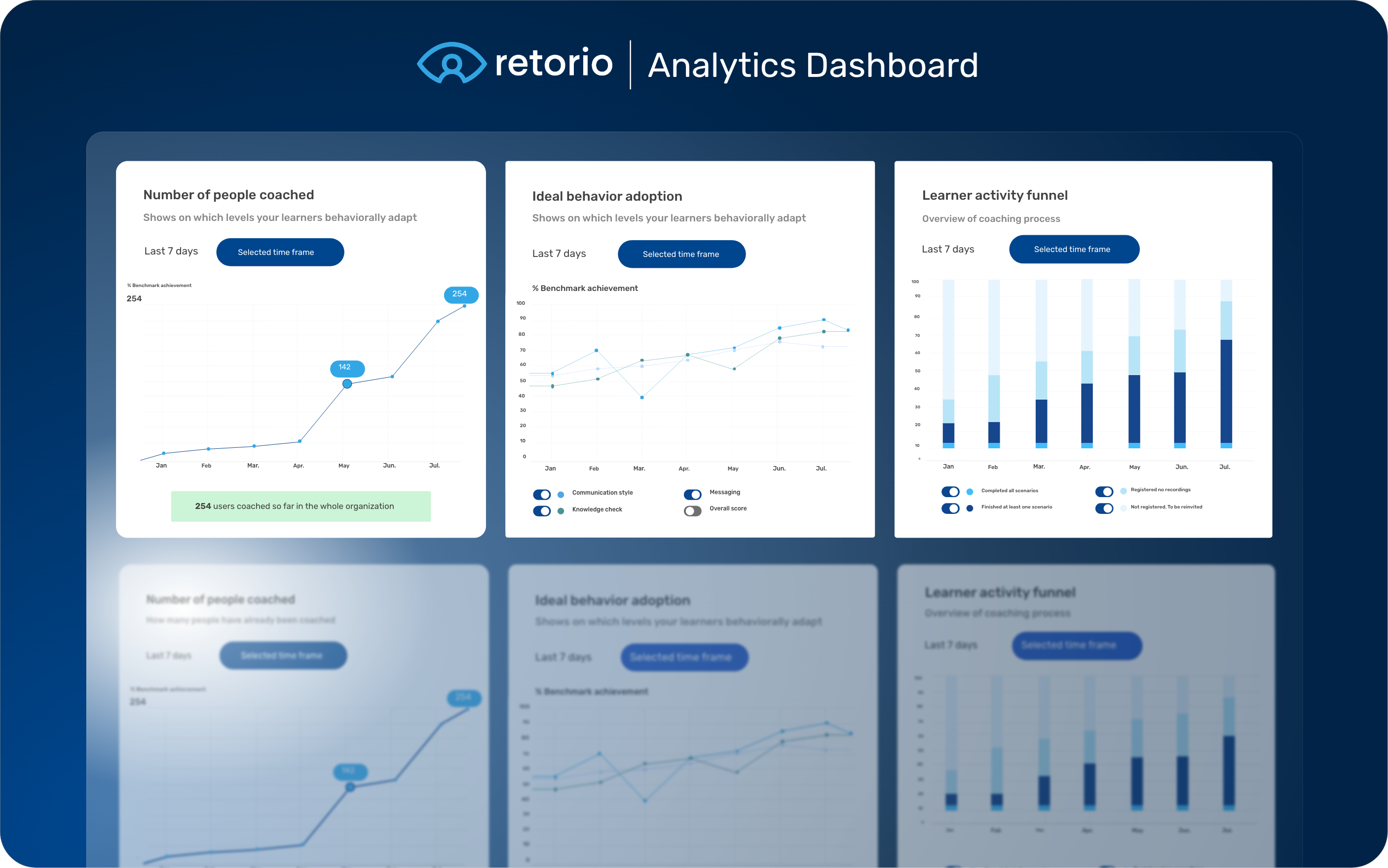
Armed with this behavioral data, you can iterate. You can instantly deploy a targeted AI sales coaching module focused solely on price defense. By tracking the improvement in AI practice scores and correlating them with subsequent CRM win rates, you finally establish a defensible, data-driven ROI for your enablement programs.
Conclusion
The modern B2B buyer is overwhelmed, highly educated, and desperate for a trusted advisor who understands their specific journey. Continuing to train your sales force based on internal product silos is a strategy for obsolescence. Mapping AI sales training to real buyer moments is the only scalable way to equip your commercial teams with the behavioral agility required to win.
By leveraging Retorio’s dynamic avatars, rapid scenario generation, and deep behavioral analytics, you transform your reps into elite "Sense Makers." Give your team the ultimate digital dojo. Stop hoping they figure it out on live calls, and start ensuring they master every critical buyer conversation before they ever pick up the phone.
Key Takeaways
- Ditch the Org Chart: Shift your training focus from internal product features to the actual, chronological moments of friction your buyers experience.
- Simulate the Journey: Use AI to design specific role-plays for Discovery, Evaluation, and Negotiation, forcing reps to adapt their communication style to the context.
- Train for Sense-Making: Equip sellers to act as information filters for overwhelmed buyers, prioritizing active listening over feature dumping.
- Connect Practice to Pipeline: Utilize behavioral analytics to correlate AI simulation scores (like Confidence and Empathy) with actual CRM win rates.
- Drive Proven ROI: Accelerate time-to-competency by 38% and multiply practice volume by 21x using automated, scalable AI role-plays.
FAQ: AI Sales Training and Buyer Journeys
Why should sales training mirror the buyer journey instead of product features?
Training based on product features often leads to "feature dumping," which alienates modern buyers. Mapping training to the buyer journey ensures that sales reps understand the specific emotional and informational needs of the customer at each stage (e.g., Discovery vs. Negotiation), allowing them to act as consultative advisors rather than just walking brochures.
How do you design AI sales training around critical conversations?
Using platforms like Retorio, you upload your specific playbooks and CRM data into an AI Coaching Generator. The AI then creates lifelike, dynamic virtual avatars that represent your specific buyer personas. You can program these avatars to simulate critical moments, such as a hostile procurement negotiation or a complex technical evaluation, allowing reps to practice safely.
How can I measure the ROI of AI practice journeys?
You measure ROI by connecting behavioral data from the AI platform to your CRM pipeline data. Retorio's Analytics Dashboard tracks improvements in specific skills like "Warmth," "Competence," and "Objection Handling." By analyzing these skill improvements alongside metrics like time-to-competency (often reduced by 38%) and increased win rates, you can directly prove the financial impact of the training.
Ready to turn your sales reps into top performers?
Stop practicing on your prospects. Give your team the ultimate digital dojo.

Written with help from LLMs, edited and checked by Önder Mutluer, Website Manager and Marketing Strategist, and Dr. Patrick Oehler, Co-founder and Co-CEO. Reviewed by Peter Holdenried, Head of Sales. How this article was researched, written and checked, and who reviews which topic: Retorio editorial policy.