

-2.jpg?width=300&name=Blog%20Covers%20(1920%20%C3%97%20960px)-2.jpg)
Most enterprise reps know MEDDPICC exists. They still open discovery calls with the same four generic questions. The deal stalls, the champion goes quiet, and the rep writes "no response" in the CRM. The problem is not the framework. The problem is that nobody gave them the exact questions.
MEDDPICC questions are discovery prompts mapped to each of the eight MEDDPICC pillars: Metrics, Economic Buyer, Decision Criteria, Decision Process, Paper Process, Implicate the Pain, Champion, and Competition. The best MEDDPICC questions surface business impact in the prospect's own language, name a specific internal sponsor, map the actual approval sequence, and expose competitive pressure before it becomes a surprise. A rep who works through all eight pillars in a structured discovery conversation knows the buyer's number, the sponsor's name, the approval sequence and the alternative before a close date is committed.
New to the framework? Start with the MEDDPICC sales methodology guide, which walks through all eight pillars and what counts as evidence on each one.
Source: Retorio, documented across 50+ enterprise clients.
The pattern underneath those numbers is not complicated. A rep who asks one or two questions per pillar leaves the same gaps in every deal, and the gaps surface at the worst possible moment. Not because the framework guarantees wins. Because the questions force the rep to know things that most reps never find out until the deal is already lost.
This post maps 40 specific MEDDPICC questions, five or six per pillar, with the coaching context for each one. Read it alongside the MEDDIC sales methodology guide if you want the framework background before you get to the questions. If your team runs the six-pillar version, this doubles as a list of MEDDIC questions: set the Paper Process and Competition blocks aside and the remaining six pillars map one to one.
What makes a MEDDPICC question good
Before the question list, one diagnostic. Most reps ask questions that confirm what they already believe instead of questions that surface what they don't know. The gap sits in the same place in most enterprise deals: the buyer's internal decision-making process, which is uncomfortable to ask about and impossible to guess. The questions below tilt toward that gap.
Three attributes separate a good MEDDPICC question from a generic one. It names a consequence, not a feature. It forces the prospect to quantify. And it identifies a person who is responsible for something, not just an opinion. All three attributes push the conversation toward the same territory, MEDDPICC's Decision Process and Paper Process pillars, which is where a deal's real timeline lives.
"What happens to your renewal rate if this doesn't get fixed by Q3?" forces quantification of the risk, not just an opinion about pain.
"Who owns the budget line this would come from?" surfaces the Economic Buyer by name, not by title or assumption.
"Is this a priority for you?" gives the rep a yes/no with no measurable business context. It feels safe to ask and tells you almost nothing.
"You mentioned cost is the main driver, right?" is a leading question. It builds false confidence that you understand the deal and skips pillars you assumed don't apply.
The eight MEDDPICC pillars and what each question must surface
Before the full question list, here is what each pillar is actually trying to uncover. Reps who understand the purpose of each pillar ask better follow-up questions when the standard question produces a vague answer.
One wording note on the I. MEDDICC Ltd's published definition of MEDDPICC writes it as Implicate the Pain, though "Identify Pain" circulates widely as an alternative wording for the same pillar. The list below uses the published wording, because it changes the question: identifying pain is something a rep can do silently in a CRM note, while implicating it means the buyer states the consequence out loud, in their own words.
| Pillar | What you need to know | Deal risk if blank |
|---|---|---|
| Metrics | The number the prospect will use to measure success. In their unit of measure, not yours. | Business case collapses at CFO stage. Champion cannot defend ROI. |
| Economic Buyer | The single person who can write the check or block it. Not a committee, not a job title: a name. | Deal stalls at procurement because nobody escalated it. You negotiated with the wrong person. |
| Decision Criteria | The explicit list of requirements the buying committee will score. Not what you think they value. | You win on the wrong dimension and lose to a competitor on the one that actually mattered. |
| Decision Process | The sequence of steps, approvals, and timelines from shortlist to signature. | Deal misses quarter because a step you didn't know about adds 6 weeks. |
| Paper Process | Legal, security review, InfoSec, vendor onboarding: who handles each and how long it takes. | Deal is "verbally closed" in Q3 and signs in Q1 of next year. Revenue recognition impact. |
| Implicate the Pain | The specific business problem with a dollar value attached. Not a feature complaint: a consequence. | No urgency. Prospect does nothing. Status quo wins. |
| Champion | The internal person who will fight for your deal when you are not in the room. Not just a friendly contact. | Someone internal kills the deal in a meeting you weren't invited to. |
| Competition | Who else is in the deal, what their stated strengths are, and who is actively championing them. | Competitive surprise at final review. You find out at the pricing stage, not at the start. |
Why unworked pillars lose late-stage enterprise deals
Late-stage losses in enterprise deals are rarely decided by the product. They are decided inside the buying group. A Gartner survey of 632 B2B buyers, published in May 2025, found that 74 percent of B2B buyer teams show what Gartner calls unhealthy conflict during the buying decision process, that buying groups reaching consensus are 2.5 times more likely to report a high-quality deal, and that those groups now run from five to 16 people across as many as four functions. Every one of those findings is a MEDDPICC problem. A rep who has mapped the Decision Process, met the Economic Buyer and tested the Champion knows where the disagreement sits and who can settle it. A rep who has not is forecasting a group decision they have never seen.
Beyond the qualification mechanics, HBR's analysis of the B2B elements of value explains why buyers commit when reps connect capabilities to business and personal value, the exact link the MEDDPICC pillars are built to surface.
40 MEDDPICC questions, by pillar
Use these in sequence during discovery. The order within each pillar matters: start with the broader business question, narrow to the specific person or number, then test the assumption you just surfaced.
The rep who asks "is this a priority for you?" gets a yes or a no. The rep who asks "what happens to your retention rate if this stays unresolved for 12 more months?" gets a number, a name, and an opening to build the business case together.
How to coach MEDDPICC question quality in practice
Knowing the questions is one thing. Getting reps to ask them in live customer calls, under time pressure, without sounding like they are reading from a checklist, is the actual coaching challenge. The gap between "knows the framework" and "asks the right question in the moment" is a behavioral skill, not a knowledge problem. It requires deliberate practice against realistic buyer personas, not another training session about the theory.
The coaching loop below is what enterprise enablement teams use to close that gap. It maps directly to how AI sales coaching accelerates MEDDPICC proficiency. For the broader qualification framework context, see the BANT framework guide for a comparison of how MEDDPICC and BANT differ at each stage.
What MEDDPICC execution looks like when it breaks down
The question list alone does not produce results. These are the most common failure patterns in enterprise teams that adopted MEDDPICC on paper but still lost deals they should have won.
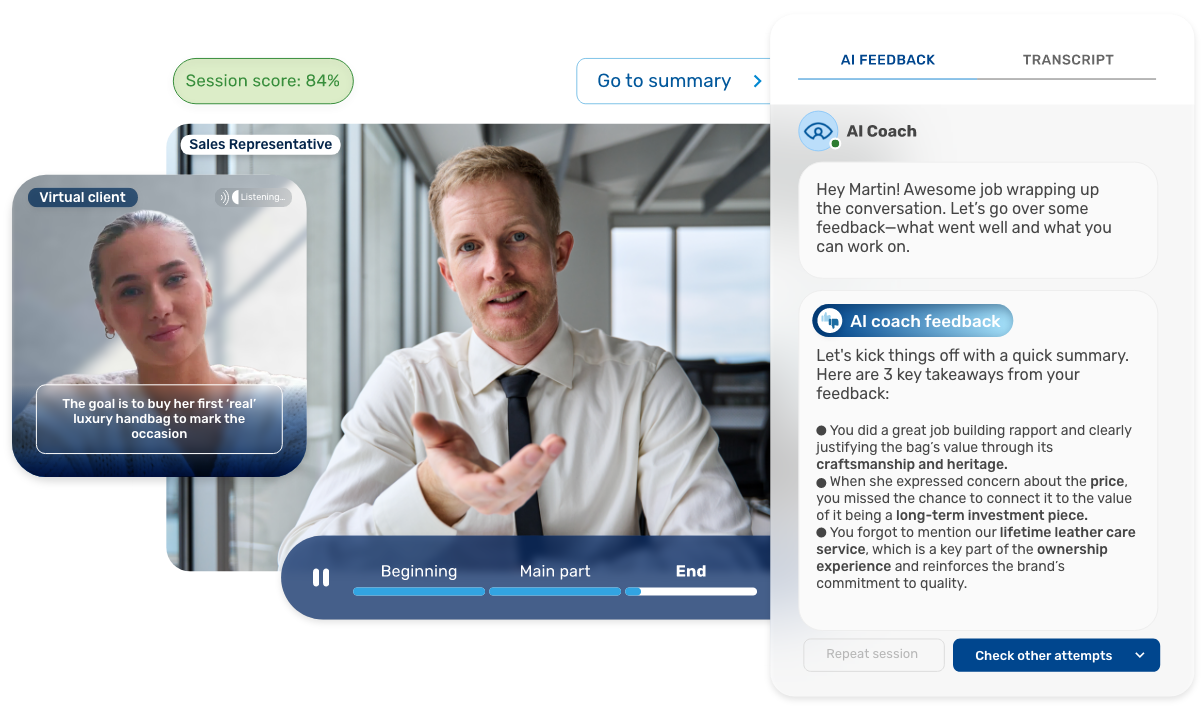
What changes when a team actually runs MEDDPICC
Two patterns show up consistently after an enterprise team moves from generic discovery to MEDDPICC-structured qualification: deal quality improves before win rate does, and forecast accuracy moves first. Here is what the before-and-after looks like in behavioral terms.
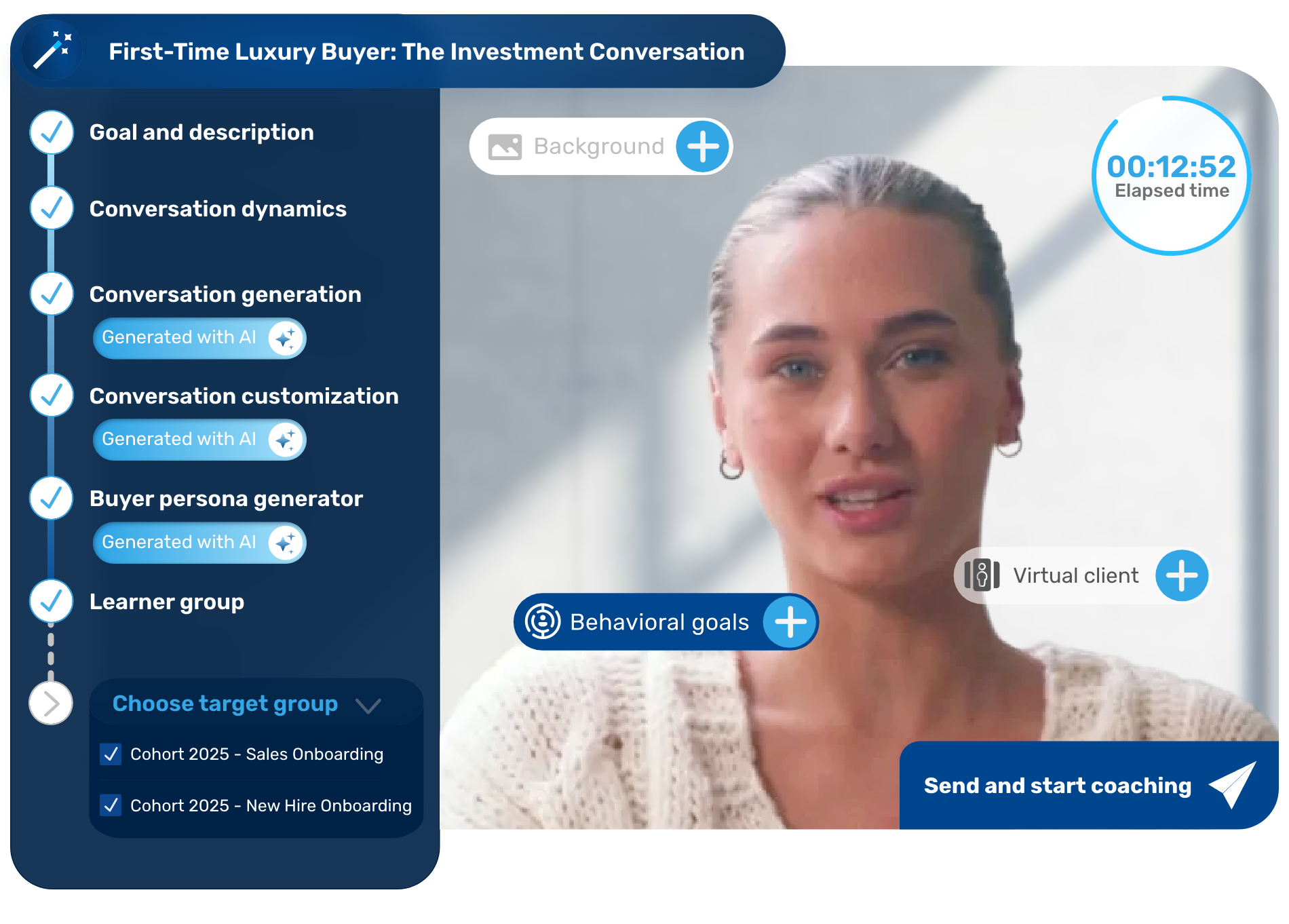
The questions in this guide work across enterprise sales methodologies. If your team uses B2B sales training programs that mix MEDDPICC with other frameworks, the pillar structure here integrates cleanly with BANT, SPIN, and Challenger. For objection handling in late-stage MEDDPICC deals, the objection handling training guide covers the specific moments where Competition and Pain pillar gaps surface as objections.
How to get your team asking these questions consistently
The 40 questions in this guide cover every MEDDPICC pillar and the most common gaps in enterprise discovery execution. The hard part is not knowing the questions. It is getting a team of 20 or 200 reps to ask the right one at the right moment in a live deal, under pressure, with a prospect who is not going to wait while the rep scrolls their notes.
The teams that close that gap do three things. They record discovery calls and tag which pillars were covered. They run targeted practice on the pillars that get skipped most often, using AI role play against realistic buyer personas. And they measure pillar completion rate as a leading indicator in deal reviews, not just win rate as a lagging one. Across Retorio enterprise deployments, sales quota achievement is up 14.6 percent and overall sales performance up 27 percent.
Your reps know MEDDPICC. They still skip pillars under pressure. Retorio coaches them on the specific questions they avoid, against virtual enterprise buyers, until the behavior is consistent on live calls.
Test AI coach in actionColumbia negotiation professor Alex Carter (TED) on why a good open question, not a pitch, is what surfaces what the other side actually needs. That is the skill behind every MEDDPICC discovery question.
Frequently asked questions about MEDDPICC questions
What is the difference between MEDDIC and MEDDPICC?
MEDDIC has 6 pillars: Metrics, Economic Buyer, Decision Criteria, Decision Process, Identify Pain, Champion. MEDDPICC adds two: Paper Process (the administrative and legal path to contract signature, which can add weeks in enterprise deals) and Competition (the explicit competitive landscape, not just the vague "we're also looking at alternatives" statement). MEDDICC Ltd's published definition of MEDDPICC writes the I as Implicate the Pain, though "Identify Pain" circulates widely as an alternative wording for the same pillar. The two extra pillars exist for complex, multi-stakeholder enterprise deals, where administrative delay and an unnamed competitor do more damage than a weak business case.
When in the sales process should I ask MEDDPICC questions?
Not all pillars belong in call one. Metrics and the pain questions are typically first-call questions. Economic Buyer identification should happen by call two. Decision Criteria and Process are mid-cycle questions, usually once there is confirmed interest. Paper Process and Champion confirmation should happen before you invest in a proposal. Competition should be surfaced as early as the prospect will share it, ideally before they have been briefed by anyone else.
How do I practice MEDDPICC questions before live calls?
The most effective method is AI role play with a virtual buyer persona that matches your target account's profile. The rep runs through the specific pillar questions, gets behavioral feedback on whether the question was clear and consequential, and repeats until it sounds natural. Repetition until it sounds natural, not a single rehearsal, is the standard: run the same pillar again until the question stops sounding like a script.
What is the biggest MEDDPICC mistake enterprise reps make?
Confusing the Champion with the most responsive contact. A real Champion has organizational influence, meaning they have fought for budget before and won. Liking your product is not the same thing. Test by asking your contact directly: "Have you been in a situation where you had to make the case for a budget decision internally, and what did that look like?" If they have never done it, they may be an enthusiastic user but not a Champion who will carry the deal when you are not in the room.
Can MEDDPICC work alongside BANT or SPIN?
Yes. BANT (Budget, Authority, Need, Timeline) covers the same ground as MEDDPICC's Metrics, Economic Buyer, Implicate the Pain, and Decision Process pillars at a higher level. MEDDPICC adds depth where BANT leaves ambiguity: Paper Process, Champion, and Competition are not addressed in BANT at all. Most enterprise teams that use both treat BANT as a first-call qualification filter and MEDDPICC as the deeper framework for deals that pass the initial filter.
Written with help from LLMs, edited and checked by Önder Mutluer, Website Manager and Marketing Strategist, and Dr. Patrick Oehler, Co-founder and Co-CEO. Reviewed by Peter Holdenried, Head of Sales. How this article was researched, written and checked, and who reviews which topic: Retorio editorial policy.