


Sales coaching benefits reps by building confidence under uncertainty, accelerating skill generalization (structured coaching teaches new skills five times faster than self-study), and improving how they handle objections and complex stakeholder deals. AI sales coaching platforms like Retorio make this measurable, scoring behavior across warmth, competence, clarity, and adaptability from role-play practice so managers can track real behavioral change.
Example. A mid-market rep keeps losing deals when the procurement lead raises budget concerns late in the process. In weekly role-play sessions, she practices holding that moment calmly instead of over-explaining. Within a month, her manager notices she stops cutting her price and starts asking about the stakeholder's actual risk concerns instead.
Source: Salesforce State of Sales research (2023).
According to Gartner research, 60% of enterprise technology buyers involved in renewal or expansion decisions regret nearly every purchase they make, not because of the product itself, but because of a frustrating buying experience and lack of alignment among stakeholders.
What's in this post:
-
The Commodities Trap
-
The Evolution of The Sales Persona in Sales Teams
-
Sales Coaching as Structured Practice for Human Judgmen
-
The Real Benefits of Sales Coaching for Sales Re
-
Measuring Sales Coaching Impact (Beyond Lagging Indicators
-
How AI Sales Coaching Makes Coaching Measurable at Scale
-
Turn Coaching into Competitive Advantage
The Commodities Trap
In 1999, Joseph Pine and James Gilmore introduced The Experience Economy, a framework describing how economic value evolves over time. As goods and services become commoditized, businesses must move up the value ladder-first to Experiences, and ultimately to Transformations, where the offering creates lasting change for the customer.
Today, many industries, whether they sell physical products, digital solutions, or a mix of both, have reached the same inflection point. Markets are saturated. Features are easy to copy. Pricing pressure is constant. In this environment, competing on the product alone becomes a race to the bottom. Customers can compare specs, reviews, and alternatives in minutes. What they can’t easily compare is what it feels like to work with a vendor, or how confident they are that the decision will deliver the outcome they care about.
This is where transactional selling breaks down.
Transactional sales models are optimized for speed and efficiency: move units, close deals, hit targets. But as offerings become interchangeable, the act of selling itself must evolve. The value shifts from what is being sold to how the buyer is guided through the decision.
That shift puts the sales rep in a fundamentally different role.
Modern sales reps are no longer the mere conduits between a product and a purchase order. They are responsible for shaping the buyer’s experience: helping customers clarify their goals, navigate tradeoffs, align internal stakeholders, and commit to a path forward with confidence. Whether the end product is a physical asset or a cloud-based service, the buying risk feels the same to the customer.
This is the essence of experience-led selling: the “experience” of being understood, challenged, and guided by someone who knows where similar decisions succeed, or fail.
Companies that recognize this shift, as a result, train reps not only on features and scripts, but also on developing judgment, empathy, and situational awareness.
In other words, in an experience economy, the sales rep is the differentiator that turns a transaction into a relationship, and a product into a lasting outcome.

The Progression of Economic Value (Pine and Gilmore, 1999)
The Evolution of the Sales Persona in Sales Teams
It happens all the time: two enterprise sales reps target the same ICP, the same account, the same budget. One rep executes a perfect playbook: polished slide decks, crisp follow-ups, flawless technical answers. The sales process is airtight.
And yet, the deal dies.
Not in procurement. Not on pricing. But quietly, in the “internal alignment” graveyard.
Why? Because organizations are afraid of risk. Buying committees stall when stakeholders aren’t aligned, incentives conflict, or no one wants to be accountable if the project goes sideways. The rep optimized for process, but ignored politics.
This is where the modern sales role diverges.
To move complex deals forward, success depends on aligning people, not just steps in a CRM. Every stakeholder must feel protected, heard, and confident in the decision. The most effective reps understand that their real job isn’t selling a product; it’s facilitating organizational change. Related reading on this coaching guide.
That’s the difference between a Solution Architect and a Trusted Advisor.
The Trusted Advisor operates with strategic empathy: the ability to understand the internal pressures, personal risk, and unspoken concerns shaping a buying decision. This can’t be scripted. It shows up in the unexpected pivot:
“Based on your current infrastructure, I don’t think we’re the right fit for this use case.”
Counterintuitively, that kind of honesty builds more trust than a dozen successful demos. It signals that the rep is invested in the customer’s outcome, not just their quota. In critical enterprise sales, credibility compounds faster than persuasion.
This shift has forced the sales persona to evolve:
- 1990s: The Information Gatekeeper (Transactional Seller)
- 2010s: The Solution Architect (Consultative Seller)
- 2020s: The Trusted Advisor
In an era of infinite information, AI-driven research, and deep buyer skepticism, only one role commands a premium. Buyers don’t need access to information or even solutions, they need help navigating risk.
The Transactional Seller asks:
“Can I get you to sign by Friday?”
The Trusted Advisor asks:
“If this project fails in six months, whose head is on the block, and how do we protect them today?”
In enterprise sales, alignment closes deals; not perfection. That is why the techniques a manager actually runs in a 1:1 matter more than the size of the playbook. It’s a mindset and it's why modern sales coaching must go beyond scripts and playbooks, focusing instead on judgment, adaptability, and real-world decision-making.
Sales Coaching for Scaling Judgment in Complex Enterprise Deals
If the Trusted Advisor is the end state, then the question becomes: how do organizations scale judgment, empathy, and strategic thinking across a sales team? Traditional coaching often falls short; focusing on scripts, activity counts, and buzzword metrics instead of the behaviors that actually shape buyer trust.
A structured sales coaching program must offer structured, repeatable practice for human complexity, a safe space where reps can practice before they perform. In enterprise environments, the biggest variables are emotional, political, and contextual. Reps are constantly navigating friction between internal stakeholders, competing priorities, and risk-averse buying committees. Coaching must prepare them for those real-world variables, not just theoretical ones.
Modern coaching increasingly leverages AI-powered platforms like Retorio, which make the invisible visible. By analyzing conversational behavior across dimensions such as talk ratios, interruption timing, response to objections, and signals of Warmth + Competence, Retorio provides concrete behavioral feedback that reflects how reps are actually perceived in AI role play. Instead of generic advice, reps see exactly where they excel and where they are weak; and can practice strategic adjustments before stepping into real client conversations.
| Feature | What It Does | Rep Benefit |
|---|---|---|
| AI Coaching Generator | Builds tailored coaching sessions from your playbooks and documents in minutes. | Reps train against real-world, role-specific scenarios aligned to your sales process. |
| Dynamic AI Role Play | Recreates lifelike conversations with virtual buyer personas. | Safe practice for “one-shot moments”, reps can rehearse hard conversations before they happen. |
| Holistic Behavioral Feedback | Measures perceived Warmth + Competence from verbal and non-verbal cues. | Reps understand how they come across, not just what they say, accelerating relational skill growth. |
| Persona Generator / Customization | Creates buyer personas with configurable traits for role plays. | Targeted practice that mirrors your actual ICPs and internal stakeholder types. |
| Analytics & Impact Tracking | Tracks engagement, skills development, and connects coaching outcomes to business KPIs. | Sales training managers and reps can see progress and ROI, turning coaching from intuition-driven to evidence-backed. |
Retorio AI Sales Coaching, Key Features & Rep Benefits
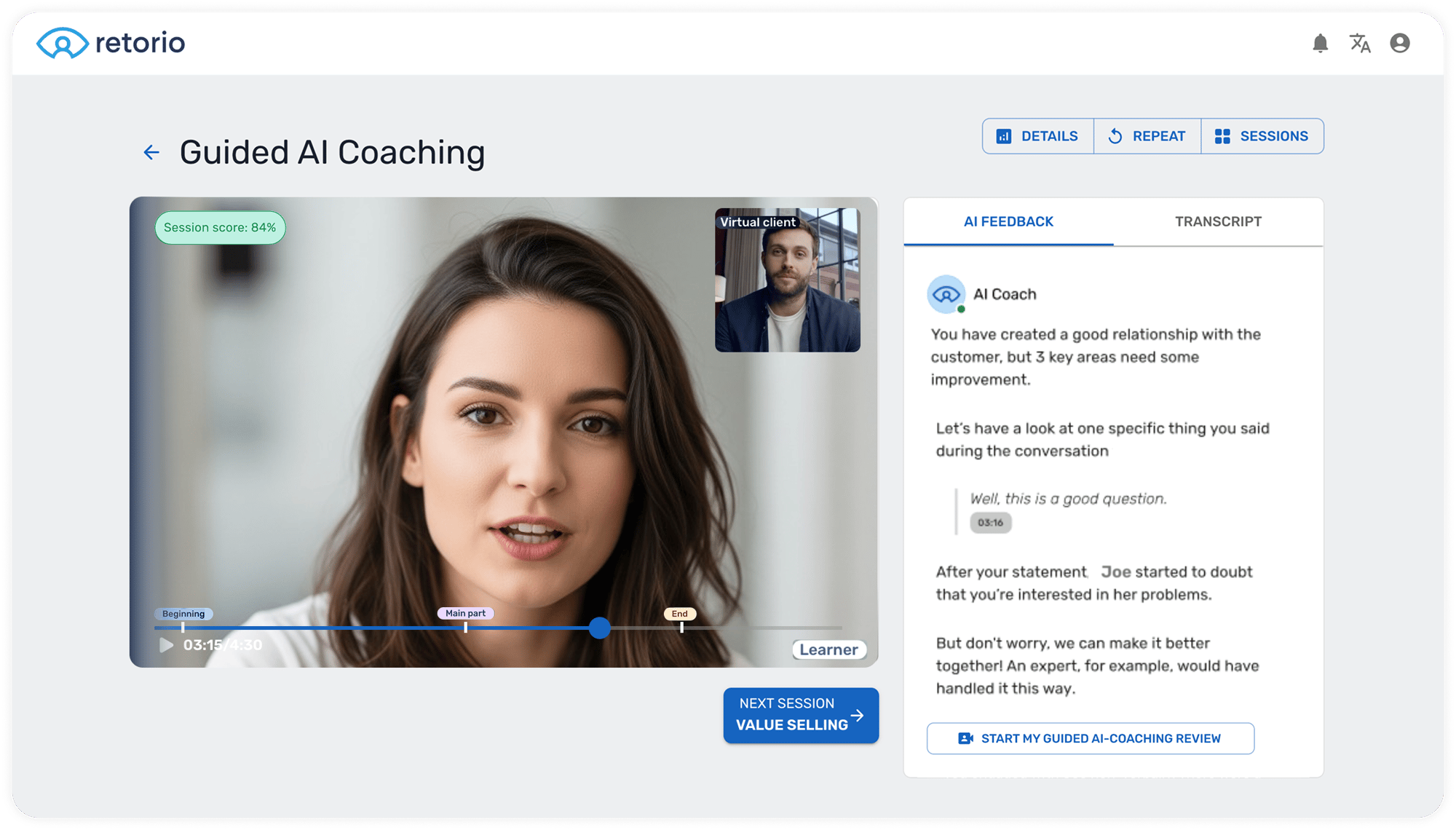
The Interface of Retorio AI Sales Coaching
According to Salesforce research, sales teams that receive regular, structured coaching see up to a 36% higher win rate and 31% greater quota attainment than those with ad-hoc coaching. This underscores that coaching shouldn't be a luxury, but a strategic lever for competitive differentiation.
The Real Benefits of Sales Coaching for Sales Reps
Sales coaching doesn’t just improve numbers on a leaderboard but transforms how reps show up with customers, internally, and in their own careers.
Expected first-year ROI from AI sales coaching at scale
See it run on your own selling motion, buyer personas, and current coaching gap.
-
First, coaching builds confidence under uncertainty. The best reps aren’t just product experts; they are outcome stewards. Coaching helps reps articulate business impact, address stakeholder fears, and navigate objections with credibility rather than defensiveness. In complex deals, confidence is contagious: buyers trust reps who can hold space for ambiguity. Deal coaching further supports reps by guiding them through the deal process, helping them validate deals and improve negotiation strategies to drive better outcomes.
-
Second, coaching accelerates skill generalization. Research shows that salespeople exposed to structured coaching learn new skills five times faster than through self-study or observational methods alone. This enables reps to move beyond rote scripts into situational mastery, a key differentiator in consultative and experience-led selling. Effective coaching and a successful sales coaching program contribute to stronger team performance and help sales teams hit revenue targets by ensuring skills are retained and applied across various selling scenarios.
-
Third, coaching fosters resilience and retention. A CSO Insights study found that consistent coaching correlates with a 14% increase in rep retention. When reps feel supported in growing their judgment and navigating real challenges, they’re more engaged, less transactional, and more invested in both customer outcomes and their own career trajectories. The coaching framework here expands this point.
-
Finally, coaching closes the gap between intent and impact. Without feedback loops, reps can plateau or even reinforce unproductive patterns. A data-informed, feedback-rich coaching culture ensures reps don’t just do more, they do better, learning from near-wins and near-losses alike. Successful sales coaching drives measurable improvements for both individual reps and overall team performance.
Measuring Sales Coaching Impact (Beyond Lagging Indicators)
Measuring sales coaching impact has traditionally been the weakest link in sales enablement. Revenue outcomes like quota attainment, win rates, and deal velocity matter. But they are lagging indicators. By the time those numbers move, it’s often too late to understand why performance changed or which coaching behaviors actually made the difference.
To truly evaluate sales coaching effectiveness, organizations need to measure what happens before the deal closes: changes in behavior, communication quality, and decision-making under pressure. That means tracking indicators such as skill adoption, consistency of execution, improvement in objection handling, and progress in closing identified skill gaps. These leading indicators create a much clearer line of sight between coaching effort and sales outcomes.
Qualitative feedback also plays a critical role, but it must be structured. A Gallup study on manager effectiveness found that how managers coach their teams accounts for up to 70% of variance in team engagement outcomes. Anecdotal impressions like “that was a good call” or “the rep seems more confident” are useful, but incomplete. The most effective sales organizations combine performance KPIs with observable behavioral data to understand whether coaching is actually changing how reps show up in customer conversations.
Ultimately, measuring coaching is about proving impact. The question isn’t “Did we coach?” but “Did the coaching measurably improve judgment, confidence, and customer trust?”
How AI Sales Coaching Makes Coaching Measurable at Scale
This is where AI sales coaching platforms like Retorio fundamentally change the equation. Instead of relying on subjective assessments or delayed revenue metrics, Retorio provides direct visibility into behavioral change: the true output of coaching.
By analyzing AI role play sales interactions, Retorio tracks how reps communicate across dimensions such as warmth, competence, clarity, and adaptability. Sales managers can see, at scale, whether coaching efforts are improving how reps listen, respond to objections, balance confidence with empathy, and navigate complex stakeholder dynamics. These are precisely the skills that define Trusted Advisors, which are traditionally the hardest to measure.
Because this feedback is standardized and consistent, managers can benchmark progress across individuals, teams, and time periods. Coaching effectiveness becomes observable: which skills are improving, which reps are plateauing, and which interventions actually lead to better performance in real deals. Instead of guessing where to focus, managers gain a clear signal on what to coach, who to coach, and when.
Most importantly, AI-powered measurement closes the loop between coaching intent and behavioral impact. Coaching stops being an act of faith and becomes a repeatable, evidence-backed process: one that helps sales leaders continuously refine their approach while giving reps clarity on how to improve.
In a sales environment where trust, judgment, and experience matter more than ever, the ability to measure those capabilities is a competitive advantage.
Turn Coaching into Competitive Advantage
Enterprise selling is no longer just about process adherence or product knowledge. It’s about guiding human decisions in complex environments, where alignment, trust, and judgment matter more than feature checklists. For deeper context, see sales framework.
The true benefits of sales coaching extend well beyond short-term performance gains. When done right, coaching develops Trusted Advisors who can navigate ambiguity, surface unspoken concerns, and reduce the personal and organizational risk that stalls deals. It strengthens the human capabilities technology cannot replace: strategic empathy, situational awareness, and adaptive thinking. Over time, these individual skills compound into organizational muscle.
What makes AI-powered sales coaching a competitive advantage is its scalability. With the right structure and tools, organizations can consistently develop judgment across teams, ensuring that excellence is not dependent on a handful of top performers but embedded into how the sales organization operates. Coaching turns experience into repeatability; and repeatability into predictable growth.
Key Stats to Remember:
| Coaching Impact Metric | Outcome |
|---|---|
| Teams with structured coaching | 36% higher win rates |
| Reps with regular coaching | 31% higher quota attainment |
| Coaching accelerates skill adoption | 5× faster learning |
| Coaching correlates to rep retention | 14% increase |
the benefits of sales coaching are not limited to improved metrics or better conversations. They lie in building sales teams capable of earning trust, navigating complexity, and creating meaningful customer outcomes. In a market where products converge and differentiation erodes, sales coaching has become a strategic investment that drives sustainable revenue and long-term customer relationships.

Frequently Asked Questions
What are the benefits of sales coaching for modern sales teams?
The benefits of sales coaching go beyond improving close rates. Effective sales coaching develops judgment, confidence, and strategic empathy: helping reps navigate complex buying decisions, align stakeholders, and earn trust. Over time, this leads to higher win rates, better quota attainment, stronger rep retention, and more predictable revenue.
How does sales coaching help reps move from transactional selling to trusted advisors?
Sales coaching helps reps shift from feature-driven conversations to outcome-focused guidance. By practicing real-world scenarios and receiving behavioral feedback, reps learn how to manage risk, ask better questions, handle objections with credibility, and support buyers through organizational change – key behaviors of Trusted Advisors.
Why is traditional sales coaching no longer enough?
Traditional sales coaching often focuses on scripts, activity metrics, and post-call feedback, which fails to prepare reps for the emotional and political complexity of enterprise deals. Modern selling requires coaching that develops judgment, adaptability, and situational awareness, not just product knowledge or process compliance.
How does AI sales coaching improve sales performance?
AI sales coaching improves performance by making communication behavior measurable. Platforms like Retorio analyze AI role play sales conversations to identify patterns related to warmth, competence, listening, and objection handling. This allows reps to practice, adjust, and improve before real customer interactions, accelerating skill development and confidence.
What is AI sales coaching and how is it different from call recording tools?
AI sales coaching focuses on practice and behavioral development, not just call review. Unlike call recording tools that analyze past conversations, AI coaching platforms like Retorio recreate realistic buyer interactions and provide immediate behavioral feedback, helping reps learn how they come across and how to improve in a safe environment.
How can sales leaders measure the impact of sales coaching?
Sales leaders should measure coaching effectiveness using both leading and lagging indicators. While win rates and quota attainment show outcomes, leading indicators: such as skill adoption, communication quality, and behavioral improvement, reveal whether coaching is actually changing how reps sell. AI sales coaching makes these changes visible and trackable.
Why is sales coaching a competitive advantage in saturated markets?
In markets where products and features are easily replicated, the sales experience becomes the differentiator. Sales coaching builds the human capabilities: trust, judgment, and empathy that buyers value most when making high-risk decisions. Organizations that invest in scalable, measurable coaching create a durable advantage competitors struggle to copy.
Written with help from LLMs, edited and checked by Önder Mutluer, Website Manager and Marketing Strategist, and Dr. Patrick Oehler, Co-founder and Co-CEO. Reviewed by Peter Holdenried, Head of Sales. How this article was researched, written and checked, and who reviews which topic: Retorio editorial policy.