


The top sales training trends for 2026 center on one shift: from one-time information delivery to continuous, AI-supported practice. Expect just-in-time over just-in-case learning, AI role-play simulation at scale, a premium on human EQ as buyers grow skeptical of automation, and measuring behavior change rather than course completion.
Example. A new pharma rep has her first hospital appointment in three days. Instead of sitting through a two-hour slide deck, she runs the same objection scenario six times against an AI avatar, gets feedback on her talk-to-listen ratio after each round, and walks in having already practiced the conversation until it feels routine.
The year 2026 marks a definitive fracture in the history of commercial sales. We are no longer just "evolving" past the methods of the last decade; we are witnessing a sales supercycle that is splitting the profession in two. On one side, we have the exponential rise of Agentic AI, autonomous bots capable of negotiating, procuring, and executing transactions with ruthless efficiency. On the other, we see the resurgence of the Human Premium, the undeniable value of empathy, critical thinking, and sense-making.
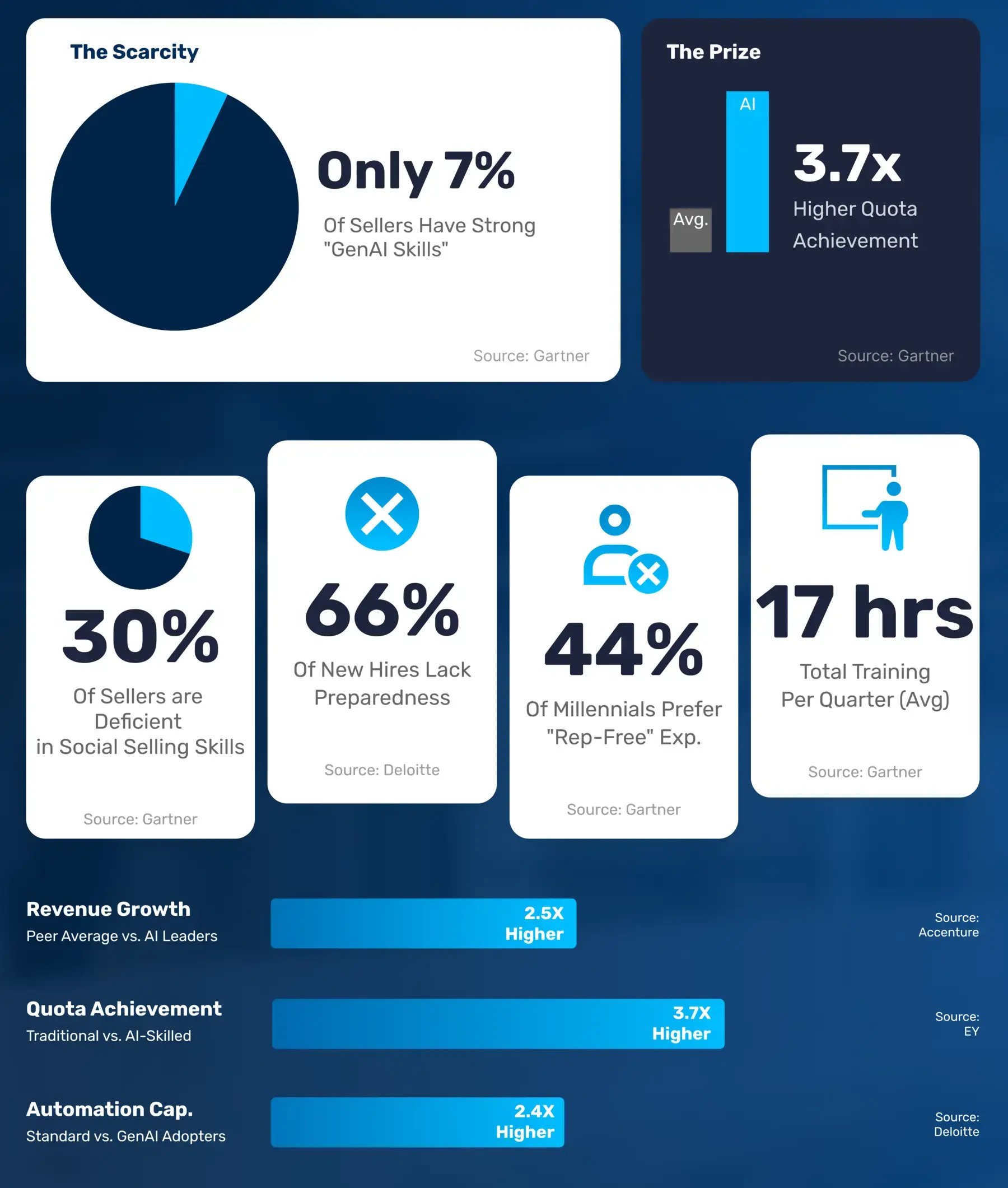
Organizations that ignore this divide will find themselves training for a game that no longer exists. If your enablement strategy still relies on static workshops, generic e-learning, and "just-in-case" knowledge dumps, you are already falling behind.
Based on proprietary research and market analysis, here is the definitive countdown of the trends that will define the winners and losers of the next era.

Download our "Top 10 Sales Training Trends for 2026" report for learning more and better experience.
The Cognitive Load Revolution: The End of "Just-in-Case" Training
For decades, sales enablement has operated on a "bootcamp" model: flood new hires with encyclopedic product knowledge during onboarding, and hope they retain it for a deal six months later.
In 2026, this model is not just inefficient; it is actively detrimental. The sheer volume of shifting specs, competitor moves, and regulations has exceeded human cognitive capacity.
Research on the Ebbinghaus Forgetting Curve shows humans forget approx. 50% of new information within one hour. Currently, 77% of sellers report struggling to complete tasks efficiently due to information overload.
The Shift: From "Just-in-Case" to "Just-in-Time"
Advanced organizations are moving to Just-in-Time Enablement. Instead of memorization, they use AI-driven "nudges" embedded in the workflow. These systems recognize context (e.g., "Competitor X mentioned in email") and surface the exact battlecard needed at that precise moment.
Strategic Action Plan:
Cut "static" content by 50%. Move it to on-demand repositories rather than live sessions.
Limit the number of internal alerts reps receive daily to prevent "notification fatigue."
Invest in tools that integrate directly into the CRM/Email client to serve content automatically.
Internal Talent Marketplaces: Solving the Retention Crisis
The "Great Resignation" has evolved into the "Great Stagnation." Employees are staying longer due to economic uncertainty, but they are often disengaged. The traditional linear career ladder (SDR → AE → Manager) is breaking down, leaving talent with nowhere to grow.
The Mobility Multiplier
Retention is no longer about perks (ping pong tables); it's about pathing.
Internal Movers
Static Roles
(Replacing a sales pro costs up to 200% of their annual salary)
From Hoarding to Exporting
The trend for 2026 is the Internal Talent Marketplace, AI-driven platforms that match employees with short-term projects based on skills, not job titles.
Leadership Shift: Managers must move from "Talent Hoarding" (guarding top performers) to "Talent Exporting" (championing their growth into new areas). This builds a more agile, loyal, and versatile workforce.
Trend #8
Navigating Buyer Skepticism: The Trust Paradox
We are living in an age of information abundance but trust scarcity. Buyers have access to more data than ever before, reviews, AI summaries, competitor comparisons, yet they have never felt less confident in their decisions.
The Epidemic of Buyer Regret
The "Growth at All Costs" era birthed aggressive personalization tactics that now feel like surveillance. This has led to a deep "Trust Deficit" between buyers and sellers.
53% of customers who experience highly personalized marketing report it as a negative experience. Even worse, two-thirds of B2B buyers report regretting their purchase decision before the contract is even fully executed. Modern sales training expands this point.
Training in 2026 must pivot from "persuasion" to "risk mitigation." Sellers need to be trained not just to close the deal, but to validate the buyer's feelings, reduce the pressure, and transparently address the downsides of their own solution to build radical trust.
Trend #7Digital Ethics as a Commercial Moat
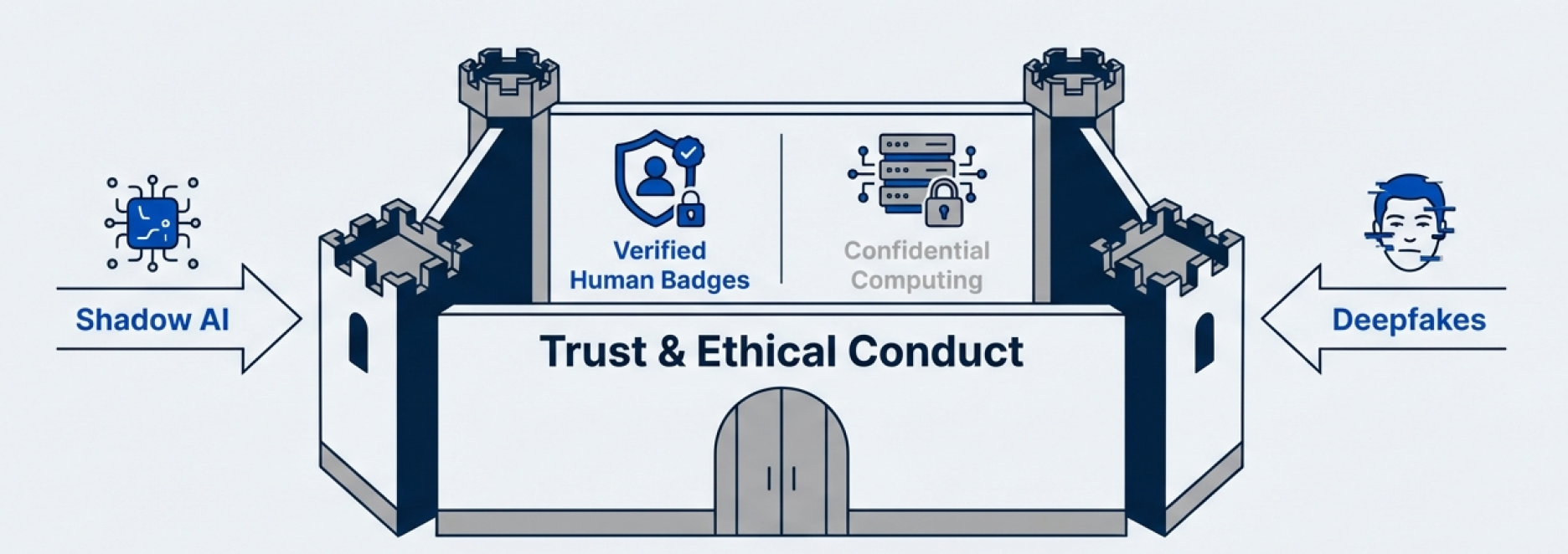
With the explosion of Generative AI, deepfakes, and "Shadow AI" (employees using unapproved AI tools), corporate risk has skyrocketed. By 2026, ethical conduct is no longer a compliance checkbox; it is a competitive differentiator.
The "Death by AI" Reckoning
Analysts predict a surge in legal cases involving "Death by AI", catastrophic failures of algorithmic decision-making. Ungoverned GenAI in commercial applications is forecast to cost companies billions in fines, legal settlements, and lost brand equity.
The Rise of "Verified Human"
In response, we are seeing the emergence of Digital Proof. Sales training must now include strict protocols on AI disclosure. If a proposal is drafted by an agent, it must be labeled. If a video testimonial is shared, it must have a cryptographic "Verified Human" badge. Buyers will increasingly demand proof that they are interacting with humans, not "agent-washed" bots.

Trend #6
The Rise of Agentic Commerce: When Bots Buy from Bots
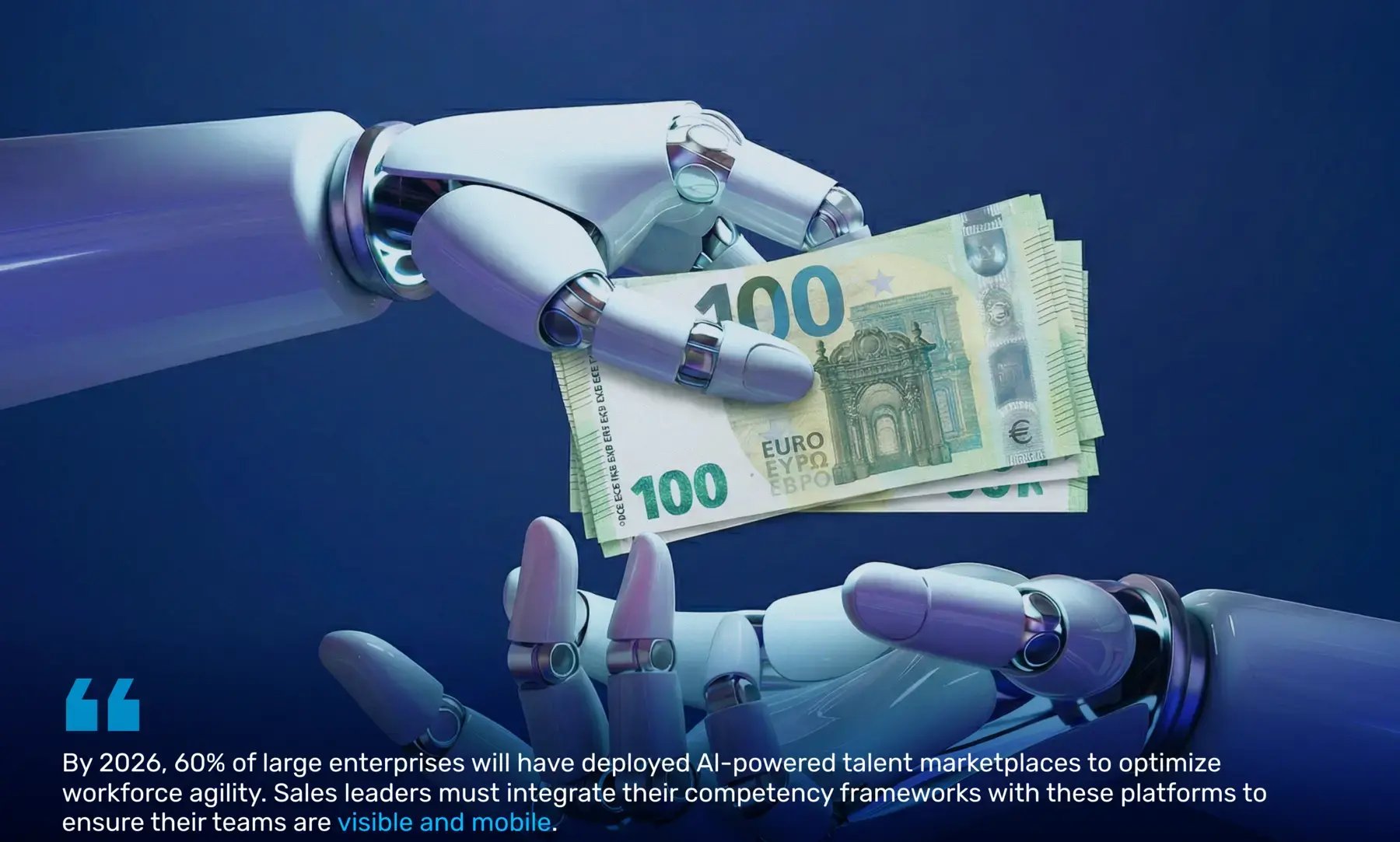
Perhaps the most consequential trend of all is the rise of the Machine Customer. By 2028, it is predicted that AI agents will outnumber human sellers by 10 to 1, and 90% of B2B buying volume will be handled by autonomous agents.
Agent Engine Optimization (AEO)
This changes the fundamental nature of sales collateral. Your pricing, technical specs, and value propositions must now be optimized for Agent Engine Optimization (AEO). If your product information cannot be parsed, categorized, and ranked by a Large Language Model (LLM), your product effectively does not exist to the machine buyer.
Negotiations in this sphere happen at machine speed. There is no "wining and dining" a bot. The "Procurement Bot" cares only about logic, spec adherence, and risk scoring. Sales teams must split their strategy: one track for human-to-human emotional selling, and another for machine-to-machine transactional selling.
Trend #5The Human Premium: EQ as the New IQ
As artificial intelligence increasingly commoditizes logic, data processing, and routine execution, the value of what remains, human connection, is skyrocketing. In the sales landscape of 2026, being "human" is no longer just a biological fact; it is a premium service tier.
Trust is Biology, Not Data
Neuroscience reveals that trust is not an abstract concept but a biological reaction. When a buyer feels "heard," "understood," and "safe," their brain releases oxytocin and activates the prefrontal cortex, moving them from a defensive state to an open state. This is triggered by mirror neurons, a unique human ability to empathize and share emotional states.
No matter how advanced an AI agent becomes, it cannot trigger these mirror neurons or creating a shared biological reality. In a world of synthetic perfection, human imperfection, empathy, and genuine warmth become the ultimate luxury goods.
By 2026, Emotional Intelligence (EQ) will stop being a "soft skill" and become a hard number. Companies are deploying behavioral analysis platforms to measure "warmth" and "active listening" as observable communication signals in real-time call recordings. The interview process is shifting: we will stop hiring "grinders" who can pound the phones (AI can do that better) and start hiring "connectors," "storytellers," and "problem solvers" who possess high cognitive flexibility and emotional resilience.
Human-Agent Symbiosis: The "Centaur" Sales Force
The future isn't a battle of Man versus Machine; it is the alliance of Man-Plus-Machine. The "Centaur" sales force represents the optimal pairing of Human Creativity + Artificial Intelligence.
Redesigning Workflows, Not Just Tasks
Winners in 2026 will not just use AI to do old things faster (like writing emails); they will redesign entire workflows to do new things that were previously impossible. This requires a "symbiotic" relationship where the sum is greater than the parts.
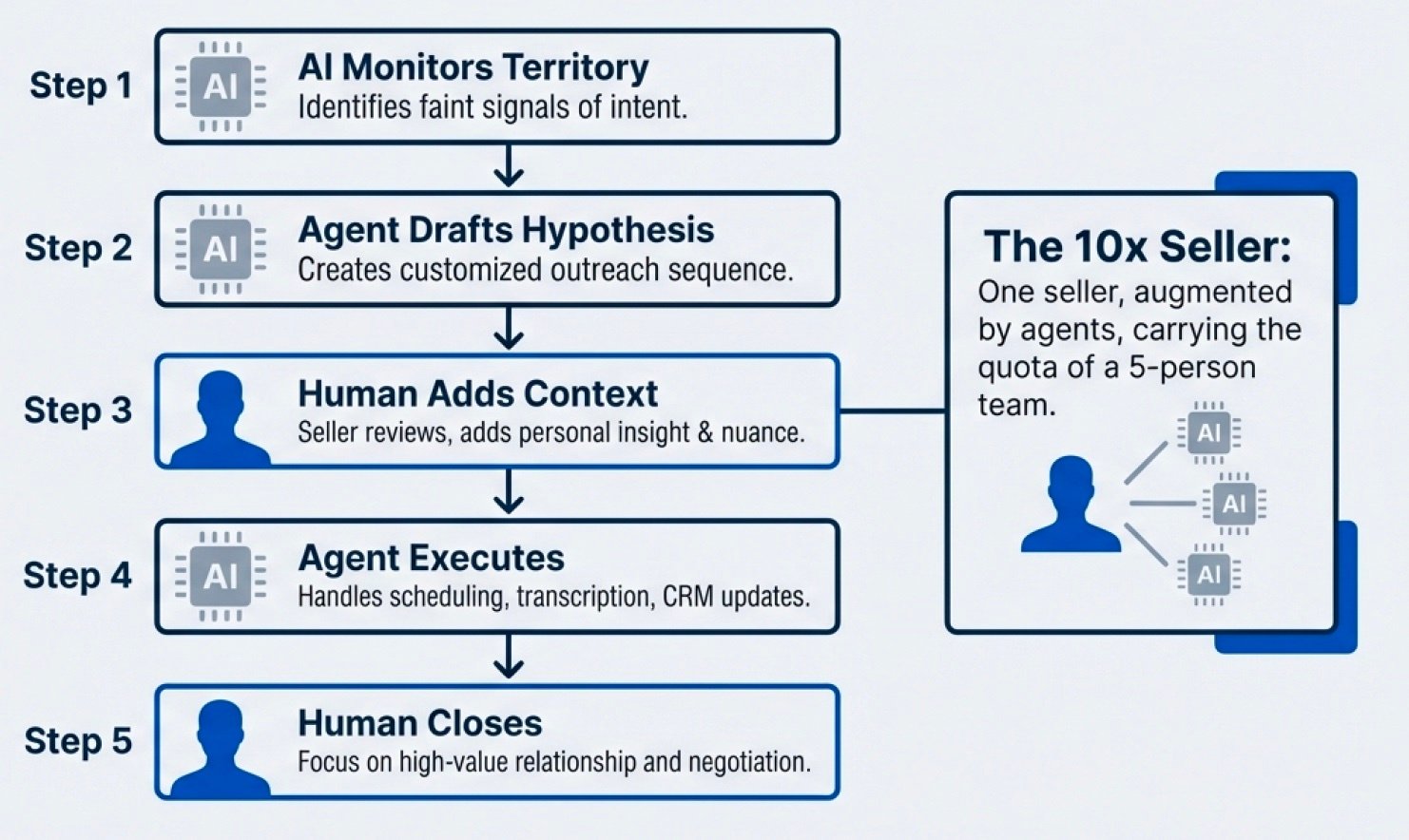
A typical Centaur Workflow in 2026 looks like this:
- AI Agent (The Scout): Autonomously monitors a territory 24/7, identifying "faint signals" of intent, such as a hiring spike combined with a specific regulatory filing.
- AI Agent (The Strategist): Drafts a hypothesis of value and a customized outreach sequence based on those signals.
- Human Seller (The Closer): Reviews this hypothesis, adds a personal anecdote or strategic insight (the human touch), and approves the send.
- AI Agent (The Admin): Handles the scheduling back-and-forth, transcribes the meeting, and updates the CRM.
- Human Seller (The Relationship): Takes the meeting to build the relationship, read the room, and negotiate complex terms.
This model allows a single seller to carry a quota that would have required a team of five in 2020, dramatically altering the unit economics of the sales organization.
Trend #3Critical Thinking Erosion: The Talent Crisis
While AI delivers on its promise of unprecedented productivity, it levies a heavy tax on the sales profession: the erosion of independent thought. As we approach 2026, we are witnessing a paradox where sellers are faster than ever, yet increasingly incapable of navigating novelty without algorithmic assistance. For deeper context, see sales training.
The "Lazy Thinking" Trap
Junior sellers are getting used to one-click emails and instant account plans. Because of this, they are losing the ability to do the hard, focused thinking that complex deals require. They struggle to break down client problems from first principles or detect the subtle political cues in a buying committee. They become merely a "standardized interface" for a model, leading to helplessness when the model fails.
The Broken Ladder
Traditionally, the SDR role was an apprenticeship where future Account Executives learned the basics. As AI agents take over research and prospecting, this training ground is disappearing, creating a massive talent void. Companies face a future with fast AI agents at the bottom and expensive experts at the top, but no one in the middle.
Gartner predicts that by 2026, 50% of global organizations will be forced to institute "AI-free" skills assessments. To combat this, training programs must create "AI-free zones", simulation scenarios where human cognition is the only tool allowed, forcing sellers to develop their critical reasoning muscles.
The Era of AI Role Play: Simulation at Scale
For decades, sales training was plagued by the "scalability" problem. You simply couldn't scale human role-play because it required a time-poor manager. Feedback was subjective, infrequent, and awkward. In 2026, AI-powered coaching simulations solve this, ushering in the era of "Perfect Practice."
The Digital Dojo: A Safe Space to Fail
In a high-stakes economy where Customer Acquisition Cost (CAC) is at an all-time high, "practicing on the prospect" is a financial disaster. It is a strategic failure to let a rep burn through their first 50 leads just to learn the ropes.
Instead, sellers now enter a Digital Dojo. They interact with photorealistic AI avatars that react with real emotion. This environment offers:
- Infinite Repetition: Reps can practice the same pitch 50 times until it becomes muscle memory.
- Psychological Safety: A space to experiment and fail without fear of judgment or career damage.
- Objective Metrics: AI provides quantifiable data on talk-to-listen ratios, filler words, sentiment, and perceived warmth.
This shifts training from a passive "lecture" model to an active "experiential" model, which drives behavior change far more effectively.
Trend #1The Sense-Making Imperative: The Only Way to Win
In a commercial world defined by the Agentic Divide, the singular strategy that unifies success in 2026 is Sense Making.
The Death of Information as Value
The traditional value of a salesperson, being a source of information, has evaporated. Buyers are not starving for data; they are drowning in it. They have read 10 whitepapers, checked 5 review sites, and heard conflicting advice. They suffer from acute analysis paralysis.
The seller's job is no longer to "give" more information (which just adds to the noise) or to "tell" the buyer what to do (which breeds skepticism). The job is to be a filter.
The Sense-Making Methodology
Sense Making is about helping the buyer organize, interpret, and prioritize the information they already have. It involves:
- Connect: Diagnosing the customer's information ecosystem. What have they read? Who are they listening to?
- Clarify: Ruthlessly reducing complexity. Filtering out the noise and correcting misconceptions.
- Collaborate: Helping the customer build a framework for decision-making that aligns with their own internal goals.
Gartner research identifies Sense Making as the highest-performing methodology. Buying groups that reach consensus are 2.5 times more likely to report a high-quality deal, and Sense Making is the primary driver of that consensus. Furthermore, 80% of sellers using this approach close high-quality, low-regret deals.
To execute this, sellers must master the Warmth + Competence framework. Warmth signals trust and empathy ("Do I trust this person?"), while Competence signals expertise ("Can this person help me?"). The "Sense Maker" is the master of answering both simultaneously.
Summary: The 2026 Sales Training Cheat Sheet
The transition to 2026 requires a fundamental audit of your current enablement strategy. Use this cheat sheet to identify where you need to shift.
| Trend | The Old Way (2020) | The New Way (2026) |
|---|---|---|
| 1. Sense Making | Seller as Information Source (Giving) | Seller as Information Filter (Guiding) |
| 2. AI Role Play | Ad-hoc, subjective role play | Simulation at Scale with objective data |
| 3. Critical Thinking | Assuming deep work happens | Mandating "AI-Free" assessments |
| 4. Human-Agent Symbiosis | Automating manual tasks | Redesigning workflows for "Centaur" teams |
| 5. The Human Premium | Focus on IQ and Logic | Focus on EQ and Empathy (Warmth) |
| 6. Agentic Commerce | Selling to Humans | Optimizing for Machine Customers (AEO) |
| 10. Cognitive Load | Just-in-Case Learning (Bootcamps) | Just-in-Time Nudges (In-flow) |
Let's Talk: Which Side of the Divide Are You On?
We’ve covered a lot of ground from the erosion of critical thinking to the rise of bots buying from bots. It’s clear that the "sales supercycle" isn't just a buzzword; it’s a fundamental restructuring of how value is created. But reading the trends is the easy part. The hard part is looking at your current enablement stack and admitting that the "just-in-case" bootcamps and static playbooks might be obsolete.
Here is the question I want to leave you with: When the AI agents inevitably take over the logic, the specs, and the scheduling... are your sellers "human" enough to handle the rest?
Are you doubling down on the "Human Premium" by training for empathy and sense-making, or are you still training robots to do a job that actual robots are about to take over? I’d love to hear what you’re seeing on the ground. Are you noticing "Lazy Thinking" in your junior reps yet? Have you tried swapping role-play for AI simulations?
Watch
Ready to Build a Team of Sense Makers?
The divide is opening. Will your team be on the side of the "Centaur" winners or the manual legacy? The future belongs to those who can blend the speed of AI with the warmth of human connection.
Don't leave your sales transformation to chance. Start measuring what matters.

References
- Gartner. (2025). "Gartner Unveils Top Predictions for IT Organizations and Users in 2026 and Beyond". Gartner Newsroom.
- Singla, A., Sukharevsky, A., et al. (2025). "The state of AI in 2025: Agents, innovation, and transformation". QuantumBlack, AI by McKinsey & Company.
- Forrester. (2025). "Predictions 2026: AI Agents, Changing Business Models, And Workplace Culture Impact Enterprise Software". Forrester Blogs.
- Gartner. (2025). "Strategic Predictions for 2026: How AI's Underestimated Influence Is Reshaping Business". Gartner Articles.
- Gartner. (2025). "Gartner Top 10 Strategic Technology Trends for 2026". Gartner Articles.
- McKinsey & Company. (2025). "The agentic commerce opportunity: How AI agents are ushering in a new era for consumers and merchants". McKinsey & Company Insights.
- Forrester. (2025). "Predictions 2026: The 'Agentic Commerce' Race And Some Potential Regrets - In Digital Commerce". Forrester Blogs.
- McKinsey & Company. (2025). "Seizing the agentic AI advantage". McKinsey & Company Insights.
- Nasdaq. (2025). "Gartner Forecasts Worldwide IT Spending to Grow 9.8% in 2026, Exceeding $6 Trillion For the First Time". Nasdaq Press Release.
- Gartner. (2019). "Gartner Reveals New B2B Sales Approach to Win in the Information Age ('Sense Making')". Gartner Press Release.
- Demand Gen Report. (2024). "Why A 'Sense Making' Approach Wins B2B Sales". Demand Gen Report.
- Gartner. (2025). "Gartner Sales Survey Finds 74% of B2B Buyer Teams Demonstrate 'Unhealthy Conflict' During The Decision Process". Gartner Press Release.
- Gartner. (2023). "Gartner Survey Finds 77% of Sellers Struggle to Complete Their Assigned Tasks Efficiently". Gartner Press Release.
- Gartner. (2024). "Gartner Survey Reveals Only 11% of Sales Organizations Are Able to Drive Commercial Success While Executing a Transformation". Gartner Press Release.
- Gartner. (2025). "Gartner Says By 2030 that 75% of B2B Buyers Will Prefer Sales Experiences that Prioritize Human Interaction Over AI". Gartner Press Release.
- Demand Gen Report. (2025). "Gartner Survey Reveals the Pitfalls of Personalization to Avoid". Demand Gen Report.
- Retorio. Dr. Patrick Oehler, (2025). "Combatting the forgetting curve with AI coaching". Retorio Blog.
- Retorio. (2025). "AI Coaching Platform | Enhance Sales and Service Skills". Retorio.
- Forrester. (2025). "Predictions 2026: Trust Gets Tested For B2B Marketing, Sales, And Product Leaders". Forrester Blogs.
- Forrester. (2025). "Predictions 2026: Trust Will Be The Ultimate Currency For B2B Buyers". Forrester Blogs.
Disclaimer: This report synthesizes independent market research and is not endorsed by the cited organizations.
Frequently asked questions
What is the biggest sales training trend in 2026?
The shift from one-time training to continuous, AI-supported practice, with just-in-time learning and role-play simulation replacing one-off courses.
How is AI changing sales training in 2026?
AI enables realistic role-play at scale and behavioral feedback, while raising the premium on human skills like empathy as buyers grow skeptical of automation.
What should sales teams measure in 2026?
Behavior change and business outcomes such as conversion and ramp time, not course completion or attendance.