



THE FRAMEWORK PAGE
What Is Sales Coaching? The Framework, Playbook, and Software for 2026
Sales coaching is the repeated loop of observing a rep's behavior in a conversation, scoring it against a named rubric, prescribing the next practice, and re-scoring. It is a behavioral capability system, not a training program. Retorio runs that loop against the Warmth and Competence framework, validated across 50+ enterprise clients and 100,000+ people coached, with a documented 38% to 42% reduction in ramp time when run end to end.
Book a demoOn this page
Definition
Sales coaching is the structured, behavior-led process by which sales managers and dedicated coaches build the observable capabilities a rep needs to convert pipeline. It runs on a measurement loop, not on a calendar. Each cycle scores a small set of named behaviors during a real or simulated conversation, identifies the two weakest signals for that rep, prescribes the next practice that targets those signals, and re-scores on the next cycle. The output is a measurable shift in how a rep talks to a customer in week four versus week one, not a certificate.
The phrase covers three things in the market, which is where the confusion starts. It covers (1) the manager-led 1:1 conversation after a call, (2) the structured cadence a sales enablement function runs across a team, and (3) the software layer that observes behavior at scale and feeds the cadence. A real coaching program uses all three, because each one alone misses something the others catch.
Last quarter at a 1,400-rep B2B SaaS organisation, the CRO asked the head of sales enablement a question that surfaces this problem cleanly. "Show me the rep whose discovery questions per minute went from 0.4 to 1.1 between week one and week eight, and show me which coaching action did it." The head of enablement could not, because the team was running training, not coaching. The two are not the same. The rest of this page is the operating definition of the second one.
Why sales coaching works when training does not
Three reasons, in order of how often they get missed in vendor demos.
It targets behavior, not knowledge. A rep who can recite the discovery framework word for word and still asks one leading question per call has a behavior problem, not a knowledge problem. Training transfers the framework. Coaching observes whether the rep uses it under pressure, scores it, and corrects it on the next call. The 41% reduction in onboarding time documented in the Vodafone VOIS deployment came from this shift, agents practicing the behavior in five role plays per scenario instead of sitting through one classroom session.
It runs on a loop, not on an event. Two days of off-site training degrade to baseline within six weeks. A coaching loop run weekly with measurable signals does not degrade, because the signal is being re-scored every cycle. The CSO Insights research on coaching effectiveness, run across multiple sales organisations, finds the highest-performing teams operate at a fundamentally different coaching cadence than average teams, not at a different content quality.
It separates the practice from the live deal. A new rep who learns objection handling on a live customer call is being trained at the expense of pipeline. A new rep who runs five practice conversations with a virtual client before that call enters the live deal with the behavior already grooved. This is the structural shift behind Retorio's documented 38% to 42% reduction in ramp time across enterprise customer studies, the rep arrives at the live conversation with the behavior already practiced.
What sales coaching is NOT
Most procurement conversations stall because the buyer and the vendor use "sales coaching" to mean three different things. The table separates them. A real coaching program contains pieces of all four columns, but only one of them is the loop.
The practical test before any procurement decision is to ask the vendor, in writing, which row of this table they are. A vendor that says "all four" is almost always row three with marketing.
The framework: Warmth and Competence as observable behaviors
A coaching rubric works only if the named behaviors are observable on a single conversation. The Retorio framework uses two axes drawn from the Big 5 behavioral research base (McCrae and John, 1992) and applied to sales conversations across enterprise deployments. Both axes break down into four observable behaviors that a coach (human or AI) can score in real time.
Warmth axis
The relational behaviors a customer can feel within the first 60 seconds. Score on every call.
Competence axis
The substance behaviors that move a deal forward. Score on every call.
Each behavior produces a numeric score per call. Each rep produces a Warmth and Competence profile across a 4-week window. The coaching action is always the same shape: identify the two weakest behaviors for this rep, prescribe two practice scenarios that target them, re-score on the next call. A team running this loop weekly produces a behavior shift in 4 weeks and a quota shift in 12.
How to run sales coaching: a 5-step pilot playbook
For a sales enablement leader piloting a coaching program across one team (10 to 30 reps) before scaling. The steps are sequential, each runs in roughly one week, total pilot length 5 weeks before the first measurable outcome.
1. Name the four to eight behaviors you will score.
Use the eight from the Warmth and Competence rubric above, or draft your own. Every behavior must be observable on a single conversation and scoreable on a 0 to 100 scale without manager interpretation. If two coaches cannot agree on a score from the same recording, the behavior is not yet defined sharply enough. Re-draft.
2. Baseline every rep on three practice conversations.
Run three practice conversations per rep against a virtual client (AI role play) or a peer (live role play if no AI tooling yet). Score each of the named behaviors. Compute the rep's Warmth and Competence profile. Identify the two weakest behaviors per rep. This is the input to step three.
3. Prescribe two targeted scenarios per rep per week.
For each rep, pick two practice scenarios that exercise the two weakest behaviors. A rep low on objection handling gets scenarios with stronger initial pushback. A rep low on discovery density gets scenarios with high-context customer personas where surface questions surface nothing. Each rep runs both scenarios twice in the week. Manager spends 30 minutes per rep per week reviewing one scored session.
4. Re-score weekly, watch the trend on the two targeted behaviors.
In a behavior-led coaching program, you do not watch overall scores. You watch the trend on the two targeted behaviors for each rep. By week three, expect movement of at least one tier on at least one of the two targets per rep. If no rep is moving on a behavior after three weeks, the behavior is too coarse or the practice scenario is wrong. Re-draft.
5. Carry behaviors into live customer calls with consent.
From week five, score the same behaviors on recorded customer calls (with consent and within data residency rules). The signal from practice carries over into the live conversation at roughly 80% retention if the rubric is consistent. The cohort quota number is your outcome measure, not the per-call score.
Software: what it adds, what it does not replace
You can run the playbook above without software. A team of 10 reps with a dedicated coach and structured peer role plays can produce a measurable behavior shift inside six weeks. The reason teams adopt a behavioral AI coaching platform is scale. At 50 reps and one coach, the bottleneck is not the coaching action itself, it is generating enough scored practice conversations per week to feed the loop. Software solves that bottleneck and adds two things a manual program cannot match.
It produces the practice repetitions at scale. A rep can run five role plays against a virtual client in the time a manager could observe one. Each role play produces a complete score on every named behavior, not just the two the manager noticed. The rep gets the next prescribed scenario within seconds, not at the next 1:1.
It produces a behavior trend per rep that is comparable across the team. A manager scoring by hand introduces variance. An AI rubric scoring every session the same way produces a behavior trend a CRO can read without translation. The coaching action remains human, the manager still owns the 1:1. The signal under the action is consistent across the org.
The Retorio coaching loop at scale
100,000+
people coached
50+
enterprise clients globally
140+
behavioral cues analyzed per session
ISO 27001 certified, GDPR-compliant, EU data residency. Behavioral Intelligence grounded in McCrae and John (1992) plus applied research from TUM, MIT, and University of Tokyo.
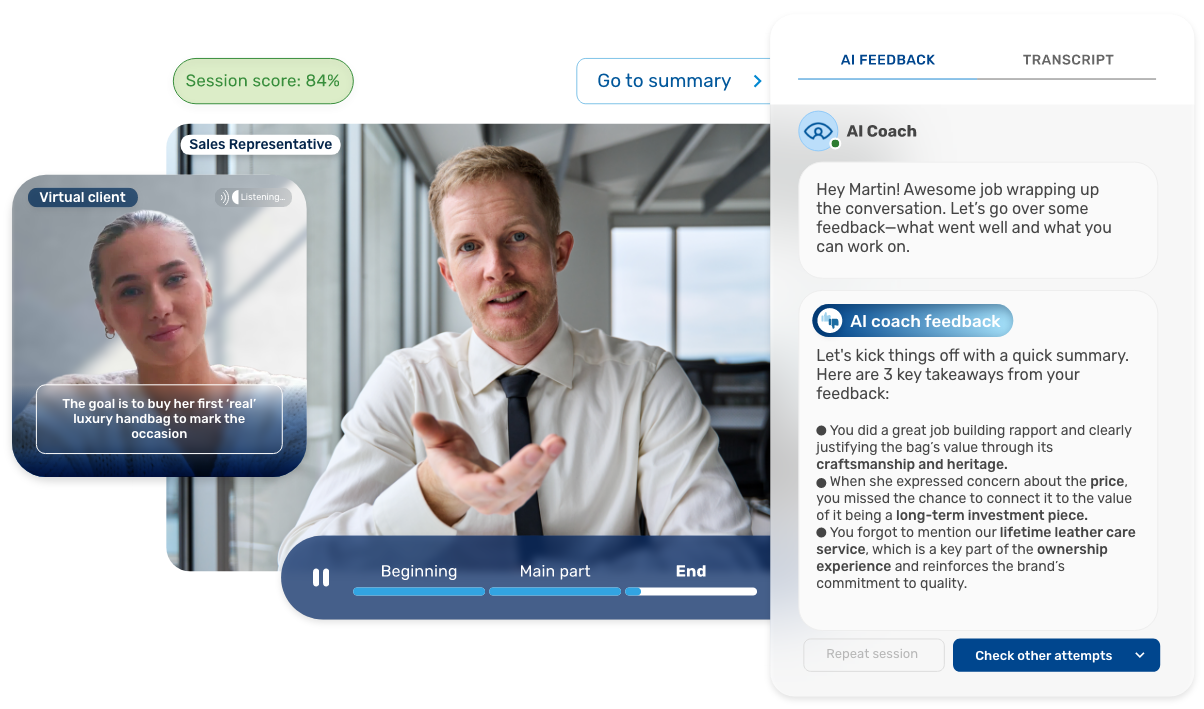
Retorio AI Coaching Platform: live behavioral scoring during a rep practice conversation, with the Warmth and Competence rubric visible on the right.
Proof: outcomes from end-to-end deployments
Three published outcomes from enterprise customer deployments that ran the loop above end to end. All numbers are from verified Retorio customer studies and stored in the proof-points registry. Composite framing where customer name is not approved for this page.
For a deeper view of how the Warmth and Competence rubric scores in practice, see our companion piece on AI sales coaching and the four behavioral signals that predict quota. For the practice-mechanic side, see how AI role play works inside a coaching loop and how sales training software fits in the same stack. For the broader category, see our overview of sales training.
FAQ
What is sales coaching, in one sentence?
Sales coaching is the loop that observes a rep's behavior on a practice or real conversation, scores it against a named rubric, prescribes the next practice that targets the weakest behaviors, and re-scores on the next conversation.
How is sales coaching different from sales training?
Sales training transfers content (a new methodology, a new product, a new playbook). Sales coaching observes whether the rep uses that content under pressure, scores it, and corrects it on the next conversation. Training is an event, coaching is a loop. The two are complements, not substitutes.
How long until coaching produces a measurable outcome?
A behavior shift on the two targeted signals per rep is expected by week three of a weekly loop. A measurable quota shift on the cohort typically lands at week 12. A ramp-time outcome on new hires is visible inside the first eight weeks because the baseline is shorter.
What is the ROI of a sales coaching program?
Documented enterprise deployments running the full loop report 15x first-year ROI computed from combined ramp acceleration, +27% sales performance lift, and 72% turnover reduction in high-performing teams. The single largest contributor is usually ramp time, because the new-hire payback window shortens by 38% to 42%.
What software supports sales coaching at scale?
A coaching platform should produce (1) practice repetitions at scale via AI role play, (2) behavioral scoring against a named rubric on every session, (3) a next-action prescription tied to the rep's weakest signals, and (4) a per-rep behavior trend a manager can read in a 1:1. Retorio is the AI Coaching Platform built around these four functions, used across 50+ enterprise clients globally.
How do you start a sales coaching program from scratch?
Start with one team of 10 to 30 reps and the 5-step playbook on this page. Name four to eight observable behaviors, baseline on three practice conversations per rep, prescribe two targeted scenarios per rep per week, re-score weekly, carry into live calls in week five. The pilot produces its first measurable behavior shift in three weeks.
Key takeaways
See the Retorio coaching loop on your team's behaviors
A 30-minute demo walks through the Warmth and Competence rubric on a scenario from your industry, the next-action prescription engine, and the per-rep behavior trend a CRO can read.
Book a demo