


High-impact sales coaching means personalizing each rep's development, keeping practice interactive with real-world scenarios, reinforcing skills through microlearning, giving regular feedback, and measuring results against sales metrics. The post lists 10 such tips and points to AI coaching platforms like Retorio, which use role play and behavioral feedback to scale practice and track adoption across reps.
Example. A sales manager notices one rep stumbles whenever a prospect asks about pricing. Instead of a general refresher, she runs a short role-play using that exact situation, watches the rep respond, and gives specific feedback on word choice. The rep handles the real conversation well the following week.
Source: Gallup, How to Improve Employee Engagement in the Workplace (2024).
Banking on your sales teams to crush quotas and bring in business growth?
Here's the current reality:
26% of sales reps say their current sales coaching is ineffective. Furthermore, just 35% of sales managers track the effectiveness of sales coaching activities of their sales coaching techniques.
Effective sales coaching is the key to bridging this gap.
By implementing a robust sales coaching and sales strategy front, a sales manager can ensure that their sales representatives are well-versed in the latest selling strategies and techniques, and never miss a deal.
This, in turn, leads to enhanced performance, increased closure rates, and stronger customer relationships. In fact, 96% of respondents in a survey of 100 companies either agreed or strongly agreed that effective sales coaching positively impacted their salespeople’s performance.
Are you a learning and development (L&D) manager or sales manager who wants to empower sales teams and ensure they're effectively meeting their goals? Do you a good sales coach and want your reps to be exceeding quotas and pushing revenue to new heights?
It's time to focus on your sales coaching methods.
What's in this post?
What is sales coaching?
Related from the sales coaching clusterRead more on how AI coaching works for sales teams, training retention and the forgetting curve, and concrete sales coaching examples that work.
Sales coaching is a transformative process that empowers and uplifts sales professionals and teams to achieve peak performance.
It encompasses the provision of guidance tactical coaching and support, enabling sales representatives to enhance their selling skills, acquire new techniques, forge customer relationships, and ultimately close deals more effectively.
Coaching plays a crucial role in giving a sales team their performance feedback and pinpointing opportunities for growth. In this age of digital transformation, sales coaching has become an invaluable asset for businesses, empowering them to thrive and succeed.
💡To understand what is sales coaching you can visit our Sales Coaching & Training page.
The Urgent Need for Effective Sales Skills Training
Are your sales training initiatives facing budget cuts, even as the pressure to hit revenue targets intensifies? Is your sales team struggling to consistently achieve quotas, and are you grappling with the challenge of pinpointing individual skill gaps and ensuring uniformly high training quality across the board? You're not navigating this alone. Learning and Development departments are frequently the first to experience budget reductions during economic uncertainty, despite compelling data showing that companies prioritizing L&D are 59% more likely to achieve growth. Imagine a scenario where you could drive up to 20% revenue growth within 12 months of scaled adoption and realize a 14.6% uplift in sales quota attainment – all while streamlining your training efforts. Discover how AI coaching delivers measurable outcomes, scalable solutions, and a demonstrable return on investment, effectively transforming your sales team's performance and fortifying your L&D budget. Continue reading for the ultimate guide and 10 essential tips that will transform your sales coaching strategy and empower your team to excel!
What kinds of sales coaching methods exist?
There are myriad methods to approach sales training, each with its own merits and demerits.
-
Traditional methods often involve in-person workshops or one-on-one coaching sessions, offering a highly personalized experience. These face-to-face interactions allow for direct feedback and tailored lessons.
However, they can be time-consuming, costly, and challenging to scale across larger sales teams.
-
E-Learning platforms offer a more flexible, scalable approach. These digital platforms provide access to a plethora of resources, allowing sales representatives to learn at their own pace and on their own schedule.
Despite these advantages, e-learning alone can often lack the personal touch and immediate feedback that direct coaching provides.
Examples of e-learning platforms that offer sales coaching for companies include SalesHood, Brainshark, and LearnCore.
-
Finally, AI-powered sales coaching platforms amalgamate the benefits of both traditional and e-learning methods, while also infusing advanced technology. Related reading on specific coaching techniques.
These platforms provide personalized feedback, scalable training, and data-driven insights, making them the paragon of modern, sales coach training. However, their effectiveness can be contingent upon the quality of AI algorithms, and there may be a learning curve for those unaccustomed to leveraging such technology.
For instance, is an AI-powered sales coaching platform that allows users to track and assess sales performance, while offering tailored resources to help close the gap between current performance and target goals.
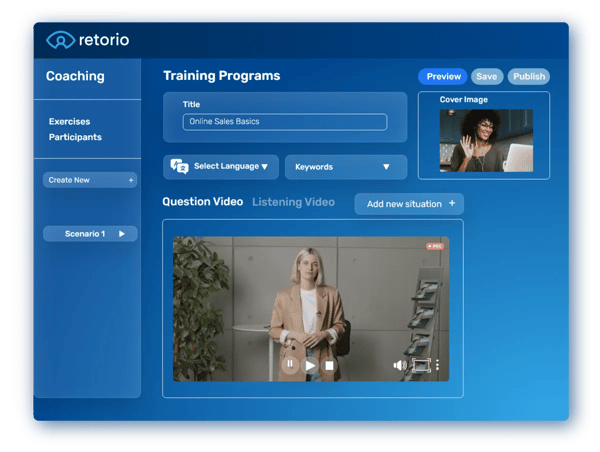 Retorio's Behavioral Intelligence Platform offers scalable, immersive training opportunities for customer-facing roles.
| Skill Category | Description | Example Skills | Relevance for L&D |
|---|---|---|---|
| Foundational Skills | Essential building blocks for any sales role. | Communication, Active Listening, Product Knowledge, Time Management, Organization | Crucial for onboarding new hires and establishing a strong base. |
| Prospecting & Lead Gen | Skills to identify and qualify potential customers. | Lead Generation Techniques, Social Selling, Networking, Database Management, Research | Vital for pipeline development and ensuring a consistent flow of opportunities. |
| Customer Interaction | Skills for engaging with customers and building relationships. | Building Rapport, Needs Analysis, Questioning Techniques, Presentation Skills, Storytelling | Directly impacts customer experience and the ability to understand needs. |
| Sales Process & Strategy | Skills to navigate the sales cycle effectively. | Sales Methodologies (e.g., Solution Selling, Consultative Selling), Pipeline Management, Sales Planning, Territory Management | Ensures a structured approach to sales and efficient resource allocation. |
| Advanced Sales Techniques | Skills for closing deals and maximizing revenue. | Negotiation, Objection Handling, Closing Techniques, Upselling & Cross-selling, Account Management | Drives revenue growth and increases deal value. |
| Technology & Tools | Skills to apply technology for sales efficiency. | CRM Utilization, Sales Automation Tools, Data Analysis for Sales, Virtual Selling | Enhances productivity and provides data-driven insights for improvement. |
What is the objective of sales coaching?
The primary goal of sales coaching sessions is to enhance the skills of sales representatives and equip them with the necessary tools to successfully seal deals. This encompasses aiding reps in identifying areas for improvement, cultivating novel selling strategies and tactics, and offering constructive feedback on their performance.
Your reps practice on real customers. Fix that.
Retorio gives every rep unlimited, judgment-free AI role play with instant, specific feedback. ISO 27001 certified, GDPR-compliant, EU AI Act aligned.
Test AI coach in actionUltimately, this endeavor should yield heightened productivity and improved outcomes for the company.
| Increased Revenue Streams | Effective sales coaching inevitably leads to the augmentation of revenue streams. It furnishes sales teams with the requisite skills to boost conversion rates, thereby amplifying the company’s bottom line. |
| Enhanced Client Retention | Sales coaching equips representatives with superior customer engagement and relationship-building skills, thus bolstering client loyalty and enhancing retention rates. |
| Optimized Sales Process | Sales coaching expedites the process of sales lifecycle optimization. By imparting tactical and strategic acumen, it enables sales reps to adeptly navigate negotiations, leading to more efficient deal closures. |
| Empowered Sales reps | On a personal level, sales coaching empowers reps by augmenting their skill sets and confidence, thereby fostering a more engaged and motivated sales team, ready to surpass their sales targets. |
| Informed Decision-Making | With access to real-time data and analytics provided by AI-powered coaching platforms, companies can make informed decisions that align with their growth objectives, optimizing both individual and team performance. |
10 Essential Tips for High-Impact Sales Coaching
So, what are the secrets to achieving sales coaching that prepares reps to handle every customer conversation and close deals like never before?
1. Personalize the Learning Experience: Generic training rarely resonates. Use AI coaching platforms like Retorio to tailor coaching paths to individual skill gaps and learning styles. Personalized content and feedback ensure relevance and keep salespeople actively invested.
2. Make it Interactive and Experiential: Move beyond passive lectures. Incorporate simulations, gamification, and role-playing exercises that allow salespeople to actively practice and apply new skills in a safe environment. Interactive learning fosters deeper understanding and retention.
3. Focus on Practical Application & Real-World Scenarios: Training should directly mirror the challenges and situations salespeople face daily. Use case studies, real call analysis (which Retorio facilitates with its AI feedback), and scenarios that are highly relevant to your specific industry and sales context.
4. Incorporate Microlearning for Continuous Reinforcement: Break down training into smaller, digestible modules delivered consistently over time. Microlearning, combined with spaced repetition, combats the forgetting curve and reinforces key concepts effectively.
5. Embrace AI Coaching: Modern challenges require a modern approach. AI coaching platforms like Retorio offer scalable personalization, objective feedback, and data-driven insights that traditional methods simply cannot match.
6. Provide Regular Feedback and Coaching: Feedback is crucial for skill development. Integrate regular feedback loops into your training programs. AI coaching excels here, providing immediate, objective feedback on communication skills, sales techniques, and more.
7. Gamify and Reward Progress: Introduce game mechanics like points, badges, and leaderboards to inject fun and motivation into training. Gamification can significantly boost engagement and encourage healthy competition among sales team members.
8. Foster a Collaborative Learning Environment: Encourage peer-to-peer learning and knowledge sharing. Create opportunities for salespeople to learn from each other's experiences, share best practices, and collaborate on challenges.
9. Align Training with Business Goals and Sales Metrics: Clearly demonstrate how sales skills training directly contributes to achieving business objectives and improving key sales metrics. Tie training content and exercises to specific performance goals to highlight relevance and ROI. Field-tested coaching tips expands this point.
10. Measure, Analyze, and Iterate Based on Data: Track key metrics to assess the effectiveness of your training programs. Use data analytics, especially those provided by AI coaching platforms like Retorio, to identify what's working, what's not, and continuously refine your training strategies for optimal impact. Companies using AI coaching have seen a potential 14.6% increase in sales quota achievement, demonstrating the power of data-driven training.
Why should companies invest in sales coaching?
Sales coaching is a vital investment for companies committed to growth and success.
It empowers sales leaders and teams to:
- Stay competitive
- Enhance skills
- Boost motivation
- Improve performance metrics
Equipping your sales team with the necessary tools for success enhances their performance and demonstrates your dedication to their growth as individuals and as a cohesive unit. It fosters an environment of trust and collaboration, elevating morale and instilling the confidence needed to close more deals.
| Benefit Category | Key Advantage | How AI Coaching Helps |
|---|---|---|
| Improved Sales Performance | Increased revenue, quota attainment, deal size, conversion rates. | Targeted skill development, personalized feedback, data-driven insights. |
| Enhanced Training Engagement | Higher participation, motivation, knowledge retention. | Personalized learning paths, interactive simulations, gamification. |
| Measurable ROI | Clear data on training impact, justification of L&D budget. | Built-in analytics, performance tracking, quantifiable results. |
| Scalability & Efficiency | Cost-effective training for large teams, optimized resource allocation. | AI-powered automation, reduced need for extensive in-person coaching. |
| Future-Proofing Sales Team | Adaptability to changing market demands, continuous skill development. | Ongoing feedback, personalized learning, prepares team for future challenges. |
In essence, sales coaching is a powerful tool that maximizes the potential of your sales teams, propelling them toward success - and leveraging AI-powered technology makes it easier than ever to create personalized training plans tailored to each team member's unique needs.

With Retorio, sales reps can practice handling realistic customer situations with AI role-plays.
Want to realize the full value of your sales team and transform your sales skills training strategy? Discover how Retorio's AI coaching platform can help you personalize learning, drive engagement, and achieve measurable results.

FAQs related sales coaching
How are companies coaching sales today?
Nowadays, numerous companies are leveraging AI-powered sales coaching platforms to enhance the efficiency and personalization of training.
These platforms offer real-time performance data and analytics, enabling sales coaches everywhere to monitor progress and identify areas for improvement effortlessly. Additionally, AI-powered platforms empower coaches to create tailored training plans that cater to the unique needs of each sales representative.
This facilitates the upskilling of sales reps, equipping them with the necessary skills to successfully close deals. Common sales coaching topics encompass prospecting, building customer relationships, understanding customer needs, negotiation, and deal closure, developing innovative sales strategies and tactics, providing performance feedback on sales calls, and delivering customized advice to enhance sales team capabilities.
What are sales coaching topics?
Good sales coaching programs equip sales reps with skills they'd require during sales cycles and their personal development. Sales training materials should prepare sales reps to be prepared for any type of sales-related conversation.
Common topics that should be covered by a coaching program include:
-
Building relationships with customers
-
Understanding customer needs and challenges
-
Negotiating and closing deals
- Dealing with hesitant clients
-
Prospecting for new leads
-
Developing strategies and tactics for selling
-
Providing feedback on performance
-
Upskilling sales teams with customized advice
By understanding and mastering these topics, sales reps can become more confident when engaging customers and ultimately close more deals for the company.
How does Retorio's AI Coaching Platform work?
Retorio analyzes real or simulated conversations (video, audio, or text) using AI to assess hundreds of behavioral parameters related to communication skills. It then provides personalized feedback, highlighting strengths and areas for improvement, and offers tailored coaching content to guide development.
What skills does Retorio's AI Coaching focus on?
Retorio focuses on a wide range of soft skills crucial for business success, including:
* Communication Skills (clarity, conciseness, positivity, empathy, etc.)
* Sales Skills (needs analysis, objection handling, closing techniques, etc.)
* Customer Service Skills (active listening, problem-solving, rapport building, etc.)
* Leadership Skills (motivation, delegation, feedback delivery, etc.)
* Presentation Skills
* Negotiation Skills For deeper context, see practical sales coaching tips.
Is Retorio only for sales teams?
No, while Retorio is highly effective for sales skills training, it's beneficial for any team that relies on strong communication and interpersonal skills. Customer service, leadership, management, and even internal communication teams can benefit significantly from Retorio's AI coaching.
What industries does Retorio work with?
Retorio is industry-agnostic and can be applied to any sector where effective communication is vital.
We work with companies in industries such as:
* Technology
* Finance
* Healthcare
* Automotive
* Retail
* Manufacturing and many more.
Why is sales coaching important?
Sales coaching is critical because it helps salespeople refine their skills, overcome obstacles, and ultimately increase sales performance. Effective sales coaching drives consistency, boosts morale, and aligns team goals with company objectives. Retorio’s AI platform helps managers provide targeted coaching, enabling salespeople to reach their full potential.
How can Retorio’s AI platform help with sales coaching?
- Scalability and Reach:
- Enables scalable reach to all sales reps, ensuring consistent, high-quality training.
- Personalized Learning:
- Offers personalized and interactive learning experiences.
- Data-Driven Recommendations:
- Provides data-driven recommendations supported by video footage and evidence.
- Objectively analyzes hundreds of behaviors, providing bias-free feedback.
- Behavioral Analysis and Improvement:
- A linear regression model projects a 2% increase in the alignment of actual behavior with ideal behavior with each coaching session.
- Quantifies behavioral changes and validates recommendations.
- Analyzes sales rep interactions to quantify, predict, and prescribe behaviors based on video analysis.
- Engagement:
- One large automotive company saw user activity between 1 and 23 sessions per person, with 67% of users repeating coaching sessions.
- Cost-Effectiveness:
- One large enterprise managed to coach 42 times more people for the same cost by switching to AI coaching.
- Improved Sales Performance:
- Enterprise deployments measure a 14% average increase in Warmth and a 15% average increase in Competence within 12 months of Retorio’s AI coaching.
- Another implementation saw a 14.6% increase in sales quota achievement.
- Efficiency and Speed:
- AI coaching can be set up in hours and immediately deployed to thousands of employees worldwide.
- 24/7 Availability:
- AI coaches are always available.
Frequently asked questions
What are some effective sales coaching techniques?
Effective sales coaching techniques include:
• Role-playing: Simulating real-world sales situations to practice pitching, overcoming objections, and closing.
• Goal setting: Establishing clear, measurable targets for each salesperson to achieve.
• Behavioral analysis: Assessing sales conversations to identify strengths and areas for improvement.
• Active listening: Teaching salespeople to listen to customer needs and respond appropriately.
Retorio’s AI platform incorporates these techniques, helping managers deliver targeted coaching based on data-driven insights.
What specific skills does sales coaching focus on?
Sales coaching focuses on specific skills that enhance sales performance, address key challenges, and align with business goals. These skills are often identified through the analysis of sales data and the behaviors of top performers.
Specific skills that sales coaching focuses on:
- Closing skills Coaching helps sales representatives develop the skills necessary to close more deals and increase sales numbers.
- Product knowledge Training ensures that sales reps are well-versed in product details, enabling them to effectively communicate value to customers.
- Sales process proficiency Coaching emphasizes the ability to lead successful sales conversations.
- Negotiation Training covers effective sales negotiation techniques to improve deal outcomes.
- Objection handling Sales coaching addresses how to handle objections, which is a key skill for converting prospects into customers.
- Emotional intelligence Coaching aims to develop emotional intelligence to improve customer interactions and build stronger relationships.
- Communication and interpersonal skills Coaching focuses on improving overall communication, including active listening, clear articulation, and persuasive messaging.
- Behavioral skills Soft skills, such as effective team collaboration and communication, are crucial for sales success.
- Adaptability Training ensures that sales teams can quickly adapt to changing market conditions and customer needs.
- Customer relationship management Coaching includes strategies for managing client relationships effectively.
The skills mentioned above can be targeted through coaching to address challenges like low revenue, failure to meet quotas, and skill gaps. AI coaching can also help with onboarding, pitching, discovery, value-based selling, and simple negotiations.
How does Retorio’s AI customize sales coaching for each salesperson?
Retorio's AI platform customizes sales coaching for each salesperson through several key mechanisms, allowing for personalized and effective training.
Methods of customizing sales coaching:
- Personalized Learning Experiences: Retorio offers personalized and interactive learning experiences tailored to individual sales rep needs. This approach contrasts with generic training sessions by adapting to each person's specific requirements.
- Data-Driven Insights: The AI provides data-driven insights that pinpoint and address specific learning gaps for each salesperson. By analyzing performance data, the system identifies areas where an individual needs the most improvement.
- Behavioral Analysis: Retorio's AI analyzes each sales rep’s interactions to quantify, predict, and prescribe behavior based on video analysis. This involves assessing communication patterns, identifying strengths, and highlighting areas for development.
- Customizable Content: Training administrators can use generative AI models to create custom coaching simulations tailored to specific sales situations and products relevant to each salesperson. This ensures that the training content directly relates to the challenges and scenarios they encounter.
- Adaptive Algorithms and Real-Time Feedback: Through adaptive algorithms and real-time feedback, the AI engages reps more effectively, fostering higher levels of interest and participation. The system provides immediate evaluations and suggestions based on the salesperson's performance in simulations.
- Identification of Winning Behaviors: The platform identifies winning behaviors from experienced sales reps and shares them across the organization. The AI compares each rep's behavior with these winning strategies, offering actionable insights for improvement.
- Bias-Free Feedback: AI coaches focus solely on behavior, disregarding demographics like age, gender, or ethnicity, ensuring unbiased recommendations. This allows salespeople to receive objective feedback based purely on their performance.
- Personalized Feedback: The AI gives personalized feedback and advice based on insights from thousands of top performers. This feedback acts like a mentor, guiding each salesperson toward adopting successful strategies.
- Real-time Monitoring and Precise Feedback: The platform provides comprehensive real-time monitoring and precise, data-driven feedback. This ensures that salespeople receive consistent and actionable insights to improve their performance.
By using these methods, Retorio's AI platform ensures that each salesperson receives coaching that is specifically tailored to their individual needs, strengths, and areas for improvement, resulting in more effective and efficient sales training.
Written with help from LLMs, edited and checked by Önder Mutluer, Website Manager and Marketing Strategist, and Dr. Patrick Oehler, Co-founder and Co-CEO. Reviewed by Peter Holdenried, Head of Sales. How this article was researched, written and checked, and who reviews which topic: Retorio editorial policy.