

Enterprise Sales Coaching
Most sales organizations already know they need coaching. The question commercial leaders actually wrestle with is: what measurable impact should I expect, and how do I defend this budget to the CFO? This post answers both, using outcomes documented across 50+ enterprise clients globally.
Quick Answer
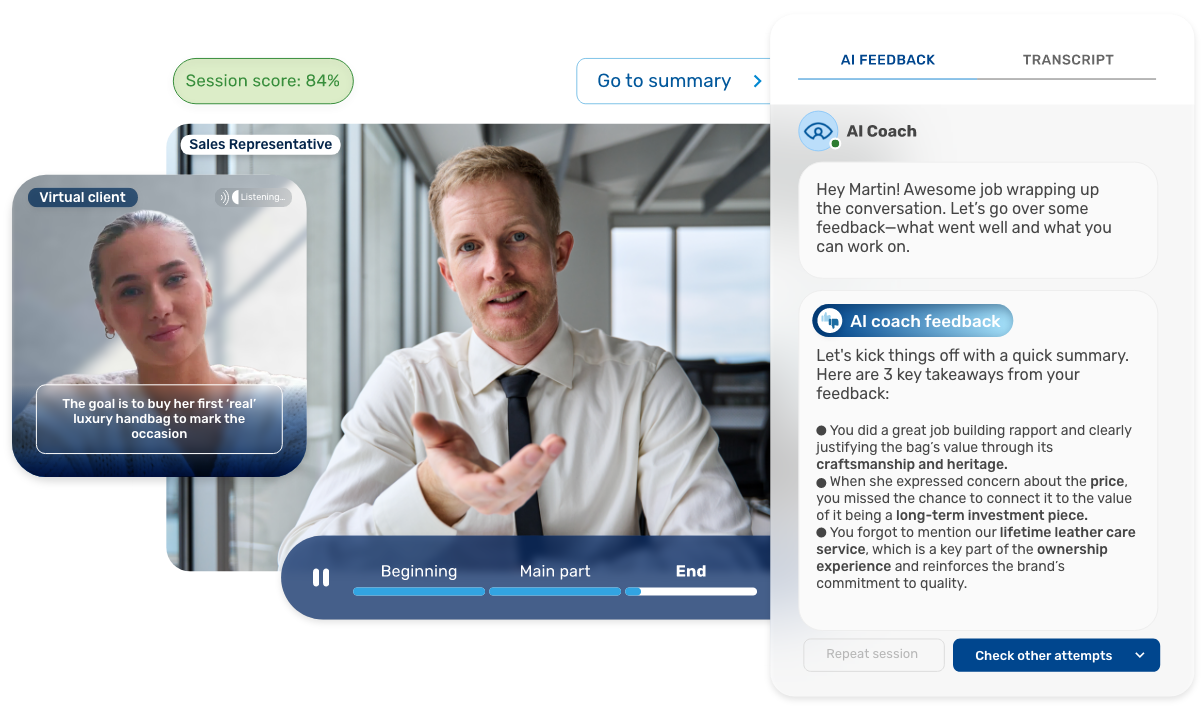
Enterprise sales coaching is a structured, repeatable program that builds the specific conversation behaviors, objection-handling instincts, and pipeline judgment that move quota at scale. The 10 most-documented commercial benefits are: faster rep ramp time, higher quota attainment, improved win rates, reduced rep turnover, lower cost-per-coached-rep, consistent messaging across large teams, measurable behavior change per session, stronger front-line manager capacity, faster new-product readiness, and a compounding ROI that increases with each subsequent cohort. Modern AI-powered coaching delivers these benefits without the scheduling constraints of human coaches, making it the operationally preferred approach in enterprise sales organizations above 50 reps.
What is enterprise sales coaching?
Enterprise sales coaching is a structured, repeatable process that helps commercial teams build the specific behaviors, discovery habits, and objection-handling patterns that move pipeline. It is distinct from sales training in that it focuses on observable, repeatable behavior change, not one-time knowledge transfer.
A Head of Sales Enablement I spoke with recently described it well: the difference between training and coaching is the difference between telling a rep how to handle a price objection and watching them do it, correcting in real time, and watching them do it again. The first sticks for a week. The second becomes instinct.
For commercial excellence leaders, the distinction matters for budget conversations. Coaching has a feedback loop. It is measurable at the individual rep level. Training does not and is not.
What enterprise coaching programs actually move
10 benefits of enterprise sales coaching
Faster rep ramp time
New reps typically spend their first weeks shadowing and consuming playbooks, neither of which builds the behavioral muscle memory needed for real calls. AI-powered sales coaching replaces passive observation with structured role-play simulations that compress the ramp cycle. Documented enterprise outcomes show 38% to 42% reduction in rep ramp time when coaching is tied to scenario-specific practice rather than one-way content delivery.
Commercial measure: time-to-first-deal, time-to-quota, weeks to first unaided close
Higher quota attainment across the team
The performance distribution in most enterprise sales teams is heavily skewed: 20% of reps drive 80% of revenue. Coaching directly addresses this by identifying the specific behaviors of top performers and building those patterns into every rep's daily practice. Enterprise customers report a +14.6% increase in quota achievement following structured coaching programs that align simulation scenarios to actual deal types.
Commercial measure: % reps at or above quota, revenue per rep, pipeline coverage ratio
Measurable improvement in win rate
Win rate is the most direct commercial signal of coaching effectiveness. McKinsey's State of Organizations research identifies skill-building as the primary lever for sustained commercial performance. When coaching is tied to deal-specific conversation scenarios, reps enter late-stage calls with practiced responses to the three or four objections that typically kill deals in their specific segment.
Commercial measure: competitive win rate, late-stage conversion rate, average deal velocity
Reduced rep turnover
Sales rep turnover costs between $100,000 and $200,000 per departure when you include recruitment, lost pipeline, and ramp costs for a replacement. Deloitte research shows reps who perceive development opportunities are significantly more likely to stay. Structured coaching directly improves rep retention, which protects pipeline continuity and cuts the backfill cost of every avoided departure. Comparing AI sales simulation platforms expands this point.
Commercial measure: sales rep churn rate, average rep tenure, backfill cost per quarter
Consistent message execution across large teams
When a sales organization scales past 50 reps, message consistency degrades fast. Each manager interprets the playbook differently. Each rep develops personal shortcuts. Coaching standardizes the observable behaviors: the discovery questions that get asked, the way the value proposition is framed against specific buyer objections, the signals of Warmth and Competence that build trust in the first seven minutes of a call. AI coaching enforces this consistency at scale because every rep runs the same scenario baseline.
Commercial measure: call quality scores, discovery completion rate, message adherence index
Lower cost per rep coached
Traditional executive coaching is expensive and does not scale below the top 10% of the team. AI coaching distributes the same quality of behavioral feedback to every rep simultaneously. At volume, the cost per session is determined by compute, not coach hours, resulting in 90% to 98% cost reduction relative to human coaching for comparable volume and detail of feedback. This changes the ROI math for commercial leaders who previously could only justify coaching for quota-carrying top performers.
Commercial measure: cost-per-rep-coached, sessions-per-budget-dollar, % team receiving coaching monthly
Benefits 7 through 10: execution-level advantages
Coaching data surfaces which behaviors each rep needs to work on, so managers spend 1:1 time on specific patterns rather than generic encouragement. Managers who coach with data become better coaches, which compounds across the team.
When a new product launches, you need the full team selling it confidently within weeks, not quarters. AI coaching lets commercial teams build launch-specific scenarios overnight and deploy them to every rep simultaneously, cutting new-product ramp time at the same rate as new-hire ramp time.
Every session produces a behavioral improvement score, giving commercial excellence leaders a direct line from coaching investment to rep performance to pipeline impact. This data closes the gap between learning metrics (completion rates) and business metrics (quota, win rate, pipeline coverage).
The coaching scenarios improve with each cohort because the behavioral data reveals which conversation patterns consistently drive outcomes in your specific deals. The second year ROI is higher than the first because the scenarios are sharper and your benchmarks are calibrated to your actual win data, not industry averages.
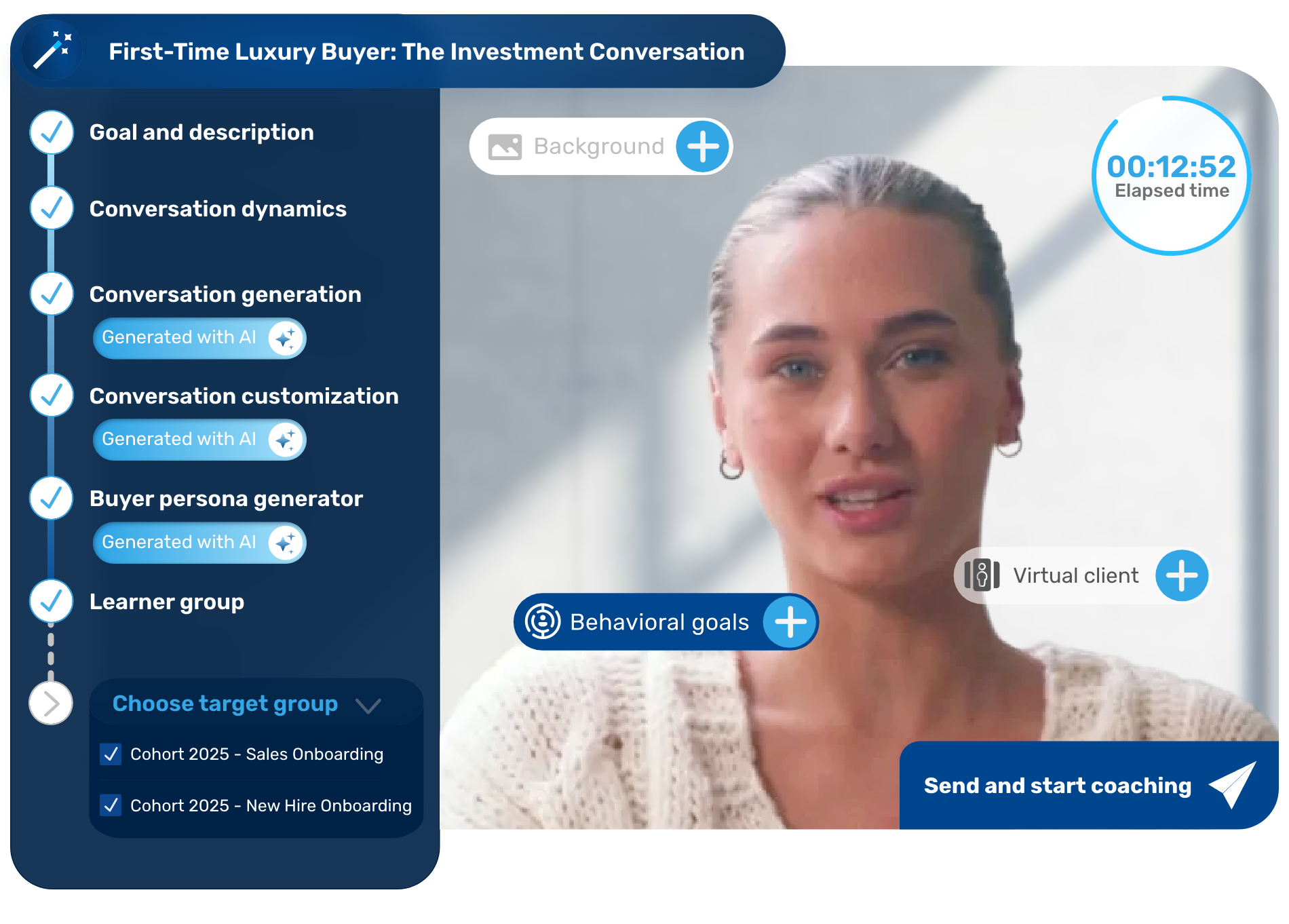
The strongest enterprise coaching programs do not measure completion rates. They measure behavioral score improvement per rep per week, then trace that to pipeline stage conversion.
Commercial Excellence perspective, validated across enterprise deploymentsAI coaching vs traditional coaching: a commercial lens
| Dimension | Traditional coaching | AI coaching (Retorio) |
|---|---|---|
| Coverage | Top 10-20% of team (coach time limits) | 100% of quota-carrying reps simultaneously |
| Feedback latency | Days to weeks after the real call | Immediate, scored during the session |
| Cost per rep | EUR 300-800 per session (external coach) | 90-98% lower at enterprise scale |
| Measurability | Self-reported or manager-observed | 140+ behavioral signals per session, scored and trended |
| Scale on launch | Sequential rollout over 3-6 months | New scenarios deployed to full team within 24 hours |
| Consistency | Varies by coach; manager-dependent | Same behavioral standard applied to every rep |
The enterprise coaching cycle: from scenario to quota impact
How enterprise teams deploy sales coaching: three approaches
Structured self-paced content. Cost-effective. Does not build conversational muscle memory. For deeper context, see the best AI tools for sales teams.
Not for: Objection handling, discovery, closing skills.
High-impact for top performers. Does not scale beyond the top 10-20% of the team.
Not for: Full-team coverage, consistent rollout, budget efficiency.
Simulation-based practice with real-time behavioral feedback. Scales to the full team. Every session scored.
Expected first-year ROI from AI sales coaching at scale
See it run on your own selling motion, buyer personas, and current coaching gap.
For teams building their first enterprise coaching program, see the complete guide to AI sales coaching and the practical playbook on sales coaching benefits for revenue teams. Both are built for Heads of Enablement evaluating where to start.
Key takeaways for commercial leaders
Ready to build the business case?
See how enterprise sales coaching delivers a 15x ROI
Validated across 50+ enterprise clients. Request a session and we will show you the behavioral model and the commercial math for your team size.
Start your free trialFrequently asked questions
What is enterprise sales coaching?
Enterprise sales coaching is a structured, repeatable process that helps large commercial teams build the specific behaviors, conversation skills, and deal instincts that move quota. Unlike classroom sessions, modern enterprise sales coaching uses AI-powered role-play simulations that give reps scenario-specific behavioral feedback at scale.
What measurable results does enterprise sales coaching deliver?
Documented outcomes include a 27% average increase in overall sales performance, 38-42% reduction in ramp time for new reps, and up to 20% revenue growth within 12 months of scaled adoption. A 15x ROI in the first year is achievable based on enterprise customer studies.
How does AI-powered sales coaching differ from traditional coaching?
Traditional coaching is limited by coach availability and scales poorly beyond top performers. AI-powered sales coaching uses behavioral simulations to give every rep immediate, consistent feedback on their specific conversation patterns, objection handling, and Warmth and Competence signals, regardless of team size.
How long does it take to see results from enterprise sales coaching?
Behavioral improvement is measurable from the first sessions. Enterprise customers typically see ramp time reductions within 8-12 weeks and quota impact within a single sales cycle when coaching is tied to deal-specific scenarios rather than generic content.
How do sales leaders measure the ROI of coaching programs?
Leading indicators include rep-level behavioral score improvement per session, time-to-first-deal for new hires, and deal stage conversion rates. Lagging indicators are quota attainment, win rate, and rep retention. The strongest ROI cases tie coaching completion directly to pipeline movement tracked in CRM.
To see how reps practice these scenarios before live calls, read our guide to AI role play for sales teams.
Written with help from LLMs, edited and checked by Önder Mutluer, Website Manager and Marketing Strategist, and Dr. Patrick Oehler, Co-founder and Co-CEO. Reviewed by Peter Holdenried, Head of Sales. How this article was researched, written and checked, and who reviews which topic: Retorio editorial policy.