


At a sales kickoff for a 600-rep insurance team, the VP of Sales Enablement pulled me aside. "We tried a speech coaching platform last year," she said. "Reps loved the feedback. Quota didn't move." That gap is the real story behind every personal speech coach versus enterprise behavior platform conversation. This post maps exactly where each type of tool starts and stops.
Yoodli Coaches the Speaker. Retorio Coaches the Team.
Where each platform focuses
Yoodli focuses on
Speech delivery- Filler words, pacing and clarity
- Presentations and interviews
- Individuals improving delivery
Retorio is built for
Commercial function- Head of Sales, VP Sales, CRO
- Sales Enablement and Commercial Excellence
- Sales academies and Sales Capabilities leads, including the ones inside the HR organisation
- Regional and frontline sales managers
- Service owners and contact-centre operations
- Sales coaches and enablement partners
The line is the mandate, not the org chart. If you are measured on quota, ramp time or conversion, the right column is yours, and that includes a sales academy that reports into HR.
Competitor positioning above describes each vendor’s own product category, not a judgement on quality or compliance. Vendor scope changes, so confirm current capabilities with the vendor.
Quick Answer
Retorio vs Yoodli comes down to one difference: the unit of change. Personal speech coaching platforms like Yoodli analyze an individual rep's fluency on a self-recorded clip. Retorio operates as an enterprise behavior platform, scoring Warmth and Competence signals across live AI role plays and surfacing team-level gaps in manager dashboards. Yoodli fits individual rep self-improvement; Retorio fits heads of sales enablement who need measurable behavior change linked to quota outcomes.
Two products, two units of change
Yoodli is a personal speech coaching tool. It analyzes an individual’s fluency, filler words, and pacing from a self-recorded clip or meeting transcript, and returns private feedback to that person. Retorio is an enterprise behavior platform built for commercial teams. It runs dynamic AI role plays, scores every session on the Warmth and Competence framework, and puts the results in a manager dashboard so enablement leaders can see team-level patterns and prove coaching ROI to the CRO.
The two products are not interchangeable. A single rep who wants private speech practice can use Yoodli. A head of sales enablement who needs measurable, manager-visible behavior change at team scale, with GDPR, EU AI Act, and ISO 27001-aligned data handling, needs Retorio.
The question your CRO actually cares about
Most comparisons between coaching platforms get stuck on features: transcription accuracy, avatar realism, scenario library size. Your CRO does not care about any of those things. She cares about one number: did quota attainment move, and can you prove coaching caused it?
That is the right question to anchor this comparison on. And it immediately creates a clean category split. Personal speech coaching platforms generate individual feedback that reps can act on voluntarily. Enterprise behavior platforms like Retorio generate team-level signal data that managers can act on systematically, with traceability from practice session to pipeline performance.
Neither category is wrong. They solve different problems. The mistake is buying one when you need the other.
Where individual speech coaching hits its ceiling
No manager visibility
Feedback lives in the rep's personal account. The manager sees nothing. If the rep doesn't act on the note, nothing changes at the team level.
No behavior traceability
Speech scores do not connect to deal outcomes. You cannot show the CFO that improving filler-word rate by 12% correlated with a 14-point increase in discovery-to-proposal conversion.
Voluntary participation
Enterprise coaching requires structure. When participation is optional, your highest performers use it and your lowest don't. The performance gap widens rather than closes.
What the Warmth and Competence framework changes
Retorio's coaching engine is grounded in the Warmth and Competence framework, a peer-reviewed behavioral model from social psychology that identifies the two independent axes on which buyers form trust and credibility judgments. Warmth signals include active listening, empathy markers, open-ended curiosity. Competence signals include structured reasoning, precise language, confident pacing.
Most speech coaching tools measure fluency within a single axis: are you speaking clearly, calmly, at an appropriate pace? That is one dimension of Competence. Retorio measures both axes, across every practice interaction, and scores them separately so a manager can see, for example, that a rep has strong Competence signals but weak Warmth, which typically predicts strength in technical demos but struggle in discovery conversations with economic buyers.
That is a different order of analytical resolution. Research from Amy Cuddy and colleagues at Harvard Business School shows that judgment on Warmth forms first and fastest, setting the trust threshold through which Competence must then pass. A rep can be technically brilliant and still lose the deal if buyers haven't formed a Warmth connection. Speech fluency training cannot catch this because it does not measure Warmth-axis signals at all.
What does each platform type actually measure?
Yes confirmed capability · Partial limited or conditional · Verify with vendor not publicly confirmed. Retorio capabilities are documented from enterprise deployments; Yoodli capabilities reflect Yoodli's public site as of July 2026.
| Dimension | Yoodli | Retorio (enterprise behavior platform) |
|---|---|---|
| Unit of analysis | Individual rep, self-recorded clip | Team-level behavioral pattern, live AI role play |
| Signal axes | Fluency, pace, filler words, clarity | Warmth (empathy, listening, curiosity) + Competence (structure, precision, confidence) -- 140+ cues analyzed |
| Manager visibility | Not published None by default; rep sees only their own results | Yes Full dashboard: team cohort scores, rep trend lines, coaching action queue |
| Scenario realism | Interactive AI roleplays with multi-persona scenarios, per yoodli.ai, Aug 2026. Independent reviews report the score weights delivery over substance. | Dynamic AI avatars (93 personas, 14 languages) respond live based on rep behavior, not scripted paths |
| Compliance posture | Verify with vendor | Yes ISO 27001, GDPR, DSGVO, EU AI Act-aligned, EU Data Residency (GCP) |
| ROI traceability | Not published Score improvement per individual; no deal-outcome linkage | Yes Behavioral improvement per session (2% average); team cohort lift linked to ramp time and quota outcomes |
Enterprise outcomes from behavior-based coaching
Retorio enterprise customer studies across 100,000+ people coached and 50+ enterprise clients shows consistent outcome improvement when Warmth and Competence signals are coached systematically, not just speech fluency alone.
Outcomes from enterprise behavior coaching vs pre-deployment baseline
+27%
Average increase in overall sales performance across enterprise deployments
100,000+
Active sales reps validated across 50+ enterprise clients globally
15x
Expected ROI in the first year of scaled enterprise deployment
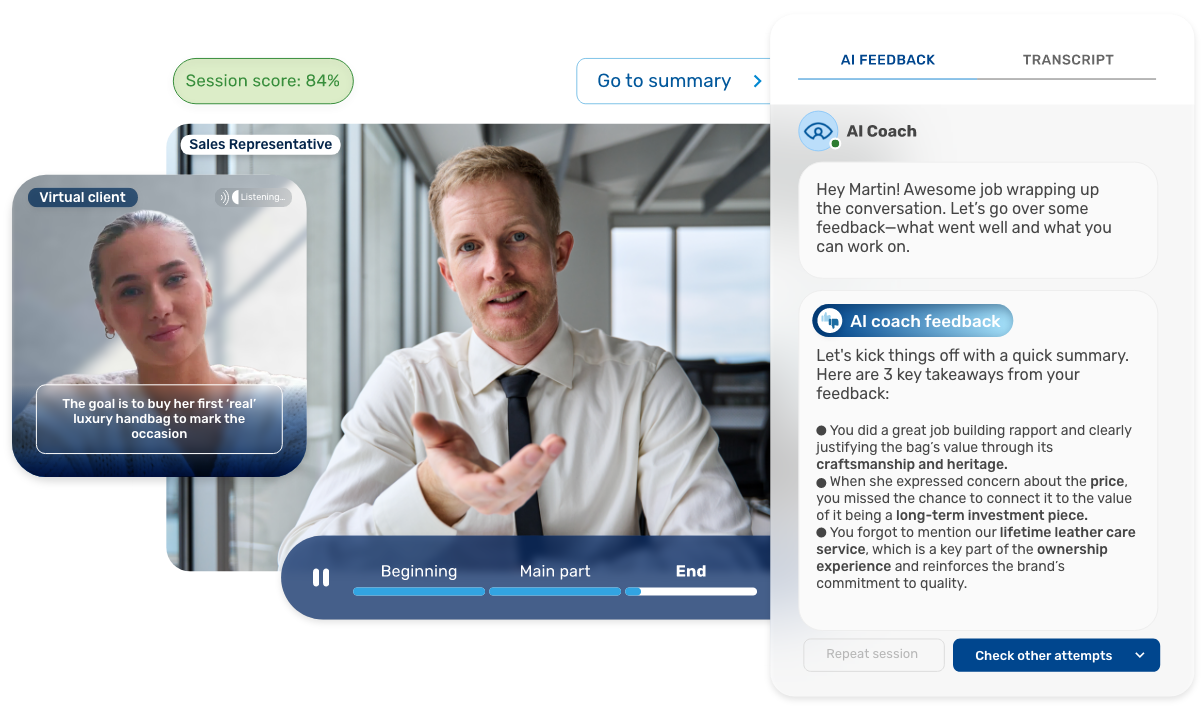
"Previously, practicing a scenario with a manager took 3-5 hours. Now, with Retorio's AI Sales training platform, our agents conduct an AI role play 5 times for each scenario independently."
Ivo Nikolov, Business Analyst, Vodafone VOIS · 1,800 agents, 38% ramp time reduction
Insight alone doesn't change how someone shows up in a conversation. You have to measure the behavior itself, tone, pacing, the things competitors can't fake with a better rubric, and give the rep somewhere to practice it again. That's the evidence enterprise buyers actually need, not proof someone watched a video.

The decision: one question, two paths
Before evaluating any platform in this category, answer one question. The answer determines which of the two paths fits.
Where is your coaching gap?
Before and after: what enterprise coaching changes
Before
After Retorio
The two axes every rep is scored on
Warmth signals
Buyers form Warmth judgments first, within the opening 30 seconds of an interaction. Retorio scores these behaviors on every practice session:
Competence signals
After trust is established through Warmth, buyers evaluate Competence. Fluency tools measure part of this. Retorio measures all of it:
The enterprise shortlist beyond Yoodli
Enterprise buyers evaluating Yoodli alternatives are usually looking for capability Yoodli was not built to provide: a manager dashboard, CRM-triggered practice, and EU data residency with GDPR and EU AI Act alignment. The table below compares Retorio against Yoodli and three other AI role-play categories enterprise teams commonly shortlist: conversation-practice platforms, cold-call simulation tools, and avatar-simulation tools for video-based scoring.
Yes confirmed capability · Partial limited or conditional · Verify with vendor not publicly confirmed as of July 2026. Retorio figures reflect documented enterprise deployments; competitor figures reflect each vendor's public site only.
| Platform | Behavioral feedback depth | EU/GDPR + ISO 27001 | Manager dashboard | Best for |
|---|---|---|---|---|
| Retorio | Yes 140+ cues, Warmth + Competence scoring across live AI role plays | Yes ISO 27001, GDPR, DSGVO, EU AI Act-aligned, GCP EU residency | Yes Team cohort scores, rep trend lines, coaching action queue | Enterprise sales, service, and leadership teams needing traceable coaching ROI |
| Yoodli | Partial Fluency, filler words, pacing from self-recorded clips | Verify with vendor | Not published Feedback stays in the individual's account | Individual reps practicing speech clarity on their own |
| Conversation-practice platforms | Partial Script adherence and talk-time scoring | Verify with vendor | Partial Verify with vendor | Scripted onboarding conversations for smaller sales teams |
| Cold-call simulation tools | Partial Call scoring, objection handling | Verify with vendor | Partial Leaderboard-style aggregate scores | SDR teams practicing cold-call volume |
| Avatar simulation with analytics | Partial Video-based conversation scoring | Verify with vendor | Partial Verify with vendor | Teams wanting video-first practice review |
Choosing by the coaching gap, not the category
For general communication practice, Yoodli itself may be enough. But for sales coaching specifically, the best Yoodli alternative depends on the same unit-of-change question this whole comparison rests on. If the gap is SDR cold-call volume, a cold-call simulation tool is a reasonable, narrower fit. If the gap is measurable, manager-visible behavior change across a commercial team, tied to quota outcomes and covered by GDPR and EU AI Act-aligned data handling, Retorio is the deeper system: it is the only platform in this table that scores both Warmth and Competence signals live, feeds a manager coaching queue, and documents enterprise outcomes across 100,000+ people coached and 50+ enterprise clients.
What to avoid when evaluating this category
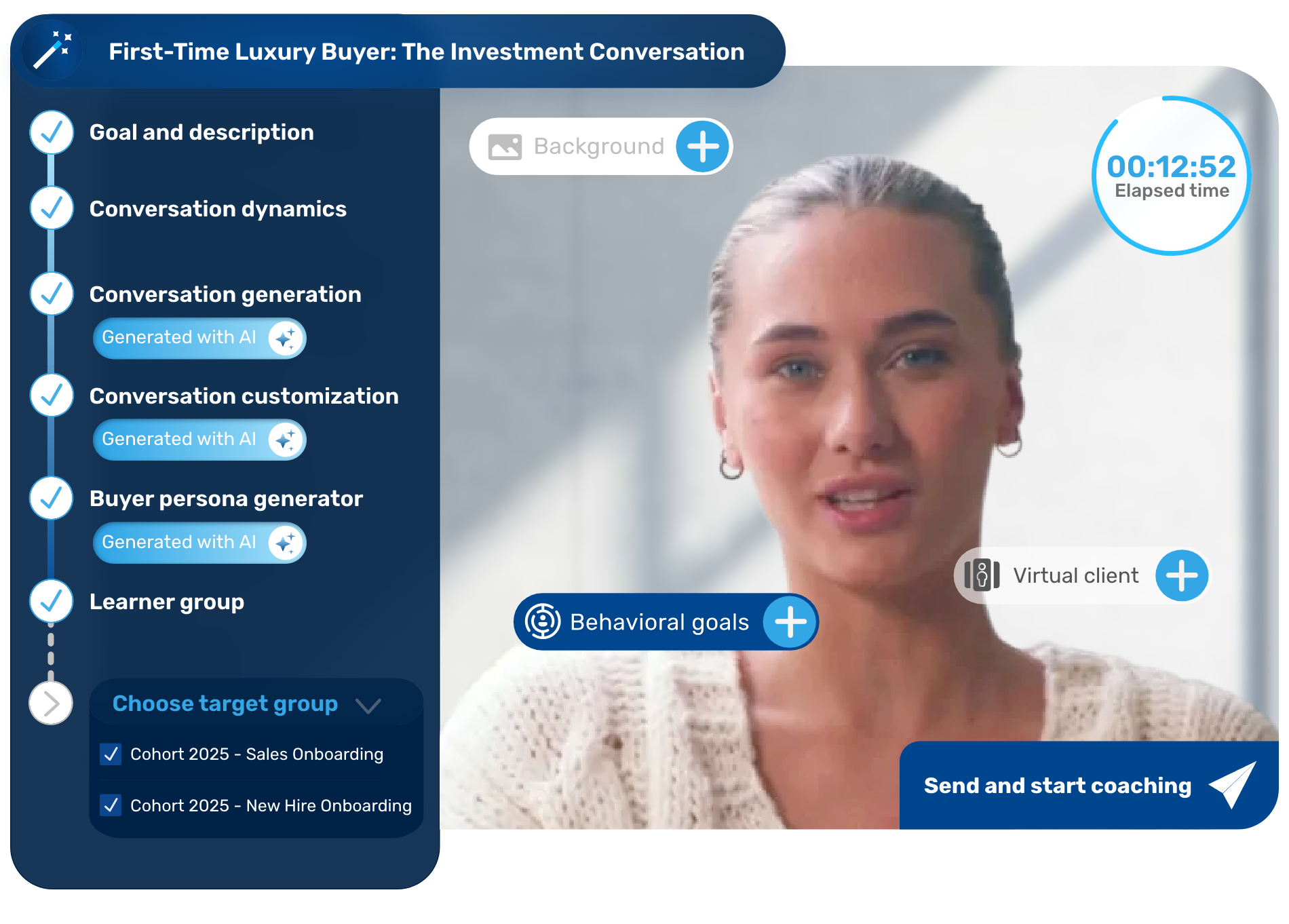
What the enterprise buyer evaluation looks like
Gartner's research on B2B buying shows that enterprise purchases involve an average of 14 to 23 stakeholders, and that the vendor who provides the clearest answer to "what happens to our business if we do nothing" wins more often than the vendor with the best feature set (Gartner, B2B Buying Journey, 2024). For coaching platforms, the "do nothing" case is measurable: Retorio enterprise customer studies shows that teams that delay enterprise behavior coaching for 12 months typically close their next annual planning cycle still quoting the same coaching ROI problem, because individual fluency improvements do not compound at the team level without structured infrastructure.
Define the unit of change
Is your coaching gap at the individual level (fluency, confidence, speech clarity) or at the team level (behavioral patterns, consistency, quota correlation)? If it is both, they require two different solutions. Most enterprise teams need team-level first.
Map the compliance requirements
For any regulated vertical, document data processing requirements before shortlisting vendors. The wrong compliance posture eliminates a platform regardless of feature score. Retorio: ISO 27001, GDPR, DSGVO, EU AI Act-aligned, GCP EU Data Residency, MLR-capable (pharma), IDD-compliant (insurance).
Run the pilot with the right cohort
Select your mid-tier cohort (reps in the 40th to 60th percentile on quota attainment). Run structured weekly sessions with the Retorio coaching loop for 90 days. Measure Warmth and Competence score trends and compare quota attainment in the cohort versus a matched control group.
Build the ROI case for the CFO
Use the pilot data to build the business case: ramp time reduction in weeks times number of annual new hires times average quota gives a revenue-at-risk number. Reduction in quota missed meetings times win rate improvement gives additional revenue. The typical Retorio deployment produces 15x ROI in year one at scale.
Related context from the Retorio blog
For more context on enterprise behavior coaching and the platform comparison landscape, these posts cover adjacent decisions:
Four gates, in order
Try it on a conversation that matters to your team
Speech coaching and enterprise coaching answer different questions. Tell us which conversations your reps struggle with and see which answer you actually need.

The bottom line
Personal speech coaching platforms and enterprise behavior platforms are not competing for the same buyer. One helps an individual rep practice speaking more clearly. The other helps a head of sales enablement prove to the CRO that coaching investment drove quota movement.
If your goal is measurable, manager-visible behavior change at team scale, with full traceability from practice session to pipeline outcome, that is the Retorio problem. If your goal is helping individual reps self-improve their presentation or communication fluency outside a structured coaching program, a personal speech coaching platform is appropriate for that specific use case.
The two tools can coexist in the same enterprise. But they cannot substitute for each other. Buying the wrong one because the demos looked similar is the most common and most expensive mistake in this category.
See Retorio in a live enterprise scenario
Run a 30-minute session with your own team's scenario. See Warmth and Competence scores in real time, then review the manager dashboard with us.
Test AI coach in actionKey takeaways
Fluency is a personal skill. Consistency across a team is an operating system. You do not get the second one by giving everyone the first, and that is the gap enterprise buyers keep discovering after the pilot.
What can you actually report to a manager?
This is the question that decides the renewal, and it is usually asked too late. A platform can generate excellent practice and still leave a sales leader with nothing to present. Measurement works on three levels, and it is worth checking each one separately rather than accepting the word "analytics" on a feature list.
What was measured, and how reliably. Retorio scores visual, auditory and textual signals together, meaning posture, pacing, tone and word choice, at above 95% accuracy on visual and textual signals and above 80% on auditory. A score that cannot name the behavior behind it cannot be coached against, so ask which signals produced the number.
Does a manager get a trend, or a pile of sessions? Retorio gives a manager dashboard with a behavioral trend view per rep, which is the artefact that makes a 1:1 start at "here is what moved" instead of "how did last week go". A list of completed sessions is activity data, not a coaching signal.
Can a commercial leader read it without translation? Since July 2026 Retorio reports at organisation level: adoption, completed scenarios and Warmth and Competence development across the whole organisation, updated as reps complete their coaching. Cohorts can be compared side by side, so the Q1 new-hire group and the Q4 group sit next to each other instead of being averaged into one number. Small cohorts stay hidden behind privacy thresholds, which is a design choice rather than a gap: a comparison view that can single out one person is one a works council will stop. This is the level that answers "is this working", and the level most often missing.
What to ask Yoodli and anyone else on your shortlist. Which signals produce the score, in writing. Whether a manager sees a per-rep trend or a session log. Whether anything aggregates above team level. And whether the export lands somewhere your revenue reporting already lives. A vendor who cannot answer the second question has built practice, not coaching.
Frequently asked questions
What is the difference between Retorio and Yoodli?
Yoodli is a personal speech coaching tool that analyzes an individual's fluency and pacing from a self-recorded clip. Retorio is an enterprise behavior platform that scores Warmth and Competence signals across live AI role plays and surfaces team-level patterns in manager dashboards. Choose Yoodli for individual self-practice; choose Retorio when you need measurable, manager-visible behavior change linked to quota outcomes.
What are the best Yoodli alternatives for enterprise teams?
Enterprise teams evaluating Yoodli alternatives typically need capability outside Yoodli's scope: a manager dashboard, CRM-triggered practice, and EU data residency with GDPR and EU AI Act alignment. Retorio, conversation-practice platforms, cold-call simulation tools and avatar-simulation tools are the AI role-play options most commonly shortlisted alongside Yoodli, each fitting a different unit of change, from SDR call volume to full enterprise behavior coaching.
Which Yoodli alternative is best for sales coaching?
The best Yoodli alternative for sales coaching depends on the coaching gap. For SDR cold-call volume, a cold-call simulation tool is a reasonable fit. For measurable, manager-visible behavior change at enterprise scale, tied to quota outcomes and covered by GDPR and EU AI Act-aligned data handling, Retorio is the deeper system: it scores Warmth and Competence signals live and documents outcomes across 100,000+ people coached and 50+ enterprise clients.
Can Retorio and a personal speech coaching tool be used together?
Yes. They operate at different levels and do not conflict. A rep can use a personal speech coaching tool for self-paced fluency practice outside of work hours while also participating in structured AI sales coaching sessions through Retorio. The manager sees only the Retorio behavioral data; the individual rep keeps their speech coaching feedback private. The two coexist cleanly in most enterprise stacks.
How long does it take to see behavioral improvement with Retorio?
Retorio enterprise customer studies shows an average 2% behavioral improvement per AI role play session. At five sessions per week, that compounds to observable score change within two to three weeks. Enterprise customers running structured weekly coaching cadences typically see manager-visible cohort improvement on at least one Warmth or Competence axis within the first 30 days.
Is Retorio compliant with GDPR and the EU AI Act?
Yes. Retorio is ISO 27001 certified, GDPR and DSGVO compliant, EU AI Act-aligned, and hosted on Google Cloud Platform with EU Data Residency. Behavioral analysis is limited to observable communication behavior during AI role play sessions, scored against defined warmth and competence dimensions. Coaching output stays with the rep and their manager and is not fed into employment decisions.
What makes Retorio different from general AI role play tools?
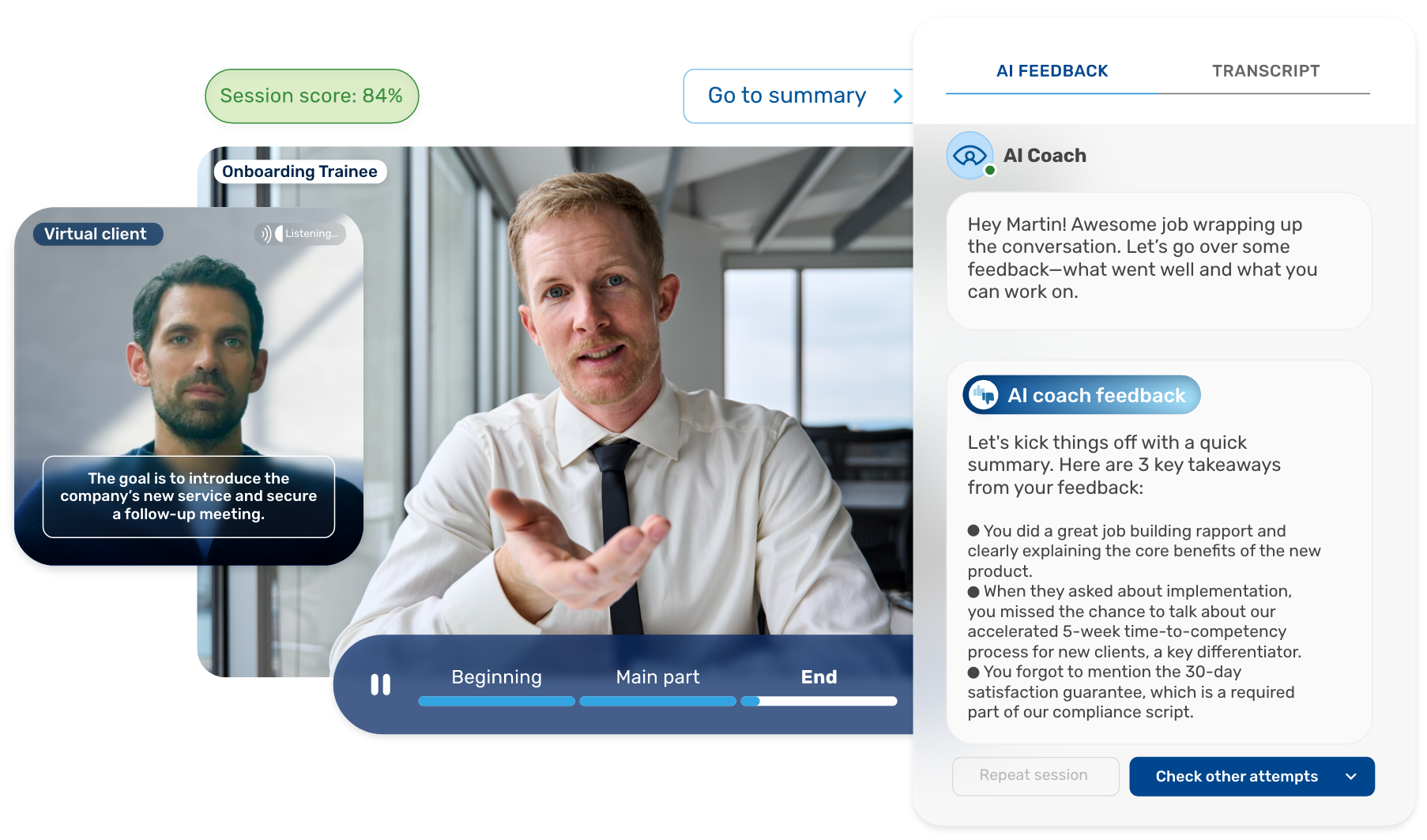
Most AI role play tools for sales score conversation quality after the session. Retorio's AI clients respond dynamically during the session based on the rep's behavioral signals, not scripted branches. After the session, Warmth and Competence scores feed a manager dashboard that shows team-level patterns and generates a prioritized coaching action queue, closing the loop between practice and performance.
Which industries does Retorio serve?
Retorio is deployed across insurance, pharmaceutical, automotive, telecom, financial services, and enterprise B2B SaaS. Each vertical has purpose-built scenario libraries. Pharma deployments operate within MLR-approved content frameworks. Insurance deployments are IDD-compliant. Customers include enterprise organizations across Europe and North America with 200 to 5,000 commercial team members.
Compare Retorio with other platforms
Evaluating more than one vendor? These guides compare the options side by side.
Last updated: July 2026.
Written with help from LLMs, edited and checked by Önder Mutluer, Website Manager and Marketing Strategist, and Dr. Patrick Oehler, Co-founder and Co-CEO. Reviewed by Peter Holdenried, Head of Sales. How this article was researched, written and checked, and who reviews which topic: Retorio editorial policy.