


The 2026 enterprise sales stack starts with revenue intelligence and CRM for pipeline visibility and forecasting, then adds AI sales coaching as a top tool. Training alone does not change behavior and observation does not scale, so coaching platforms simulate calls and give behavioral feedback that turns strategy into what reps actually say in conversations.
Example. A new enterprise rep prepares for a CFO objection call. Instead of sitting through a workshop, she runs three simulated conversations in the coaching platform that afternoon and gets instant feedback on her pacing and value messaging. She walks into the real call the next morning having already worked through the moment that would have tripped her up.
Tool Fatigue is real.
If you’re leading an enterprise sales org in the US or EU right now, you know the feeling. Your reps are drowning in a “Franken-stack” of dashboards, CRM add-ons and automation layers. Managing all these tools creates confusion and inefficiency, highlighting the need for integrated solutions that streamline workflows.
We were promised these tools would make selling easier. Instead, our teams spend 62% of their week managing the tools meant to help them sell.
It's an irony that despite having more data than ever, revenue leaders are still staring at the same old problem: We have a great strategy on paper, but it’s not showing up in our reps’ conversations.
How do we turn high-level strategy into measurable sales behavior at scale?
This goes beyond the “top sales tools of 2026”, it’s about identifying the missing layer in the stack that finally connects process to performance.
What is a Sales Tool, Truly?
Sales tools are the backbone of high performing sales teams, they help to streamline every stage of the sales process and close more deals. The best sales tools support sales reps throughout the entire sales cycle from first outreach to final handshake. By automating admin tasks and allowing sales reps to analyze sales calls, these tools free up time for sales reps to focus on what matters most: building relationships and driving revenue.
.png?width=678&height=381&name=Video%20Trailer_Retorio%20@LEARNTEC%20(2).png)
The Shift: From More Tools to Smarter Sales Tools
For years, companies invested in:
- CRM systems
- Outreach automation
- Analytics platforms
- Enablement libraries
These remain essential tools for sales and marketing, but they focus primarily on process and data. Traditional tools often require sales teams to spend significant time on administrative tasks, such as communications and scheduling, which can detract from higher-value activities. Smarter tools are now reducing this burden by automating routine work and freeing up time for strategic selling.
What’s emerging now is a new category of software sales tools that focus on what truly moves revenue: Sales behavior.
Instead of just measuring how much work you do, the next generation of sales tech focuses on helping you master the craft of communication.
The 2026 Enterprise Sales Tool Stack
Here’s what high-performing enterprise sales teams are prioritizing:
Today, business tools often integrate with CRM systems, calendars and email platforms, helping sales teams streamline workflows, reduce manual work and boost productivity.
1. Revenue Intelligence & Customer Relationship Management (CRM)
Still foundational. These remain core sales organization tools for pipeline visibility and forecasting. Customer relationship management systems help organize and improve every customer relationship by centralizing customer data, while CRM data is used to personalize outreach and track each stage of the sales pipeline.
2. Automation & Engagement Platforms
Modern online sales tools streamline outreach, sequence management and personalization. A robust sales engagement platform combines multiple sales engagement tools to automate and optimize multi-channel sales outreach, ensuring consistent and personalized communication with prospects. These platforms often integrate communication tools such as email, chat and video to enhance team collaboration and improve engagement rates. Plus they support deal management with analytics and workflow automation so sales teams can track deal progress and allocate resources efficiently throughout the sales process.
3. Sales Enablement Systems
Content management, playbooks, certifications... classic tools for selling at scale. Modern sales enablement systems often integrate with marketing tools to ensure seamless alignment between sales and marketing efforts. These platforms provide valuable analytics and insights to support data driven decisions, so teams can optimize strategies and improve performance. Features such as intent tracking, AI coaching and call insights are common, so sales professionals can better understand prospects and refine their approach.
4.1. Sales Calls and Conversational Intelligence: The New Frontier
In 2026, sales conversations remain the heartbeat of the deal for one reason: People buy from people. While AI handles the data, it is the sales rep’s ability to build trust, read the room, and show empathy that is truly irreplaceable.
Conversational Intelligence (CI) isn't here to replace the rep; it’s here to act as their "Cognitive Co-pilot," removing the noise so the human connection can shine.
Modern CI tools act as a "Second Brain" during live interactions, allowing reps to stay fully present with the buyer rather than scribbling notes.
AI handles the "What" (transcripts and data entry), so the rep can focus on the "Why" (the buyer’s underlying emotions and goals).
By surfacing engagement patterns, AI helps reps recognize when a prospect is hesitant, allowing for a more authentic, empathetic response.
Using insights from previous interactions to ensure every conversation feels like a continuation of a relationship, not a cold transaction.
As a 'Human-First' Mentor, today’s sales leader is moving past managing by spreadsheets to focus on coaching for character.
AI identifies "micro-behaviors" like tone and pacing, helping reps develop genuine executive presence.
Spot "hidden" skepticism that a human might miss in a busy 10-person Zoom call.
Ensure that as deals move from Sales to Customer Success, the human nuances of the relationship aren't lost in the handoff. For deeper context, see enterprise sales coaching.
Conversational intelligence is the "connective tissue" that ensures the human story is heard across the entire organization:
Feed the real voice of the customer (not just data points) back to marketing to keep messaging authentic.
Democratize the wisdom of your best "human connectors" so the whole team learns how to build trust faster.
Every touchpoint becomes more relevant because it’s informed by the real human needs expressed in previous calls.
In a world of increasing automation, the right tools support the process and protect the salesperson’s time. By handling the analytical heavy lifting, AI allows sales professionals to do what they do best: build lasting human relationships.
4.2. AI-Powered Sales Coaching (The Fastest Growing Category)
This is where the biggest innovation is happening.
Unlike traditional software for sales reps, AI sales coaching platforms analyze and develop real sales conversations, at scale. These platforms leverage sales intelligence to uncover actionable insights from conversations, so sales reps can identify areas for improvement and make data driven decisions. They also integrate with other sales tools so sales teams can optimize their outreach and skill development within a unified workflow.
Why AI Sales Coaching is a Top Sales Tool
Enterprise sales leaders have realized something important:
-
Training alone doesn’t change behavior.
-
Observation doesn’t scale.
-
Managers don’t have time to coach everyone deeply.
This is where AI sales coaching tool for sales reps comes in.
Modern AI sales coaching platforms are:
- A simulation environment
- A behavioral feedback engine
- A digital sales coach
- A collaboration hub for the customer success team to deliver tailored action plans and customer management
They go beyond traditional sales tools by focusing on:
- Communication skills
- Objection handling
- Executive presence
- Emotional intelligence
- Value messaging clarity
And most importantly:
They make performance measurable.
Example: AI Sales Coaching in Action
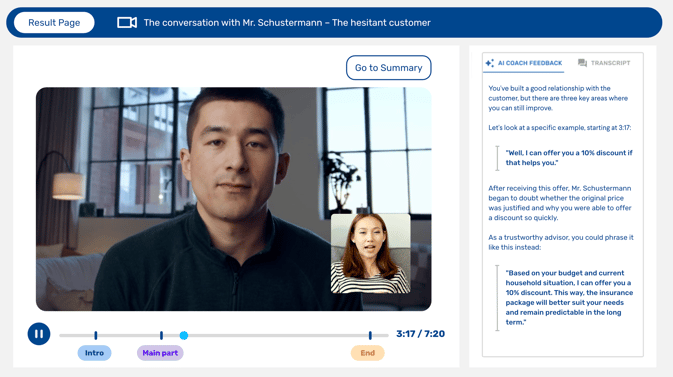
Let’s take the example of an AI powered sales coaching tool like Retorio.
Expected first-year ROI from AI sales coaching at scale
See it run on your own selling motion, buyer personas, and current coaching gap.
Instead of sending reps to one off workshops, enterprises can:
- Run realistic AI driven sales simulations
- Let reps practice critical conversations
- Get instant behavioral feedback
- Track skill development over time
These AI coaching tools also support revenue teams by providing integrated solutions that help both sales and marketing professionals work together more efficiently.
This transforms coaching from: “Did they attend training?” to “Has their objection handling improved by 18%?” For large companies this kind of AI sales coaching tool for sales reps creates:
- Standardized skill development across regions
- Scalable onboarding
- Objective performance data
- Reduced dependency on manager availability
That’s why AI sales coaching is becoming one of the top tool for sales management investments in enterprise environments. Research into AI sales coaching benefits shows organizations see measurable improvement in ramp time and quota attainment within the first quarter of deployment.
The Real Difference Between Tools for Sales, and Tools That Drive Revenue
Not all sales tools are equal. As HBR noted in a landmark study, the shift from solution selling to insight-led selling is now the primary driver of top-quartile sales performance.
Many support the sales process.
Few improve the salesperson.
In 2026, the best tools for sales share three characteristics:
- Behavioral Intelligence: They analyze real human performance, not just clicks and calls.
- Scalability: They work across 500+ reps without requiring 500 managers.
- Measurability: They connect learning directly to performance metrics.
This is where next-gen sales organization tools differ from legacy platforms. For a full breakdown of how platforms compare, see the guide to enterprise AI sales coaching. These tools also support revenue operations by providing unified management of deal pipelines and enhanced data visibility across teams so teams can be better aligned and revenue optimized.
Enterprise Reality: Why This Matters Now
In both US and EU enterprise markets sales teams are facing significant headwinds. The Salesforce State of Sales Report found that reps spend only 28% of their time actually selling, with the rest lost to administrative tasks and tool management.
This means enterprise teams are facing:
- Longer buying cycles
- More stakeholders per deal
- Higher compliance requirements
- AI driven procurement scrutiny
This means modern tools for sales reps must support not only activity, but credibility, clarity and consultative selling skills. These tools should also improve sales performance by streamlining, monitoring and optimizing all sales efforts throughout the sales process.
Companies that rely solely on traditional software sales tools focused on pipeline tracking are missing a key competitive advantage. The distinction is sharpest when you compare AI role play versus call coaching in enterprise sales, two tools that appear similar but drive different outcomes.
The new edge? Behavioral AI.
Final Thought: The Sales Tool That Coaches
The most progressive enterprises are no longer asking:
“What are the top sales tools?”
They are asking:
“What tools actually change how our salespeople perform?”
If your stack includes CRM, automation and enablement, but no scalable coaching layer, you are optimizing the process without upgrading the player.
In 2026 the real competitive advantage isn’t more tools for selling.
It’s smarter tools for sales.
And increasingly that means AI powered coaching platforms that make sales performance measurable, scalable and continuously improvable.
Checklist: Is Your Sales Stack Ready for 2026?
Can your reps move a deal through the pipeline without manually logging more than 2-3 fields in the CRM?
Do your reps have a safe, AI-driven environment to practice high-stakes objections before they call a real prospect?
Is coaching reserved only for your top 5% of deals, or does every rep have the access to the feedback they need to grow and succeed?
Can you measure the specific skill growth (e.g., empathy, executive presence) of your team as a data point in your quarterly reviews?
Does your enablement tool automatically serve the right marketing content based on the actual conversation the rep just had?

Frequently Asked Questions
With so many sales tools available in 2026, where should we prioritize our budget?
The "Franken-stack" is a real risk. Most enterprise leaders are now prioritizing integration over quantity . A foundational stack needs a CRM for data and an engagement tool for outreach, but the biggest ROI is currently found in the "Performance Layer" , tools that actually improve how reps speak and handle objections, rather than just tracking their activity.
How does AI Sales Coaching differ from standard Conversational Intelligence?
Standard Conversational Intelligence is a "looking back" tool; it records and summarizes what happened. AI Sales Coaching is a "looking forward" tool. It takes the insights from those recordings and provides a space for reps to practice. It moves the needle from just identifying a mistake to correcting it through simulated practice.
We already have a Sales Enablement platform. Isn't that enough?
Enablement platforms are great for housing content (decks, case studies, and playbooks). However, having the "map" isn't the same as "driving the car." While Enablement gives reps the information, AI sales coaching builds the behavioral muscle memory they need to deliver that information convincingly under pressure.
How do we ensure these new AI tools actually improve sales behavior at scale?
The key is Democratized Coaching . In the past, high-level feedback was a "luxury" reserved for top reps or the biggest deals because managers were the bottleneck. AI sales coaching removes that barrier, giving every rep, from the new hire in Berlin to the veteran in New York, instant, objective feedback on every interaction.
Does adding an AI sales coaching layer add more administrative work for my reps?
Actually, it’s designed to do the opposite. By automating the "drills" and basic skill-building, reps become more confident and efficient. Modern tools like Retorio integrate directly into the workflow, so reps can spend less time wondering "how do I say this?" and more time actually engaging with prospects.
What is the most common mistake companies make when building their 2026 stack?
The biggest mistake is optimizing the process but ignoring the player . You can have the best CRM and the fastest automation, but if your reps aren't coached to handle the "17 seconds that decide a deal," those tools won't save the revenue. The most successful stacks in 2026 are the ones that prioritize behavioral intelligence alongside data.
Written with help from LLMs, edited and checked by Önder Mutluer, Website Manager and Marketing Strategist, and Dr. Patrick Oehler, Co-founder and Co-CEO. Reviewed by Peter Holdenried, Head of Sales. How this article was researched, written and checked, and who reviews which topic: Retorio editorial policy.