

AI role play is not a software category. It is a practice mechanic inside a larger coaching system. The vendors that confuse the two will sell you a chatbot. The ones that close the loop will move ramp, quota, and turnover. This piece is the buyer's mental model for telling the two apart.
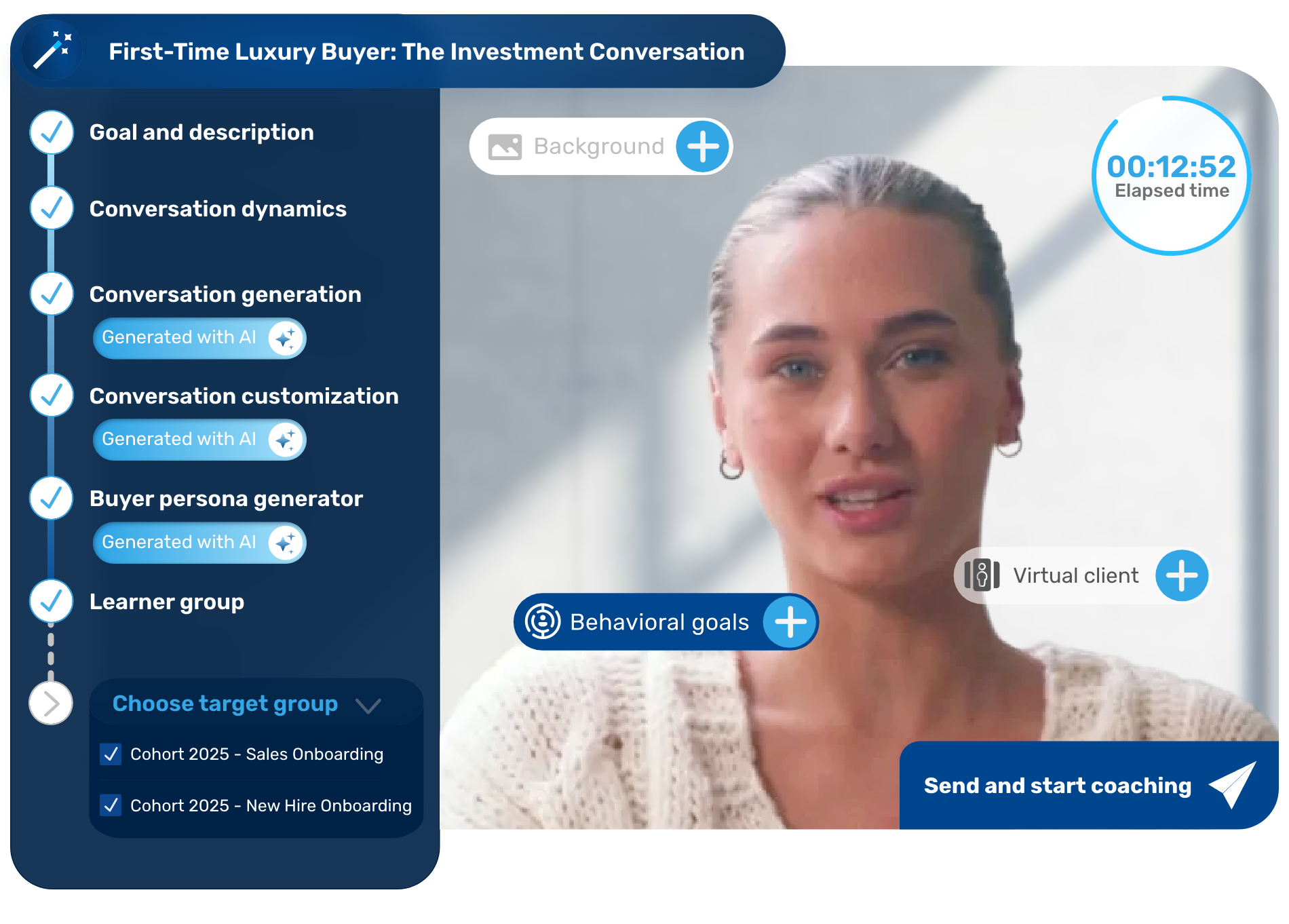
A sales enablement lead configures a discovery role play. The rep practices against the virtual customer. The coaching layer scores observable behaviors, queues the next scenario, and re-measures on the following session.
AI role play for sales teams is a practice mechanic inside a coaching loop, not a product category. A virtual customer takes the rep through a realistic call. The coaching layer underneath scores observable behaviors, picks the next practice, and re-measures on the next session. Without that closing loop, you have a chatbot. With it, you have a coaching system that moves ramp, quota, and turnover.
Example. A new insurance agent runs a discovery role play with a virtual customer on Tuesday morning. The AI scores four behaviors, flags two missed objections, and queues a 6-minute follow-up scenario for Wednesday targeting that exact behavior. Friday the agent runs the real call.
Source: Retorio enterprise customer studies, 50+ enterprise clients.
Most "AI role play" pitches describe the wrong layer
A Head of Sales Enablement at a DACH insurance group told me she had sat through six vendor demos in a quarter. Every demo opened with a virtual customer talking to a rep on screen. Every demo closed with a transcript and a sentiment chart. None of the six could answer her one question: after the rep finishes the practice call, what changes in their behavior on the real call next week.
That is the gap. The market sells the visible part of AI role play (the avatar, the conversation, the transcript) and skips the part that actually moves quota: the loop that scores observable behaviors against a rubric, picks the next practice for the rep on the basis of the previous one, and re-measures.
This piece is for the sales enablement leader, the head of commercial excellence, and the sales coach who has to walk into the next vendor meeting with a real evaluation framework instead of a demo impression. We will define what AI role play actually is, when it earns its budget, where it stops working, and how to pressure-test the practice loop a vendor is selling.
What AI role play for sales teams actually is
AI role play is a practice conversation between a rep and a virtual customer powered by a generative AI model. The virtual customer plays a defined persona (a CTO doing technical discovery, a procurement lead pushing back on pricing, a regulated-industry buyer asking about compliance). The rep practices on demand, alone, as many times as they want, without burning a manager hour.
That is the surface. The coaching system underneath is what determines whether the role play moves performance or stays a curiosity.
The coaching layer does three things on every practice call:
That is the loop. Role play without it is a video game. Role play with it is the coaching mechanism that produces measurable behavior change.
The closed practice loop, not the avatar
The dashed loop-back arrow closes the cycle. Each Debrief queues the next Practice scenario for the rep, targeted at the lowest-scoring behavior signal.
Why sales teams adopt AI role play (the four reasons that survive a CFO review)
When the CFO asks "why are we buying this?", four answers hold up. The rest collapse under follow-up questions. The numbers below come from Retorio enterprise customer studies of 50+ enterprise clients.
Vodafone VOIS cut new-hire ramp time from 8 weeks to 5 weeks for 1,800 customer service agents annually. Documented 38% to 42% ramp-time reduction across enterprise studies.
Vodafone VOIS dropped human trainer effort from 26 hours to 8 hours per new hire (69% reduction) by moving structured practice from the trainer's calendar to the AI loop.
Nürnberger Versicherung reduced turnover in newly trained insurance agents by 72% (from 18% to 5%) by running a consistent practice rubric across cohorts.
Sales performance lifts +27% and quota attainment lifts +14.6% after a 12-week behavioral cycle. The lift comes from the loop closing on every rep, not from any single intervention.
None of these are the demo headline ("realistic avatar, 38 voices, 14 languages"). All four are the result of the coaching loop running for 8 to 12 weeks against a defined rubric. The platform features are necessary. The loop is what makes them work. A practitioner's view on this comes from Harvard Business Review's "The Feedback Fallacy": behavior change shows up only when feedback is delivered against a clear, repeatable rubric tied to observable behavior, not when it's delivered as opinion or sentiment.
Three outcomes the practice loop produces
Source: Retorio enterprise customer case studies, public-permission set.
AI role play vs human role play vs call coaching
Three practice mechanisms compete for the same time slot in a rep's week. They are not substitutes. They cover different jobs and the best deployments use all three. The comparison between AI role play and call coaching in particular deserves a more careful unpacking than most vendor decks give it.
| Dimension | AI role play | Human role play | Call coaching |
|---|---|---|---|
| Practice scenario | Generated on demand, persona library | Manager script in a 1:1 | Recorded real call after the fact |
| Sustainable frequency | Multiple sessions per week, 5-10 min each | 1-2 per month, 30-60 min each | After significant calls, ad hoc |
| Manager hours per rep weekly | Below 0.5 (manager reviews the trend) | 1 to 2 (manager runs the practice) | 2 to 3 (manager reviews recordings) |
| Best for | Discovery, objections, qualification, compliance talk tracks | Deal coaching on a specific live opportunity | Real-conversation behavior coaching after the fact |
| Measurement output | Per-rep behavior trend on the same rubric, weekly | Manager's qualitative read | Transcript with annotated moments |
| Weakness | Virtual persona, lower emotional stakes than a real call | Manager bandwidth caps it at low frequency | The call already happened, the rep cannot retry |
| Quota lift driver | Compound behavior change across the team | Deal-level lift on the coached opportunity | Selective improvement on observable patterns |
| Typical split in a real deployment | ~70% of practice volume | ~20% (live-deal prep) | ~10% (post-call review) |
The argument is not AI role play instead of human coaching. The argument is AI role play for the high-frequency, high-volume practice that no manager has time to deliver, freeing managers to do the deal coaching and the call review that needs a human in the room. Without the AI loop running in the background, the manager's hours never reach the high-stakes coaching that needs them.
Previously, practicing a scenario with a manager took 3 to 5 hours. Now, with Retorio's AI Sales training platform, our agents conduct an AI role play 5 times for each scenario independently.
The Vodafone VOIS case is the cleanest illustration of the trainer-time shift: structured practice moves from the trainer's calendar (26 hours per hire) to the rep's own browser (running independently, 5 times per scenario), and the trainer's hours collapse to 8 per hire while ramp time also compresses by 38%.
The five-step rollout that earns the second budget cycle
Most AI role play pilots stall not on the technology but on the rollout. The pattern that survives the first quarterly review and gets renewed for year two looks like this. A useful outside reference here is Gartner's sales enablement research, which finds that the deployments that scale are those where coaching cadence is built into the manager's weekly rhythm, not bolted on as a one-off training event.
Do not start with a scenario library. Start with the three rep moments where a behavior shift translates to revenue this quarter. Common picks: a discovery call for a specific buyer persona, an objection-handling moment for the current deal-killer, a renewal conversation for at-risk accounts. Write each scenario as a one-page brief covering who the virtual customer is, the opening 60 seconds, and what the rep is expected to do. The scenarios library helps but the calibration to your selling motion is the work.
The vendor's default rubric will be too generic. A pharma MSL needs a compliance signal added. A renewals manager needs a retention-signal. A logo-acquisition AE needs a discovery-density signal. Spend one week with the head of enablement and two senior reps calibrating the rubric. The calibration is the difference between a coaching system that the team uses and one that the team ignores.
Pick 10 to 20 reps for the first cohort. Capture a behavioral baseline on the rubric before the role play loop starts (use a recorded real call if possible, otherwise an unscored practice call). Run two AI role play sessions per rep per week for four weeks. At week 4, measure the four signals again. Two of the four should have moved.
Open the role play platform to the rest of the team. Set a cadence the team can sustain: two sessions per week, 8 to 12 minutes per session, scenarios queued by the system. The manager runs a weekly 15-minute review against the per-rep trend. At week 12, measure quota attainment against the baseline cohort.
The deployment graduates when the manager stops asking the team to do role plays and the team stops asking permission. The role play loop is the default Tuesday-and-Thursday coaching cadence. The manager's 1:1 time shifts to deal coaching and career conversations because the practice volume is being absorbed by the AI.
The five patterns that kill an AI role play deployment
In the behavioral dataset, the deployments that did not survive year one shared a small set of failure patterns. Each one is fixable if you spot it in the first 30 days.
The first pattern is the most common in pharma and insurance deployments where the L&D team has scenario-building muscle. The fifth is the most common in commercial SaaS deployments where the procurement clock is running. Either one kills the loop.
Watch: how great leaders give feedback
Practice only compounds when the feedback after it is specific enough to act on. Simon Sinek on giving feedback, published May 2026.
Source: Simon Sinek (YouTube), May 2026.
How to pressure-test an AI role play vendor in 30 minutes
Three questions filter most of the noise. Ask them in this order in the demo.
First, what happens after the rep clicks "end session"? A vendor that answers "the rep sees their transcript" is selling a chatbot. A vendor that answers "the system scores four observable behaviors, queues the next scenario, and updates the 30-day trend the manager sees" is selling coaching.
Second, show me a per-rep behavior trend across 30 days. A real coaching system produces a per-rep, per-signal trend line that a manager can read in 15 seconds. If the vendor pivots to a leaderboard or a team aggregate, the per-rep loop is not closed.
Third, where does the rubric come from, and can we calibrate it? The right answer is "we ship a default rubric and run a 1 to 2 week calibration with your head of enablement". The wrong answer is "the model figures it out" or "the rubric is hard-coded".
Three questions, three concrete artifacts. If the demo can produce all three live, the practice loop probably exists. If the demo dances around any of them, the loop is being assembled in the deck.
What this means for your next budget review
If AI role play is on your shortlist, the decision is not whether to invest. The numbers across 50+ enterprise clients make that case. The decision is which layer you are buying.
A platform that runs the practice conversation, scores observable behaviors, picks the next practice, and re-measures on the same rubric is coaching. It will move ramp by week 6, two signals by week 4, and quota by week 12.
A platform that runs the practice conversation and stops there is role play. It will produce engagement metrics in the first quarter and stall by quarter two.
The four-question vendor filter sorts one from the other in 30 minutes. Use it. For a deeper look at the scenario design side of the loop, particularly for new product launches and re-skilling, the interactive scenarios piece walks through the practical scenario-design moves that move a quarterly review.
Walk through the four-signal rubric on one of your real call recordings or a practice session. Retorio's behavioral science team will run the scoring with you and show what the next practice would be for that rep.
Key Takeaways
FAQ
What is AI role play for sales teams?
AI role play is a practice conversation between a rep and a virtual customer powered by generative AI, used to rehearse discovery, objection handling, and qualification calls. In a real coaching system, the AI scores observable rep behaviors after the practice call, picks the next scenario, and re-measures on the next session. The role play is the surface. The scoring loop underneath is what changes rep behavior.
Does AI role play actually move quota?
In Retorio enterprise customer studies across 50+ enterprise clients, quota attainment lifts +14.6% and overall sales performance lifts +27% after a 12-week AI coaching cycle. The lift comes from the closed practice loop running consistently, not from the role play feature on its own.
How is AI role play different from a call coaching platform?
A call coaching platform analyzes calls that already happened with a real customer. AI role play is practice before the real call. The two are complementary in a strong coaching cadence: AI role play handles the high-frequency rehearsal, call coaching handles the after-the-fact behavior review. Roughly 70% of practice volume sits on AI role play, 20% on human role play for live deals, 10% on call coaching.
How long does an AI role play deployment take to show results?
Two of four behavior signals shift by week 4 in Retorio deployments. Quota attainment shifts by week 12. Ramp acceleration (38% to 42% in Vodafone VOIS data) shows earlier, by week 6 for new hires. Pilots shorter than 12 weeks do not produce a clean buying decision because the loop has not had time to close on enough sessions per rep.
Is AI role play GDPR-compliant?
Retorio is ISO 27001 certified, GDPR-compliant, EU AI Act aligned, and hosted on Google Cloud Platform with EU data residency. Practice conversations with a virtual customer do not process real customer data, so they fall outside most consent requirements. Recorded real customer calls (a separate feature) require explicit consent under Art. 6 GDPR.
Can AI role play replace human sales coaching?
No, and the deployments that try this fail. AI role play handles the high-frequency, high-volume practice that no manager has time to run. Human coaching handles deal coaching on live opportunities, career conversations, and the calls that need a manager in the room. The right split is roughly 70% AI for practice volume, 30% human for live-deal and career work.
What sales teams benefit most from AI role play?
New-hire SDR and AE cohorts (ramp acceleration), service teams onboarding new agents (the Vodafone VOIS case), insurance agents under IDD compliance (the Nürnberger Versicherung case), pharma MSL teams under MLR compliance (with a tuned compliance signal on the rubric), and tenured AEs being re-skilled on a new product launch.
Written with help from LLMs, edited and checked by Önder Mutluer, Website Manager and Marketing Strategist, and Dr. Patrick Oehler, Co-founder and Co-CEO. Reviewed by Peter Holdenried, Head of Sales. How this article was researched, written and checked, and who reviews which topic: Retorio editorial policy.