


Creating training scripts for AI role plays means defining a customer persona and scripting instructions that an AI avatar follows in a live simulation. With Retorio's AI Coaching Platform, L&D teams automate this generation, cutting delivery from months to under 40 minutes. You pick adaptive dynamic simulations for soft skills or strict procedural scripts, with personas built on Warmth and Competence.
Example. A pharma field trainer builds a simulation in under an hour: the AI avatar plays a skeptical oncologist who challenges the rep on clinical data. The rep runs the conversation three times, gets instant feedback on tone and clarity, and walks into the real visit having already handled the hard questions.
You are a Learning and Development (L&D) leader staring at a towering stack of product manuals, battle cards, and compliance guidelines. You have three weeks to prepare a global, multilingual sales force for a critical product launch.
In the past, you would have spent months creating training scripts for AI role plays or peer-to-peer workshops, only to watch reps forget 90% of the material within a week. This "Cognitive Load Revolution" is paralyzing your workforce. To overcome this, you need a frictionless environment where knowledge is transformed into interactive, behavioral muscle memory. This is the exact challenge that modern generative technology solves.
The enterprise landscape demands agility. Reps are overwhelmed, and traditional "just-in-case" training events are failing to drive revenue. Creating training scripts for AI role plays is no longer a manual, labor-intensive process.
By leveraging Retorio’s AI Coaching Platform, L&D teams can now automate content generation, reducing delivery time from months to under 40 minutes. This paradigm shift allows your team to engage in realistic, immersive simulations that replicate the high-stakes "one-shot moments" determining commercial success.
Why are traditional training scripts failing modern sales teams?
Traditional training scripts fail because they focus entirely on rote memorization rather than contextual behavioral practice. They provide the "what" (product knowledge) but fail to address the "how" (behavioral execution and communication style).
When reps rely on static, memorized scripts, they lack the "Human Premium", the empathy, active listening, and agility required to navigate complex B2B buying committees.
This disconnect leads to up to 73% of reps missing their quotas, and creates severe compliance risks in highly regulated sectors like Pharmaceutical Sales.
Furthermore, human-led role-playing is unscalable; managers simply do not have the capacity to provide consistent, objective feedback to thousands of reps simultaneously.
How does creating training scripts for AI role plays improve sales performance?
Creating training scripts for AI role plays improves performance by transforming static documents into dynamic, multimodal practice environments where reps receive immediate, objective feedback on their communication style.
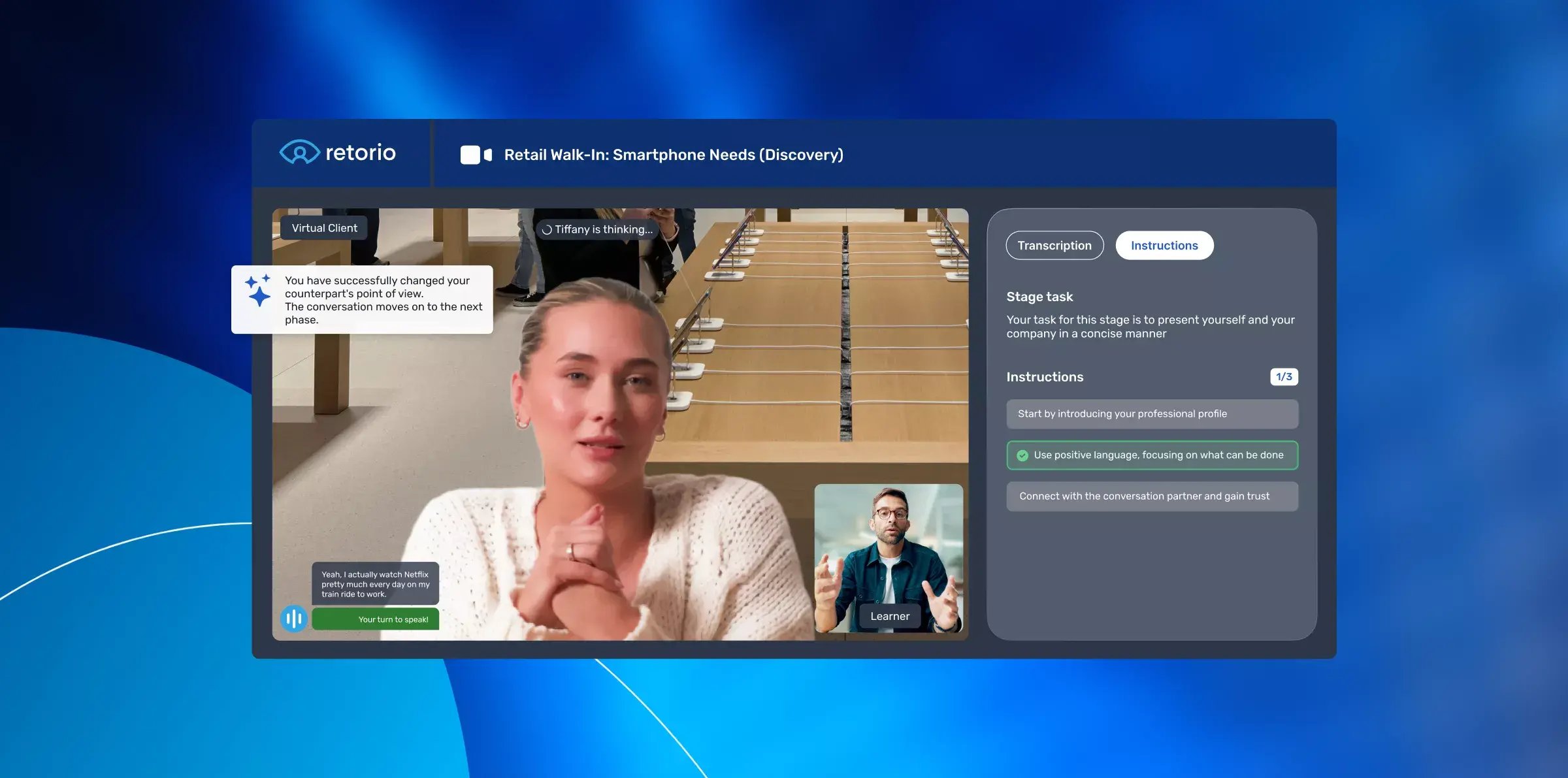
Instead of reading a PDF, reps practice on-demand with lifelike virtual avatars that react to their tone, pacing, and word choice. This "digital dojo" provides a psychologically safe space to fail and learn.
Retorio analyzes the visual, vocal, and verbal cues of the rep, grading them on scientifically validated metrics like "Warmth" and "Competence." This ensures that reps do not just know their lines, but deliver them with absolute conviction and empathy.
What are the two distinct types of AI role-play scripts?
Retorio’s engine offers two distinct architectural modes for creating training scripts for AI role plays, allowing L&D leaders to choose between adaptive fluidity and strict procedural adherence.
Designed for complex soft skills, objection handling, and relationship building where the conversation path is not linear.
You define the high-level parameters (Goal, Persona, Context), and the AI generates the script in real-time, reacting dynamically to whatever the rep says. The admin defines specific "Stages" (Beginning, Main Part, End) to guide the flow, but the rep has the freedom to navigate the conversation naturally.
Best for standardized pitches, exact compliance statements, or specific process adherence (e.g., "The Perfect Pitch") using a pre-defined, linear flow.
The admin inputs "Good" and "Bad" examples of the desired interaction, often pulling directly from successful CRM/HRM transcripts. The AI generates four specific questions for the avatar to ask, and the admin defines exactly what the rep must say in response (or builds from scratch via "Manual Mode").
Examples for AI role play
Moving from theory to practice requires concrete examples. Here are the most popular, high-impact AI role-play scenarios, persona configurations, and scripting instructions that enterprise training managers use to build programs on the Retorio platform.
10 role-play scenarios you can paste in today
Each block below is a complete scenario brief: who the AI plays, what they want, how they push back, what ends the conversation, and the behaviour to score. Paste one into your scenario generator and change the names and numbers to your own.
The ten topics are ordered by what enterprise teams actually search for, measured across our own Search Console queries for the 28 days to 26 August 2026. Leadership feedback and service de-escalation lead by a wide margin, which is worth knowing before you build a library that starts with cold calling.
A first-time manager has to give corrective feedback to someone who outperforms them technically.
ROLE: You are Martina Falk, a senior engineer with nine years in the company. You report to the rep in this conversation, who was promoted three months ago.
SITUATION: You have missed two sprint commitments and skipped the last three stand-ups. You believe the deadlines were unrealistic and that nobody consulted you when they were set.
HOW YOU BEHAVE: Open cooperative but guarded. If the manager opens with process or policy, become defensive and cite your technical record. If the manager names the specific missed commitments and asks what got in the way, open up and give the real reason: you were pulled onto an unlogged escalation. Never volunteer that reason unless you are asked an open question.
WHAT ENDS THE CONVERSATION: End when the manager and you agree on one concrete change and a date to review it, or when the manager gives up and closes with a generic encouragement.
SCORE THE REP ON:
- Names the observable behaviour, not the personality
- Asks at least one open question before proposing a fix
- Leaves the conversation with a dated, specific commitment
A support agent takes a call from a customer already three failed contacts deep.
ROLE: You are Deniz Aydin, a small-business owner whose card terminal has been down for four days. You have called three times and been promised a callback twice.
SITUATION: You are losing roughly 400 euro a day. You open the call angry and you interrupt.
HOW YOU BEHAVE: Stay hot for the first two turns. Escalate if the agent reads a script, apologises without acknowledging the four days, or asks you to repeat information you have already given. Cool down only when the agent states back the concrete cost to your business and gives a named next step with a time. If the agent offers a discount before acknowledging the problem, reject it and escalate.
WHAT ENDS THE CONVERSATION: End when you accept a next step with a time and an owner, or when you demand to cancel the contract.
SCORE THE REP ON:
- Acknowledges the specific cost before offering any remedy
- Does not ask for information already given
- Closes with an owner and a time, not an apology
A field rep introduces a new indication to a sceptical specialist inside a five-minute window.
ROLE: You are Dr. Renner, a consultant cardiologist. You have five minutes between patients and you have seen this class of product fail before.
SITUATION: The rep wants to discuss a new indication. You have read the headline data and you are unconvinced by the comparator arm.
HOW YOU BEHAVE: Interrupt within the first 30 seconds to ask which comparator was used. Push back on any claim that goes beyond the label. If the rep stays on label and offers the study limitations unprompted, give them the remaining time and one real clinical question. If the rep overstates, end the meeting.
WHAT ENDS THE CONVERSATION: End when you agree to look at the data yourself, or when the rep makes an off-label claim.
SCORE THE REP ON:
- Stays inside the approved label under time pressure
- Volunteers a limitation before being pushed
- Converts the interruption into a question rather than defending
A new rep in week two runs their first full discovery call without a manager on the line.
ROLE: You are Tomasz Wieczorek, Head of Operations at a 600-person logistics firm. You took this meeting because a colleague mentioned the category, not because you are shopping.
SITUATION: You have a vague problem: driver turnover. You have not costed it and you have no budget line.
HOW YOU BEHAVE: Answer only what you are asked. Do not volunteer the turnover number unless the rep asks a quantifying question. If the rep pitches features in the first five minutes, become polite and vague and start closing the meeting. If the rep asks what turnover costs you, engage and reveal that you replaced 40 drivers last year.
WHAT ENDS THE CONVERSATION: End when a next step is agreed with a named participant, or after 12 minutes with no quantifying question asked.
SCORE THE REP ON:
- Asks a quantifying question before naming any product
- Repeats the problem back in the buyer's own words
- Books a next step with a named person, not a generic follow-up
An advisor handles a suitability conversation where the profitable product is the wrong one.
ROLE: You are Sabine Vogt, 54, comparing occupational disability cover. Your neighbour told you a unit-linked policy pays better.
SITUATION: You want the higher-return product. Your actual situation, a physically demanding job and no savings buffer, makes the simpler cover the suitable one.
HOW YOU BEHAVE: Push for the product your neighbour recommended. If the advisor agrees in order to please you, accept and end the call happy. If the advisor asks about your job and your buffer, engage, but keep resisting once: say the other product still sounds better.
WHAT ENDS THE CONVERSATION: End when you either buy the unsuitable product or accept a documented explanation of why the simpler cover fits.
SCORE THE REP ON:
- Asks about circumstances before recommending anything
- Declines the profitable but unsuitable product and says why
- Documents the reasoning in language the customer repeats back
A rep meets the objection that is really a budget freeze in disguise.
ROLE: You are Priya Raghunathan, VP Customer Experience. You ran a successful pilot and you now say the timing is wrong.
SITUATION: The real reason is that a hiring freeze landed last week and you do not want to say so.
HOW YOU BEHAVE: Open with 'let us revisit next quarter'. If the rep argues value or offers a discount, repeat the timing line and disengage. If the rep asks what changed since the pilot, admit the freeze. Once it is on the table, engage on whether the project can be funded from an existing line.
WHAT ENDS THE CONVERSATION: End when a path is agreed that fits a frozen budget, or when the rep accepts the deferral without finding the real reason.
SCORE THE REP ON:
- Asks what changed rather than restating value
- Does not discount before the real objection surfaces
- Proposes a path that fits the constraint the buyer actually named
A rep qualifies an inbound lead that looks perfect and is not.
ROLE: You are Alex Brennan, an enthusiastic L and D manager at a 4,000-person manufacturer. You requested the demo yourself.
SITUATION: You have no budget authority and the decision sits with a commercial director who does not know about this yet.
HOW YOU BEHAVE: Be warm and eager throughout. Answer product questions in detail. Deflect any question about budget or approval with 'I am driving this internally'. Only if the rep asks directly who signs, admit the commercial director exists and that they have not been briefed.
WHAT ENDS THE CONVERSATION: End when the rep either books a meeting including the commercial director, or books a second demo with you alone.
SCORE THE REP ON:
- Establishes who signs before agreeing to a second demo
- Stays warm while asking an uncomfortable question
- Turns the champion into a route to the economic buyer
A rep has 20 seconds to earn the rest of a cold call.
ROLE: You are Jonas Keller, Head of Sales at a mid-market software firm. You are between meetings and you did not ask for this call.
SITUATION: You get four of these calls a week and you end all of them.
HOW YOU BEHAVE: Interrupt at eight seconds with 'what is this about'. End the call if the rep launches into a pitch, mispronounces the company, or asks how you are today. Give 60 more seconds only if the opener names a specific, plausible problem in your world and asks permission to continue.
WHAT ENDS THE CONVERSATION: End at 'no thank you', or when you agree to a 15-minute call next week.
SCORE THE REP ON:
- Names a specific problem in the buyer's world in the first sentence
- Asks permission rather than assuming it
- Handles the interruption without speeding up
A rep faces a professional buyer whose job is to extract a discount.
ROLE: You are Karin Stoll, Senior Procurement Manager. You have run this category for eleven years.
SITUATION: You have already decided to buy. Your target is 12 percent off list, and you have a competing quote you will not show.
HOW YOU BEHAVE: Open by praising the product and then demand 12 percent. Use silence after your demand. If the rep concedes anything without asking for something in return, demand a further 5 percent. If the rep trades, for example a longer term or a case study, negotiate seriously and settle between 4 and 7 percent.
WHAT ENDS THE CONVERSATION: End at an agreed number, or when the rep says they will check internally.
SCORE THE REP ON:
- Never concedes without asking for something in return
- Holds silence instead of filling it
- Keeps the final number inside the approved floor
A rep runs the final call where everyone has agreed and nothing is signed.
ROLE: You are Michael Osei, COO. You have said yes verbally twice.
SITUATION: Legal has had the contract for three weeks. You are not stalling on purpose, it simply is not anyone's priority.
HOW YOU BEHAVE: Be friendly and positive. Reconfirm that you want to proceed. Deflect any question about a date with 'legal has it'. If the rep asks who in legal, what they are waiting for, and offers to join a call with them, give a name and accept the help.
WHAT ENDS THE CONVERSATION: End when a named legal contact and a date exist, or when the rep accepts 'legal has it' and hangs up.
SCORE THE REP ON:
- Asks who and what is blocking, not whether it is progressing
- Offers to remove the blocker rather than chase it
- Leaves with a name and a date
Two rules carry more weight than the wording. Give the counterpart a reason to resist and a condition under which they stop resisting, or the simulation rewards talking rather than listening. And score observable behaviour, warmth and competence cues you could point at in a transcript, not a verdict on the person.
How to Build the "Persona" (The AI Avatar's Character)
Training managers can deeply customize the AI avatar to ensure the script feels realistic. When building your simulation, consider these four persona dimensions:
Configure the avatar as a "German Auto Purchasing Manager" demanding open-book costs, or a "Tech Procurement Officer" focused on data sovereignty.
Define doctors as "Science Driven," "Tailored Treaters," or "Comfort Driven" to test the pharmaceutical rep's clinical adaptability.
Instruct the AI engine to be "Talkative," "Pushy," "Skeptical," or "Good-natured" to change the emotional tenor of the conversation.
Set the avatar's starting attitude toward your company or product as "Positive," "Neutral," or "Negative".
Examples of Scripting Instructions ("Do's" and "How's")
When designing the actual flow of the conversation, training managers use "Do's" (the instructional goal) and "How's" (the exact best-practice phrasing). Here is a standard Telecom Cross-Selling flow:
Your reps practice on real customers. Fix that.
Retorio gives every rep unlimited, judgment-free AI role play with instant, specific feedback. ISO 27001 certified, GDPR-compliant, EU AI Act aligned.
Test AI coach in actionDo (Instruction): "Greet the customer in a friendly manner" or "Offer a coffee".
How (Best Practice): "Can I offer you a coffee while we pull up your account?"
Do (Instruction): "Ask about the customer's current streaming services".
Do (Instruction): "Explain the cost savings".
How (Best Practice): "You are currently paying nearly €100 per month for Sky, Netflix, and Disney+. With Magenta TV Smart and Magenta MegaSport, you would pay only €70 per month. This saves you an average of €30 each month."
Do (Instruction): "Address contract concerns" or "Isolate the objection".
How (Best Practice): "Are there any other concerns holding you back besides the long contract commitment?"
How do you build custom AI personas for sales training?
You build custom AI personas by configuring a multi-dimensional character profile that goes far beyond a simple text prompt, encompassing demographics, psychographics, and business context.
When using the Persona Generator, you do not just write lines; you build a living stakeholder. The setup includes three core pillars:
Assigning an age, gender, and name to the avatar to create a realistic visual and auditory baseline.
Defining the persona's personality (e.g., "Dominant," "Hesitant," "Talkative"), their core values (e.g., "Integrity"), and their baseline attitude (Positive, Neutral, or Negative).
Establishing B2B or B2C parameters, assigning a specific job role (e.g., "Skeptical CFO"), selecting the industry, and setting the overarching tone of the session (Professional, Catchy, or Custom).
How does AI role-play software ensure compliance for regulated industries?
AI role-play software ensures compliance through specialized "Reference" features that explicitly tie the AI's evaluation logic to uploaded legal frameworks, MLR guidelines, or IDD compliance texts.
In highly regulated sectors like Pharmaceutical Sales or Insurance, generic AI feedback is a liability. Retorio solves this by allowing admins to attach specific text references (up to 1000 characters) to instructions.
The AI checks the rep's spoken response against these exact legal texts. If a rep misses a mandatory disclaimer, the feedback links directly to the specific paragraph in the uploaded PDF, ensuring the coaching is 100% legally sound and completely devoid of "AI hallucinations."
Conclusion
The ability to deploy highly relevant, culturally nuanced, and strictly compliant training at scale is the defining characteristic of elite sales organizations in 2026. Creating training scripts for AI role plays is the bridge between static organizational knowledge and dynamic field execution.

By leveraging Retorio’s "no-code" AI Coaching Generator, you can transform months of instructional design into minutes of automated generation. Whether you need strict Scripted Conversations for regulatory adherence or Dynamic Simulations for high-level negotiation practice, Retorio provides the architecture. Give your sales training the agility it deserves, auto-translate your scenarios into 14 languages for your global teams, and turn your reps into the trusted advisors modern buyers demand.
Test AI coach in action
Key Takeaways
Zero-Code Automation: Upload your existing PDFs, battle cards, and CRM transcripts to generate interactive video simulations in under 40 minutes.
Dual-Mode Scripting: Choose between Adaptive Dynamic Simulations for soft-skills training or structured Scripted Conversations for perfect pitch adherence.
Deep Customization: Build fully fleshed-out AI personas by configuring demographics, psychographics (attitude/personality), and industry context.
Bulletproof Compliance: Use the "Reference" feature to link AI feedback directly to mandatory legal texts, ensuring safe practice for Pharma and Finance.
Global Scalability: Create one "Master Script" and deploy it instantly to thousands of reps, with auto-translation available in 14 languages.
FAQ: AI Training Scripts and Role Plays
What is the difference between Dynamic and Scripted AI simulations?
Dynamic Simulations use adaptive AI to react in real-time to whatever the rep says, making them ideal for practicing non-linear soft skills and objection handling. Scripted Conversations follow a pre-defined, linear flow where the admin controls the exact questions asked by the avatar, which is best for standardized pitches and strict compliance training.
How long does it take to create an AI role-play script?
Using a platform like Retorio, creating training scripts for AI role plays takes under 40 minutes. Administrators simply upload existing source materials (like product sheets or sales playbooks), and the AI Coaching Generator extracts the knowledge to build the scenario automatically.
Can AI training integrate with my CRM data?
Yes. Retorio can integrate with CRM and HRM systems. This allows L&D teams to pull real-world "Good" and "Bad" examples from actual emails or call transcripts, ensuring the AI role-play scripts are based on authentic, localized business realities rather than generic scenarios.
Watch: Speaking so people want to listen
Julian Treasure's TED Talk on vocal delivery maps directly to the "How" layer of every coaching script. Your reps spend months building product knowledge. This shows them how to make it land.
How AI role play transforms enterprise sales coaching
Interactive AI role-play scenarios for sales training
Written with help from LLMs, edited and checked by Önder Mutluer, Website Manager and Marketing Strategist, and Dr. Patrick Oehler, Co-founder and Co-CEO. Reviewed by Peter Holdenried, Head of Sales. How this article was researched, written and checked, and who reviews which topic: Retorio editorial policy.