


The interactive AI role play scenario is a dynamic, simulated conversation between a sales rep and an AI-powered avatar that listens, analyzes tone, and responds in real time. Reps rehearse calls, objections, and negotiations in a psychologically safe space, get behavioral feedback scored on Warmth and Competence with video analysis and content accuracy, and enterprise deployments have measured 38-42% reductions in ramp time from this rehearsal.
Example. A SaaS rep faces the "your competitor is cheaper" objection in a live deal. Before the next call, she runs the same objection three times in an AI scenario, adjusting her tone each time. The platform scores her Warmth and Competence and flags where she sounds defensive. She walks into the real call composed.
Source: Ebbinghaus forgetting curve (memory research) (1885).
Modern sales teams are distributed and digital-first, yet training often remains static and passive.
The Solution: Interactive AI Roleplay. A transformative evolution that moves from "watching videos" to "active rehearsal" in a psychologically safe environment.
You are on a call with a high-value prospect. They just threw a curveball objection about pricing that you didn't anticipate. Your palms sweat, your mind races, and you stumble over your words. The deal slips away.
This painful scenario is all too common when your sales team practices on live leads instead of in a safe environment.
But what if you could have practiced that exact conversation fifty times before it ever happened? With AI Role play Scenarios, you can.
Traditional sales training often relies on peer-to-peer role-playing, which can be awkward, logistically difficult to schedule, and inconsistent in quality.
Sales managers simply don't have the time to role-play with every rep every day. This leaves a massive gap in readiness.
AI Role play Scenarios bridge this gap by providing an on-demand, psychologically safe space where reps can master their pitch, refine their tone, and handle objections without risking a single dollar of your pipeline.
What Are Interactive AI Role Play Scenarios?
AI Role play Scenarios are dynamic, simulated conversations between a rep and an AI-powered avatar. Unlike old-school "choose your own adventure" click-throughs, these scenarios use advanced voice and video technology to create a lifelike interaction. The AI listens to what you say, analyzes how you say it, and responds in real-time based on the persona it is adopting.
Whether you need to train a new hire on a discovery call or coach a veteran on negotiating with a procurement officer, AI simulations offer a scalable solution. They allow your team to practice "one-shot moments" in a risk-free environment, ensuring they are ready when it counts.

The awkward "Money Talk": Make them play "Extending Payment Terms" so they can get comfortable telling a vendor, "We love you, but you're getting paid in 90 days, not 30".
From Scripted to Dynamic Simulations
Modern AI Coaching Platforms offer two main types of training experiences:
The Sales Role Play Scenarios Worth Practicing (and the Behavioral Signals AI Scores)
Most teams know they should be role-playing more. What stalls them is not knowing which conversations to build first. Below are the scenarios that show up in almost every enterprise sales cycle, plus the specific Warmth and Competence behavioral signals Retorio scores in each one, so you can see exactly what "good" looks like before a rep ever picks up the phone.
Situation. A rep has 8 to 12 seconds to earn attention before a prospect hangs up or mutes the call.
What the rep practices. Opening with a clear reason for the call, a relevant trigger, and a question that invites a real answer instead of a scripted pitch.
Signals AI scores. Warmth signals: tone warmth and pace in the first 15 seconds. Competence signals: clarity of the value statement and confidence under a fast decline. Good looks like a calm, specific opener that earns 30 more seconds, not a rushed monologue.
Situation. The prospect is willing to talk but has not yet admitted the real problem behind their stated request.
What the rep practices. Asking open, sequenced questions that uncover business impact, avoiding the trap of pitching before the pain is confirmed.
Signals AI scores. Warmth signals: active listening and follow-up questions that build on what the buyer just said. Competence signals: question sequencing and how quickly the rep connects the answer to a business outcome.
Situation. Mid-conversation, the prospect raises a real concern: price, competitor comparison, timing, or internal buy-in.
What the rep practices. Acknowledging the objection without becoming defensive, then reframing with evidence instead of arguing the point away.
Signals AI scores. Warmth signals: whether the rep validates the concern before responding. Competence signals: how the rep uses proof points and stays composed instead of over-explaining. Good looks like the objection lowering the buyer's guard, not raising it.
Situation. The deal has cleared discovery and objections, but the rep hesitates to ask for the next concrete commitment.
What the rep practices. Proposing a specific next step and a date, then holding silence instead of filling it with more selling.
Signals AI scores. Warmth signals: confidence delivered without pressure. Competence signals: whether the ask is specific (a signed date, a stakeholder introduction) rather than vague. Good looks like a direct, comfortable ask that does not need a follow-up email to clarify.
Situation. Legal or procurement pushes back on payment terms, SLAs, or scope right before signature.
What the rep practices. Trading concessions instead of giving them away, and protecting margin while keeping the relationship intact.
Signals AI scores. Warmth signals: whether the rep keeps the tone collaborative under pressure. Competence signals: whether every concession is tied to something gained in return. Good looks like a rep who can say no to a term without damaging trust.
Situation. A deal has gone quiet for three or more weeks after showing strong early signals.
What the rep practices. Re-engaging with a specific reason to reconnect rather than a generic 'just checking in' message, and surfacing what changed.
Signals AI scores. Warmth signals: whether the re-engagement feels helpful rather than pushy. Competence signals: whether the rep references something concrete from the prior conversation. Good looks like the buyer re-engaging with new information, not silence.
Situation. A rep has to tell an existing customer about a price increase, a delay, or a service issue.
What the rep practices. Leading with the fact plainly, owning the impact, and presenting the resolution before the customer has to ask for one.
Signals AI scores. Warmth signals: whether the rep acknowledges the customer's frustration before defending the company's position. Competence signals: clarity and directness, avoiding vague language that erodes trust further.
Pharma and life sciences: a vertical worth its own scenario set
Regulated selling motions need their own scenario library. These three come up most often when building AI role play for medical sales and field teams.
Situation. A medical rep presents efficacy and safety data to a skeptical, time-pressed healthcare provider.
What the rep practices. Staying strictly on-label, leading with data the HCP cares about, and handling clinical pushback without overstating claims.
Signals AI scores. Warmth signals: whether the rep respects the HCP's time and expertise. Competence signals: accuracy against approved messaging and composure when challenged on a data point.
Situation. A field team is being briefed on a new product launch and must be able to repeat the core message consistently across regions.
What the rep practices. Delivering the launch narrative with the same accuracy and energy regardless of audience size or region.
Signals AI scores. Warmth signals: engagement and energy that transfers to a live room. Competence signals: message consistency across reps, which is exactly what a launch needs at scale.
Situation. A device rep presents cost and outcome data to a hospital value-analysis committee, a mixed audience of clinicians and finance.
What the rep practices. Adjusting the same evidence base for two different audiences in one meeting, clinical outcomes for physicians, total cost of ownership for finance.
Signals AI scores. Warmth signals: reading the room and adjusting to whoever is asking. Competence signals: accuracy of the cost and outcomes data under committee-style cross-examination.
See Retorio's AI coaching engine score a live conversation in real time.
Which sales role play scenarios should your team practice?
A scenario is only useful when it maps to a moment reps actually lose. These are the highest-leverage scenarios to rehearse, and the behavioral signal Retorio scores on each, grounded in the Warmth and Competence model. Practice them on demand, as many times as a rep needs, before the real conversation.
Core B2B sales scenarios
Pharma and life sciences scenarios
Comparing Training Methods: Human vs. AI
How does AI stack up against traditional methods? The efficiency gains are stark. Clients have reported reducing training content generation time from months to under 40 minutes.
Traditional peer-to-peer role play and AI role play are not mutually exclusive, but they solve different constraints. The table below compares them across the criteria enablement leaders actually evaluate.
| Criterion | Traditional peer role play | AI role play (Retorio) |
|---|---|---|
| Availability | Scheduled depends on manager or peer time | 24/7 on-demand, no scheduling |
| Feedback timing | Subjective, after the fact, often days later | Immediate scored on Warmth and Competence |
| Repetitions per rep | 1-2 per quarter, limited by manager bandwidth | Daily, as many as needed to build muscle memory |
| Scalability | Bottlenecked by trainer or manager headcount | Unlimited reps practice simultaneously |
| Objectivity | Varies by evaluator, prone to bias | Consistent, data-driven scoring every session |
| Scenario build time | Days to weeks to script and coordinate | Minutes, via Retorio's AI session generator |
| Psychological safety | Partial peers and managers are watching | High private practice space, fail without an audience |
Behavioral feedback, not a transcript score
Many role play tools stop at keyword matching: did the rep say the right words. Retorio scores the behavior underneath the words using the Warmth and Competence framework, tone, pacing, eye contact, and confidence, because a rep can say all the right things and still lose the room. That distinction is what turns a role play session into a coachable, measurable behavior change instead of a script-reading exercise, a distinction Gartner's research on AI in sales also flags as the gap between training completion and actual behavior change.
How to Build Effective AI Role Play Scenarios
Creating impactful training doesn't require a degree in coding. Platforms like Retorio utilize a "no-code" approach. Here is a simple workflow to get started:
Theory is useful, but seeing the tool in action is better. Here is a step-by-step walkthrough of how a Sales Enablement Manager at a SaaS company creates a simulation to train their team on handling a specific objection.
Mastering the "It's Too Expensive" Objection
Context: Your team is selling Enterprise CRM software. Competitor X has just lowered their price, and prospects are using this to push for discounts. You need to train 50 reps to defend value without dropping price.
You don't need to write a script. Simply copy paste your existing "Competitor Battle Card" PDF or paste the text from your pricing webpage into Retorio's AI session generator. The coaching framework here expands this point.
Define who the rep will be talking to. For this scenario, you select the "Skeptical CFO" avatar to simulate a high-pressure negotiation.
Click "Generate." Within minutes, Retorio creates a video-based simulation. You watch a preview where the AI CFO says:
"I've looked at your proposal, but Competitor X is offering nearly the same feature set for 20% less. I can't justify this premium to my board. Can you match their price?"
You confirm the scenario looks accurate and hit Publish.
Your 50 reps receive a notification. They can now practice this exact negotiation on their phone or laptop. The AI gives them instant feedback if they use "weak language" or fail to mention the "Security Value" pillar you uploaded in Step 1.
.webp?width=795&height=384&name=retorio-ai-role-plays-for-sales-698b1caeeba8e%20(1).webp) The 'Just Looking' Test: Send your team into the virtual store to face Tiffany, the customer who just wants a phone for "Netflix on the train." If they can't uncover her needs here, they aren't ready for the Saturday morning rush.
The 'Just Looking' Test: Send your team into the virtual store to face Tiffany, the customer who just wants a phone for "Netflix on the train." If they can't uncover her needs here, they aren't ready for the Saturday morning rush.The Feedback Loop: How AI Coaches Your Reps
The coaching happens after the conversation. Once a rep completes an AI Role play Scenario, they receive a detailed breakdown of their performance.
The AI analyzes non-verbal cues like eye contact and facial expressions.
Reps get scores on "Warmth" (empathy, active listening) and "Competence" (confidence, clarity).
Did the rep mention the right value proposition? The AI checks for key messaging and keyword usage.
This granular level of feedback helps reps identify their blind spots. Armed with this insight, they can jump right back into another simulation to improve instantly.
Unlocking Next-Level Skills: The "Safe Space" Advantage
Unlike traditional training, AI roleplays adapt in real-time. If a rep stumbles, the AI customer reacts-injecting industry-specific objections or altering their attitude.
This creates a "Psychological Safety Net" where sellers can practice high-stress conversations-from complex objection handling to high-value negotiations-with zero risk to revenue.
If you are still weighing whether AI role play or live call coaching fits your team better, this comparison breaks down when to use each.
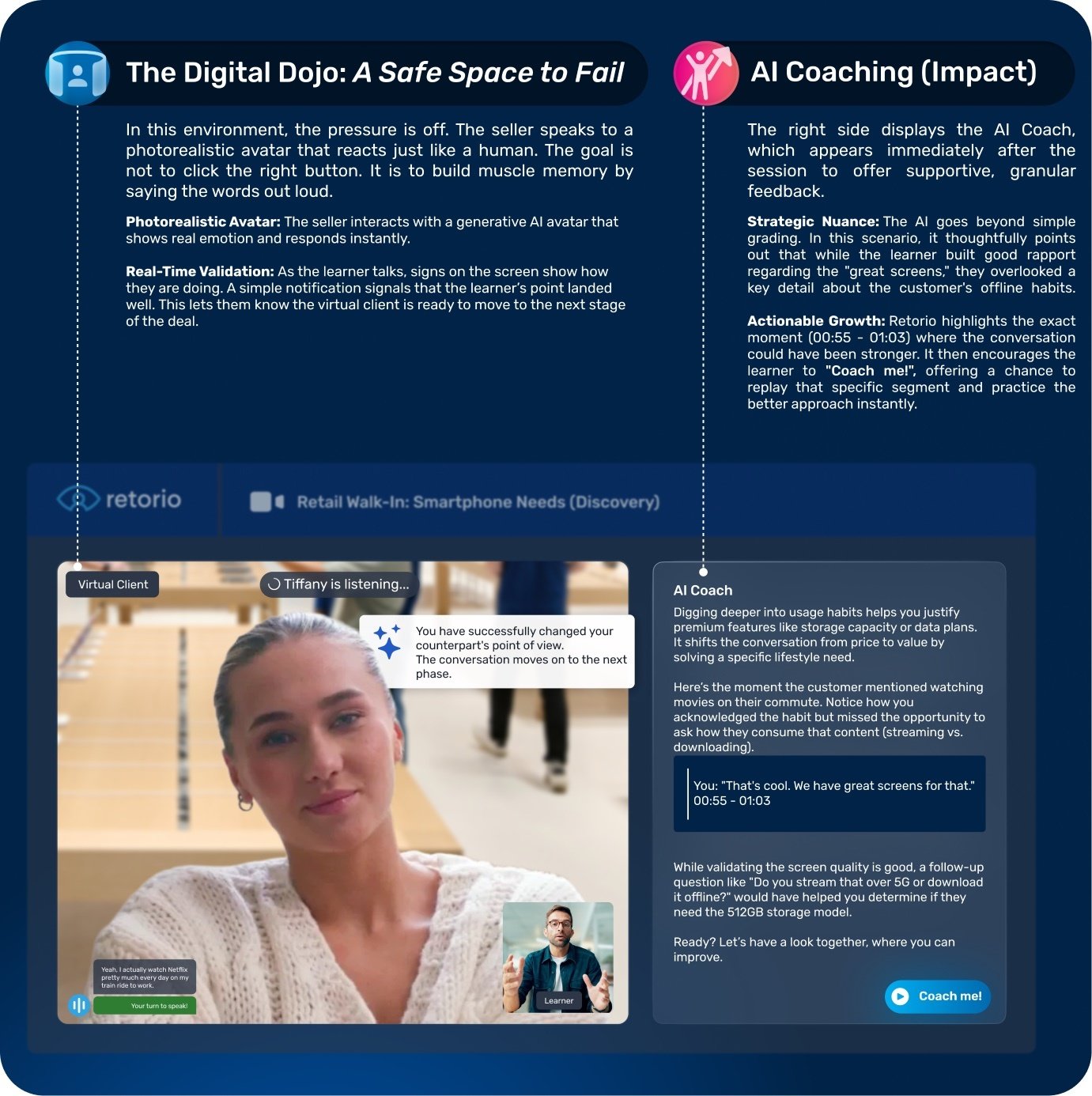
Safe Space to Fail: The left side describes the "Digital Dojo," an environment designed to build "muscle memory" by letting sellers speak to photorealistic avatars that react with real emotion, removing the pressure of practicing on live clients.
The AI alters respondent attitude and objections based on the rep's verbal and non-verbal cues.
Get objective data on tone, pacing, and energy immediately after every session.
Democratize elite coaching. Make high-quality practice accessible to distributed teams, anytime. For deeper context, see role-play coaching.
Learn more about technology driving modern role play at Retorio AI Sales Training.
Designing Realistic Simulations for Mastery
A powerful AI roleplay engine doesn't just recite a script; it adapts content, tone, and difficulty to reflect the unique challenges of your market.
Data from these sessions is harvested using Behavioral Intelligence models, giving enablement leaders aggregated analytics on skill gaps and compliance readiness. Before you shortlist vendors, see how to evaluate AI sales role play software against your own requirements.
Measuring Impact: From Practice to Performance
Ultimately, the power of interactive AI roleplay is unlocked through rigorous measurement. These insights are not anecdotal; they are hard data. HBR research on why most sales training fails to change behavior points to the same conclusion: consistent, behavior-focused practice, not one-off training events, is what moves quota attainment.
Transparent measurement equips leadership with concrete evidence of program ROI, bridging the historical gap between training spend and business impact.
See What Measurable Practice Looks Like on Your Team
Don't leave your revenue to chance. Start practicing today.

Key Takeaways
FAQ: Enterprise AI Role Play
It is a common initial concern, but adoption data suggests otherwise. Because the environment is "psychologically safe" (no manager watching over their shoulder), reps often feel more comfortable practicing with an AI than a peer. The video-based avatars reduce the "uncanny valley" effect, making the conversation feel natural within the first 60 seconds.
Historically, building simulations took weeks. With generative AI, you can now upload your existing sales playbooks, battle cards, or PDF case studies, and the system generates a roleplay scenario in under 30 minutes. You simply tweak the persona's objection difficulty and hit publish.
Keyword spotting is the baseline, but it isn't enough for complex sales. The AI analyzes Behavioral Intelligence-measuring non-verbal cues like energy, pacing, tone consistency, and active listening. It scores reps on "Warmth" and "Competence," ensuring they aren't just reading a script, but connecting with the buyer.
Weekly is the minimum for a skill to stick. Reps working on a specific scenario, an objection type or a negotiation pattern, benefit from short, repeated sessions rather than one long practice block. Most teams see the fastest improvement when reps run a 10 to 15 minute scenario before a week's high-stakes calls, not once a quarter.
No, and it is not meant to. AI role play handles the repetition managers cannot scale, daily practice, objective scoring, and safe failure. Managers stay essential for judgment calls: which deals need attention, which reps need a harder conversation, and how coaching connects to quota and career growth. The two work together, not instead of each other.
Yes, with the right guardrails. Pharma and medical device teams use AI role play to rehearse HCP detailing calls, product launch briefings, and value-analysis-committee presentations while staying strictly within approved, on-label messaging. Because every session is scored and logged, it also gives compliance teams a consistent record of what reps actually practiced.
Track a leading indicator and a lagging indicator together. The leading indicator is the per-session Warmth and Competence score, which should trend up within a few weeks of consistent practice. The lagging indicators are the numbers the business cares about: ramp time for new hires, win rate on objection-heavy deals, and quota attainment over a full quarter.
Call recording analysis is retrospective, it tells you what already happened on a real, and often already-lost, deal. AI role play is rehearsal: reps practice the hard conversation before it happens with a real customer, and it is repeatable as many times as needed with no downside risk. Many teams use both, recorded-call analysis to find the gap, and role play to close it.
Treat the library as two layers. The core layer is the scenarios every region runs: discovery, the price objection, the renewal conversation, the launch briefing. Those are written once centrally and stay identical, which is what makes rep scores comparable between Madrid and Munich. The regional layer is the small set of local variations, a different regulator, a different competitor, a different buying committee, and it is owned by the region rather than by headquarters. A library stops scaling when both layers sit centrally, because every local change queues behind one team, or when neither does, because after a year no two regions practice the same thing. Ask a vendor who can create and edit a scenario, how long an edit takes, and whether a regional edit forks the scoring rubric or inherits it. Inheriting is what keeps the dashboard comparable.
The thing to test is not whether the platform speaks the language, it is whether it scores the same way in that language. Most tools will hold a conversation in German or Spanish. Fewer apply the same rubric across all of them, so a rep in one market gets marked down for directness that reads as competence in another. Before rolling out, run the same scenario in each language against the same rep-level script and compare the scores. If they diverge with no behavioral reason, the rubric is being applied unevenly and the dashboard will mislead your managers. Ask specifically which languages are supported for the scored feedback rather than only for the conversation, and whether the scenario text and the rubric are maintained in one place instead of translated into separate copies that drift apart.
Yes, and the variability is the useful input. Pull the calls where the deal turned, look at what the top quartile did at that moment, and write the scenario around the moment rather than around the whole call. The point is not to replay a recording, it is to isolate the behavior that separated the outcomes and have every rep practice that one exchange until it is repeatable. Two cautions. Recordings carry customer data, so write the scenario from the pattern rather than pasting the transcript, which also keeps it usable across accounts. And tie the practice score to the same CRM stage you are trying to move, or you will improve a rehearsal metric and see nothing in pipeline. The measurement section above sets out which correlations are worth tracking.
Three things beyond a general sales library. First, scenarios written for the regulated motion rather than adapted from software sales: the HCP detailing call with efficacy and safety data, the skeptical time-pressed clinician, the access and reimbursement conversation. Second, a rubric that keeps warmth and competence separate, because in medical selling the common failure is a rep who is accurate and cold, or warm and imprecise, and one blended score hides both. Third, control over what is claimed: the scenario and its scoring have to be reviewable by medical affairs before reps see them, and editable the week a label changes. The pharma and life sciences scenario set above is where most field teams start.
See how your reps sound before the real call. Give every rep unlimited, judgment-free AI role play with instant behavioral feedback.
Test AI coach in actionWritten with help from LLMs, edited and checked by Önder Mutluer, Website Manager and Marketing Strategist, and Dr. Patrick Oehler, Co-founder and Co-CEO. Reviewed by Peter Holdenried, Head of Sales. How this article was researched, written and checked, and who reviews which topic: Retorio editorial policy.