


50+ enterprise clients. Here is what actually separates a coaching tool from expensive noise.
Every sales stack vendor added "AI coaching" to their pitch deck in 2025. The result: a market where the terminology has become meaningless and the buying decision has become genuinely hard. This post cuts through that. We rank the best AI sales coaching tools in 2026 on one standard: does behavioral change actually happen, and does a manager have visibility into it?
Tool or software? The distinction this guide uses.
The market uses "tool", "platform" and "software" as if they were the same thing, which is a large part of why this decision is hard. This guide is about tools: single-job products a rep or a manager uses inside their own week. A role-play bot, a transcript scorer, a pitch recorder. Usually bought per team or per seat, often adopted without procurement, and judged on whether one person is still using it after the first fortnight.
If you are choosing the system your whole organisation deploys, with licensing, admin roles, CRM integration, data residency and an audit trail, that is a platform decision rather than a tool decision. Start with the software comparison.
Quick Answer
The best AI sales coaching tools in 2026 combine behavioral simulation, observable scoring, and manager feedback loops into a single workflow. Platforms that score only call transcripts (conversation intelligence) measure what reps say but not how they adapt under pressure. The most effective tools add role-play simulation where reps practice handling objections in realistic scenarios, an AI that scores behavioral signals (warmth, confidence, clarity), and a dashboard that tells managers exactly which rep needs what kind of rep coaching this week. For enterprise teams requiring GDPR compliance and EU data residency, the shortlist narrows further. This article evaluates nine platforms across six dimensions so sales enablement leaders can compare on what matters for revenue, not on feature checklist marketing.
Before we rank specific platforms, it helps to understand why the category splits into genuinely different products. Most buyers discover this difference after they have already signed a contract. The six evaluation categories below will help you avoid that.
How we evaluated the 9 platforms
Each platform was assessed on the same six-dimension rubric. Weighting reflects what sales enablement leaders consistently tell us matters most: does behavioral change happen at scale, and can managers act on what they see?
| Category | What it measures | Weight |
|---|---|---|
| Behavioral depth | Does the platform score observable signals (warmth, confidence, pacing, eye contact) or just keyword presence? | 30% |
| Simulation fidelity | Can reps practice with a realistic virtual client that adapts, pushes back, and switches topics mid-conversation? | 25% |
| Manager workflow | Does the coach dashboard tell a manager which rep needs what this week, without requiring them to watch full recordings? | 20% |
| Scenario customization | Can the sales ops team build new scenarios in hours, not months of professional services? | 12% |
| EU compliance | GDPR data residency, DSGVO alignment, ISO 27001 certification, EU AI Act readiness | 8% |
| Integration depth | Does the platform push scoring data back into CRM and LMS workflows, or is it a separate silo? | 5% |
What each dimension delivers to revenue metrics
The six categories are not equally weighted because they do not deliver equal business outcomes. This matrix shows the direct link between what a platform does well and the metric your CFO cares about.
| Platform strength | Ramp time impact | Conversion uplift | Manager overhead | Compliance risk |
|---|---|---|---|---|
| Behavioral depth | 38-42% faster | +27% vs. baseline | Low (AI does scoring) | Low (no biometric) |
| Simulation fidelity | Faster (deliberate practice effect) | +14.6% quota attainment | Low (async) | Low |
| Manager workflow | Moderate | High (targeted interventions) | Very low (digest view) | Low |
| Conversation intelligence only | Minimal | ~12% (call logging) | High (watch recordings) | Varies |
| No EU data residency | n/a | n/a | n/a | HIGH (DPA risk) |
Uplift by platform approach
Not all "AI coaching" delivers the same result. When you normalize across enterprise deployments, behavioral simulation platforms consistently outperform tools that only analyze recorded calls.
"We did not need another tool that tells us what our reps said on calls. We needed something that changed how they show up in the next call. The behavioral scoring gave us a language for coaching that everyone on the team understood."
VODAFONE VOIS, on shifting from call logging to AI coaching at scale
A 4-step process for shortlisting AI coaching tools
Most vendor evaluations skip the hardest question until it is too late: can your managers actually use this without it becoming another ignored dashboard? These four steps prevent that outcome.
Define the behavior gap, not the feature wish list
Before opening a single demo, write down three specific behaviors that separate your top 10% of reps from the rest. "Better objection handling" is not a behavior. "Rep acknowledges the prospect's concern before pivoting to the value proposition" is a behavior. Tools that can score behaviors that specific belong on your shortlist. Tools that cannot do not.
Output: 3 observable behavior definitions shared with all evaluation participants before demos begin.
Run the manager workflow test before any rep feature demo
Ask the vendor to show you the manager dashboard with real data. Have your most time-constrained frontline manager sit next to you. Ask them: "If you had five minutes this Monday morning, what would you do here?" If they cannot answer that question from what they see, the platform will not get adopted. Conversation intelligence tools almost universally fail this test because they require watching recordings to derive insight.
Output: pass/fail score from frontline manager who was not coached on the demo beforehand.
Audit the EU compliance architecture before procurement
For teams operating under GDPR or handling sales conversations in Germany, Austria, or Switzerland, the compliance question is not optional. Ask each vendor for their data processing addendum, their sub-processor list, and their EU AI Act conformity documentation. Retorio is ISO 27001 certified, GDPR and DSGVO compliant, EU AI Act aligned, and hosted on GCP with EU data residency. Most US-headquartered vendors cannot provide equivalent documentation.
Output: DPA and sub-processor list received and reviewed by legal before contract negotiation.
Run a 30-day behavioral pilot, not a feature pilot
A feature pilot measures clicks. A behavioral pilot measures whether rep behavior on those three observable definitions from Step 1 changed over 30 days. Assign the same 15 reps across two tools if you are running a head-to-head comparison. Pre-define the measurement: behavioral scores at day 0 and day 30, quota attainment at day 30, completion rate, and manager satisfaction score. This is the only data that predicts rollout success at 500 reps.
Output: pre-registered metrics sheet signed off by the buying committee before pilot launch.
The nine platforms: where each fits
We grouped the nine platforms into three tiers based on the six-dimension rubric above. Tier 1 platforms score on all six dimensions; Tier 2 score well on three or four; Tier 3 score on one or two. For enterprise teams above 200 reps, Tier 3 platforms create more management overhead than they solve.
Your reps practice on real customers. Fix that.
Retorio gives every rep unlimited, judgment-free AI role play with instant, specific feedback. ISO 27001 certified, GDPR-compliant, EU AI Act aligned.
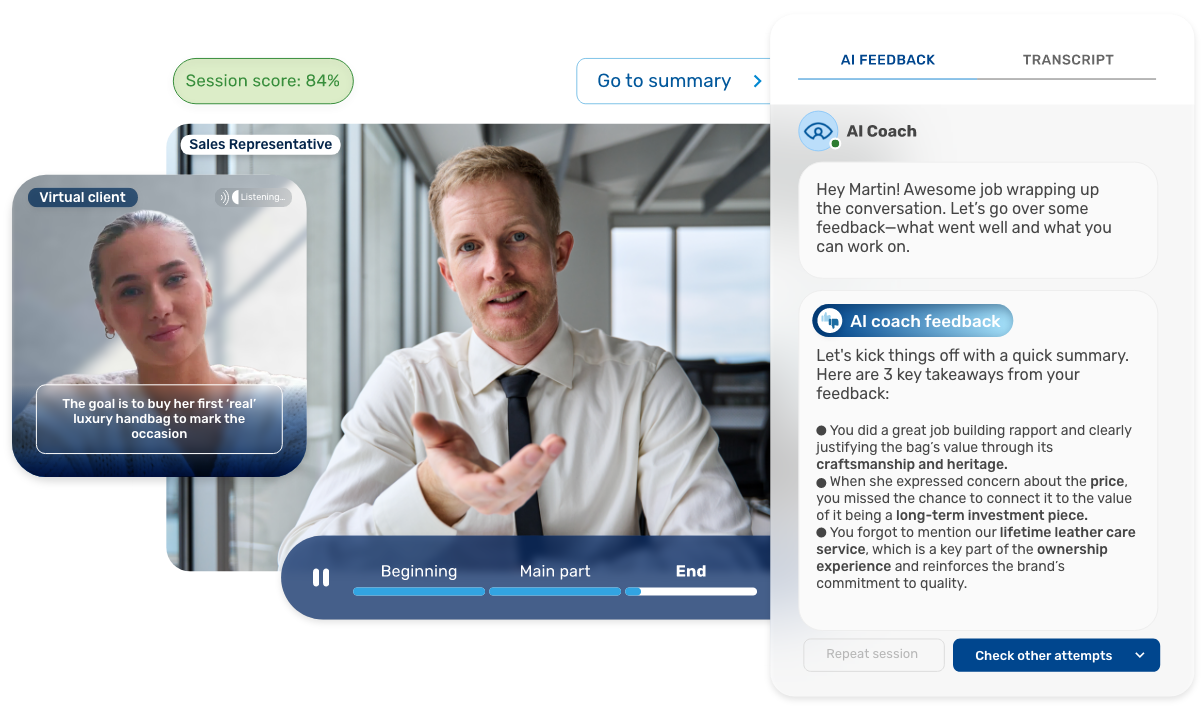
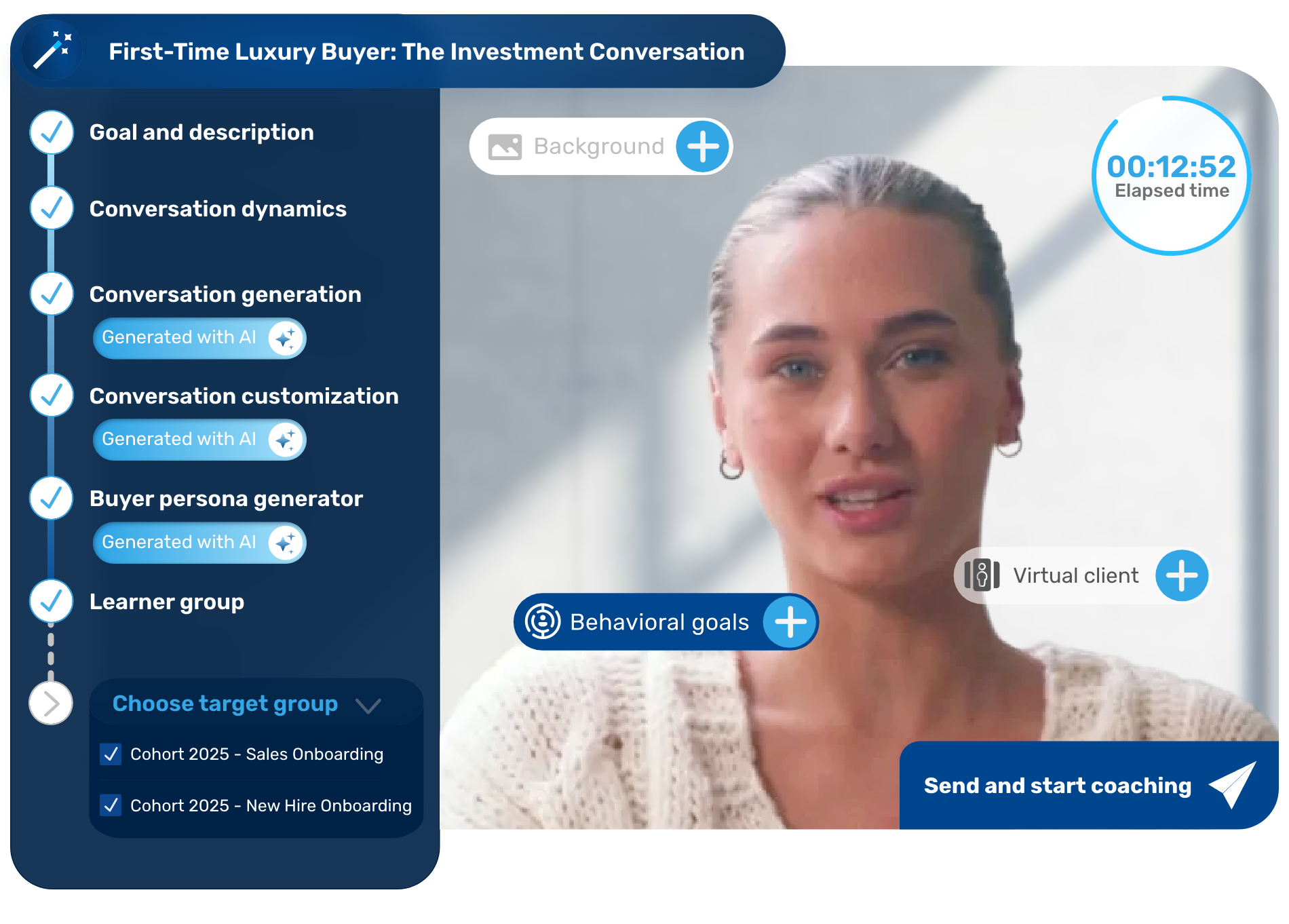
Test AI coach in actionTier 1 (behavioral + simulation + EU compliance): Retorio is the only platform in this tier that combines behavioral simulation, observable behavioral scoring, manager feedback workflow, and full EU compliance in a single product. For a full breakdown of how AI sales coaching works at the architecture level, our companion post walks through the underlying model.
Tier 2 (call analysis + some coaching workflow): Several conversation intelligence platforms added a "coaching" tab to their call recording interfaces in 2024-2025. These tools are valuable for analyzing deal conversations after the fact but do not create deliberate practice loops. Reps see what they did wrong; they do not practice doing it right. The top AI sales coaching software comparison for 2026 covers these platforms in more detail if you are evaluating in this category.
Tier 3 (readiness and content delivery): Platforms in this tier are primarily content delivery and knowledge assessment tools. They measure whether reps watched a video and passed a quiz. They do not measure whether rep behavior changed in a live conversation. The distinction between sales enablement and AI coaching is a useful frame if your organization conflates the two.
For teams already using a Tier 2 or Tier 3 platform and evaluating whether to layer AI coaching on top, see our guide to sales coaching tools that integrate with existing stacks.
Five purchasing mistakes that cost teams a full quarter
The AI coaching market is moving fast. But the fundamentals of what makes a sales rep effective in a complex enterprise conversation have not changed. Warmth signals trust; competence signals credibility; both are measurable. The best AI coaching tools in 2026 are the ones that score both, at scale, in a way your managers can act on. HBR research on feedback effectiveness shows that specific behavioral feedback loops produce significantly greater capability improvement than generic performance ratings, a finding that holds across every enterprise deployment we have run. McKinsey's commercial excellence research points to the same structural gap: most commercial organizations measure outcomes but not the behaviors that produce them.
Conclusion
The question is not whether AI belongs in your sales coaching stack. It does. The question is whether the AI you pick scores observable behavior or just records conversation content. For enterprise teams that need measurable ramp time reduction, quota attainment improvement, and EU compliance, the shortlist is short. Behavioral depth, simulation fidelity, and manager workflow are the three dimensions worth optimizing on. Everything else is features.
See how AI coaching reduces ramp time by 38-42%
Book a 30-minute session. We will walk through your specific rep behavior gaps and show you how a behavioral pilot would be structured for your team.
Book your sessionKey takeaways
Frequently asked questions
What is the difference between an AI sales coaching tool and a conversation intelligence platform?
Conversation intelligence platforms record and analyze sales calls after they happen. They identify what was said, which topics came up, and how the conversation correlated with deal outcomes. AI sales coaching platforms add a practice loop: reps simulate future conversations with a virtual client, receive behavioral scoring in real time, and get specific feedback on how they communicate. AI coaching platforms also give managers a forward-looking view of which reps need what intervention, rather than a backward-looking call library.
How long does it take to see measurable results from an AI coaching deployment?
In Retorio deployments across enterprise teams, behavioral scores typically improve within the first three sessions (one to two weeks). Statistically significant changes in quota attainment and ramp time emerge after four to eight weeks of consistent use. The platforms that deliver the fastest results combine high simulation fidelity, specific behavioral scoring, and regular manager check-ins triggered by the coaching dashboard.
Is AI sales coaching compliant with GDPR?
It depends on the platform. Retorio is GDPR and DSGVO compliant, ISO 27001 certified, EU AI Act aligned, and processes all data on GCP infrastructure within the EU. Several US-headquartered vendors do not offer equivalent EU data residency or have not completed EU AI Act conformity documentation. For any deployment where reps are EU residents, require a Data Processing Addendum and a sub-processor list from every vendor before procurement.
What behavioral signals does an AI coaching tool actually score?
The most rigorous behavioral AI platforms score signals across two dimensions grounded in established behavioral science: warmth (signals of trust, empathy, and rapport) and competence (signals of expertise, clarity, and confidence). Specific measurable signals include eye contact, vocal pacing, clarity of value proposition delivery, response relevance when handling objections, and adaptability when the virtual client shifts topic.
Can an AI coaching tool replace a sales manager?
No. The strongest AI coaching tools are designed to make managers more effective, not to replace them. The platform handles the observation and scoring work that currently requires managers to watch 40-minute call recordings. It surfaces the three reps who need coaching attention this week and flags the specific behavioral pattern that needs work. The manager still has the conversation, builds the relationship, and sets the coaching direction.
How should I structure a pilot of an AI sales coaching tool?
A meaningful pilot has four components: a baseline behavioral assessment of all participating reps on day zero, a defined scenario set (three to five objection-handling scenarios relevant to your current sales motion), a 30-day practice cadence with at least six sessions per rep, and pre-registered success metrics agreed by the buying committee before the pilot starts. Without pre-registered metrics, you cannot distinguish platform effect from natural variation.
Written with help from LLMs, edited and checked by Önder Mutluer, Website Manager and Marketing Strategist, and Dr. Patrick Oehler, Co-founder and Co-CEO. Reviewed by Peter Holdenried, Head of Sales. How this article was researched, written and checked, and who reviews which topic: Retorio editorial policy.