



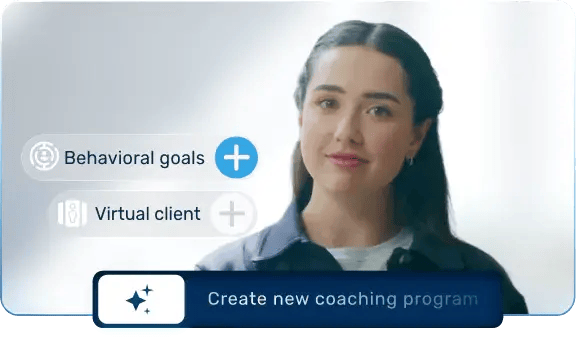
Guided AI coaching
The conversation is the easy part. Knowing what to change is the product.
After every role play, the rep gets the few behaviours worth changing next and the line to try instead.

What the coach does with one role play
One seven-minute visit with a sceptical GP. The coach pinpoints what matters, explains why it matters, and walks the rep through their own conversation.
Before the call, the enablement lead sets the scenario, the criteria it is scored on and the approved material the coach may draw its advice from.
The rep runs the visit. The coach then reads the recording in one pass: what was said, how it sounded and how it looked.
Every competency is scored against the threshold your organisation defines. Success is not a perfect score, it is clearing that line.
Instead of a long list of corrections, the coach picks the three to four changes with the most impact, and each opens into the sub-skills behind it.
Each point is tied to the second it happened, with what the rep said, why it lost the buyer, and a line they can say in their own style.
Every attempt is kept. The rep runs it again until every skill clears the threshold, so improvement is a number rather than a feeling.


Every feature, one agentic layer
Named behaviour, not a grade
Knowing what to change is the product. Every run is read against the Warmth and Competence framework and comes back as specific, named behaviour rather than a grade.
-
WarmthRelationship builderTrusted advisorTransactionistSpecialist+32CompetenceFirst tryBest try
Two questions, one picture
Warmth and Competence are the two axes a buyer answers about a rep. The quadrant says which one is carrying the conversation and which is missing.
-
1Answer the price question first2Drop the hedge words3One question at a timeWhat you said“I think we could maybe look at the price.”Try this instead“The price stays. Here is what it buys you.”
Three fixes, and the line to say
After the role play the coach picks the three to four changes with the most impact, shows what the rep said, and gives the line to try instead.
-
Confidencefirst trybest try3484PresenceImprovableMasteredDoubt wordsPartially masteredMasteredFiller wordsImprovableMastered
Skills, then sub-skills
Each skill opens into the sub-skills underneath it, so the feedback names the behaviour instead of the score.
- Criteria can follow your playbookThe behaviours being scored are configurable, so a session is judged against your standard rather than a generic one.
- The method is on the screenWhat was measured is stated where the score is shown, which is the first thing a procurement reader asks for.
- Thresholds are yoursWhat counts as mastered is a number your organisation sets, which is what makes a score arguable in a coaching conversation.
- Applied knowledge scored apartWhether the rep knew the material is measured separately from how they said it.
- Managers coach the momentsThe run identifies where the conversation turned, so the manager spends the session coaching instead of playing the customer.
- Role-based access to resultsWho can see an individual result is a permission, not a convention.
- The line to use insteadEach focus point shows what the rep said, why it lost the buyer, and a better line to try on the next run.
- More than 140 behavioural cuesWhat the rep says and how they say it, mapped onto Warmth and Competence rather than into a personality label.
- Three to four focus points, not thirtyThe guided coach surfaces the top points to work on, because a list of everything is a list nobody acts on.
- Advice from your approved materialTactical recommendations come from documents you upload and approve, so the coaching says what your organisation endorses.
- Defensible in regulated industriesAdvice is not invented by an open model, which is why teams under medical or legal review can put it in front of a field force.
- The method is publishedHow a score is produced, and how it is calibrated per language and behaviour category, is documented and open to your review.
From guided practice to a real conversation
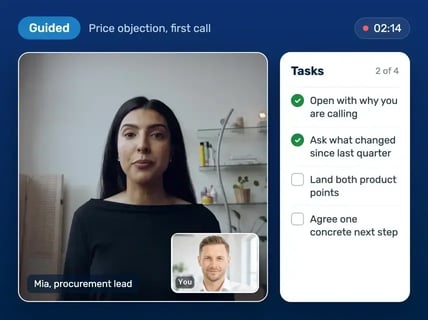
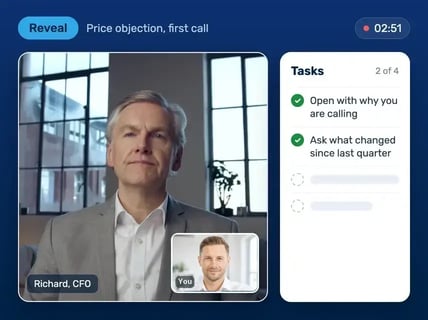
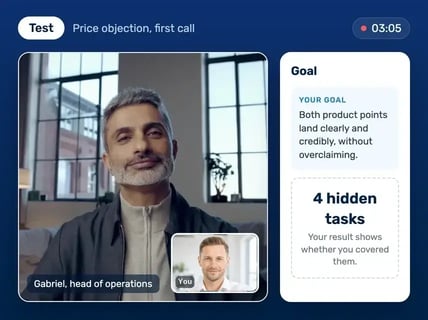
Each session runs in one of four modes, chosen when it is built. The guidance pulls back with each mode, until the rep is in an open conversation.
- GuidedThe full task list stays on screen while the rep talks. The most structured mode, for reps new to a scenario.
- RevealEach task appears once the rep has covered it, so reps recall the steps instead of reading them.
- TestOnly the goal is shown and the tasks stay hidden. The result shows which ones the rep covered.
- NaturalNo instructions, an open conversation scored against your behavioural goals. The closest to a real call.
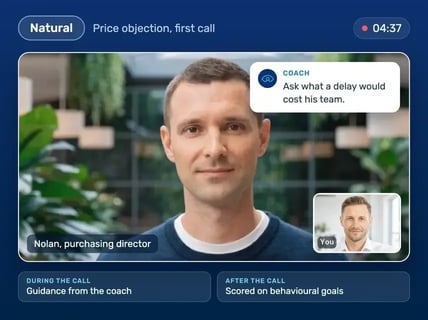
Guided, Reveal and Test give feedback on the instructions you set. Natural gives feedback on behavioural goals and is the mode for real-world readiness. Which modes are available is set per organisation, and Natural needs multimodal feedback switched on.
Skills with research behind them
What a session is running on
The scenario, the counterpart and the numbers every role play depends on, none of them on the screens above, and what the teams running it say.
-
Scenarios
Built from your material, and the research you ask for.
Your enablement team briefs the coach on the goal and uploads the product sheet, the battle card or the pricing rules. When you ask, the coach adds public competitor research and shows where each point came from. In the role play itself, the counterpart answers only from the material you approved.
-
Counterparts
The customer your reps dread, in the language they sell in.
93 photorealistic avatars, 38 voices and 14 languages. You set the persona's background, its attitude towards your company and how hard it pushes, then reuse it across scenarios. The rep in Lisbon and the rep in Munich practise against the same standard.
 Deutsch
Munich Français
Lyon Português
Lisbon English
Manchester Español
Madrid Italiano
Milan -
Analytics
Adoption and progress by cohort, not by anecdote.
Which cohorts are practising, how many scenarios they complete, and how Warmth and Competence move across the organisation over time. Compare cohorts side by side. Small groups stay hidden behind privacy thresholds, by design.
-
In their words
“If you're looking for a scalable, engaging, and effective way to drive behavioral change in your organization, AI-driven coaching like Retorio is the way forward.”See customer references Irit Hovich, Senior Director, Global Talent Management, Head of Diversity and Inclusion, Teva38-42%reduction in ramp time69%less human trainer effort15xexpected ROI in the first year
The rest of the platform










See the feedback on a real conversation
Bring one conversation your reps find hard. We will run it in the demo and show you the feedback each rep would get.
Book a demo


.png)

Frequently asked questions
What does a rep get after each role play?
The three to four changes with the most impact, not a long list of corrections. Each one is tied to the second it happened, with what the rep said, why it lost the buyer, and a line they can say in their own style. The points are read against the Warmth and Competence framework.
When does a skill count as mastered?
When it clears the threshold your organisation defines. Success is not a perfect score, it is clearing that line: by default 75 is the target and 50 the floor, and both can be set per programme. Every attempt is kept, and the rep runs the scenario again until every skill clears the threshold.
How accurate is it?
Every score is traceable to the moment in the recording it came from, and the method is shown next to the score, so a reviewer sees what was measured before deciding what to do with it. Criteria follow your playbook rather than a generic rubric, and where the evidence is thin the coach says so instead of inventing a finding.
What does the enablement lead set up before the first run?
The scenario, the criteria it is scored on and the approved material the coach may draw its advice from. The coach then reads every recording against that standard, so the feedback follows your playbook rather than a generic rubric.
How do the four conversation modes change the feedback?
Guided, Reveal and Test give feedback on the instructions you set. Natural gives feedback on behavioural goals and is the mode for real-world readiness. Which modes are available is set per organisation, and Natural needs multimodal feedback switched on.
Which skills does the AI coach focus on, and why?
Four skills: active listening, empathy, confidence and persona-oriented communication. Each is backed by published sales research. Listening affects the customer relationship and sales results (Itani, Goad and Jaramillo 2019). Salesperson empathy is linked to trust and satisfaction (Aggarwal et al. 2005). Frequent hedges and hesitation lower credibility (Erickson et al. 1978). Adapting to the customer raises performance (Franke and Park 2006).