


Train your sales team with AI in five steps: identify the behaviors that win deals, build realistic conversation scenarios, let reps practice against AI buyer personas, analyze their verbal and nonverbal patterns, then coach the specific gaps. The point is judgment, not memorized scripts. AI role play lets reps practice repeatedly and turns invisible sales behavior into measurable, coachable feedback.
Example. A new rep runs a discovery call three times against an AI buyer persona. Each time, the system flags that she rushes past budget hesitation instead of exploring it. Her manager reviews that specific moment, and they practice the pause together once. By her next real deal, handling budget pushback feels natural.
An Early Sales Lesson
Marc Benioff noticed something early on while building Salesforce. Two sales reps could walk into the same meeting with the same product, the same pitch deck, the same training, and walk out with completely different results. One would leave with a clear next step. The other would hear, “We’ll get back to you.”
When leaders tried to explain the difference, the answers were vague: better presence, stronger relationships, just a more natural salesperson. But the real difference was simpler. The top reps handled the conversation differently. They asked sharper questions, paused at the right moments, and explored hesitation instead of pushing past it.
Those small choices in the moment are what decide deals, and they’re also the hardest skills to teach. You can hand someone a framework or a script, but real sales performance comes down to how people respond when the conversation is happening.
Observable Selling: The Real Opportunity of AI in Sales Training
Sales has always had a measurement problem.
Revenue is measurable. Pipeline is measurable. Activity is measurable.
But sales behavior, the thing that actually drives deals, has traditionally been invisible.
Why did one rep win the deal while another lost it?
Managers usually answer with guesses:
- “Better relationship building.”
- “Stronger storytelling.”
- “More confidence.”
The use of AI in sales training changes that.
Modern AI tools for sales reps can analyze communication patterns that were previously difficult to measure consistently. HBR's coverage on coaching effectiveness repeatedly shows that observable feedback tied to specific behaviors produces faster skill development than general guidance. AI makes that specificity scalable. Patterns now measurable include:
- Clarity and structure of arguments
- Engagement signals during presentations
- Question quality during discovery
- Verbal and non-verbal confidence
- Persuasion patterns in objection handling
Sales intelligence is a key component of these tools, providing actionable insights by analyzing customer interactions and sales conversations.
Sales technology leverages these insights to improve training outcomes by automating feedback and supporting more effective coaching.
In other words, AI for sales training turns intuition into observable behavior.
Once behavior becomes visible, it becomes trainable.
Turning Insight into Action: How AI Trains Your Sales Team
Understanding the behaviors that separate top performers is one thing. Turning those insights into consistent skill across your team is another.
Training a sales team with AI typically follows five practical steps that help reps practice, learn, and improve in the moments that truly decide deals:
- Define successful sales behaviors (what top performers do in conversations)
- Create realistic AI sales scenarios such as discovery calls or objection handling
- Let reps practice with AI buyers repeatedly
- Use behavioral AI analysis to evaluate communication skills
- Turn insights into targeted coaching
Why Most AI in Sales (Training) Is Overhyped
Let’s be honest: a large portion of the current AI in sales ecosystem focuses on productivity.
-
AI writes emails.
AI generates call summaries.
AI drafts LinkedIn messages.
These are examples of AI handling repetitive tasks and routine tasks, such as data entry, follow-up emails, and scheduling, which helps free up sales teams to focus on higher-value activities.
These tools are useful. But they rarely transform performance. According to Salesforce's State of Sales research, sales reps spend nearly a third of their time on non-selling activities, and the biggest performance differentiator is not tooling but the quality of conversations.
This is why the most impactful companies use AI in sales for a different purpose: skill development.
The real value is not just to automate routine tasks, but to enhance human skills and elevate sales conversations.
Where AI Actually Changes Sales Training
When companies use AI for sales coaching, three things become possible that traditional training simply cannot achieve. Additionally, AI-driven sales training supports a more adaptive and effective sales strategy by allowing sales teams to adjust their approach in real-time, optimize processes, and improve overall sales execution.
Unlimited sales conversation practice
Role plays are valuable but limited. Managers rarely have time to run multiple simulations with every rep.
An AI sales training platform allows reps to practice sales conversations repeatedly, including: discovery calls, product positioning, pricing discussions, difficult objections, to name but a few.
Repetition builds confidence, which directly impacts real customer conversations.
Objective feedback on communication
Human coaching often relies on subjective impressions, while modern AI sales systems evaluate elements such as: speed clarify, listening behavior, confidence signals, and customer sentiment.
Natural language processing enables AI to interpret and assess these communication elements.
Instead of vague advice like “be more consultative,” reps receive precise insights about their communication patterns.
Faster replication of top performers
With artificial intelligence for sales, organizations can identify behavioral patterns among top performers and convert them into training scenarios. AI does this by analyzing key data points and data points, such as specific actions, communication styles, and decision-making processes, exhibited by high performers to inform and enhance these training scenarios.
This is one of the most powerful ways to use AI for sales at scale.
How to Train Your Sales Team with AI in 5 steps
Turning AI sales training into real performance improvement requires a structured approach. This approach is designed to drive sales growth by leveraging AI-powered tools and strategies that optimize the sales cycle and enhance customer engagement. For context on what this looks like across larger sales organizations, see how enterprise sales coaching teams structure the same progression.
See how AI sales coaching works for your team.
Test AI coach in actionStep 1: Identify the behaviors that win deals
Start by analyzing successful sales conversations, including analyzing historical data and historical data to identify patterns that lead to success.
Look at:
- How top reps open discovery calls
- How they guide problem exploration
- How they position value
- How they handle resistance
- Reviewing CRM data for additional insights
Next, convert common deal situations into practice environments.
Typical scenarios include:
- First discovery meetings
- Solution presentations
- Objection-heavy calls
- Budget negotiations
- Procurement discussions
Incorporate real-world sales examples and AI-generated personalized messages into these scenarios to enhance realism and better prepare reps for actual sales conversations.
Instead of static role plays, sellers interact with simulated buyers.
These AI personas respond dynamically, forcing reps to think, adapt, and communicate clearly. AI agents and generative AI power these realistic buyer simulations, enabling autonomous, intelligent interactions that closely mimic real-world sales scenarios.
Here is where AI sales training delivers the real insight.
AI analyzes both verbal and nonverbal communication patterns, such as:
- Argument structure
- Clarity of messaging
- Conversational flow
- Emotional engagement
- Purchasing patterns
Managers can focus their coaching on specific gaps rather than giving generic advice. They can identify exactly where each rep needs improvement, assign targeted practice, and step in selectively to guide reps through challenging skills or reinforce key behaviors.
This combination of practice, analysis, and coaching is what makes AI sales training powerful.
How Retorio Turns AI Sales Coaching into Reality
Retorio’s AI sales coaching platform is designed specifically to train the communication behaviors that drive successful sales conversations. The platform leverages sales AI tools, and AI technology to automate training workflows, provide data-driven insights, and enhance sales team performance through intelligent, personalized learning experiences.
Here’s how sales teams use Retorio in practice, along with a quick look at how the platform works.
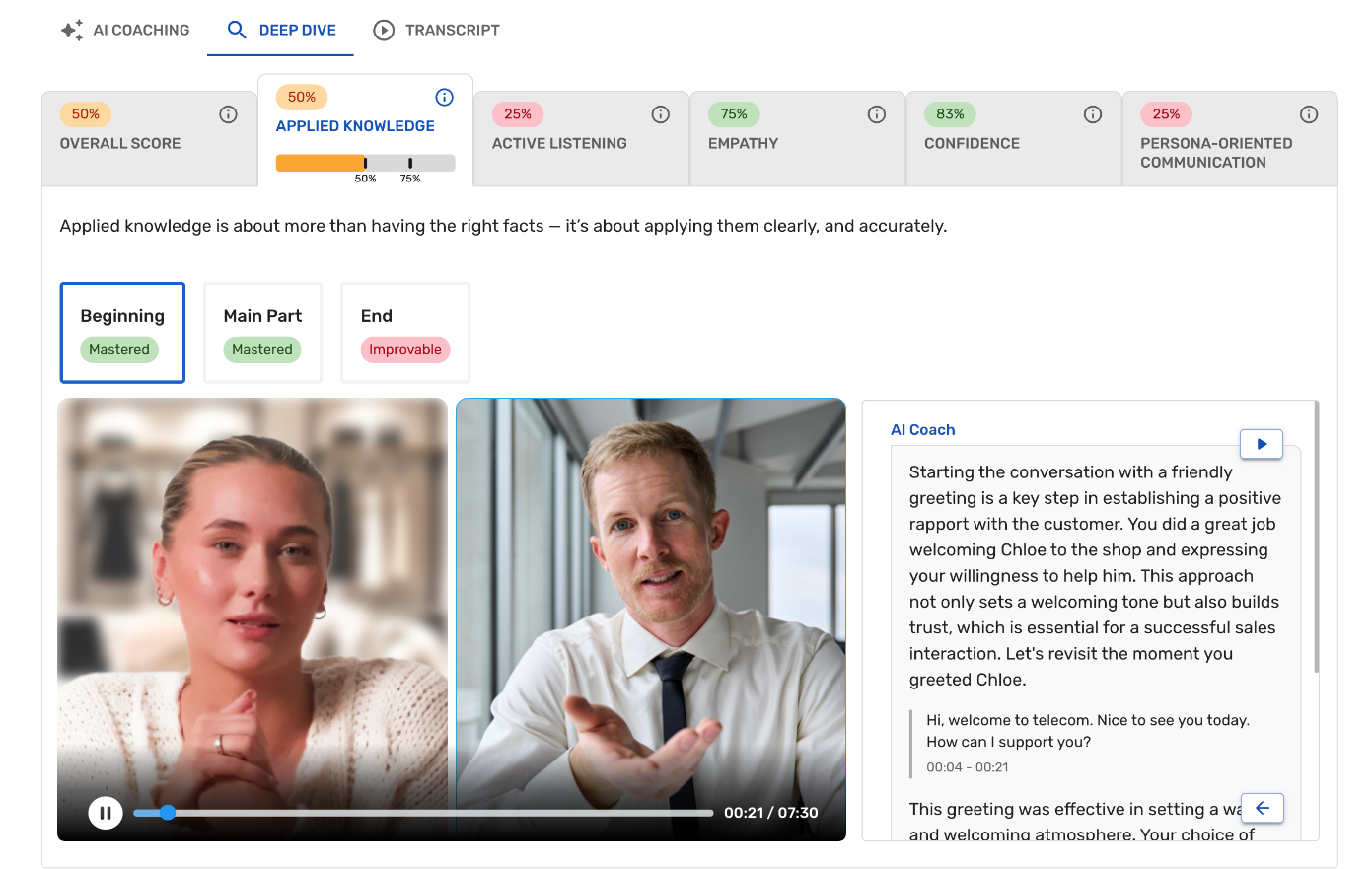
AI-driven conversation simulationsSales reps interact with AI buyer personas in realistic scenarios. These simulations replicate common sales situations such as discovery conversations, objection handling, and scheduling next steps. Reps can practice repeatedly, experiment with different approaches, and refine both their messaging and delivery before engaging in real customer meetings. |
|
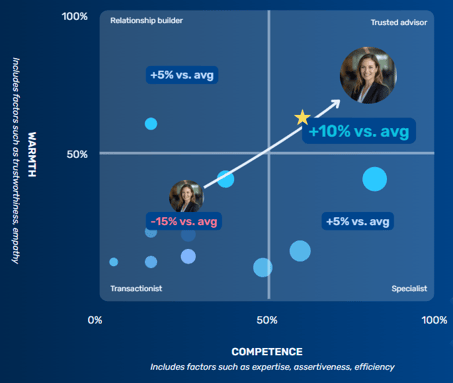
Instant AI coachingAfter each simulation, reps receive feedback on their strengths, improvement areas, and key behavioral patterns. The system analyzes both verbal and nonverbal signals based on established frameworks like Warmth + Competence . This helps reps understand not only what they communicate, but also how they come across – making it easier to strengthen both expertise and trust in customer conversations. |
|
|
Scalable global sales training
Top-performing sales reps rarely succeed by chance. Their results are often driven by repeatable behaviors: how they ask questions, handle objections, and structure conversations. With Retorio, these successful patterns can be identified and turned into scalable training scenarios, allowing organizations to consistently develop these skills across entire sales teams and make effective selling the norm rather than the exception. |
|
.webp?width=1710&height=827&name=retorio-ai-role-plays-for-sales-698b1caeeba8e%20(1).webp)
The Future of AI in Sales Training Is Skill Acceleration
The future of AI in sales training focuses on making people better at their craft. Marc Benioff noticed early that the best reps succeed not because of scripts or slides, but because of how they handle the conversation in the moment. AI behavioral training helps new reps ramp faster, spreads the habits of top performers across the team, and turns coaching into a data-driven process. At its core, AI gives every rep the chance to run confident, human conversations that win deals and build trust, creating a lasting edge for the business.
Key Takeaways
-
1. Sales performance is driven by behavior, not just knowledge
Product knowledge and sales frameworks matter, but the biggest difference between average and top performers happens inside real conversations: how reps ask questions, respond to objections, and build trust.
-
2. AI makes sales behavior observable and trainable
- Traditionally, managers could only guess why one rep succeeded and another failed. AI in sales training can analyze communication patterns such as questioning, persuasion structure, and confidence, turning intuition into measurable behavior.
-
3. The biggest impact of AI in sales training is skill development
Most AI tools focus on productivity, like writing emails or summarizing calls. The real value comes when companies use AI to train sales skills, especially communication and conversation execution.
4. Repeatable practice improves sales execution
AI-powered simulations allow sales reps to practice critical conversations repeatedly: such as discovery calls, objections, and negotiations – before speaking with real customers. This builds confidence and consistency.
5. AI sales training is scalable across teams
Platforms like Retorio allow organizations to deliver consistent, data-driven coaching at scale, helping teams replicate top performer behaviors and improve sales conversations across the entire organization.
Ready to leverage your sales team's performance?

FAQ
What is the biggest benefit when you train your sales team with AI?
The core benefit is repeatable practice before critical customer conversations, which improves consistency and execution quality.
How do sales teams use AI to practice customer conversations?
Sales teams use AI to simulate common sales situations such as discovery calls, product presentations, and objection handling. AI can analyze how reps communicate and provide behavioral feedback on things like message clarity, persuasion structure, and engagement.
This allows reps to improve their skills through repeated practice before important customer meetings.
Does AI replace salespeople?
No. The most effective use of artificial intelligence in sales focuses on augmenting human skills rather than replacing them. AI improves preparation, communication, and coaching; making sales teams more effective.
Written with help from LLMs, edited and checked by Önder Mutluer, Website Manager and Marketing Strategist, and Dr. Patrick Oehler, Co-founder and Co-CEO. Reviewed by Peter Holdenried, Head of Sales. How this article was researched, written and checked, and who reviews which topic: Retorio editorial policy.