


On July 22, 2026, Synthesia, the AI-avatar video company, launched Roleplay Sessions: scored practice conversations for sales and leadership, built with interactive avatars that talk, ask questions, and push back. Retorio scores those same conversations behaviorally, with 38-42% faster ramp in documented enterprise deployments. A Synthesia alternative search is not really a video-avatar decision. It is a scoring-methodology decision, because the choice that matters is not which avatar looks more real, it is what the system measures and what happens to the rep after the score comes back.
Who each platform is built for
Synthesia is built for
A training and communications mandate- L&D and training content teams
- Internal comms and onboarding video
- Compliance training rollouts
- Corporate video production at scale
Retorio is built for
A commercial mandate- Head of Sales, VP Sales, CRO
- Sales Enablement and Commercial Excellence
- Sales academies and Sales Capabilities leads, including the ones inside the HR organisation
- Regional and frontline sales managers
- Service owners and contact-centre operations
- Sales coaches and enablement partners
The line is the mandate, not the org chart. If you are measured on quota, ramp time or conversion, the right column is yours, and that includes a sales academy that reports into HR.
If you searched for a Synthesia alternative this week, you are probably one of two buyers: an existing Synthesia customer wondering whether Roleplay Sessions covers what you need, or a Sales Enablement leader or Head of Commercial Excellence comparing AI roleplay coaching options for the first time now that a second serious vendor has entered the category. This guide compares the two honestly, names what each is genuinely good at, and tells you which one fits which buyer.
A Synthesia alternative for sales roleplay coaching is a platform built for scored practice conversations, not video creation with practice added on. Synthesia's Roleplay Sessions scores reps against a per-scenario competency rubric in four languages (English, German, Spanish, French). Retorio runs scored roleplay coaching in 14 languages, including German, Spanish, French, Italian, Portuguese, Polish, Dutch, Czech, Turkish, Greek, Bulgarian, Russian and Korean, with the platform interface available more broadly, built on Warmth and Competence behavioral scoring since 2018 and validated across 100,000+ people coached at 50+ enterprise clients globally.
Example. A Head of Sales Enablement at a multinational insurer needs new hires in Germany, Poland, and Italy to practice the same objection-handling scenario before their first live call. She needs the roleplay itself available in each rep's language, not just the video library it sits inside.
Source: Retorio platform data, 100,000+ people coached across 50+ enterprise clients globally; platform specs as of 2026.
Synthesia Roleplay Sessions, in short
Synthesia is best known for AI-generated video: turning a script into a presenter-led video using one of its avatars, in what the company advertises as 160+ languages. On July 22, 2026, TechCrunch covered the company's move into a new, adjacent category with Roleplay Sessions: interactive avatars that talk back, ask questions, and push back in live practice conversations, covering scenarios such as cold calls, discovery, objection handling, customer support, and management or feedback conversations.
By Synthesia's own feature page (retrieved 30 July 2026), Roleplay Sessions scores each practice conversation against a skills rubric built per scenario, with competency-level scores, and gives managers KPI dashboards, score distributions, skill breakdowns, and exportable transcripts. The roleplay itself runs in four languages: English, German, Spanish, and French. That is worth being precise about, because Synthesia's well-known 160+ languages figure describes its video-generation product, not Roleplay Sessions. On the compliance side, Synthesia's own page lists a broad certification stack for the feature: SOC 2 Type II, ISO 27001, ISO 27701, and GDPR with EU data residency. Rollout is staged, starting with existing Synthesia customers before wider availability.
None of that is a knock. Synthesia built a genuinely strong avatar and video-creation product first, and that certification breadth reflects a company that has already sold into large enterprise IT and compliance teams. Roleplay Sessions is a real, capable entrant into AI roleplay, launched by a company with the avatar technology and enterprise trust to back it.
What is Retorio, and how is it different?
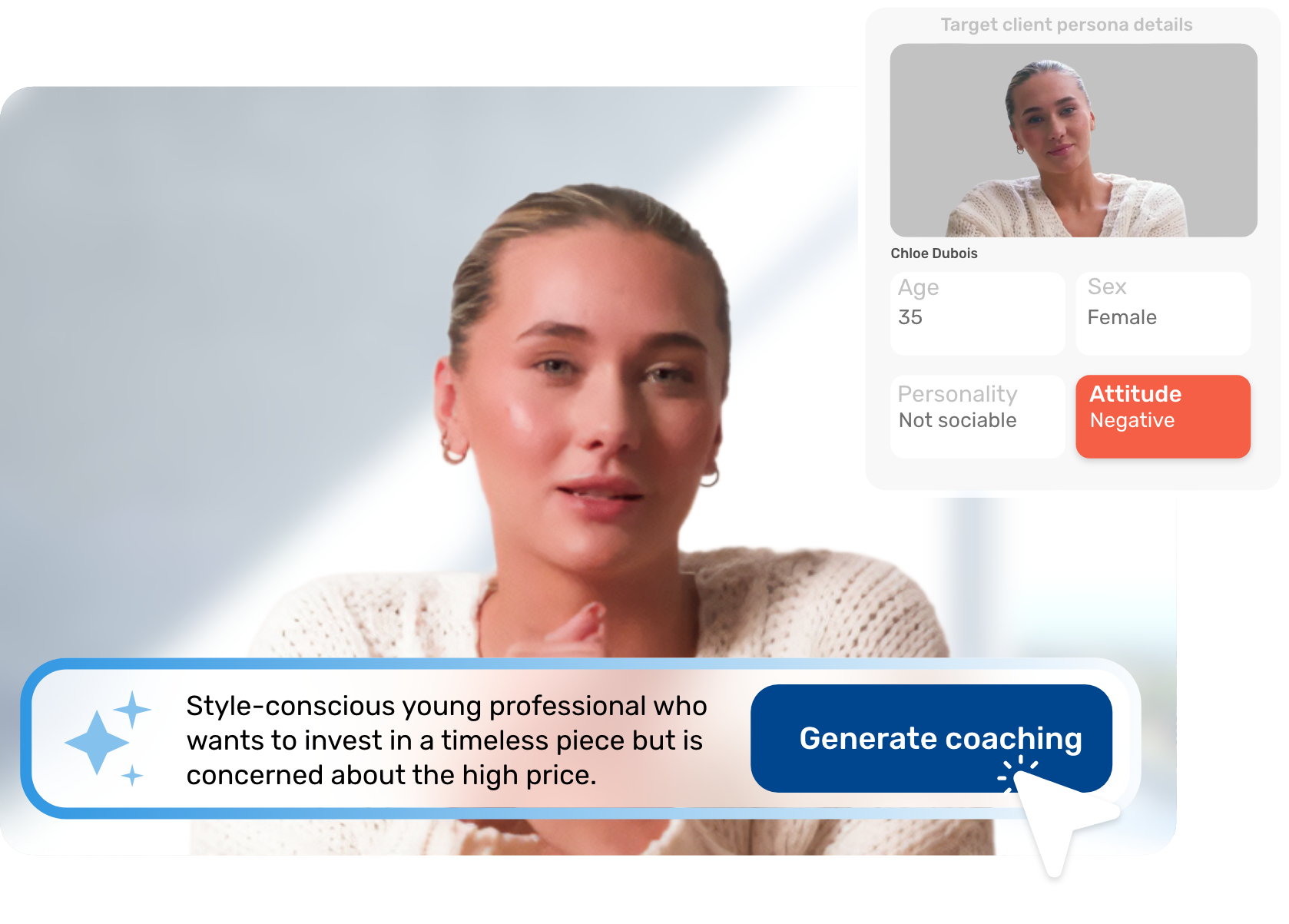
Retorio is an AI sales coaching platform, built since 2018 around the Warmth and Competence behavioral framework: how a rep comes across, not only what they say. Reps practice AI roleplay scenarios against virtual buyers, and the platform scores 140+ behavioral cues across tone, pacing, and non-verbal signal, not just whether a scripted talking point got mentioned. After the session, the rep gets up to three prioritized improvement areas with video-anchored coaching insights, included in the coaching tier, then chooses to repeat the scenario or move to the next one, while the manager sees the behavioral trend for that rep over time.
The practical difference for a buyer: a per-scenario competency rubric checks whether the rep covered the right ground for that scenario. Behavioral scoring checks how the rep delivered it, whether the tone read as collaborative or defensive, whether pacing gave the buyer room to respond, whether non-verbal signal matched the words. Both are legitimate ways to grade a roleplay. They produce different coaching. A competency rubric tells a rep what to say next time. Behavioral scoring tells a rep how to say it differently, which is the harder, more durable skill to build.
Retorio's AI roleplay for sales runs today in 14 languages, more than three times Roleplay Sessions' four-language coverage, which matters directly for a DACH-plus-global enterprise rollout where German, Spanish, French, Italian, Polish, and other languages all need the same rubric applied consistently. On compliance, Retorio is ISO 27001 certified, GDPR-compliant, EU AI Act aligned, and hosted on GCP with EU data residency. Synthesia publishes SOC 2 Type II, ISO 27001 and ISO 27701 for Roleplay Sessions, with customer data in Ireland. Both are strong, enterprise-grade postures; a fair comparison does not pretend otherwise.
Roleplay languages, not video-generation languages
Synthesia vs Retorio: a buyer's comparison
Compare the two on the criteria a Sales Enablement or Commercial Excellence buyer actually weighs, not on avatar realism alone. Where a Synthesia capability is not confirmed on its own feature page, this table says so rather than guessing.
| Buyer criterion | Synthesia Roleplay Sessions | Retorio |
|---|---|---|
| Core focus | AI avatar video creation, with roleplay added as a new feature | Dedicated AI sales and leadership coaching platform, built since 2018 |
| Scoring method | Per-scenario competency rubric, competency-level scores | Yes Warmth and Competence behavioral scoring, 140+ cues (tone, pacing, non-verbal signal) |
| Behavioral signals measured | Not published | Yes Visual, auditory, and textual signal (posture, pacing, tone, word choice), validated at >95% visual/textual accuracy and >80% vocal accuracy |
| Roleplay realism: dynamic vs scripted | Yes Interactive avatars that talk, ask questions, and push back, per its feature page | Yes Real-time dynamic avatar conversation that adapts to the rep's delivery, not decision-tree based |
| Feedback format after a session | Yes Per-session competency score with a skill breakdown and exportable transcript | Yes Up to 3 prioritized improvement areas with video-anchored coaching insights, included in the coaching tier; rep repeats the session or moves to the next one |
| Roleplay languages | 4: English, German, Spanish, French | Yes 14: English, German, French, Italian, Spanish, Portuguese, Bulgarian, Czech, Dutch, Greek, Korean, Russian, Turkish, Polish |
| Manager analytics | Yes KPI dashboards and score distributions across reps | Yes Manager dashboard with behavioral trend view per rep |
| Org and cohort-level analytics | Not published | Yes Organization-level adoption, completed scenarios and Warmth and Competence development, plus cohorts compared side by side, with small cohorts held behind privacy thresholds |
| Scenario authoring | Yes | Yes No-code generator builds scenarios from uploaded playbooks, battle cards, and MLR-approved product sheets; CRM integrations with Salesforce and HubSpot |
| Vertical fit and regulated industries | Not published | Yes IDD-aligned insurance rollouts (Nürnberger Versicherung) and MLR-approved pharma scenarios built only from approved source material |
| Compliance and certifications | Yes SOC 2 Type II, ISO 27001, ISO 27701, GDPR with EU data residency | Yes ISO 27001 certified, GDPR-compliant, EU AI Act aligned, GCP EU data residency |
| Data residency and hosting | Partial GDPR with EU data residency stated; hosting provider not published, verify with vendor | Yes Google Cloud Platform (GCP) hosting with EU data residency |
| Deployment model | Staged rollout, existing Synthesia customers first | Yes Available now to enterprise customers, with cohort management to phase a rollout by region, product line, or seniority |
| Track record and deployment evidence | Launched July 22, 2026, no public deployment data yet | Yes 38-42% documented ramp-time reduction across 100,000+ people coached and 50+ enterprise clients globally; building AI coaching since 2018 |
Synthesia figures reflect Synthesia's own Roleplay Sessions feature page as of July 2026. Retorio figures come from documented enterprise deployments. Neither vendor's claims here are used to imply the other is non-compliant or lower quality; both certification stacks are strong.
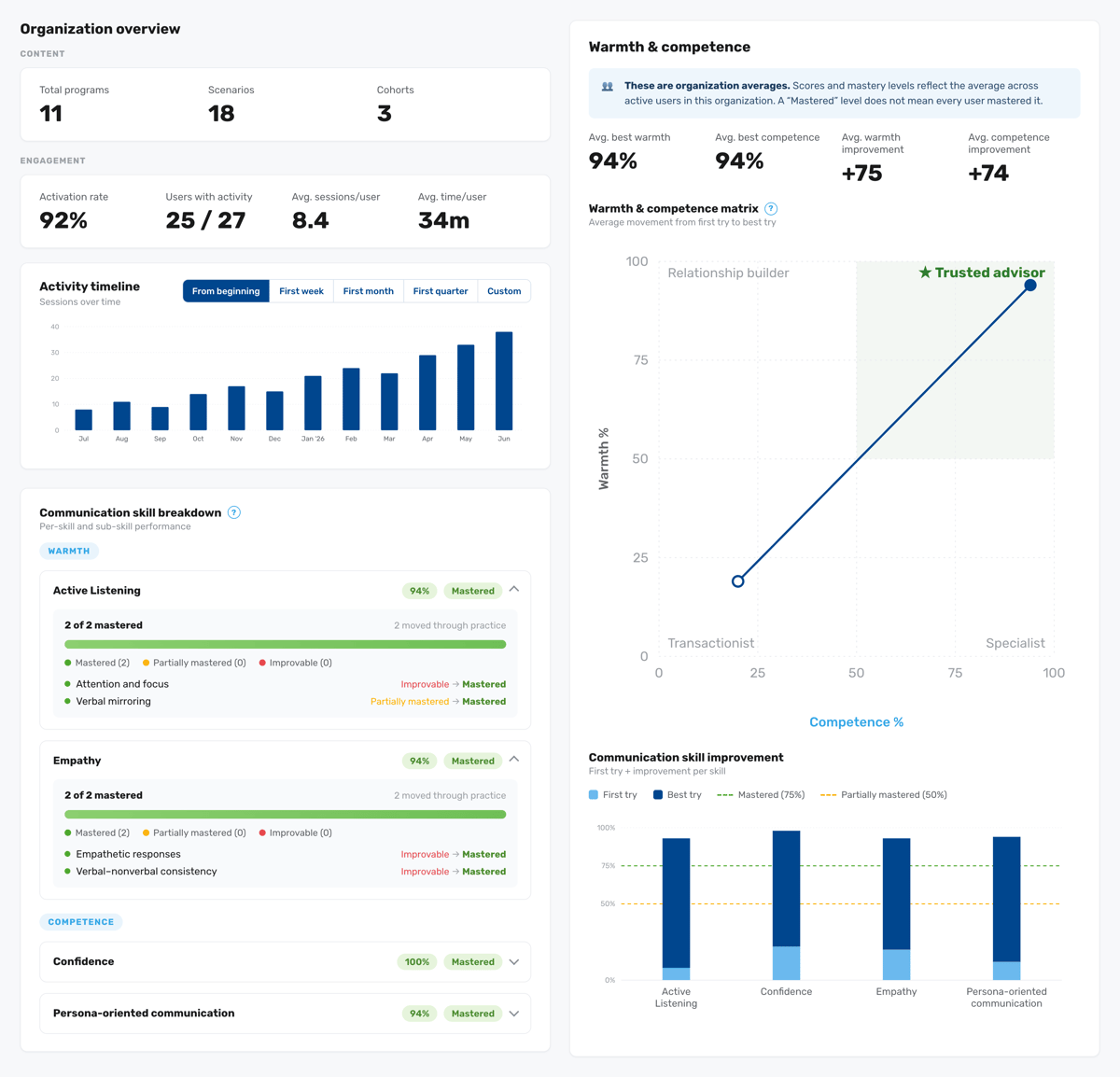
Behavioral progress for a whole organization, not one rep at a time
Read plainly, this is not a table where one vendor sweeps the other. Synthesia brings a broader out-of-the-box certification stack and a mature enterprise-IT posture, inherited from years of selling video into large organizations. Retorio brings a deeper, purpose-built behavioral scoring method, a much wider roleplay language footprint, and eight years of deployment evidence in the specific job of changing rep behavior.
The track-record gap is worth naming plainly rather than glossing over. Retorio has been building AI coaching since 2018, on a dataset that now spans 100,000+ people coached across 50+ enterprise clients globally, which is why it can point to a documented 38-42% ramp-time reduction and named customer outcomes rather than a demo reel. Roleplay Sessions launched on July 22, 2026, from a company whose core business and engineering focus for years has been avatar video generation, not sales coaching methodology. That does not make the feature weak on day one; TechCrunch's coverage of the launch treated it as a credible move into a real category. It does mean a buyer evaluating it today is evaluating a brand-new feature against a much longer production deployment history, and that difference in maturity is exactly the kind of thing a rigorous AI sales role-play software evaluation should surface rather than assume away.
Previously, practicing a scenario with a manager took 3-5 hours. Now, with Retorio's AI Sales training platform, our agents conduct an AI role play 5 times for each scenario independently.
Ivo Nikolov, Business Analyst at Vodafone
Which one fits which buyer?
The honest answer depends on the job you are hiring the platform to do, and there are real cases where Synthesia's Roleplay Sessions is the better starting point. It is also worth separating this from a related question we cover in more depth: AI roleplay versus call coaching in enterprise sales, which is about practice versus post-call review rather than about which roleplay vendor to pick.
What are you trying to build?
Why the closed coaching loop matters more than the score itself
A score is only useful if something happens after it. Both Synthesia's competency rubric and Retorio's behavioral scoring can tell a rep how a practice conversation went. The difference buyers should test for is what the system does next.
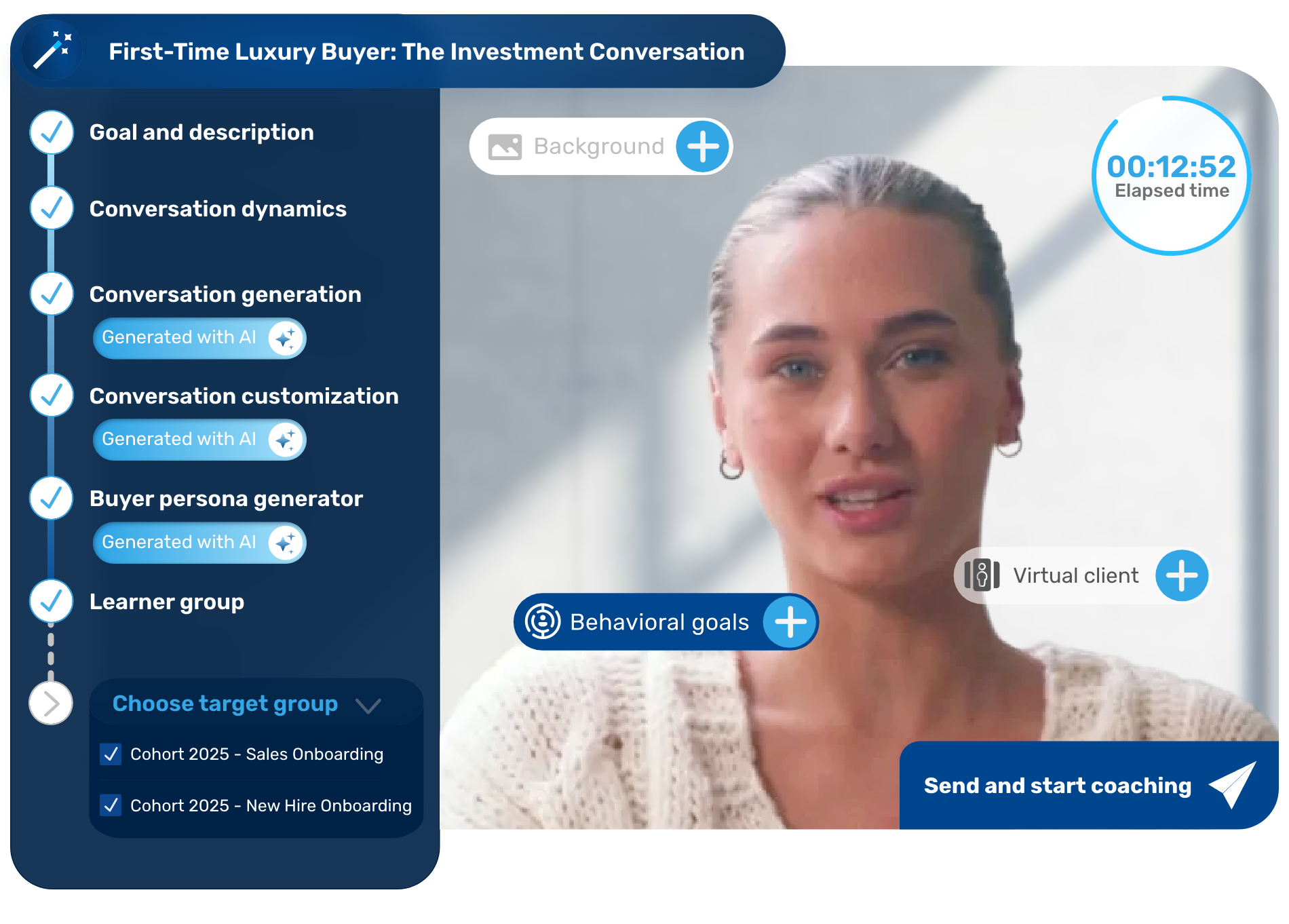
Retorio's coaching approach is deliberately closed: the rep practices a roleplay scenario, the platform scores the behavioral signal against the Warmth and Competence rubric and surfaces up to three prioritized improvement areas with video-anchored insight, the rep chooses to repeat the scenario or move on, and the manager sees the trend, not just a single snapshot score. This repetition-and-review pattern is the mechanism behind Retorio's documented 38-42% ramp-time reduction, not a one-time competency check.
The closed coaching loop
Ask this question of any AI roleplay vendor evaluation, Synthesia included: after the scenario ends and the score renders, what does the rep actually see, and does the platform make it obvious what to practice next? A platform that stops at the score has built a grading tool. A platform that surfaces prioritized, video-anchored feedback and a clear next step has built a coaching system, and the documented benefits of structured sales coaching consistently trace back to that repetition-and-review pattern rather than to the scoring moment itself.
It is also worth being clear about what this does not claim. It does not mean every rep improves on every attempt, and it does not replace a manager's judgment about what a rep is ready for next. What it does is give the rep a specific, prioritized answer to "what should I work on," so a manager spends coaching time on the conversation that matters most instead of on deciding where to start.
Five questions to ask before you choose
A per-scenario competency rubric checks whether the rep covered the right ground. Behavioral scoring checks tone, pacing, and non-verbal delivery. Ask each vendor to show the rubric, not just the score screen.
Test: request a sample scored transcript and read what specifically earned or lost points.
Separate the vendor's video-generation language count from its roleplay-coaching language count. They are often very different products with very different coverage.
Test: ask for the language list on the specific roleplay-scoring feature, in writing.
A single graded rehearsal is not the same as prioritized, video-anchored feedback that tells the rep exactly what to work on next.
Test: ask the vendor to demo a low score, then show exactly what practice the rep gets next.
A brand-new feature launch and an eight-year deployment history carry different evidence weight. Ask for named customer outcomes, not a demo reel.
Test: ask for a documented ramp-time or turnover number from a named or verifiable customer.
Confirm what your procurement team actually needs, ISO 27001, GDPR, EU AI Act alignment, and EU data residency, then check each vendor against that list directly.
Test: request certification documentation in writing before the deal moves to legal.
Source: Retorio, "AI-Sales Coaching" (July 2026). A walkthrough of the Retorio AI coaching platform in action, used as supporting context for evaluating AI roleplay and coaching vendors.
As more vendors add AI roleplay features to adjacent products (see Gartner's broader resource on artificial intelligence in sales for category context), the evaluation discipline that matters is whether a rep gets a clear next step after a low score, not which avatar looks best. That view lines up with Harvard Business Review's "The Feedback Fallacy", which found that feedback alone, without a structured way to practice differently, rarely builds the skill it is meant to improve.
Insight alone doesn't change how someone shows up in a conversation. You have to measure the behavior itself, tone, pacing, the things competitors can't fake with a better rubric, and give the rep somewhere to practice it again. That's the evidence enterprise buyers actually need, not proof someone watched a video.

See it on your own sales conversations
Tell us which conversations your reps struggle with and we will show you how the same practice runs inside Retorio.

What can you actually report to a manager?
This is the question that decides the renewal, and it is usually asked too late. A platform can generate excellent practice and still leave a sales leader with nothing to present. Measurement works on three levels, and it is worth checking each one separately rather than accepting the word "analytics" on a feature list.
What was measured, and how reliably. Retorio scores visual, auditory and textual signals together, meaning posture, pacing, tone and word choice, at above 95% accuracy on visual and textual signals and above 80% on auditory. A score that cannot name the behavior behind it cannot be coached against, so ask which signals produced the number.
Does a manager get a trend, or a pile of sessions? Retorio gives a manager dashboard with a behavioral trend view per rep, which is the artefact that makes a 1:1 start at "here is what moved" instead of "how did last week go". A list of completed sessions is activity data, not a coaching signal.
Can a commercial leader read it without translation? Since July 2026 Retorio reports at organisation level: adoption, completed scenarios and Warmth and Competence development across the whole organisation, updated as reps complete their coaching. Cohorts can be compared side by side, so the Q1 new-hire group and the Q4 group sit next to each other instead of being averaged into one number. Small cohorts stay hidden behind privacy thresholds, which is a design choice rather than a gap: a comparison view that can single out one person is one a works council will stop. This is the level that answers "is this working", and the level most often missing.
What to ask Synthesia and anyone else on your shortlist. Which signals produce the score, in writing. Whether a manager sees a per-rep trend or a session log. Whether anything aggregates above team level. And whether the export lands somewhere your revenue reporting already lives. A vendor who cannot answer the second question has built practice, not coaching.
Conclusion
Synthesia's entry into AI roleplay is a real, credible move by a company with strong avatar technology and an enterprise-trusted certification stack. It does not make Retorio's approach obsolete, and it does not make that move a copy of anyone else's. The two products answer different questions. If you need occasional roleplay bundled into a video-creation workflow you already use, in English, German, Spanish, or French, Roleplay Sessions is a reasonable, convenient option. If you need scored, behavior-level coaching that gives reps a clear next practice, runs in 14 languages, and carries years of enterprise deployment evidence, that is the specific job Retorio was built for. Ask both vendors the five questions above before you decide.
Run one real scenario through Retorio's Warmth and Competence scoring and see the feedback the rep gets back. It takes a few minutes, in any of 14 roleplay languages.
Key takeaways
FAQ
What is Synthesia Roleplay Sessions?
Synthesia Roleplay Sessions, launched July 22, 2026, is a feature from the AI-avatar video company Synthesia that lets reps and managers practice scored conversations, such as cold calls, discovery, objection handling, and management feedback, against interactive avatars. It scores each session against a per-scenario competency rubric and runs in English, German, Spanish, and French.
Is there a good Synthesia alternative for sales roleplay coaching?
Retorio is a purpose-built AI sales coaching alternative, using Warmth and Competence behavioral scoring rather than a per-scenario competency rubric, running roleplay coaching in 14 languages, and validated across 100,000+ people coached at 50+ enterprise clients globally. Retorio has been building AI coaching since 2018.
How is Retorio different from Synthesia Roleplay Sessions?
Retorio scores how a rep delivers a conversation, tone, pacing, and non-verbal signal across 140+ behavioral cues, then gives the rep up to three prioritized, video-anchored improvement areas to practice next. Synthesia's Roleplay Sessions scores whether the rep hit the right points on a per-scenario competency rubric. Retorio also runs in 14 languages versus Synthesia's 4 for roleplay specifically.
Does Synthesia Roleplay Sessions support German and other languages?
Yes, Synthesia's Roleplay Sessions supports English, German, Spanish, and French. Its often-cited 160+ languages figure describes Synthesia's separate video-generation product, not the Roleplay Sessions feature, so enterprise rollouts needing broader language coverage should confirm roleplay-specific language support directly with Synthesia.
Is AI roleplay coaching GDPR-compliant?
Retorio is ISO 27001 certified, GDPR-compliant, EU AI Act aligned, and hosted on GCP with EU data residency. Synthesia states SOC 2 Type II, ISO 27001, ISO 27701, and GDPR with EU data residency for Roleplay Sessions on its own feature page. Confirm current certification scope directly with either vendor before procurement sign-off.
Should I switch from Synthesia to Retorio, or use both?
Many teams can reasonably use both: Synthesia for video content creation, and Retorio for the coaching job of scoring behavior and closing the practice loop across languages. Switch only the roleplay-coaching piece if your gap is multi-language rollout or behavior-level scoring rather than video production.
What is Warmth and Competence behavioral scoring?
Warmth and Competence is the behavioral science framework behind Retorio's scoring: warmth signals like tone and collaborative language, and competence signals like clarity and pacing, are scored across 140+ observable cues in a practice conversation. It measures how something was said, which is distinct from a checklist that only checks whether the right topic was covered.
Compare Retorio with other platforms
Evaluating more than one vendor? These guides compare the options side by side.
Written with help from LLMs, edited and checked by Önder Mutluer, Website Manager and Marketing Strategist, and Dr. Patrick Oehler, Co-founder and Co-CEO. Reviewed by Peter Holdenried, Head of Sales. How this article was researched, written and checked, and who reviews which topic: Retorio editorial policy.