


Platform comparison / AI sales coaching
It is week 6 of an enterprise RFP. The Head of Sales Enablement at a DACH insurance group has the shortlist down to two: Retorio and Kickscale. Both are EU-built, both promise AI sales coaching, both pass the first procurement screen on data residency. The room is now asking the harder question: which one actually fits a 400-rep commercial team running across insurance, service, and field sales? The short answer, before the detail below: the deciding factor is scope. Retorio coaches behavior across sales, service, and leadership in a single deployment, with ramp time cut 38-42% and +27% sales performance measured at week 12.
This is not a feature checklist. It is a category decision framework for sales enablement leaders who have to make a call and defend it to a CFO.
Retorio vs Kickscale is a category decision, not a feature checklist. Both are EU-built AI sales coaching platforms with strong data-protection posture. Kickscale is Vienna-based and optimized for sales call analysis with Austrian data residency. Retorio is Munich-built, scales across sales, service, and leadership coaching for enterprise organisations, with a four-signal behavioral rubric, ISO 27001 certification, EU AI Act alignment, and documented outcomes including 15x first-year ROI and 38 to 42 percent ramp-time reduction. Pick by enterprise scope, framework depth, and the proof of outcome on your revenue metrics.
Example. A Head of Sales Enablement at a DACH insurance group is comparing both vendors for a 400-agent rollout across new business, renewals, and service. After two demos, the question that decides the RFP is not "who has better avatars" but "which platform shows a measured behavioral lift at week 12 across all three commercial roles, not just sales calls".
What each platform actually does
Both platforms market in the AI sales coaching category, and both have a credible EU compliance posture. The architectures underneath are designed for different problems. Walking through what each one is built for is the cleanest way to start a category decision.
Where each platform focuses
Kickscale focuses on
Meeting analysis- Recorded real customer calls
- Meeting summaries and insights
- Managers reviewing after the fact
Retorio is built for
Commercial function- Head of Sales, VP Sales, CRO
- Sales Enablement and Commercial Excellence
- Sales academies and Sales Capabilities leads, including the ones inside the HR organisation
- Regional and frontline sales managers
- Service owners and contact-centre operations
- Sales coaches and enablement partners
The line is the mandate, not the org chart. If you are measured on quota, ramp time or conversion, the right column is yours, and that includes a sales academy that reports into HR.
Competitor positioning above describes each vendor’s own product category, not a judgement on quality or compliance. Vendor scope changes, so confirm current capabilities with the vendor.
Kickscale: AI-powered sales call analysis
Kickscale is a Vienna-based AI sales platform centered on sales call recording, transcription, and AI-driven post-call analysis. A rep makes a call, the platform captures the conversation, and a language model produces a structured summary plus coaching observations. The product positions strongly on Austrian and EU data residency, a real differentiator against US-based call intelligence vendors. For B2B sales teams with high recorded-call volume that need faster managerial review, the conversation analysis layer is the value proposition. Kickscale's growth motion is well suited to mid-market European SaaS sales teams looking for an EU-anchored alternative to US call intelligence platforms.
Retorio: AI coaching loop across the commercial function
Retorio is a Munich-built AI sales coaching platform designed around a different question. The unit of analysis is not the call, it is the behavioral signal profile of each rep. Reps practice against dynamic AI role play scenarios that mirror their actual ICP and sales motion. Every session is scored against a four-signal behavioral rubric covering discovery quality, acknowledgment, value framing, and close attempts. The platform then surfaces the two or three behaviors each rep should work on next, and a manager dashboard rolls those gaps up to a team-level view.
That design generalizes beyond the sales call. The same rubric that scores a sales rep's discovery scores a service agent's escalation handling and a frontline manager's performance conversation. The Vodafone VOIS deployment covers 1,800 new customer service agents annually, not sales reps. Retorio runs across sales, service, and leadership coaching for enterprise organisations in insurance, pharma, telecommunications, and automotive.
The four criteria that decide the call
Feature comparison spreadsheets are not what decides enterprise procurement. Four category-level criteria do. A practical evaluation framework for Retorio vs Kickscale focuses on enterprise scope, behavioral framework depth, EU compliance proof, and the outcome evidence on real revenue metrics.
Decide by use case, not by feature
Source: Retorio competitive evaluation framework, 2024-2026.
Criterion 1: enterprise scope, not just sales
A growing share of commercial budgets is moving toward unified coaching across sales, service, and leadership. Harvard Business Review research on the feedback fallacy argues that the limiting factor in commercial capability is not information delivery, it is consistent AI coaching across every customer-facing role. Buying separate tools for the SDR team, the contact center, and the field organization fragments measurement and inflates total cost of ownership.
Kickscale's center of gravity is the sales call. If your buying mandate is sales-only and you have a high volume of recorded calls already, that focus is a feature. If your mandate covers service agents handling escalations, account managers running renewals, and frontline leaders coaching their teams, the call-analysis architecture stops generalizing. Retorio is engineered for the broader scope from the start.
Criterion 2: behavioral framework depth
The difference between "we analyze your calls" and "we coach the behaviors that change outcomes" sounds rhetorical, but it shows up in the post-session output. Retorio's AI coaching framework is grounded in peer-reviewed research, including TUM, MIT, and University of Tokyo work, and runs against 140+ observable behavioral cues per session. The output is a four-signal score plus a rank-ordered list of the next two behaviors to work on.
Call analysis platforms give you a structured transcript plus AI-generated coaching suggestions. That is useful when the rep already has the underlying behaviors and just needs faster review cycles. It is not the same as a measurement system that tells you which behavior is the bottleneck on Tuesday and how much that rep has moved on it by Friday.
Previously, practicing a scenario with a manager took 3-5 hours. Now, with Retorio's AI Sales training platform, our agents conduct an AI role play 5 times for each scenario independently.
Ivo Nikolov, Business Analyst at Vodafone
Criterion 3: EU compliance proof, not just data residency
Both platforms have a credible EU posture. Kickscale's Austrian residency is genuine. Retorio's compliance stack is broader: ISO 27001 certified, GDPR-compliant, EU AI Act-aligned, hosted on Google Cloud Platform with EU data residency, and Munich-built under German Bundesdatenschutz. For DACH enterprises in regulated verticals, the procurement gate is rarely about a single certification. It is about whether the vendor can show a complete posture across GDPR, the EU AI Act, ISO 27001, and provable EU hosting.
Retorio's pharma deployments operate under Medical, Legal, Regulatory review with 100 percent compliance during practice, a Zero-Hallucination architecture that pulls only from MLR-approved documents. That depth tends to be the deciding factor in pharma and insurance RFPs where procurement is non-negotiable on regulatory rigor.
Criterion 4: outcome evidence on real revenue metrics
Documented Retorio outcomes, enterprise customer studies
Source: Retorio enterprise customer studies, 50+ enterprise clients, 100,000+ people coached, 2024-2026.
Documented Retorio enterprise outcomes include a 38 to 42 percent reduction in new-hire ramp time, a 41 percent reduction in overall onboarding time at Vodafone VOIS, a 27 percent average increase in overall sales performance, and a 72 percent drop in turnover at Nürnberger Versicherung. First-year ROI is 15x.
Kickscale's published outcome data centers on time saved per rep on call review and improved coaching coverage. Those are real efficiency wins for a call-heavy sales organization. They are not the same metric as ramp-time reduction across 1,800 new agents, or quota-attainment lift across a 400-rep field force. When the CFO asks how the platform pays for itself, the proof needs to be denominated in the metric the business already uses.
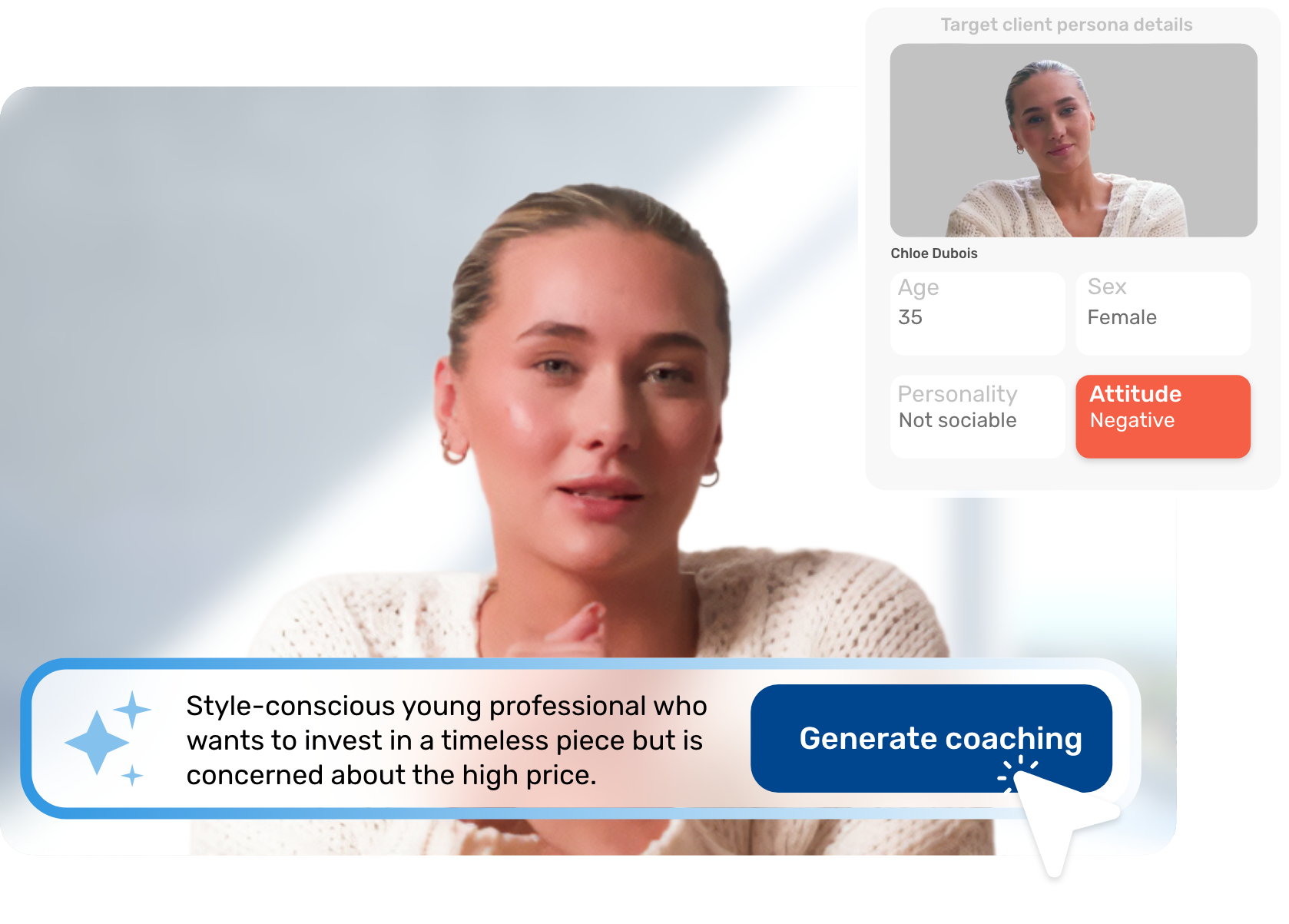
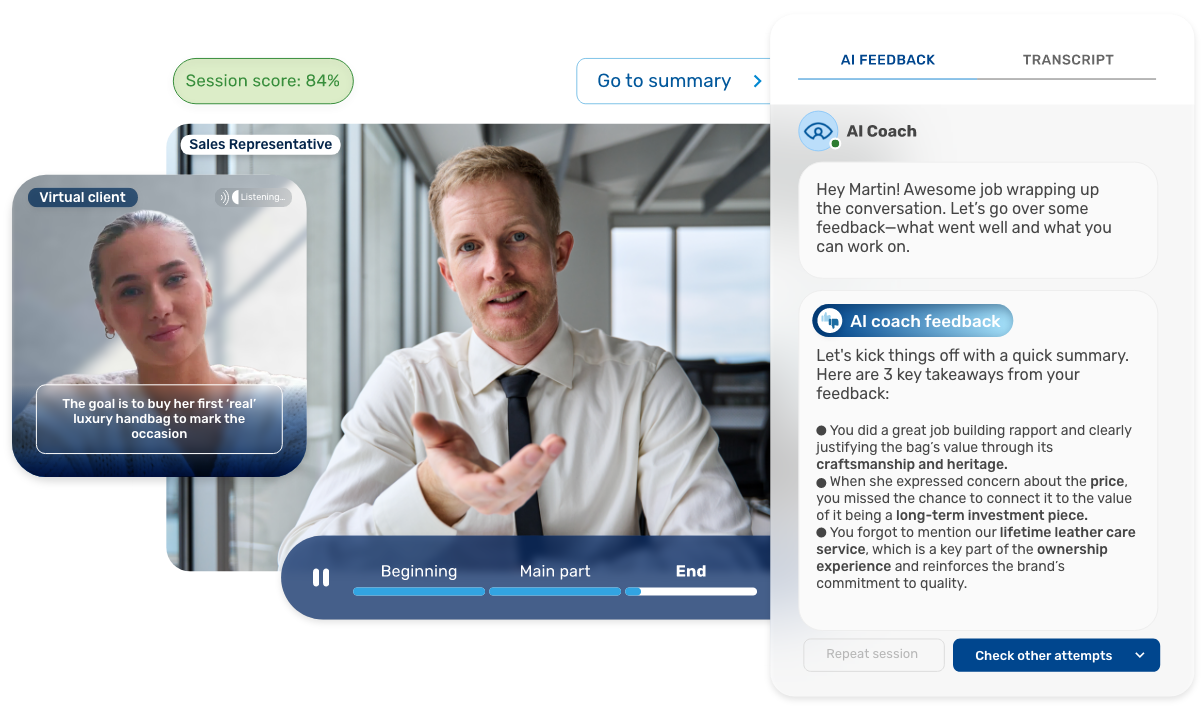
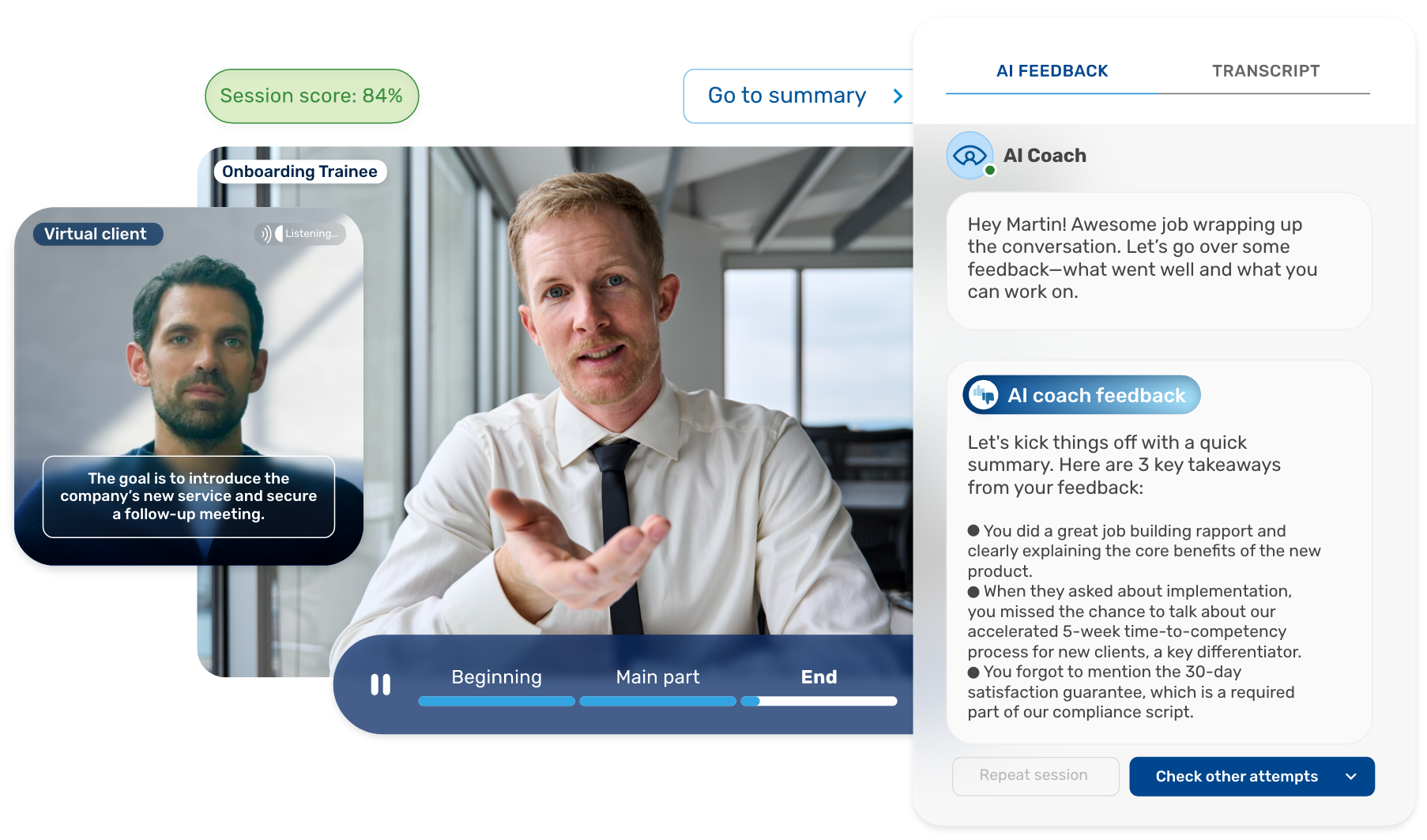
Source: Retorio, AI Sales Coaching, published July 2026. The two criteria this comparison narrows to, shown in one session: what gets scored, and what the manager does with it.
Insight alone doesn't change how someone shows up in a conversation. You have to measure the behavior itself, tone, pacing, the things competitors can't fake with a better rubric, and give the rep somewhere to practice it again. That's the evidence enterprise buyers actually need, not proof someone watched a video.

Side-by-side: Retorio vs Kickscale
| Criterion | Retorio | Kickscale |
|---|---|---|
| Coaching scope | Sales, service, leadership, field operations | Sales calls and conversation analysis |
| Primary unit of analysis | Behavioral signal profile per rep, scored on a 4-signal rubric | Recorded sales call, structured AI summary |
| Practice mechanism | Dynamic AI role play against industry-specific scenarios, 93 avatars, 38 voices, 14 languages | Live call capture, post-call review |
| Outcome evidence | 15x first-year ROI, 38 to 42% ramp reduction, +27% sales performance, +14.6% quota achievement | Time saved on call review, improved coaching coverage |
| EU compliance posture | GDPR, EU AI Act-aligned, ISO 27001, GCP EU residency, Munich-built | GDPR, Vienna-based, Austrian/EU data residency |
| Pharma / regulated industries | MLR-aligned, Zero-Hallucination architecture, used at Teva | No published pharma-specific compliance framework |
| Reference enterprise customers | Vodafone VOIS, Nürnberger Versicherung, Daimler Truck, Teva | DACH-based mid-market sales teams |
| Best fit | Multi-role commercial coaching across enterprise scale with measurable behavioral outcomes | EU-based mid-market sales teams needing call analysis with regional data sovereignty |
Two notes on this table. First, both platforms are credible. The choice depends on what the buyer is actually solving. Second, the comparison is intentionally based on published positioning. Where Kickscale has not made a specific claim public (for example, pharma MLR posture), the cell reflects that gap rather than asserting absence.
A 4-step evaluation framework
Most platform comparisons fail because the buyer evaluates against a generic feature list rather than the specific behaviors that matter for their commercial scope. The framework below is what works at enterprise scale, refined across hundreds of AI sales coaching software evaluations over the past two years.
Define your coaching scope before any demo
Write down which roles need coaching: sales reps, service agents, account managers, field leaders. If three or more roles are in scope, a sales-call-only platform will only solve one third of your problem. If only the sales motion is in scope, a call analysis layer may be sufficient.
Measure: number of customer-facing roles requiring coaching in year one.
Ask each vendor for a week-12 outcome trajectory
Request a named reference customer where the vendor can show the rep's behavioral signal profile at week 0 and week 12, plus the business outcome that moved. A vendor that cannot connect coaching to a revenue or operational metric is selling a recording tool, not a coaching platform.
Measure: business outcome delta documented per reference (ramp days saved, turnover percent, quota lift).
Run the EU compliance gate at full depth
Data residency is not enough. Ask for the ISO 27001 certificate, the EU AI Act risk classification, the GDPR data-flow map, and the EU AI Act conformity assessment plan. For pharma or insurance, add the MLR or IDD compliance framework. Vendors who pass the first gate on residency often fail at depth.
Measure: number of compliance artifacts the vendor can produce within 5 business days.
Score the post-session output against your operating model
After a practice session, what does the manager see? A transcript with AI suggestions is one model. A behavioral score with a rank-ordered next-two-behaviors list is another. The post-session artifact is what the frontline manager actually uses on Monday morning. If the artifact does not change how that manager runs the next 1:1, the platform will not change outcomes.
Measure: time the frontline manager spends per rep using the platform's session output.
What to avoid in a Retorio vs Kickscale evaluation
Most enterprise platform evaluations fall into the same patterns. Naming them upfront keeps the procurement timeline honest.
First 90 days, side by side
Categories diverge most visibly in the first 90 days of deployment. A Retorio rollout at a 200-rep enterprise team is configured against the company's own sales methodology and scenario library in the first two weeks. By week four, the manager dashboard surfaces which behavioral gaps cluster across the team and the two behaviors that, corrected, would move the most reps. By week twelve, Gartner's research on sales enablement notes that behavioral capability lifts predict revenue impact at the 90-day mark, and Retorio's enterprise studies show +27 percent sales performance and a 38 to 42 percent ramp-time reduction over the same window.
A call analysis rollout follows a different cadence. The first two weeks integrate call recording infrastructure. Weeks two to four build the manager review habit. By week twelve, the team has a structured post-call review system with measurable time saved per manager. That is a real productivity win. It is a different metric than behavioral lift, and it suits a different commercial scope. For DACH-specific compliance context, our deep-dive on EU AI Act compliance for SaaS coaching platforms walks through the specific obligations regulated enterprises need to satisfy before sign-off.
Two rollouts, ninety days, different milestones
See what scored practice looks like at your scale
Meeting intelligence and coaching solve different halves of the problem. Tell us your team size and we will show you where scored practice fits.

What can you actually report to a manager?
This is the question that decides the renewal, and it is usually asked too late. A platform can generate excellent practice and still leave a sales leader with nothing to present. Measurement works on three levels, and it is worth checking each one separately rather than accepting the word "analytics" on a feature list.
What was measured, and how reliably. Retorio scores visual, auditory and textual signals together, meaning posture, pacing, tone and word choice, at above 95% accuracy on visual and textual signals and above 80% on auditory. A score that cannot name the behavior behind it cannot be coached against, so ask which signals produced the number.
Does a manager get a trend, or a pile of sessions? Retorio gives a manager dashboard with a behavioral trend view per rep, which is the artefact that makes a 1:1 start at "here is what moved" instead of "how did last week go". A list of completed sessions is activity data, not a coaching signal.
Can a commercial leader read it without translation? Since July 2026 Retorio reports at organisation level: adoption, completed scenarios and Warmth and Competence development across the whole organisation, updated as reps complete their coaching. Cohorts can be compared side by side, so the Q1 new-hire group and the Q4 group sit next to each other instead of being averaged into one number. Small cohorts stay hidden behind privacy thresholds, which is a design choice rather than a gap: a comparison view that can single out one person is one a works council will stop. This is the level that answers "is this working", and the level most often missing.
What to ask Kickscale and anyone else on your shortlist. Which signals produce the score, in writing. Whether a manager sees a per-rep trend or a session log. Whether anything aggregates above team level. And whether the export lands somewhere your revenue reporting already lives. A vendor who cannot answer the second question has built practice, not coaching.
The bottom line
Retorio vs Kickscale is not adversarial. Both are credible EU-built AI coaching platforms with clear category lanes. Kickscale fits EU-based sales teams whose primary need is call analysis with regional data sovereignty. Retorio is built for multi-role enterprise commercial coaching with the behavioral framework depth, regulated-industry compliance, and quantified outcome evidence enterprise deployments require.
The decision is not which platform is better. It is which one fits your commercial scope, framework depth, compliance bar, and outcome metric. The business case for sales coaching rarely fails on platform choice alone. It fails when the platform's category does not match the buyer's actual coaching scope. Get the category decision right first, and the platform-level evaluation follows naturally.
See the rubric in action
Run a Retorio coaching session on your own sales scenario.
No generic demo. Your own ICP, your own behavioral rubric. See the 4-signal score and the next two behaviors your reps need to work on.
Test AI coach in actionKey takeaways
Compare Retorio with other platforms
Evaluating more than one vendor? These guides compare the options side by side.
Being built in Europe answers where the data sits. It does not answer whether the behavior changed. Procurement should ask both questions, and only one of them shows up in a security questionnaire.
Frequently asked questions: Retorio vs Kickscale
What is the main difference between Retorio and Kickscale?
Kickscale is a Vienna-based AI sales platform centered on sales call recording and AI-driven post-call analysis. Retorio is a Munich-built AI coaching platform for multi-role commercial coaching across sales, service, and leadership, scoring reps against a four-signal behavioral rubric. The category lane differs: Kickscale optimizes for sales call analysis; Retorio optimizes for behavioral capability building across the commercial function.
Is Retorio more compliant than Kickscale for European enterprise deployments?
Both platforms operate in the EU. Retorio is documented as ISO 27001 certified, GDPR-compliant, EU AI Act-aligned, hosted on Google Cloud Platform with EU data residency, and Munich-built. For pharma, Retorio operates under MLR review with 100 percent compliance during practice and a Zero-Hallucination architecture. Kickscale publishes GDPR compliance and Austrian/EU data residency. In regulated sectors, the breadth of Retorio's stack is typically the deciding factor.
What ROI evidence does Retorio have from enterprise deployments?
Documented outcomes include a 38 to 42 percent ramp-time reduction, +27 percent sales performance, +14.6 percent quota achievement, and 15x first-year ROI. Vodafone VOIS reduced ramp time from 8 weeks to 5 weeks across 1,800 service agents annually, with 41 percent lower onboarding time and 69 percent less trainer effort. Nürnberger Versicherung documented a 72 percent drop in turnover with 650,000 euros annual cost savings.
Can Retorio replace Kickscale for a sales-only team?
Retorio covers sales coaching as one application of its behavioral rubric. For a sales-only team whose primary bottleneck is post-call review volume, Kickscale's call analysis is purpose-built. For teams whose limiting factor is behavioral capability across multiple call types, Retorio's four-signal rubric and dynamic AI role play produce measurable lift that call analysis alone does not.
Does Retorio work for contact center and service teams, not just sales reps?
Retorio's AI coaching rubric applies to any commercial role where communication quality determines the outcome, including contact center agents, customer success managers, and frontline leaders. Vodafone VOIS covered 1,800 customer service agents annually. Kickscale's design center is the sales call and does not generalize as directly.
Which platform is better for DACH insurance and pharma RFPs?
For regulated DACH industries like insurance under IDD and pharma under MLR, Retorio's compliance stack plus named references (Nürnberger Versicherung, Teva) tend to be the deciding factor. The breadth of ISO 27001, EU AI Act, GCP EU residency, Bundesdatenschutz provenance, and a Zero-Hallucination MLR architecture for pharma addresses the full procurement gate.
Written with help from LLMs, edited and checked by Önder Mutluer, Website Manager and Marketing Strategist, and Dr. Patrick Oehler, Co-founder and Co-CEO. Reviewed by Peter Holdenried, Head of Sales. How this article was researched, written and checked, and who reviews which topic: Retorio editorial policy.