

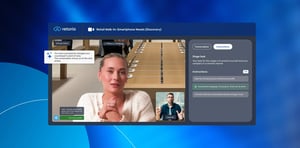
Field force effectiveness (FFE) is how well a field-based commercial team, pharma reps, medical science liaisons, or field sales, converts each customer interaction into trust and a message that lands. Most FFE programs still measure it with reach and frequency, call counts and visit volume, which describe activity but not skill. The missing lever is behavioral readiness: whether a rep can open a conversation, handle an objection, and stay on message under pressure, measured directly through AI role-play rather than inferred from a call log.
Example. A district manager reviewing two reps with identical call counts finds one consistently opens strong and recovers from objections, the other does not, a gap no activity dashboard would have shown before the next quarter's numbers came in.
Field force effectiveness is not a reach-and-frequency problem. It is a readiness problem that reach-and-frequency metrics were never built to see.
Most commercial organizations with a field team, pharma and medtech reps detailing HCPs, field sales reps covering named accounts, service technicians upselling on site, already track FFE closely. Calls per week, visit frequency by territory, share of voice against competitors. Those numbers are necessary. They are also the reason a field force can look effective on a dashboard for two quarters before a launch underperforms or a territory churns, because none of them measure whether the rep was actually good in the room.
What field force effectiveness means, and why reach and frequency are not it
Field force effectiveness describes how well a distributed team of reps converts field time into business outcomes: access retained, message adopted, deal or prescription moved. The metric got built around what was easiest to log automatically from a CRM: calls made, visits completed, samples dropped, minutes spent on site. Those are reach and frequency, and they answer a different question than effectiveness does. Reach and frequency tell you the rep showed up. They do not tell you what happened once they were in the room.
That gap matters more as field access tightens. A pharma rep now gets a shorter window with a physician than five years ago. A field sales rep covering a named account competes with three vendors doing the same outreach. When the window shrinks, what a rep does inside it decides more of the outcome than how often they show up. A commercial excellence leader running FFE off activity data alone is optimizing for a variable that explains less of the result every year.
How most teams measure FFE today, and where it breaks down
The standard FFE toolkit is territory-level activity analytics: call plans, visit compliance, coverage and frequency targets, sometimes layered with a promotional-response model correlating rep activity to prescription or sales lift. It is useful for resourcing and territory design. It was never built to answer the question a VP of Sales or a Head of Commercial Excellence actually needs answered before a launch: is this rep, in this territory, ready to hold the room and deliver the message correctly.
The reason activity-only FFE breaks down is simple: two reps can log identical call volume and coverage and still produce completely different outcomes, because the variable that decides the outcome, what the rep actually did in the room, was never captured. A field organization measuring only reach is running the loop above with step 2 missing.
Why behavioral readiness is the missing FFE lever
Retorio scores field readiness against the Warmth and Competence framework, a behavioral-science model of how people judge trustworthiness in a live interaction. Warmth signals whether the customer or HCP believes the rep is on their side. Competence signals whether the rep's answer was precise and confident enough to be worth another thirty seconds of attention. A rep can hit every activity target and still lose access by rushing an opening, arguing with an objection instead of acknowledging it, or reading as unprepared under a direct question.
McKinsey's work on commercial excellence in field-based selling makes a related point: the organizations that hold up field performance under access pressure are the ones that treat rep skill as a measured, coached variable rather than an assumed one. See McKinsey's research on commercial excellence in life sciences. That is the same shift behind measuring FFE by behavior instead of by call count.
How AI role-play builds and measures field readiness
AI role-play lets a rep rehearse the actual field conversation before it happens, against a virtual persona built to behave like the customer or HCP they will face, and get scored on the behaviors that decide the outcome rather than on whether the call happened. For pharma and medtech teams, the training-design pattern behind this is covered in depth in our guide to pharmaceutical sales training.
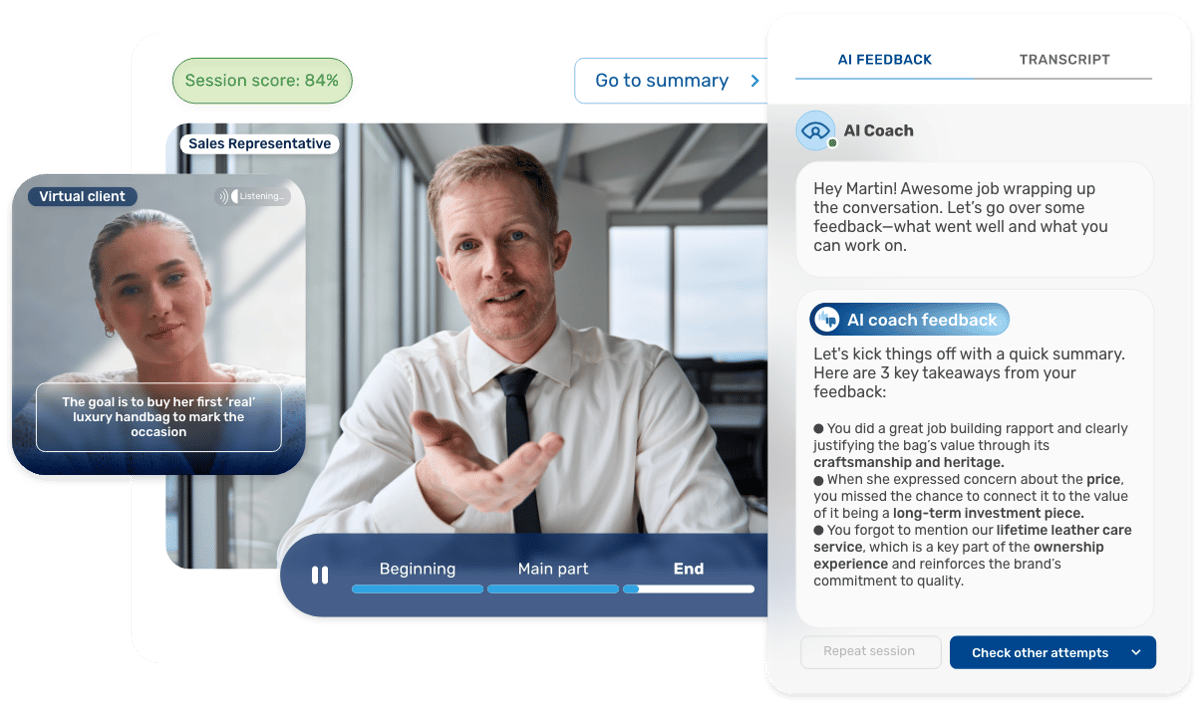
For medical and pharma commercial teams, the same scoring approach applies directly to HCP-facing conversations. See our guide to the best medical sales training programs for how readiness scoring adapts to a regulated, MLR-reviewed conversation.
Harvard Business Review's work on deliberate practice makes a related point outside the field context: repeated, scored rehearsal under realistic conditions builds durable skill in a way that one-time knowledge transfer or activity tracking does not. See HBR's coverage of coaching and deliberate practice. That is the same principle behind scoring field readiness by behavior, not by call count.
Behavioral-readiness FFE versus traditional activity-metric FFE
Commercial Excellence and Field Enablement leaders evaluating this shift are not choosing between measuring FFE and not measuring it. Every organization already measures something. The choice is between an approach that measures activity and one that measures the behavior that produces the outcome.
| Criterion | Behavioral-readiness FFE | Traditional activity-metric FFE |
|---|---|---|
| What is actually measured | Yes Rep behavior: opening, objection handling, message accuracy, scored against Warmth and Competence | Calls made, visits completed, coverage and frequency against plan |
| Leading or lagging indicator | Yes Leading: readiness is known before the field visit happens | Lagging: activity is logged after the visit, outcome lags further behind |
| Consistency across territories | Yes Identical rubric applied in every territory and language | Depends on local manager observation and CRM discipline, varies by region |
| Correlation to field outcome | Yes Behavioral score tracked against access retained, message adoption, deal or prescription movement | Weak: activity volume correlates poorly with outcome once access tightens |
| Regulated-industry fit (MLR-aware) | Yes Knowledge base restricted to MLR-approved materials for pharma and medtech scenarios | Not applicable, activity data carries no message-accuracy signal |
| Data residency and certification | Yes ISO 27001 certified, GDPR-compliant, EU AI Act aligned, GCP EU data residency | Varies by CRM vendor, rarely built around behavioral data at all |
Comparison of measurement approaches, based on documented Retorio platform capability. Not a claim about a specific competing vendor.
Five ways activity-only FFE measurement goes wrong
Connecting practice to field outcomes and rolling it out across a large field team
The organizations that get this right do not try to convert the entire field force to behavioral measurement in one release. They start with the highest-stakes segment and prove the correlation before scaling.
Document what the field org already tracks, call volume, coverage, frequency, so the readiness score is added on top of existing reporting rather than replacing it overnight.
Choose the segment with the tightest access window or the highest cost of a bad interaction, and run AI role-play scoring against the Warmth and Competence rubric for one full cycle.
Compare the pilot territory's readiness scores against access retained, message adoption, or deal movement, and confirm the behavioral signal moves ahead of the lagging metric.
Roll the identical scenario library and scoring rubric out to comparable territories so managers are evaluating every rep against one consistent standard.
Add readiness alongside activity metrics in the same commercial excellence reporting, so leadership reviews reach, frequency, and behavior together instead of activity alone.
For field organizations running both field and inside teams on the same standard, our guide to AI sales training for pharma field teams covers the deployment model for keeping field and inside reps on one rubric.
What sets Retorio apart for field force effectiveness measurement
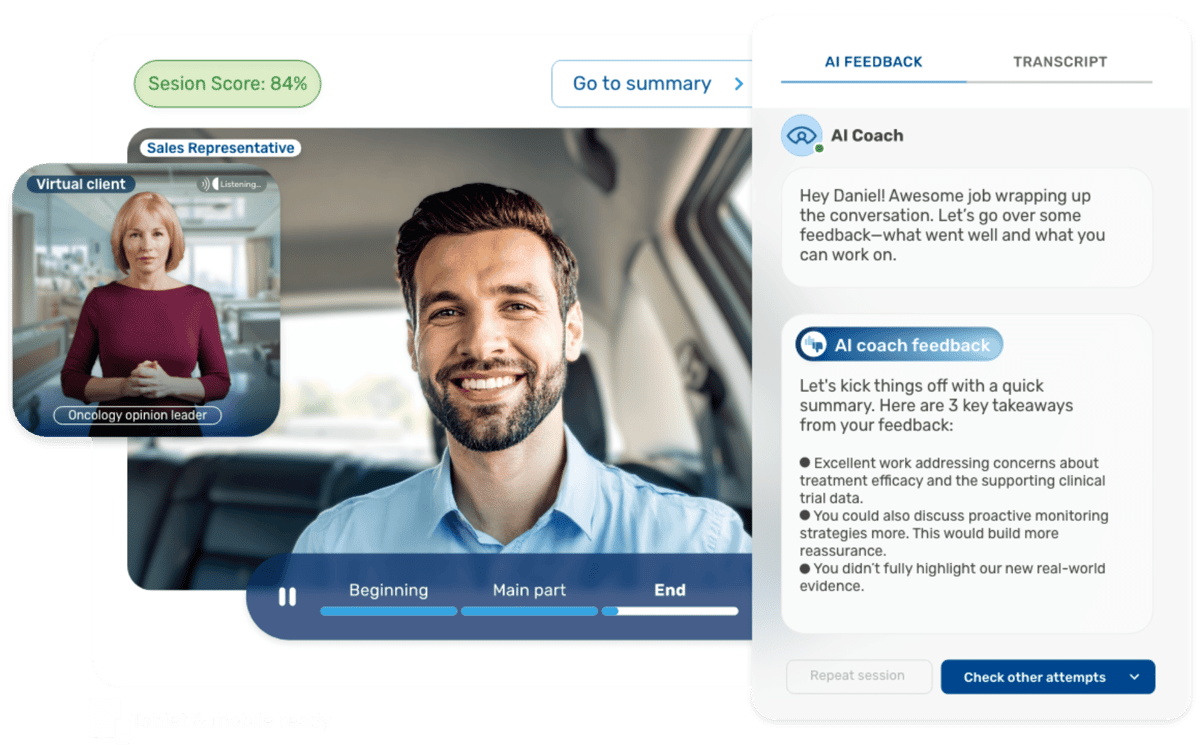
Most AI coaching platforms score general sales conversations. Retorio's approach differs on the points that matter to a field organization measuring effectiveness at scale. Scoring runs on 140+ behavioral cues across video and audio against the Warmth and Competence framework, not a keyword match against a transcript, which is what makes the readiness score a genuine leading indicator rather than a rebadged activity metric. For pharma and medtech field teams, the knowledge base can be restricted to MLR-approved materials so every scenario stays inside the compliance boundary Medical, Legal, and Regulatory require. And the platform is ISO 27001 certified, GDPR-compliant, and EU AI Act aligned, hosted on Google Cloud Platform with EU data residency, the compliance posture a field-effectiveness program has to clear before a single behavioral data point is collected.
Teams building their first readiness scenario library can start from our guide to interactive AI role-play scenarios for sales training. Retorio's broader work across pharma field, medical affairs, and inside sales readiness is covered on the pharmaceutical industry page.
Measure field force effectiveness by readiness, not just reach
Give your field team unlimited, scored practice before the visit, and give Commercial Excellence a readiness signal that moves ahead of the lagging metric.
Test AI coach in actionFrequently asked questions
What is field force effectiveness?
Field force effectiveness is how well a distributed team of field-based reps, pharma and medtech detailing reps, field sales reps, or service technicians, converts field time into business outcomes: access retained, message adopted, or a deal moved. It is most commonly measured through activity metrics like call volume and visit frequency, though those numbers describe reach, not skill.
Why isn't reach and frequency enough to measure field force effectiveness?
Reach and frequency confirm the rep showed up. They do not measure what happened once they were in the room, which is the variable that actually decides whether an HCP keeps listening or a prospect moves forward. Two reps with identical call counts can produce very different outcomes because the behavioral variable was never captured.
How do you measure behavioral readiness in a field team?
Reps rehearse the actual field conversation against an AI-driven virtual persona built to react like the customer or HCP they will face, and the AI scores the rep's opening, message accuracy, and objection handling against the Warmth and Competence framework. The readiness score is available before the field visit happens, which makes it a leading indicator rather than a lagging one.
Is behavioral readiness scoring MLR-compliant for pharma field teams?
Yes, when the platform restricts its knowledge base to MLR-approved materials. Retorio's scoring ties every coaching criterion to approved source documents, so a rep cannot be coached toward an off-label claim, and the training stays auditable for Medical, Legal, and Regulatory review.
How does behavioral readiness correlate with field outcomes?
Enterprise deployments track readiness scores against access retained, message adoption, and deal or prescription movement over successive coaching cycles. Because the readiness score is measured before the field visit, it moves ahead of lagging outcome metrics, giving Commercial Excellence teams an earlier signal than activity data alone provides.
Does field force effectiveness measurement apply outside pharma?
Yes. Any field-heavy commercial organization, medtech, field sales, or service teams doing on-site upsell, faces the same gap between activity metrics and behavioral skill. The same Warmth and Competence rubric applies whether the conversation is a physician detail, a named-account sales visit, or a service call.
Author: Retorio Sales Team. Retorio is an AI Coaching Platform for enterprise sales and service organizations.
Compliance: Retorio is ISO 27001 certified, GDPR-compliant, EU AI Act aligned, and hosted on Google Cloud Platform with EU data residency. All practice conversations are processed on EU infrastructure under ISO 27001 controls.
External citations: Fiske, Cuddy, and Glick (2007) Trends in Cognitive Sciences: Warmth and Competence framework. EU Regulation (EU) 2024/1689: EU AI Act. GDPR Article 22: automated decision-making. McKinsey: commercial excellence research in life sciences.
Last updated: August 2026.
Written with help from LLMs, edited and checked by Önder Mutluer, Website Manager and Marketing Strategist, and Dr. Patrick Oehler, Co-founder and Co-CEO. Reviewed by Martin Weber, Director Business Development Healthcare & Life Sciences. About Retorio· Editorial policy