


Coaching reps and managers for high-stakes conversations means rehearsing the specific moments that decide outcomes, a renewal call, an escalation, a tough performance conversation, before they happen live. A 5-step framework works best: map the conversations that matter, build behavioral awareness with a Warmth and Competence lens, practice in structured scenarios, give feedback the person can act on immediately, and coach for consistency across the whole team. AI coaching platforms make this repeatable at scale instead of a one-time workshop.
Example. A frontline manager preparing for a difficult renewal call practices the conversation twice against an AI coaching scenario built from the account's actual history. The feedback flags that she interrupts the customer when discussing price. She corrects it before the real call and keeps the account.
Last verified July 2026.
A manager I worked with used to dread renewal calls with one particular account. She knew the numbers, she knew the objections, and she still walked out of the call feeling like she had talked past the customer instead of with them. The gap was not knowledge. She had the playbook. What she had never had was a place to rehearse the actual conversation, get specific feedback on what she said and how, and try it again before the stakes were real.
That gap shows up constantly in customer-facing teams. Reps and managers walk into escalations, discovery calls, renewal conversations, and coaching conversations having read the material but never having practiced the behavior. Knowledge transfer and behavior change are two different things, and most enablement programs are built to deliver the first while quietly hoping for the second.
This is where structured, AI-supported practice changes the equation. A rep or manager can rehearse a high-stakes conversation as many times as it takes, against a scenario built from the actual account or situation, and get behavioral feedback immediately instead of waiting for an annual review or a post-mortem after the deal is already lost.
What structured practice coaching for high-stakes conversations actually is
Structured practice coaching is a development approach that has customer-facing teams rehearse the specific conversations that determine business outcomes, rather than sitting through generic training content. It combines a defined scenario (the situation, the counterpart, the stakes), a behavioral rubric (what good looks like, observably), repeated practice, and feedback the person can act on right away. Harvard Business Review's coaching research consistently finds that structured, feedback-driven practice outperforms one-time content delivery for durable behavior change.
Done well, it covers the moments that carry the most risk and the most upside for a commercial team: a discovery call with a skeptical buyer, a price objection, an escalation with an angry customer, a coaching conversation with an underperforming rep, or a renewal call where the account is at risk. Each of these is a high-stakes conversation in the sense that a manager or rep only gets a small number of real attempts, and a bad one is expensive.
Unlike a one-time workshop, structured practice coaching is designed to be repeated. A rep does not practice a discovery call once and move on. They practice it, get scored against specific behaviors, adjust, and practice again, in a psychologically safe environment where a mistake costs nothing.
Why reps and managers need deliberate practice, not just more content
Most commercial teams already have the content: playbooks, battlecards, onboarding decks, a CRM full of best-practice call recordings. What they are missing is a structured way to rehearse the behavior those materials describe. Behavior change requires repetition and feedback, not another slide deck.
The distinction matters because passive content consumption and active practice are different cognitive processes. Watching a recorded best-practice call teaches recognition. Rehearsing the conversation yourself, with a partner who pushes back and specific feedback on what changed, teaches production, which is the skill that shows up in a real customer conversation.
The value of coaching is not the session itself. It is what a rep or manager does differently on the next real conversation, and whether we can show that it moved.

A 5-step framework for coaching high-stakes conversations
These five steps come from how enterprise Sales Enablement and Commercial Excellence teams actually build practice-based coaching programs, not from a generic training template. Each step includes what to measure so a manager can tell whether it is working.
Map the conversations that actually decide outcomes
Start by identifying the small number of conversation types that carry the most risk or the most upside for your team: a discovery call, a price objection, an escalation, a renewal at risk, a coaching conversation with an underperforming rep. Define what success looks like in each one, as specific observable behaviors rather than vague traits.
Measure: number of high-stakes conversation types mapped and the behavioral rubric defined for each.
Build behavioral awareness with a Warmth and Competence lens
Warmth and Competence is a well-established framework from social psychology describing how people judge intent (warmth) and ability (competence) in any interaction. Retorio's AI coaching platform scores observable cues, tone, pacing, and language against this framework. The scientific foundation traces back to Five-Factor personality research, notably McCrae and John (1992), used here only to inform AI coaching, never to assess or screen a person.
Measure: baseline warmth and competence scores across a rep or manager cohort before coaching begins.
Practice in structured, repeatable scenarios
Reps and managers rehearse the mapped conversations against realistic scenarios built from your own playbooks, accounts, and product context, not generic scripts. The scenario reacts, pushes back, and changes based on what the person says, which is what makes the practice transfer to a real conversation.
Measure: practice sessions completed per person per high-stakes conversation type.
Give feedback the person can act on immediately
Feedback that arrives weeks later in an annual review does not change behavior. Feedback on the specific things said and done, delivered right after the practice session, does. The environment has to be psychologically safe: a rep who fears judgment will not practice the conversation that actually needs work.
Measure: time between a practice session and delivered feedback, and repeat-practice rate.
Coach for consistency, not just individual talent
A single strong rep does not fix a team's close rate. Because every person practices against the same scenario and rubric, a manager can see where the whole team is consistently strong or weak on a specific behavior, and target coaching there instead of relying on inconsistent one-off feedback.
Measure: variance in behavioral scores across the team, tracked over time.
What the data shows when teams practice deliberately
Comparing practice formats
Most coaching programs combine more than one of these. The point is to match the format to the stage of skill building, not to pick a single one.
| Practice format | What it builds | Best used for |
|---|---|---|
| Live role-play with a manager | Real-time adaptability, manager rapport | Early skill-building, small teams |
| AI coaching practice | Repeatable behavioral feedback at scale | Onboarding, ongoing certification, distributed teams |
| Peer practice | Confidence, shared team language | Reinforcing a skill already coached once |
| Structured scenario library | Consistency across a large team, audit trail | Enterprise rollout, regulated industries |
| Certification checkpoint | Readiness gate before a real high-stakes conversation | New hire ramp, new product launch |
What this means for the business
Better-prepared reps and managers translate into results a commercial leader can put in a QBR, not just a completion rate. Salesforce research on sales performance makes the same point: teams that invest in ongoing, structured coaching consistently outperform teams relying on one-time onboarding.
Faster ramp for new hires
New reps and managers who practice the conversations they will actually face, before they face them, reach full productivity faster. Retorio's enterprise deployments document a 38 to 42 percent reduction in ramp time.
Higher quota and revenue performance
Teams that practice deliberately close more consistently. Retorio customers report a +14.6 percent increase in quota achievement and up to 20 percent revenue growth within 12 months of scaled adoption.
Less trainer time spent on repetition
Manager and trainer time is the bottleneck in most enablement programs. When AI coaching handles the repeated first-pass practice, managers spend their time on the conversations that need a human, not on running the same drill twenty times. Retorio deployments show a 69 percent reduction in trainer effort.
Stronger retention on high-performing teams
Reps and managers who feel prepared for the hard conversations, rather than thrown into them, stay longer. Nürnberger Versicherung documented a 72 percent lower turnover on teams using structured coaching.
Source: Retorio enterprise customer studies.
For a deeper look at what predicts quota attainment specifically, see AI sales coaching: 4 behavioral signals that predict quota. For managers building their own coaching cadence, what leadership coaching actually involves is a useful companion piece. And for the mechanics of running structured role-play at scale, see AI sales role play: complete guide and tools.
Getting started
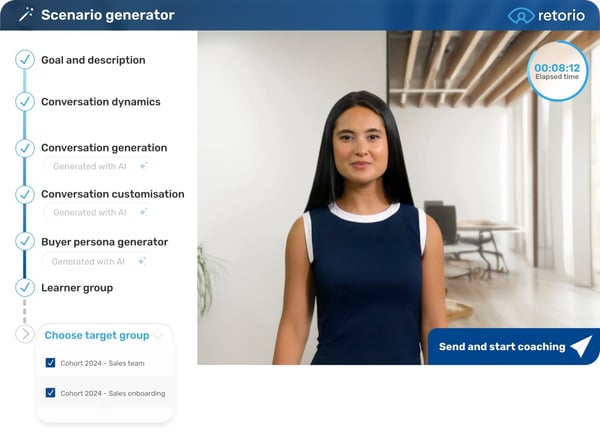
Retorio's AI coaching platform gives Sales Enablement and Commercial Excellence teams a library of realistic, role-play scenarios built from your own accounts and playbooks. Reps and managers practice the specific high-stakes conversations they will actually face, get behavioral feedback mapped to the Warmth and Competence framework, and managers see cohort-level trends instead of individual anecdotes.
The practice happens in an on-demand, psychologically safe space that is available 24/7, so a rep can rehearse a renewal call the night before it happens, not just during a scheduled workshop.
See how Retorio's AI coaching platform helps reps and managers rehearse high-stakes conversations before they happen live, with feedback mapped to a defined behavioral framework.
Test AI coach in actionFAQ
What is structured practice coaching for high-stakes conversations?
It is a coaching method where reps and managers rehearse the specific conversations that decide business outcomes, such as a renewal call, an escalation, or a difficult performance conversation, before they happen live. An AI coaching platform runs the practice, scores observable behavior against a defined rubric, and gives feedback the person can act on immediately. It replaces one-off workshops with repeated, measurable practice.
How is this different from traditional sales or service training?
Traditional training transfers knowledge: a deck, a webinar, a certificate. It rarely changes what a person actually does on a live call. Structured practice coaching is built around repetition and feedback on behavior, which is what the research on deliberate practice and skill retention says actually changes performance.
What is the Warmth and Competence framework?
Warmth and Competence is a well-established model from social psychology describing the two dimensions people use to judge anyone they interact with: how much they trust your intent, and how much they trust your ability. Retorio's AI coaching platform scores observable behavioral cues, tone, pacing, and language, against this framework, and the framework itself is grounded in decades of personality and social-perception research, including the Five-Factor (Big Five) model described by McCrae and John (1992).
Does Retorio use personality assessment to evaluate candidates or employees?
No. Retorio is a coaching platform, not a hiring or personality-assessment tool. The Big Five and Warmth and Competence research is used only as the scientific foundation for how the platform scores observable behavior in a practice conversation, never to assess, rank, or screen a person.
How does AI coaching build consistency across a sales or service team?
Every rep and manager practices against the same scenario and the same scoring rubric, so a manager can see where a whole team is strong or weak on a specific behavior, not just how one person felt about a session. That visibility is what lets Sales Enablement and Commercial Excellence teams target coaching where it actually moves a number.
How much practice does someone need before a real high-stakes conversation?
Enough repetitions to move a skill from conscious effort to habit, typically a handful of short structured sessions rather than one long workshop. Retorio's enterprise deployments document a 38 to 42 percent reduction in ramp time when practice is built into onboarding and ongoing coaching, rather than treated as a one-time event.
Is Retorio's AI coaching platform GDPR and EU AI Act compliant?
Yes. Retorio is GDPR-compliant, EU AI Act-aligned, and ISO 27001-certified, and is hosted on Google Cloud Platform with EU data residency. This is standard for every deployment, not an add-on.
Does structured practice coaching actually improve business outcomes?
When practice is deliberate, repeated, and tied to specific behavioral feedback, yes. Retorio's enterprise customers report a 38 to 42 percent reduction in ramp time, a 69 percent reduction in trainer effort, and a 72 percent reduction in turnover on high-performing teams. Ask any vendor for the denominator and measurement method behind a claimed outcome number.
Written with help from LLMs, edited and checked by Önder Mutluer, Website Manager and Marketing Strategist, and Dr. Patrick Oehler, Co-founder and Co-CEO. Reviewed by Peter Holdenried, Head of Sales. How this article was researched, written and checked, and who reviews which topic: Retorio editorial policy.