


Two platforms, two different theories of what makes a rep better. Second Nature scores how closely a rep follows a script. Retorio scores observable behavior against warmth and competence dimensions, then tracks whether that behavior actually changes across sessions. That distinction decides what your CFO can read a result from: script adherence produces a completion rate, AI coaching produces a quota-linked line. In enterprise deployments, the behavioral loop is what cuts ramp time by 38-42%, and that is the number enablement leaders take into the finance review.
A head of sales coaching at a 300-rep B2B software company once described their first year with an AI coaching platform like this: "The reps loved it. Completion rates were great. And then we ran the cohort analysis at month six, and nothing had moved on quota." When I asked what the platform had scored, she said: "How well they matched the call script. How confident their voice sounded. Things like that." That is the platform telling a rep they did well. It is not a coaching system.
The comparison between Retorio and Second Nature lands in exactly this gap. Both involve AI, both involve practice conversations. The difference is what happens after the conversation ends, and whether the output drives a behavioral change the next time the rep is in front of a customer.
Second Nature and Retorio are not competing for the same outcome. Second Nature focuses on script adherence and vocal confidence scoring. Retorio scores observable behavioral signals across Warmth and Competence dimensions, generates a ranked next-action for each rep, and gives managers a 30-day per-rep trend they can trace to quota attainment. For enterprise teams with a quota-traceable coaching mandate, they are different categories.
Source: Retorio enterprise customer studies, 100,000+ people coached across 50+ enterprise clients (Vodafone VOIS, Nürnberger Versicherung, and others).
Retorio vs Second Nature: which should you choose?
If your coaching mandate is checking whether reps followed a required script, Second Nature's script-adherence and vocal-confidence scoring covers that need directly. If your mandate is closing quota gaps by changing a specific behavior, Retorio is the fit: it scores observable Warmth and Competence signals per session, ranks the next behavior to practice, and gives managers a 30-day per-rep trend that traces to pipeline stage. Enterprise teams with an EU compliance requirement (GDPR, ISO 27001, EU AI Act) and a quota-traceable coaching mandate consistently choose the behavioral model over script checking.
Comparison last reviewed: July 2026.
Where each platform focuses
Second Nature focuses on
Scripted roleplay- Reps rehearsing a pitch
- Knowledge and message checks
- Certification-style run-throughs
Retorio is built for
Commercial function- Head of Sales, VP Sales, CRO
- Sales Enablement and Commercial Excellence
- Sales academies and Sales Capabilities leads, including the ones inside the HR organisation
- Regional and frontline sales managers
- Service owners and contact-centre operations
- Sales coaches and enablement partners
The line is the mandate, not the org chart. If you are measured on quota, ramp time or conversion, the right column is yours, and that includes a sales academy that reports into HR.
Competitor positioning above describes each vendor’s own product category, not a judgement on quality or compliance. Vendor scope changes, so confirm current capabilities with the vendor.
What each platform actually scores
The fastest way to understand any AI coaching platform is to ask: what does it measure, and what does the rep get after they finish a session? That output, not the platform's marketing language, tells you what it will change in the field.
Script-adherence platforms score whether the rep covered the required talking points, whether their tone sounded confident, and how closely their language matched a target script. That output is useful for checking compliance with a playbook. It is not the same as identifying why a rep loses deals or what behavior needs to change on the next call with a real customer.
AI coaching platforms score observable behaviors across standardized dimensions (Warmth: acknowledgment, active listening, empathy signals, follow-through language; Competence: discovery question density, value framing, objection handling, close language). That output is a rank-ordered list of three behaviors to work on, plus a trend line the manager can compare week-over-week.
Five dimensions: scripted practice vs AI coaching
The head-to-head: five dimensions that matter
Enterprise buyers evaluating AI coaching platforms consistently ask the same five questions. Here is where each platform lands.
| Evaluation dimension | Second Nature | Retorio |
|---|---|---|
| What the AI scores | Script coverage, vocal confidence, talk-time ratio, keyword frequency | Observable multimodal behavioral signals across what was said, how it was said (voice), and body language (video). Warmth (active listening, empathy) and Competence (confident delivery, persona-oriented communication), scored per turn. |
| Output after each session | Transcript, leaderboard score, checklist of covered vs missed points | Per-skill behavioral scores with the top 3 behaviors to practice next, each linked to the exact moment in the rep's own video, plus a 30-day trend for the manager. |
| Manager dashboard | Manager dashboard for individual and team progress, plus proficiency heatmaps for comparison, per secondnature.ai, Aug 2026 | Per-rep behavioral trend traceable to pipeline stage, and the next three behaviors to practise, with small cohorts held behind privacy thresholds |
| Compliance & data residency | SOC 2 Type II, US and EU deployment options | ISO 27001 certified, GDPR-compliant, EU data residency on GCP, EU AI Act-aligned for enterprise procurement |
| Scientific foundation | NLP-based conversation analysis, speech confidence modeling | Built on the Warmth and Competence framework (Fiske, Cuddy, Glick), grounded in a 100,000+-rep behavioral dataset, with research backing from TUM, MIT and the University of Tokyo. |
Previously, practicing a scenario with a manager took 3-5 hours. Now, with Retorio's AI Sales training platform, our agents conduct an AI role play 5 times for each scenario independently.
Ivo Nikolov, Business Analyst · Vodafone VOIS · 1,800 agents coached annually
Matching the alternative to what your committee has to prove
The best Second Nature alternative depends on what your buying committee needs to prove. If the requirement is EU data residency, ISO 27001 certification, and a manager dashboard that traces coaching to quota attainment, Retorio is the closest behavioral-science-grounded alternative. If the requirement is purely script coverage checking for a regulated call flow, Second Nature remains a valid fit for that narrower use case.
The alternatives enterprise teams actually evaluate
Beyond Retorio, enterprise teams evaluating Second Nature alternatives typically shortlist cold-call simulation tools, speech coaches, and avatar-simulation tools. The table below compares all five options across the criteria enterprise buyers ask about most: behavioral feedback depth, EU compliance, CRM integration, deployment time, and role-play format. Cells marked "Verify with vendor" reflect capabilities not publicly confirmed as of July 2026; only Retorio's row is asserted from Retorio's own documentation.
| Platform | Behavioral feedback | EU/GDPR + ISO 27001 | CRM integration | Deployment time | Role-play format |
|---|---|---|---|---|---|
| Retorio | Yes 140+ behavioral cues, warmth + competence scoring | Yes ISO 27001, GDPR, EU AI Act, GCP EU residency | Yes Salesforce, HubSpot, Dynamics, trigger-based | Days (AI scenario generator from call recordings) | Avatar-based AI role play, 93 avatars, 14 languages |
| Second Nature | Partial Script adherence + talk-time scoring | Partial Verify with vendor | Partial Verify with vendor | Verify with vendor | Conversational AI role play |
| Cold-call simulation tools | Partial Call scoring, objection handling | Verify with vendor | Partial Verify with vendor | Verify with vendor | AI buyer persona simulations |
| Speech and communication coaches | Partial Communication coaching, filler words, pacing | Verify with vendor | Verify with vendor | Verify with vendor | Speech coaching + meeting analysis |
| Avatar simulation with analytics | Partial Video-based conversation scoring | Verify with vendor | Partial Verify with vendor | Verify with vendor | AI role play |
Legend: Yes confirmed capability, Partial partial or unconfirmed capability, Verify with vendor not publicly documented. Retorio's row reflects Retorio's own product documentation; competitor cells are not sourced from competitor data and should be confirmed directly with each vendor before a purchase decision.
Insight alone doesn't change how someone shows up in a conversation. You have to measure the behavior itself, tone, pacing, the things competitors can't fake with a better rubric, and give the rep somewhere to practice it again. That's the evidence enterprise buyers actually need, not proof someone watched a video.

Where each platform delivers the most value
Both platforms have legitimate use cases. Picking the wrong one is not a question of vendor quality. It is a question of mismatched outcome expectations.
What managers can report to finance: platform type comparison
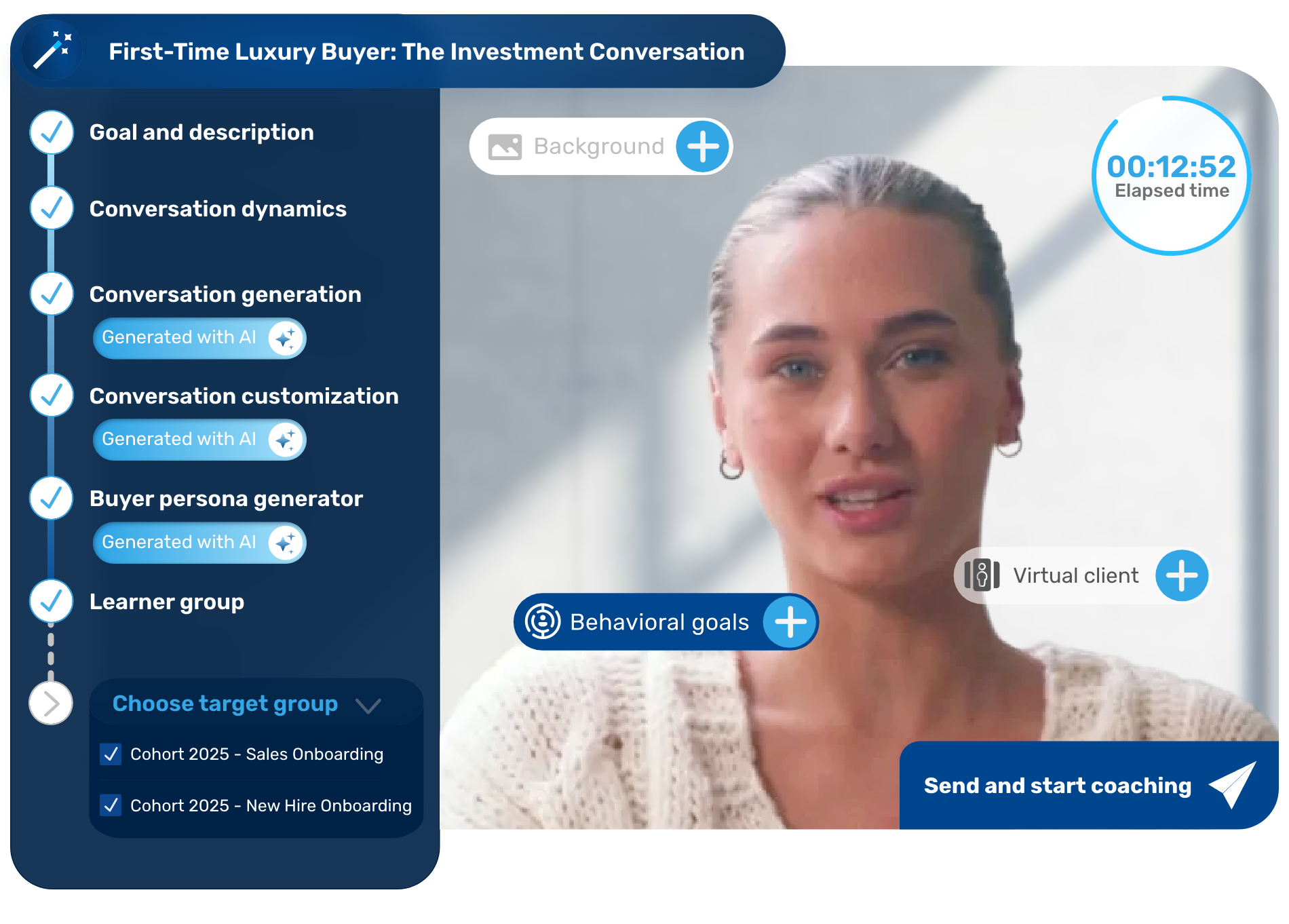
What a manager sees after eight sessions
The four questions to ask before you decide
Any vendor comparison becomes cleaner when you move from feature lists to outcome questions. These four filter the decision for enterprise sales and service teams.
What does the platform measure after end session?
Why it matters: If the output is a sentiment score or a leaderboard position, you are measuring activity, not coaching effectiveness. Ask to see a live demo of what a rep receives after completing one session, specifically what the "next steps" output looks like.
What to look for: Behavioral dimension scores (Warmth, Competence or equivalent), rank-ordered next practice, and whether the output changes rep behavior on the next real call.
What does the manager see, and can they act on it?
Why it matters: Coaching platforms that only surface engagement data (sessions completed, average score) force the manager to make coaching decisions without behavioral evidence. Effective AI sales coaching gives the manager a per-rep trend line, not an aggregate leaderboard.
What to look for: Can the manager filter by rep, see 30-day behavioral trends, and identify which behavior dimension each rep is weakest on this week?
What does procurement need to see?
Why it matters: Enterprise procurement now routinely includes an AI Act compliance check, a GDPR data residency question, and an ISO 27001 requirement. If your vendor cannot answer these in writing before the procurement stage, the deal stalls. For a full rundown of what to ask, see our 2026 AI sales coaching software guide.
What to look for: ISO 27001 certificate, EU data residency confirmation, EU AI Act alignment documentation, a DPA template ready to send to your legal team.
Can you connect coaching activity to quota outcomes?
Why it matters: This is the renewal question. Most coaching platforms can show you adoption metrics. Very few can show you a cohort of reps who completed a coaching cycle and their quota attainment at week 12 vs a control group. Ask your vendor to show you a specific customer cohort where coaching completion predicted quota performance.
What to look for: A named case study (not aggregate anonymized data) where ramp time and quota attainment improved within a measurable timeframe. If the vendor cannot name a customer who can speak to this on a reference call, that is a signal.
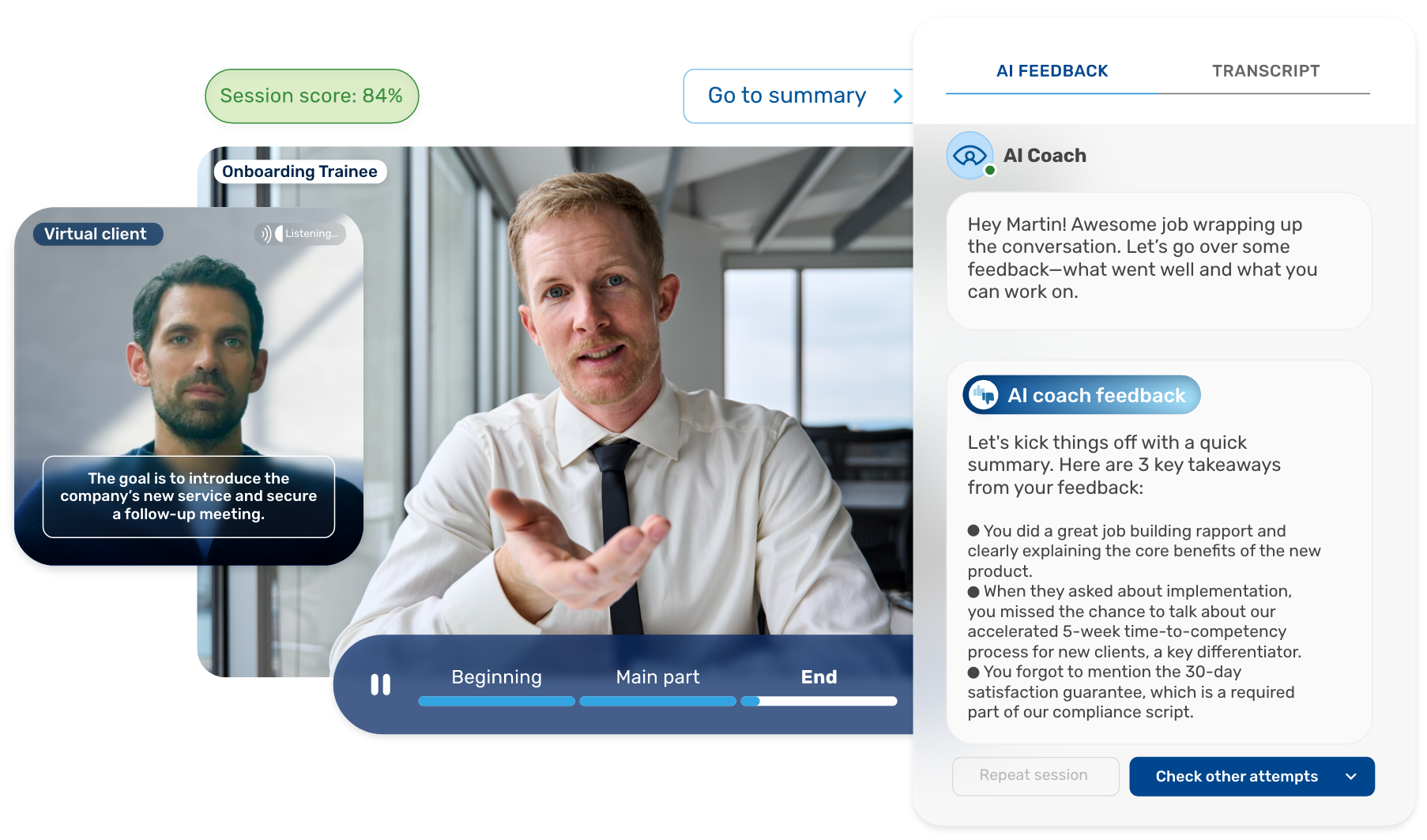
What not to use either platform for
How the behavioral science difference plays out in practice
The gap between script adherence and AI coaching is not a feature gap. It is a scientific model gap. Here is the practical version of that distinction.
When a rep finishes a session on a script-adherence platform, they receive feedback that sounds like: "You covered 7 of 9 required topics. Your vocal confidence was in the top 40% of the group. Missed: pricing objection handling." That feedback tells the rep what they forgot to say. It does not tell them whether their customer felt heard, whether their discovery questions surfaced a real pain point, or whether their tone in the first three minutes built enough rapport to keep the buyer engaged.
When the same rep finishes a session on an AI coaching platform, they receive: "Your Warmth score was 68 this session, below your 90-day average of 74. Your empathy signal rate dropped in the second half of the call. Recommended next practice: a 15-minute scenario focused on active listening acknowledgment after a customer objection." That feedback tells the rep exactly what happened and what to practice next. The manager sees this. The coach sees this. The next session is targeted, not generic.
The underlying research behind this distinction is well established. Behavior change, as measured in organizational psychology, requires specific observable targets, immediate feedback on that specific target, and spaced repetition across multiple sessions. Platforms that score aggregates (total call quality, overall confidence) cannot direct that loop. For a deeper read on the AI coaching model, see how AI coaching works inside sales enablement programs.
See Retorio's coaching loop in action: CRM context becomes the scenario, the session is scored on behaviour, and the manager gets the next action. Retorio, published June 2026.
If your coaching mandate includes quota outcomes, behavioral loops are the right category
Script adherence platforms are useful for compliance checking and onboarding volume. AI coaching platforms are built for the question your CFO actually asks: did this investment change quota? If that is your mandate, start with Retorio.
Test AI coach in actionA script tells a rep what to say. Behavior decides whether the buyer believes them. We score the second one, because that is the part a manager can still change in week eight.
Put both approaches against your own scenario
The difference between these platforms shows up in a real scenario, not a feature list. Bring yours and we will run it.

What can you actually report to a manager?
This is the question that decides the renewal, and it is usually asked too late. A platform can generate excellent practice and still leave a sales leader with nothing to present. Measurement works on three levels, and it is worth checking each one separately rather than accepting the word "analytics" on a feature list.
What was measured, and how reliably. Retorio scores visual, auditory and textual signals together, meaning posture, pacing, tone and word choice, at above 95% accuracy on visual and textual signals and above 80% on auditory. A score that cannot name the behavior behind it cannot be coached against, so ask which signals produced the number.
Does a manager get a trend, or a pile of sessions? Retorio gives a manager dashboard with a behavioral trend view per rep, which is the artefact that makes a 1:1 start at "here is what moved" instead of "how did last week go". A list of completed sessions is activity data, not a coaching signal.
Can a commercial leader read it without translation? Since July 2026 Retorio reports at organisation level: adoption, completed scenarios and Warmth and Competence development across the whole organisation, updated as reps complete their coaching. Cohorts can be compared side by side, so the Q1 new-hire group and the Q4 group sit next to each other instead of being averaged into one number. Small cohorts stay hidden behind privacy thresholds, which is a design choice rather than a gap: a comparison view that can single out one person is one a works council will stop. This is the level that answers "is this working", and the level most often missing.
What to ask Second Nature and anyone else on your shortlist. Which signals produce the score, in writing. Whether a manager sees a per-rep trend or a session log. Whether anything aggregates above team level. And whether the export lands somewhere your revenue reporting already lives. A vendor who cannot answer the second question has built practice, not coaching.
Frequently asked questions
What is the core difference between Retorio and Second Nature?
Retorio scores observable behavioral signals (Warmth and Competence) and generates a ranked next-action for each rep after every session. Second Nature focuses on script coverage, vocal confidence, and keyword adherence. The outputs serve different management questions: Retorio answers "what behavior needs to change to improve quota?" and script-adherence platforms answer "did the rep follow the playbook?"
Is Retorio compliant for EU enterprise procurement?
Yes. Retorio is ISO 27001 certified, GDPR-compliant, EU AI Act-aligned, and hosted on Google Cloud Platform with EU data residency. Your procurement and legal teams can request the DPA, security documentation, and compliance certificates directly.
Can both platforms show quota-linked coaching outcomes?
Retorio generates a 30-day per-rep behavioral trend that managers can correlate to pipeline stage and quota attainment at the cohort level. The Vodafone VOIS deployment (1,800 agents, 38% ramp time reduction) is a publicly available case study. Script adherence platforms typically report adoption metrics: session completion rates and average scores. Ask each vendor to show a named reference where coaching data traced to a quota outcome.
How does Retorio's behavioral scoring work?
Retorio scores across 140+ observable behavioral cues per practice session, mapped to the Warmth and Competence framework (grounded in Fiske, Cuddy, Glick social psychology research, validated with TUM, MIT, and University of Tokyo). Warmth covers relational behaviors (active listening, empathy, acknowledgment, tone calibration). Competence covers deal-moving behaviors (discovery sequencing, value framing, objection handling, close language). Every session produces a score on both axes plus a ranked list of three behaviors to practice next.
Is Retorio an alternative to Second Nature for pharma and insurance sales teams?
For regulated industries, Retorio's compliance architecture includes MLR-aligned scenario generation for pharma (pulls only from approved documents, zero hallucination), IDD compliance framing for insurance, and full EU data residency for DACH enterprise procurement. The platform is deployed at Nürnberger Versicherung (72% turnover reduction) and Biotest, among others in insurance and pharma. Second Nature does not publish equivalent regulated-industry case studies for DACH.
Retorio vs Second Nature: which one should you choose?
Choose Second Nature if your only requirement is checking script coverage and vocal confidence for a regulated call flow. Choose Retorio if your mandate is to close quota gaps by changing a specific rep behavior, and you need a 30-day per-rep trend, EU data residency, ISO 27001 certification, and EU AI Act alignment for procurement.
What is the best Second Nature alternative?
For enterprise teams that need behavioral scoring, EU compliance, and quota-traceable outcomes, Retorio is the closest alternative grounded in the Warmth and Competence framework. For teams that only need script-adherence checking, Second Nature covers that narrower need directly.
What are the best Second Nature AI alternatives?
The platforms most commonly shortlisted alongside Second Nature are Retorio (behavioral scoring, EU compliance, CRM-triggered deployment), cold-call simulation tools (AI buyer persona call scoring), speech coaches (speech coaching and meeting analysis), and avatar-simulation tools (video-based conversation scoring). Confirm compliance and CRM capabilities directly with each vendor, since only Retorio publishes ISO 27001 and GDPR documentation for EU enterprise procurement.
Compare Retorio with other platforms
Evaluating more than one vendor? These guides compare the options side by side.
Written with help from LLMs, edited and checked by Önder Mutluer, Website Manager and Marketing Strategist, and Dr. Patrick Oehler, Co-founder and Co-CEO. Reviewed by Peter Holdenried, Head of Sales. How this article was researched, written and checked, and who reviews which topic: Retorio editorial policy.