

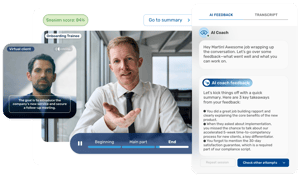
The sales training strategies that actually move quota in 2026 share three traits: they use deliberate, repeated practice instead of one-time events, they give feedback on specific observable behaviors instead of general impressions, and they get measured against a rep-performance metric instead of a completion rate. AI role play, manager-led call coaching, and spaced micro-practice rank highest on the evidence; generic e-learning modules and annual kickoff training rank lowest.
Example. A 400-rep SaaS sales org replaces its annual two-day kickoff training with weekly 15-minute AI role play sessions tied to the current quarter's top objection. Managers see which reps still stumble on pricing pushback and coach that specific gap instead of re-running the whole deck.
Published July 2026.
Every "sales training strategies" list on the first page of Google right now is a version of the same nine or ten tactics: role play, shadowing, micro-learning, gamification, peer coaching. The tactics are not wrong. What is missing from all of them is a ranking. Nobody tells you which of these strategies is backed by real evidence that it changes what a rep does on the next call, and which one is popular because it is easy to schedule and easy to report a completion rate for.
We build an AI coaching platform, so we have a stake in this question. We also have operating data from 50+ enterprise clients, and we can point to the behavioral-science research that explains why some of these strategies work and others do not. This is a ranked list, not an alphabetical one. Strategies are ordered by how directly they connect to documented behavior change, not by how common they are in an L&D calendar.
Why most sales training strategies do not survive contact with a real call
The gap between "we ran the training" and "reps do it differently on Tuesday" is the single biggest failure point in sales coaching. Ebbinghaus's forgetting-curve research, replicated by Murre and Dros (2015) in PLOS ONE, found that without active retrieval and repetition, most new information is lost within days. A one-time workshop, however well designed, is exactly the format this research says will not stick.
The second problem is feedback quality. Ericsson, Krampe, and Tesch-Römer's deliberate practice research (1993, Psychological Review) is explicit that skill improvement requires repeated practice of the specific skill with feedback tied to that skill, not general encouragement or a satisfaction survey. Most sales training strategies fail one or both conditions: they are one-time, or the feedback is generic.
Use this filter on any strategy before you fund it: does it create repeated practice, does the feedback target a specific observable behavior, and can you measure it against a performance metric instead of a completion rate? Strategies that pass all three are ranked first below.
9 sales training strategies, ranked by behavior-change evidence
Each strategy below includes what it is, why it does or does not hold up against the deliberate-practice research, and the specific metric to track if you run it.
AI role play with behavioral feedback
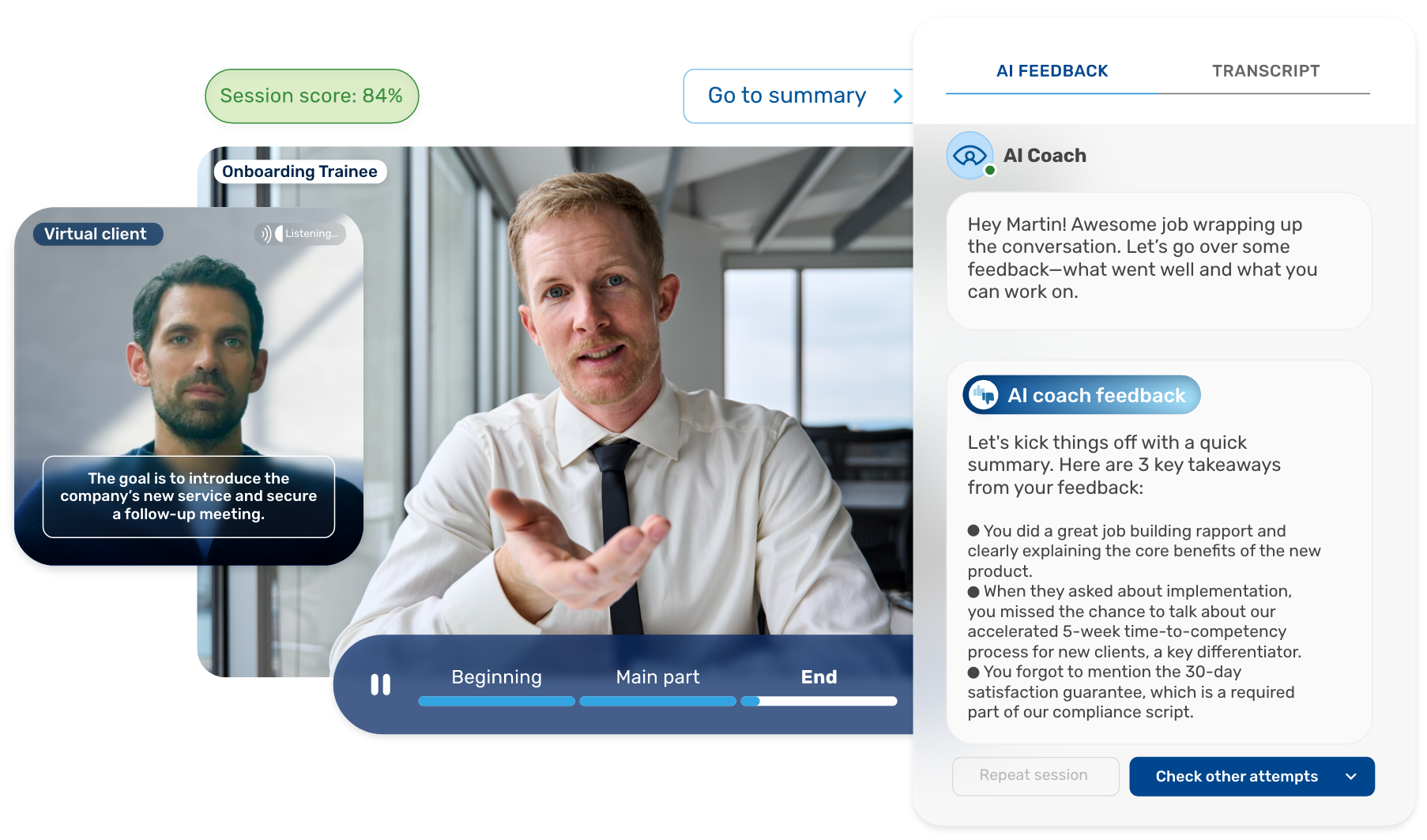
Reps practice objection handling, discovery, and negotiation against a dynamic AI buyer persona that pushes back, then get feedback on specific observable behaviors: talk ratio, questions asked, how an objection was actually handled. It is the closest format to real deliberate practice because it is repeatable on demand and the feedback is behavioral, not a manager's general impression. In Retorio's enterprise deployments, this has been documented at 38 to 42% ramp-time reduction and a 69% reduction in trainer effort at Vodafone VOIS (26 hours to 8 hours per new hire).
Measure: time-to-first-deal or time-to-quota for reps using it, plus session frequency per rep per week.
Manager-led call review with a named skill rubric
A manager reviews a recorded or live call against a defined skill model (not a gut check) and gives feedback tied to one or two specific behaviors to change on the next call. This works because it satisfies the deliberate-practice conditions, but it is manager-time-intensive and inconsistent across a large team unless the rubric is standardized. It pairs well with AI role play: role play builds the skill before the call, call review checks whether it transferred.
Measure: the specific behavior named in the last review, tracked call over call (did talk ratio actually change).
Spaced micro-practice on a single skill
Short, frequent practice sessions (10 to 15 minutes) on one narrow skill, spaced across weeks instead of packed into a single event. This directly applies the spacing effect from the forgetting-curve research: distributed practice produces better retention than the same total hours delivered in one block. Works best when tied to a live objection or deal pattern the team is facing that quarter, not a generic curriculum.
Measure: skill-specific score improvement across sessions (not just completion of the sessions).
Peer coaching and top-performer scripting
Top reps share exactly what they say and do in a specific scenario (a script, not a vague "be more consultative"), and others practice it. This has real evidence behind it because it converts tacit skill into an observable, practiceable behavior. It fails when the "sharing" stays at the level of a war-story anecdote instead of a specific, repeatable move the rest of the team can drill.
Measure: adoption rate of the specific scripted behavior in subsequent calls.
Certification gates before a rep faces a real buyer
A rep must demonstrate a defined proficiency level, usually through role play or manager assessment, before being cleared for live customer conversations in a new product line, territory, or regulated scenario. This does not build skill by itself; it enforces that the skill-building already happened. It is high-value for regulated industries (insurance, pharma) where an unprepared rep on a live call has compliance exposure, not just a lost deal.
Measure: percentage of reps certified before first live call in the scenario, and error rate for certified versus uncertified reps.
Scenario libraries built from your own deals
Practice scenarios drawn from your actual playbooks, CRM patterns, and recent deal losses instead of generic vendor templates. Reps transfer skill far better when the practice scenario resembles the real deal they will face next week. This strategy is really a multiplier on whichever practice format you use above (role play, call review, micro-practice); it is what makes any of them relevant instead of generic.
Measure: percentage of practice scenarios sourced from real deal data versus stock content.
Gamified leaderboards on activity metrics
Points, badges, and leaderboards tied to activity counts (calls made, modules completed). This drives short-term engagement but has weak evidence for durable behavior change, because it rewards volume and completion, not the quality of what was practiced. It is not worthless: it can increase participation in a genuinely useful format (like micro-practice). It should never be the primary strategy, only a wrapper on one.
Measure: if you must run this, measure the downstream skill metric it is meant to drive, not the leaderboard score itself.
Static e-learning modules and video libraries
Self-paced videos and slide-based courses that reps watch and click through. Watching content is not the same cognitive act as practicing a skill: passive consumption does not build durable procedural skill according to the same research base cited above. Useful as a knowledge layer (product facts, compliance requirements) but not as a mechanism for changing what a rep says or does on a call.
Measure: if used, measure knowledge-check accuracy only. Do not measure it against a behavior or quota metric; it is not designed to move one.
Annual kickoff or quarterly workshop training
A single multi-day event, usually tied to a sales kickoff. Ranks last because it is structurally the opposite of what the forgetting-curve and deliberate-practice research recommends: one dose, no spacing, and feedback that stops the moment the event ends. It is still useful for alignment, morale, and launching a new initiative, but it should never be the strategy a coaching program is built around, only the kickoff for one.
Measure: behavior retention 30 and 90 days after the event, not the event's satisfaction score.
A training strategy is only as good as what a rep does differently on their next call. Everything else is activity.

See how AI role play builds the practice layer for your team.
Test AI coach in actionThe three questions to ask before you fund any strategy
Budget conversations for coaching programs usually get won or lost on whether the enablement leader can answer these questions, not on which tactic sounds newest.
Does it create repeated practice?
One workshop is an event. A weekly cadence of practice is a program. If the strategy cannot be run more than once a quarter, it is not a coaching strategy, it is a kickoff.
Does feedback target a specific behavior?
"Great job" is not feedback. "You interrupted the buyer twice before they finished their objection" is. If the format cannot produce the second kind of feedback, it will not change behavior.
Can it be measured against performance, not completion?
Completion rate tells you people showed up. Ramp time, quota attainment, and win rate on the targeted skill tell you whether it worked. Report the second kind of number to your VP, not the first.
A practical starting stack for 2026
Most enablement leaders we work with start with AI role play for repeatable practice, manager-led review for the calls that matter most, and a certification gate for any new product or regulated scenario. That combination covers all three questions above without requiring a full training-calendar overhaul.
Retorio · Next-level AI sales coach for pharma and beyond
What the evidence says about each format
The chart below plots each strategy's evidence strength as summarized above: how directly it satisfies the deliberate-practice conditions (repetition, specific feedback, measurable outcome) versus how commonly it appears in a typical enablement calendar.
How to measure whether a strategy is actually working
The comparison below gives you a starting framework: what each strategy category should be measured against, and what a false-positive result looks like so you do not mistake activity for progress.
| Strategy category | Right metric | False-positive signal to ignore | Coaching cadence |
|---|---|---|---|
| AI role play | Ramp time, quota attainment, skill-score trend across sessions | Sessions completed per rep | Weekly |
| Manager call review | Change in the named behavior, call over call | Number of reviews conducted | Weekly to biweekly |
| Spaced micro-practice | Skill-specific score improvement across the spaced sessions | Module completion percentage | Weekly, 10-15 min |
| Certification gates | Error rate, certified vs. uncertified reps in live calls | Percentage who passed on first attempt | Per launch or product change |
| Annual kickoff | Behavior retention at 30 and 90 days post-event | Event satisfaction survey score | Annual, needs follow-up program |
This answers the coaching-cadence follow-up question directly: high-evidence formats (role play, call review, micro-practice) work best weekly or biweekly, not quarterly. Certification gates and kickoffs are event-driven and need a follow-up practice cadence attached, or the behavior decays per the forgetting-curve research cited above.
Retorio's AI coaching platform gives reps repeated, on-demand practice against realistic buyer personas, with behavioral feedback mapped to a defined skill model and manager-level analytics on what changed. It is the format at the top of the evidence ranking above, built for enterprise scale.
Test AI coach in actionConclusion
The strategies that move quota in 2026 are the ones that create repeated practice, give feedback on specific observable behaviors, and get measured against performance instead of attendance. AI role play, manager-led call review, and spaced micro-practice sit at the top of that list because they satisfy all three conditions. Annual kickoffs and static e-learning sit at the bottom because they satisfy none of them reliably, no matter how well produced they are.
Start by auditing your current training calendar against the three questions in this guide. Anything that cannot answer "does it create repeated practice, does feedback target a specific behavior, can it be measured against performance" is a candidate to retire or redesign, not fund again for 2026 unchanged.
Key Takeaways
FAQ
What is the most effective sales training strategy in 2026?
AI role play with behavioral feedback ranks highest because it creates repeated, on-demand practice with feedback tied to specific observable behaviors, the two conditions deliberate-practice research says are required for durable skill change. Retorio's enterprise data shows 38 to 42% ramp-time reduction using this approach.
How often should sales coaching happen?
High-evidence formats, AI role play, manager call review, and spaced micro-practice, work best on a weekly or biweekly cadence. Quarterly or annual events need a follow-up practice program attached, or the behavior change decays within days per forgetting-curve research.
Is AI role play better than classroom-style sales training?
They solve different problems. Classroom training transfers knowledge (product facts, methodology concepts). AI role play builds the behavioral skill to apply that knowledge in a live conversation. Teams that use both, knowledge first, then repeated practice, see better transfer than either alone.
How do you measure sales coaching ROI?
Measure the performance metric the strategy is meant to move, not attendance or completion. For practice-based strategies, that is ramp time, quota attainment, or a skill-specific score trend. Retorio's enterprise studies document 15x expected first-year ROI and a 69% reduction in trainer effort at Vodafone VOIS, both tied to specific, auditable metrics rather than a satisfaction score.
Should we retire annual sales kickoff training?
Not entirely: kickoffs are useful for alignment, morale, and launching a new initiative. The mistake is treating the kickoff as the coaching strategy itself. Pair it with a weekly practice cadence (role play or micro-practice) so the skills introduced at kickoff do not decay within days.
Best sales training programs in 2026: how to evaluate and choose
AI sales coaching: 4 behavioral signals that predict quota
Training is dead. The future of sales is coaching.
AI sales role play: the complete guide + software comparison
Author: Retorio Capability Team. Retorio is an AI Coaching Platform for enterprise sales and service organizations.
Compliance: Retorio is ISO 27001 certified, GDPR-compliant, EU AI Act aligned, and hosted on Google Cloud Platform with EU data residency. No prohibited inference is performed. All practice conversations with virtual customers are processed on EU infrastructure under ISO 27001 controls.
Sources: Murre and Dros (2015) PLOS ONE, forgetting curve replication. Ericsson, Krampe, and Tesch-Römer (1993) Psychological Review, deliberate practice. Retorio enterprise customer outcome data (retorio.com), June 2026: Vodafone VOIS Telecom scope 1,800 new customer service agents annually; Nürnberger Versicherung scope, new insurance agents under IDD compliance.
Last updated: July 2026.
Written with help from LLMs, edited and checked by Önder Mutluer, Website Manager and Marketing Strategist, and Dr. Patrick Oehler, Co-founder and Co-CEO. Reviewed by Peter Holdenried, Head of Sales. About Retorio· Editorial policy