


The five personality types every successful team needs are the Team Leader, the Innovator, the Analyst, the Charismatic connector, and the Planner. Each maps to a distinct pattern on the Big Five (OCEAN) personality model. U.S. companies alone spend more than $14 billion a year on leadership development, yet most of that investment targets only the Team Leader role while the other four go undeveloped. High-performing teams balance all five rather than over-indexing on one.
Example. A new product launch is stalling. The Team Leader rallies the group, the Innovator rewrites the pitch, the Analyst identifies the right accounts, the Charismatic rep gets the meetings, and the Planner makes sure every follow-up happens. All five roles are needed before the deal closes.
You may be a jack of all trades, but you're definitely a master of none if you can't work together in a team with others.
Work positions increasingly involve interacting with colleagues who aren't even in the same line of profession. You may need to cross paths with different departments, discuss and collaborate together to reach a common goal.
Companies are beginning to invest more in how to create and build teams, as they recognize that teamwork is essentially the key to accomplishing the overall objectives and goals of an organization.
Research has highlighted how teams can perform and grow together, and that to create a high-performing team, there are essential personalities that every team must have in order to have successful performance.
After all, Steve Jobs may be a visionary genius who transformed the way we interact and live today with his innovations - but we can't forget that he also motivated and led a team of hard-working professionals, who persevered to make Apple reach the hands of so many of us around the world today.
So let's just say, the need for effective teamwork is absolutely critical for any business.
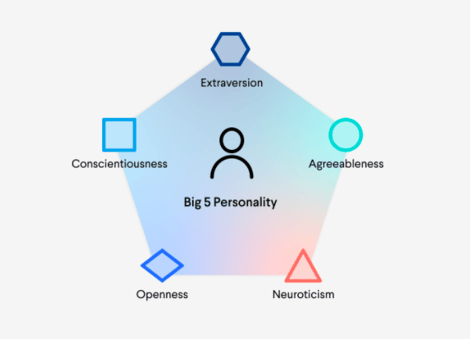
In this article, we'll be looking into the five personalities that every team needs to have, and which characteristics of the Big 5 model (one of the most prominent models in present psychology) each personality correlates to.
Who Is the Team Leader, and Why Does Every Team Need One?
“Leaders must be close enough to relate to others, but far enough ahead to motivate them.” -John C. Maxwell Big five mbti difference expands this point.
Every team needs someone who inspires, energizes, and encourages the others in the team to keep on pushing, and that is exactly the role of the leader. In fact, leadership is one of the major sources of an organization's productivity and competitive advantage.
Ideal leaders are those who also have high levels of emotional intelligence - this includes skills such as being able to control the impulse, curb impatience, properly regulate mood, prevent frustration, and have empathy and hope.
As companies realize the importance of fostering a good leader in every workplace, they're starting to invest in leadership development training programs that aim to strengthen leadership cultures, competence, and overall organizational performance.
In 2012, companies in the United States reported spending approximately $14 billion dollars annually on leader development, and the amount spent on leader development increased 14% in 2013.
Of the Big Five Personality Traits, often referred to as 'OCEAN' (openness, conscientiousness, extroversion, agreeableness, and neuroticism), extraversion, and agreeableness were positively correlated with overall self-ratings of leader development behavior. Studies revealed that narcissists tend to be attracted to positions of power, and narcissism is positively related to some leader development outcomes.
However, they might be particularly ill-suited for leader development programs. Understanding what drives effective leadership in sales contexts is explored further in the Warmth and Competence framework for sales performance.
How to spot the Team Leader in a real meeting: they are the one who names the goal out loud when the room goes quiet, who checks in on quieter teammates before moving to the next agenda item, and who takes the blame for a missed deadline instead of assigning it. If your team is missing this pattern, meetings tend to end without a clear next step and morale dips quietly instead of visibly, which makes the gap easy to miss until turnover shows it. For a deeper look at the specific behaviors that separate strong leaders from the rest, see our breakdown of the leadership skills every successful leader has.
Who Is the Innovator, and How Do They Drive Team Growth?
The creative input to the team comes from the innovator - this person brings new ideas to the table and can transform group efforts with new insights which focus on issues, and cause thinking breakthroughs.
During a project, innovators are the ones who craft bold but realistic visions and conceive entirely new value propositions, all while managing extreme uncertainty.
Studies are shedding light on the importance of innovation in the success of teams, and organizations are looking into their human resources to produce innovative behaviors, as industries demand high additional value creation in the knowledge economy.
Looking at the Big Five Model, empirical studies show positive connections between openness to experience and employees’ innovativeness.
How to spot the Innovator: they ask "what if we did this completely differently" in the middle of an otherwise routine planning call, and they get restless in meetings that only rehash what already exists. The risk with Innovators is not a lack of ideas, it is follow-through: without a Planner nearby, their best ideas stay half-built. Pairing an Innovator with a Planner on the same initiative is one of the simplest team-design fixes available.
Who Is the Analyst, and Why Do Teams Need a Critical Thinker?
These are the critical thinkers that don't rush to conclusions. They embrace rationality and are the team's strategic thinkers. They tend to be more focused on function and fact-oriented, as opposed to what makes everyone emotionally satisfied.
See how AI sales coaching works for your team.
Test AI coach in actionAnalysts are not always socially easy to handle due to their diligent and long process of decision-making. However, their ability to see both short-term and long-term gains and issues is incredibly valuable for a high-performing team.
Taking a look at the Big Five Personality Model, the analyst personality team member is likely to score high on openness, be more introverted, and score lower on agreeableness. For deeper context, see science big 5 useful ai.
How to spot the Analyst: they are the one who asks "what does the data actually say" before the team commits to a direction, and who catches the flaw in a plan two steps before it becomes expensive. Teams without an Analyst tend to move fast and confidently in the wrong direction, because nobody is assigned to slow down and check the assumption.
Who Is the Charismatic Connector, and Why Do They Matter for Customer-Facing Teams?
“I’ve learned that people will forget what you said, people will forget what you did, but people will never forget how you made them feel.” -Maya Angelou
These are the team members who have the people skills. They are confident individuals who are good communicators and make good listeners. They often do well working directly with customers and are particularly valuable on sales or customer service-oriented teams.
An important element of charismatic team members is that they make a point of listening to others - they are assertive, confident, inspiring, and warm. There is also a strong correlation between emotional intelligence and charisma. These personality types don't hesitate to show empathy, and can easily understand other employees' thoughts and emotions.
The individuals tend to score high on extroversion, openness, and agreeableness on the Big Five personality traits model.
How to spot the Charismatic connector: they are the one the client asks for by name, and the one new hires gravitate toward during onboarding because they make people feel heard rather than processed. This is precisely the Warmth signal Retorio's AI coaching platform scores in a discovery call, active listening cadence, response latency, and shared-interest language, because it predicts whether a buyer keeps engaging after an objection, not just whether the pitch was delivered correctly.
Who Is the Planner, and How Do They Turn Ideas Into Execution?
A team may have developed a bunch of great ideas, but use is that if there is no great plan to execute those great ideas?
This is where the planner in the team shines - these team members have a reliable personality type who base their decisions on keeping order. They are steadfast, punctual, and responsible by nature.
These are the employees who meet deadlines with ease, and constantly have a list of to-dos at their fingertips. As they are able to see any incoming curve balls in the road, you can count on them to have strategies for improving a team's performance and overall efficiency.
Of the Big Five personality types, these individuals tend to have high levels of conscientiousness and lower neuroticism. For teams focused on building consistent sales results, see how AI coaching for sales teams uses behavioral data to identify and develop these natural strengths.
How to spot the Planner: they are the one who sends the recap email with owners and dates before anyone asks for it, and the one a new hire's onboarding checklist usually runs through. Teams without a Planner generate plenty of energy and plenty of ideas, and very little of it survives contact with a real deadline.
What Happens When a Team Is Missing One of These Personality Types?
These are not rare situations. They are the default state of most teams that formed organically rather than by design, and they explain a lot of the friction that gets blamed on "communication problems."
If you want to explore how Retorio can assist L&D leaders in optimizing their coaching and training processes, simply schedule a meeting to learn more.

Frequently Asked Questions
What are the five personality types every high-performing team needs?
Every high-performing team benefits from five distinct roles: the Team Leader who motivates and directs, the Innovator who generates and tests new ideas, the Analyst who applies critical thinking and keeps the team grounded in data, the Charismatic who builds relationships and communicates across stakeholders, and the Planner who converts strategy into reliable execution. These five types map closely to the Big Five personality traits model (OCEAN).
Can one person fill multiple personality roles on a team?
Yes, especially in smaller teams. A strong Analyst may also carry Planner qualities, and a charismatic Team Leader can overlap with the Innovator role. The key is that across the team as a whole, all five functions are covered. When one role is absent, teams tend to struggle at that specific function: a team with no Planner misses deadlines; a team with no Innovator stagnates.
How does AI coaching help develop the five team personalities?
AI coaching platforms like Retorio run scenario simulations tied to each personality's most common development gaps. A rep identified as a natural Analyst but weak on interpersonal warmth can practice stakeholder conversations with an AI avatar and receive immediate feedback on tone and body language. Each session is logged so managers can track improvement over time without waiting for a quarterly review cycle.
Which Big Five personality traits correlate most with each team role?
Team Leaders tend to score high on extraversion and agreeableness. Innovators show the strongest link to openness to experience. Analysts score high on conscientiousness and lower on agreeableness, because their skepticism is the point. Charismatics rank highly on extraversion, agreeableness, and openness. Planners typically score highest on conscientiousness and lowest on neuroticism, making them the team's stabilizing force under pressure.
What happens when a team is missing one of the five personalities?
The gap shows up directly in team output. No Innovator: the team executes reliably but fails to adapt to market changes. No Analyst: decisions are fast but poorly validated, leading to costly mistakes. No Charismatic: internal communication breaks down and client relationships suffer. No Planner: creative ideas pile up with no follow-through. No Team Leader: the group fragments under pressure. Identifying these gaps early is why personality-aware team building matters for commercial results.
Written with help from LLMs, edited and checked by Önder Mutluer, Website Manager and Marketing Strategist, and Dr. Patrick Oehler, Co-founder and Co-CEO. How this article was researched, written and checked, and who reviews which topic: Retorio editorial policy.