


AI role play for objection handling gives reps realistic, repeatable practice against an AI buyer that pushes back like a real prospect. Reps rehearse price, competitor, and timing objections, get scored on observable behaviors like acknowledgment and value framing, and managers coach the specific gap each rep shows. Retorio scores this practice across warmth and competence.
Example. A regional sales manager stops sending reps into renewal calls cold. Each rep now rehearses the three objections that killed last quarter's deals against an AI buyer, gets scored on how they acknowledge and reframe, and the manager coaches the one move the dashboard flags per rep.
This is what makes objection handling so frustrating to fix. Reps can recite the right answer in a classroom and still freeze on a live call, because knowing a rebuttal and executing it under a real buyer's pushback are two different skills. The second one only comes from repetition, and most teams give reps almost none of it. A manager might run a role play once a quarter if there is time. That is not enough repetitions to change what a rep does in the moment that decides the deal. If you want the fundamentals first, our guide to objection handling training covers the frameworks; this piece is about the practice engine that makes them stick.
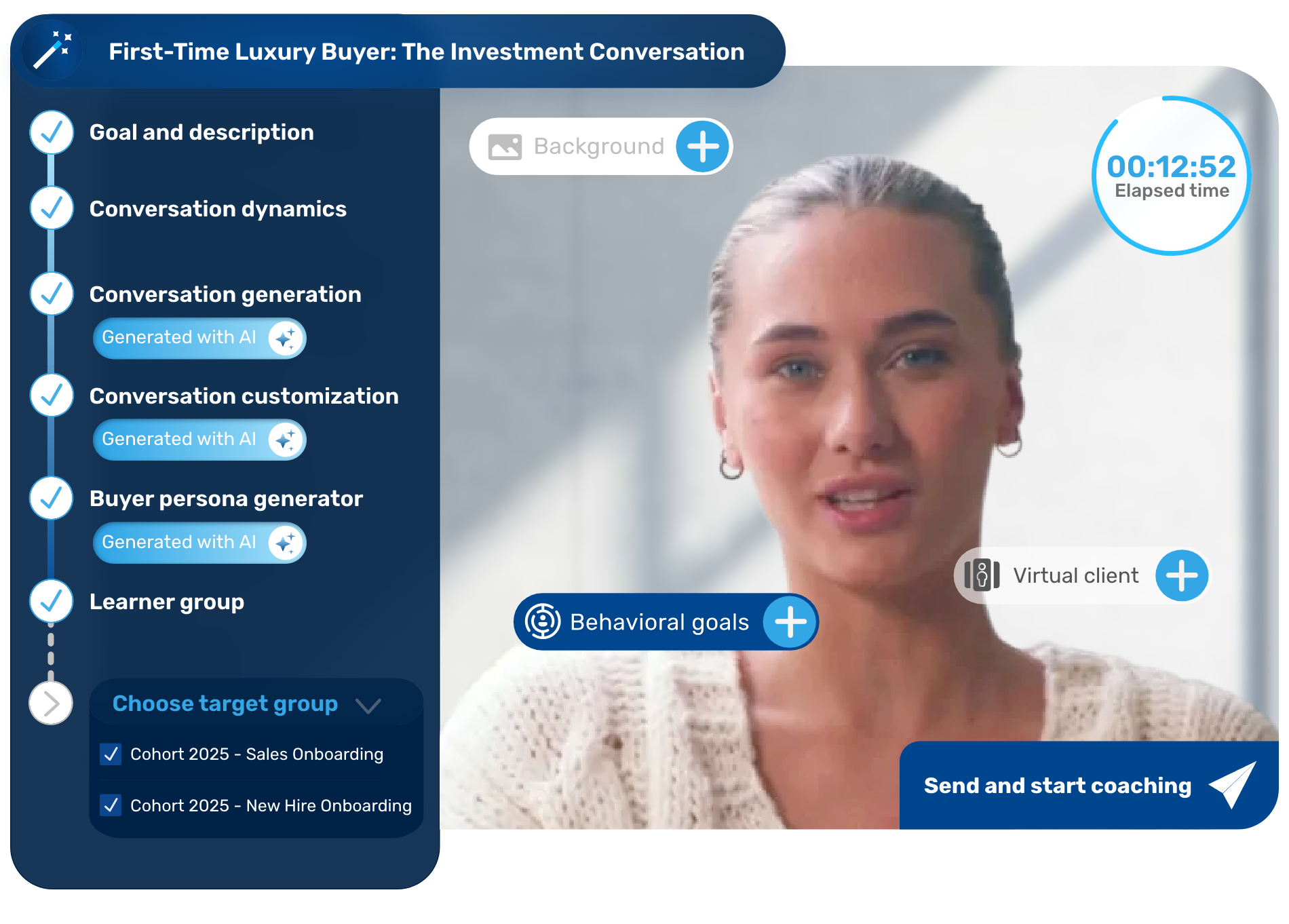
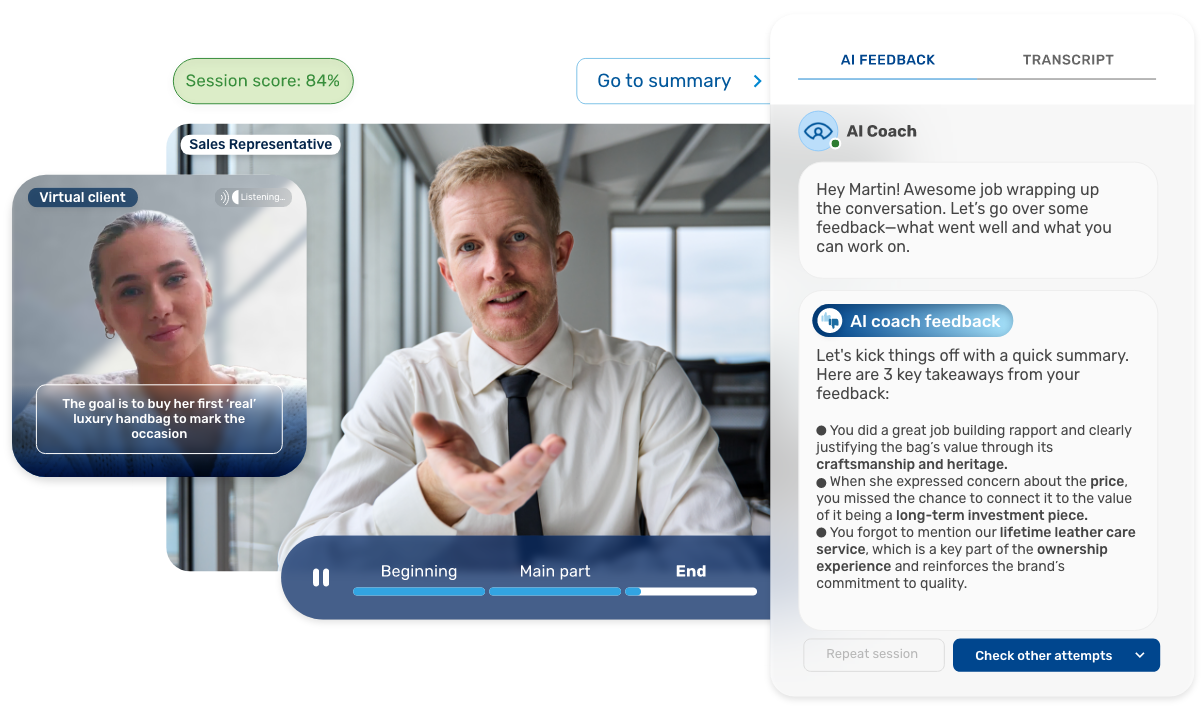
AI role play closes that repetition gap. A rep can face the same price objection ten times in an afternoon against an AI buyer that reacts like a real one, get scored on how they handled it, and see exactly which move to fix before the next attempt. Below is how it works, what good objection handling actually looks like when you score it, and how to roll it out so the behavior shows up on live calls.
(Retorio data)
(Retorio data)
The score stage is highlighted because it is the one a manual role play almost always skips, and it is what makes each repetition better than the last.
What good objection handling actually looks like when you score it
"Handle the objection" is too vague to coach or to score. To make practice useful, you have to break the moment into observable behaviors a rep either does or does not do. The four moves below make up what we call the Acknowledge-Diagnose-Reframe-Confirm loop (ADRC), and each one is something AI sales coaching can watch for on every rehearsal.
Why AI role play is the right practice engine for objections
The hard part of objection handling is not learning the ADRC moves, it is making them automatic. That takes volume, realism, and honest feedback, and traditional practice gives you at most one of the three. A quarterly manager role play is realistic but rare. An e-learning module is scalable but has no live pushback. AI role play is the first option that delivers all three at once, which is why the AI role play approach to sales practice has become the backbone of modern objection coaching.
The realism matters more than it sounds. Buyers keep raising the bar on what a good sales conversation feels like; Gartner's research on the B2B buying journey shows buyers spend only a small fraction of their time actually meeting with sales reps, so the few minutes a rep gets have to count. An AI buyer that pushes back with a real objection, reacts to a weak answer, and stays in character gives reps a place to spend their reps where it is safe to fail. They can mishandle a price objection at eleven at night with nobody watching, see the score, and try again, instead of learning the lesson on a live deal.
What scored, repeated practice moves in enterprise deployments
When practice becomes continuous instead of occasional, the whole training system gets cheaper and stickier. In the Vodafone VOIS program, scored AI rehearsal cut overall onboarding time by 41% and reduced trainer effort by 69%, from 26 hours to 8 hours per new hire, and Nurnberger Versicherung documented 72% lower turnover in coached teams. Objection handling rides on the same engine: more reps, more realistically, at a fraction of the manager time.
How AI role play compares to other ways teams practice objections
Most teams already practice objections in some form. The methods are not equal on the things that decide whether the skill transfers to a live call: how many reps a rep actually gets, how honest the feedback is, and whether you can see improvement. Cells marked "Verify with vendor" reflect capabilities that vary by provider and should be confirmed directly.
| Practice method | Repetition volume | Behavioral feedback | Measurable progress | Scales across the team | EU/GDPR + ISO 27001 |
|---|---|---|---|---|---|
| AI role play with behavioral scoring (Retorio) | Yes Unlimited runs, any hour | Yes 140+ cues, warmth and competence | Yes Per-behavior score, run to run | Yes No manager-hour ceiling | Yes ISO 27001, GDPR, EU AI Act, EU residency |
| Manager-led role play | Partial Limited by manager hours | Partial Specific but inconsistent | No Rarely recorded or scored | No Does not scale past a few reps | Yes No platform data |
| E-learning / objection scripts | No Read and quiz, no live rehearsal | No Quiz scores only | Partial Completion rates only | Yes Scales, but not skill | Verify with vendor |
| Live-call learning (learn on the deal) | No One shot, on a real customer | Partial Only if a manager rides along | No Outcome only, not behavior | No Costs real deals to learn | Verify with vendor |
"Previously, practicing a scenario with a manager took 3-5 hours. Now, with Retorio's AI Sales training platform, our agents conduct an AI role play 5 times for each scenario independently."
Ivo Nikolov, Business Analyst at Vodafone
How to roll out AI objection practice in 90 days
You do not need to overhaul the whole program to see whether this works. Sequence it so the first behavior change is measurable inside one quarter.
5 mistakes that make objection practice fail
How to measure whether objection practice is working
Track two layers together. Leading indicators tell you the behavior is changing now: rehearsal volume per rep, the behavior score on each ADRC move, and how fast the gap closes week over week. Lagging indicators confirm it reached the business: win rate on deals where the objection appears, average discount given, and quota attainment. When acknowledgment scores climb and the average discount falls a quarter later, you have proof the practice caused the result, which is exactly what you need to defend and grow the program.
Retorio's cross-customer data shows the pattern at scale: a 15x expected first-year return on investment, up to 20 percent revenue growth within twelve months of scaled adoption, and a +14.6 percent increase in quota achievement. Those are outcomes of the full loop, face through coach, not of any single training event.
The through-line
Reps do not lose deals because they never heard the right rebuttal. They lose them because they never practiced it under pressure. AI role play turns objection handling from a line a rep can recite into a move they reach for automatically, because they have already made it a hundred times where it was safe to fail.
Watch: how sales enablement turns into sales success
A short look at how enablement leaders connect practice and coaching to real sales outcomes, the same engine behind scored objection rehearsal.
Source: Retorio (YouTube).
Give your reps unlimited objection reps. See how scored AI role play changes how they handle price and competitor pushback.
Test AI coach in action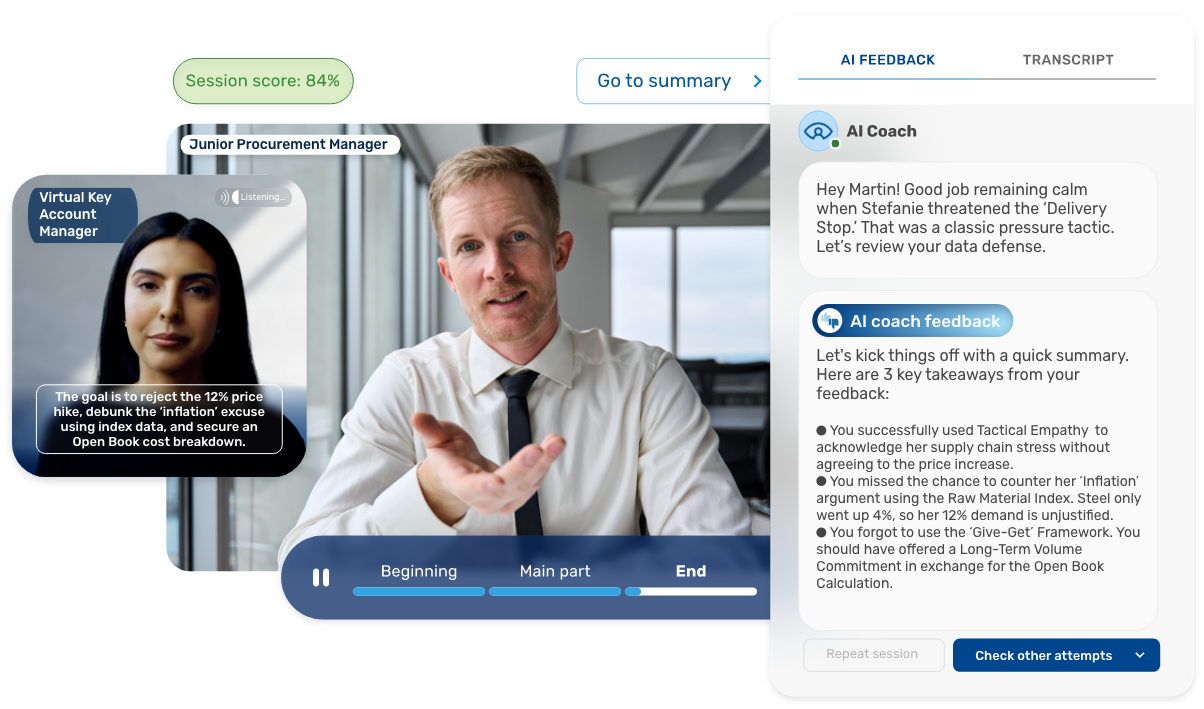
Frequently asked questions: AI role play for objection handling
What is AI role play for objection handling?
AI role play for objection handling is a practice method where reps rehearse against an AI buyer that pushes back with realistic objections like price, competitor, or timing. The rep responds out loud, the AI reacts in character, and the platform scores observable behaviors such as acknowledgment, diagnosis, and value framing so reps and managers see exactly what to improve before the next live call.
How do you practice objection handling with AI?
Start with the three objections that actually cost you deals, build a scenario from each, and have reps run them repeatedly against the AI buyer. Score one behavior at a time using a framework like Acknowledge-Diagnose-Reframe-Confirm, then have managers coach from the score each week. Volume and spaced repetition are what turn a rehearsed line into an automatic move.
Is AI role play better than manager-led role play for objections?
They work best together. Manager-led role play is realistic but rare, because a manager cannot run enough sessions to build a reflex. AI role play adds the missing volume and consistent, objective scoring, so managers spend their limited time coaching the specific gap the scores surface rather than acting as the practice partner.
What behaviors should you score in objection handling?
Score the moves, not the exact words: whether the rep acknowledged the concern before answering, asked a clarifying question to diagnose the real objection, reframed around the buyer's stated value instead of discounting, and confirmed the objection was resolved before advancing. Retorio scores this practice across warmth and competence using 140+ verbal, vocal, and visual cues.
How long does it take to improve objection handling with AI role play?
A focused 90-day cycle is enough to show a measurable behavior change: pick three objections, baseline one behavior, set a weekly rehearsal cadence, coach from the score, and compare the before-and-after. Because reps can get many repetitions a week instead of one a quarter, the target behavior usually starts moving within the first few weeks.
Is AI sales role play GDPR-compliant?
It depends on the vendor. Retorio is ISO 27001 certified, GDPR-compliant, EU AI Act-aligned, and hosted on Google Cloud Platform with EU data residency. For any platform, confirm in writing where conversation data is processed and stored before you roll it out to the field.
Written with help from LLMs, edited and checked by Önder Mutluer, Website Manager and Marketing Strategist, and Dr. Patrick Oehler, Co-founder and Co-CEO. Reviewed by Peter Holdenried, Head of Sales. How this article was researched, written and checked, and who reviews which topic: Retorio editorial policy.