


A renewal business case for a coaching program shows finance what the program changed, not what it delivered. Show four things: reps used it, their behavior on named skills changed, new reps ramped faster, and conversion or quota moved. Start the baseline in month one. In a 2025 Gartner survey, 31% of CSOs named proving the ROI of AI tools a top challenge.
A Head of Sales Enablement has six weeks until the coaching contract renews. Instead of a usage report, she brings the CFO one page: participation by team, scores on two coached conversations before and after, time to first deal for the last two hiring cohorts, and win rates for coached and uncoached reps.
It is eleven weeks before the contract ends. The email from finance is one line long: “Before we renew, can you show me what we got for this?” The enablement leader opens the vendor dashboard. It shows logins, sessions completed and a satisfaction score. None of it answers the question. Finance did not ask whether reps liked the program. Finance asked what changed in the business. That gap, between what a coaching program reports and what a budget owner needs to see, decides more renewals than price does.
This guide is for Sales Enablement leaders, Heads of Commercial Excellence and Sales Capabilities owners who have to defend a coaching budget at renewal, usually to finance and procurement, sometimes to a new CRO who did not sign the original contract. It covers the evidence finance accepts, how to tailor the case to each stakeholder, a 12-month evidence calendar, the ROI calculation and a six-week renewal plan. If you are still designing the wider enablement function around the program, start with our quota-focused sales enablement playbook.
What is a renewal business case for a coaching program?
A renewal business case is the document that asks the business to keep funding a program it already pays for. It looks like the original purchase case, but it is a different kind of argument. The first case was a forecast: if we coach these conversations, we expect ramp time, conversion and retention to improve. The renewal case is a report: here is what happened against the baseline we agreed, here is how confident we are that coaching caused it, and here is what we propose for next year.
That shift changes what counts as evidence. A forecast can rest on vendor case studies and analyst research. A report cannot. Finance will compare your numbers with the ones in the original approval, and procurement will compare the price with what the business actually used. The renewal case also carries a proposal, because most renewals are a decision about scope: renew as is, expand to a new team or country, or shrink to the groups where the program clearly worked.
The pressure to prove value is not only felt by enablement. In a Gartner survey of 227 chief sales officers, 31 percent cited difficulty proving the ROI of AI-driven tools as a top challenge to their 2026 sales objectives. Gartner's analyst Sandhya Mahadevan adds a point every renewal owner should keep in mind: proving ROI is often as much about organizational alignment and expectation setting as it is about measurement mechanics. Her advice is to secure CFO support for the approach early and to keep a reliable baseline of seller productivity and sales capacity.
31%
of chief sales officers cite difficulty proving the ROI of AI-driven tools as a top 2026 challenge (Gartner, 227 CSOs).
25%
of respondents in a McKinsey survey said their training programs measurably improved business performance.
30%
of organizations use any metric beyond participant feedback to judge their programs, according to McKinsey.
Why most renewal business cases fail
Most renewal cases fail for a simple reason: they report activity, and finance is asking about outcomes. The pattern is old. In McKinsey's article on getting more from training programs, the authors found that only 50 percent of organizations even track participants' feedback, and only 30 percent use any other kind of metric. In their words, many companies essentially measure effectiveness by asking participants whether they liked it. Only one quarter of respondents to a McKinsey survey said their programs measurably improved business performance.
Few programs measure what finance asks about
The same article points to the fix. Track a program against the hard business metric it is meant to improve, and where that is not possible, measure leading indicators such as actual behavior change. Three habits keep the gap open:
The evidence chain finance accepts
A renewal case is convincing when each claim rests on the one before it. We call it the evidence chain: four links, each with a metric someone outside enablement can check. If a link is missing, the claims after it are hard to believe, no matter how good the final number looks.
Link 1
Used
Reps practised, and kept practising without being chased. Show voluntary participation by team and sessions per rep per month, not total logins. Data owner: the coaching platform.
Link 2
Changed
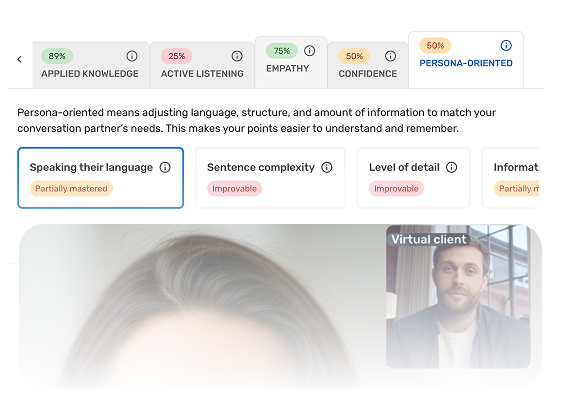
Behavior on the coached conversations improved. Show scores on two or three named behaviors at the start and now, calibrated against what managers hear on real calls. Data owner: the platform plus manager reviews.
Link 3
Faster
New reps reached productivity sooner. Show time to first deal or time to quota for hiring cohorts before and after the program. Data owner: the CRM and sales operations.
Link 4
Won
Conversion, win rate or quota attainment moved for the coached group compared with a group that was not coached, or with the same group before. Data owner: the CRM and finance.
The order matters more than any single number. Usage without behavior change tells finance the program is popular. Behavior change without a ramp or conversion effect tells the CRO it is interesting. Only the full chain tells the business it is working. For the conversion link, pick the metrics your sales leadership already trusts; our guide to sales performance metrics that predict quota covers which ones lead and which ones lag.
In renewal reviews we join, the moment that decides the meeting is usually the second link. The enablement lead shows participation, then shows a win rate chart, and someone from finance asks how she knows the reps behave differently. When the answer is a before-and-after score on a named conversation, such as how reps handle a price objection, the room relaxes. When the answer is a satisfaction survey, the discussion turns to price.
Finance rarely cuts a program it can see working. It cuts the one that can only show it was used.
Retorio Customer Success Team, on renewal reviews
Build the case for each person in the room
A renewal decision is rarely made by one person. Each stakeholder reads the same case looking for a different answer, and the case that wins anticipates all of them. The table below is the checklist we use to prepare.
| Stakeholder | What they actually ask | Evidence that answers it | Where the data comes from |
|---|---|---|---|
| CFO or finance partner | Did this pay back, and how sure are you? | A conservative value range against total cost, with the attribution logic written out. | CRM, finance, the original approval document |
| Procurement | Are we paying for what we use? | Active users against licensed seats, usage by team, and the scope you propose for next year. | Coaching platform usage reports |
| CRO or Head of Sales | Did it move pipeline and quota? | Win rate and quota attainment for coached reps against a comparison group. | CRM, sales operations |
| Frontline sales managers | Does it save me time or cost me time? | Manager hours spent on role plays before and after, and which reps they now coach first. | Manager survey, calendar sample |
| Country or business unit heads | Would it work for my team? | Results from the team most similar to theirs, and the languages and scenarios available. | Pilot team data, platform scenario library |
| IT and data protection | Has anything changed since we approved it? | Current certifications, data residency and any new features that touch personal data. | Vendor security pack, data processing agreement |
Two rows deserve extra preparation. Procurement will almost always open a price conversation, and the strongest position is to arrive with usage data and a scope proposal of your own, so the discussion is about value per active rep rather than a percentage discount. It also helps to know how vendors in this category structure their fees; our overview of how AI sales coaching platforms price explains the common models. The country and business unit row matters because many renewals are really expansion decisions. A head of sales in a second country does not care about the global average. They want to see the team that looks most like theirs.
The 12-month evidence calendar
The only reliable way to have a strong renewal case is to start collecting it on the day the program starts. A calendar makes that concrete. It fixes six checkpoints across the contract year, each with one job, so that by month eleven you are assembling evidence rather than searching for it.
Six checkpoints between kick-off and renewal
How to calculate sales training ROI for the renewal
Sooner or later someone asks for a single ROI number, usually phrased as sales training ROI because that is how finance thinks about the category. The formula is simple: the value you can attribute to the program, minus its total cost, divided by its total cost. The hard part is the value, and the safest way to build it is line by line.
Then discount the result. Coaching is rarely the only change in a sales year, so attribute only the share you can defend and present the outcome as a range, not a point. A conservative range that survives questions is worth more in the room than an impressive figure that collapses at the first one.
What is a good ROI for a coaching program? There is no universal benchmark, and you should be wary of anyone who quotes one without context. The useful comparison is with the other ways finance could spend the same money, such as another hire or a larger incentive pool. Retorio puts the expected first-year ROI of its AI coaching at 15x, but your finance team will trust your own numbers, built from your own CRM, far more than any vendor figure.
Six weeks before the renewal: the plan
Even with a full year of evidence, the last six weeks decide how the case lands. This is the sequence that works best in the renewals we support.
Weeks 6 to 5: Pull the chain together
Export participation and behavior scores from the platform, ramp and conversion data from the CRM, and any retention data for first-year reps. Put each link on one slide with its baseline next to it.
Ready when: every claim in the case points to a data source someone outside enablement can open.
Weeks 5 to 4: Pre-wire finance and the CRO
Walk your finance partner through the attribution logic before any formal meeting, and ask what would make them doubt it. Do the same with the CRO for the conversion numbers. Surprises in the decision meeting cost more than weak results.
Ready when: finance has challenged the numbers once and you have answered in writing.
Weeks 3 to 2: Write one page and a proposal
Put the decision on one page: what the program changed, the value range, the cost, and your proposal for next year. Renew, expand or narrow, each with a reason. Everything else goes into an appendix.
Ready when: a reader can make the decision from page one alone.
Weeks 2 to 0: Close scope and price
Bring procurement the usage data and your scope proposal, so the negotiation is about value per active rep. Confirm IT and data protection have what they need for the renewal review, so the contract does not stall on paperwork.
Done when: the contract is signed before the end date, with the metrics for next year's case already agreed.
Where AI coaching makes the case easier
The weakest link in most renewal cases is the second one. Traditional role plays and workshops leave almost no record of how a rep's behavior changed, so enablement teams end up with usage figures on one side, revenue on the other, and nothing in between.
AI coaching produces that middle link as part of the work. Every practice conversation with a virtual customer is scored on the same named behaviors, so you can show how each team's handling of discovery, objections or negotiation moved over the year, and where it did not. Managers see who is stuck and coach those reps first, which also gives you the manager-time line for the ROI calculation. If you are planning to expand the program to new teams, our guide on building an enterprise sales program covers the rollout decisions that shape next year's evidence.
75-93%
voluntary participation rates in Retorio customer programs, the first link of the chain.
38-42%
reduction in ramp time, documented in Retorio enterprise customer studies.
+14.6%
increase in sales quota achievement in Retorio customer results.
These are results from Retorio customers, not guarantees for your own coaching program. They are useful in a renewal case as a reference point for what the chain can look like when each link is measured, and as a check on your own numbers: if your results are far above or below them, finance will ask why, and you should know the answer first.
Common mistakes in a renewal business case
Most of these come from treating the renewal as a sales pitch for the vendor instead of a report on the business.
The short version
A renewal business case is a report, not a forecast. Agree the metrics with finance at the start, collect a baseline in month one, and fill in the evidence chain as the year goes: reps used the program, their behavior changed, new reps ramped faster, and conversion moved. Tailor the case to each person in the room, present value as a conservative range, and bring a scope proposal of your own. The renewals that go smoothly are the ones where finance has already seen the evidence before the meeting.
Make the middle of the evidence chain visible
Let reps practise the conversations that matter with realistic virtual customers, and see how each team's behavior changes over the year, ready for your next renewal.
Test AI coach in actionFrequently asked questions
What should a renewal business case for a coaching program include?
A short decision page and an appendix. The page states what the program changed against the agreed baseline, a conservative value range against total cost, and a proposal for next year: renew, expand or narrow. The appendix carries the evidence chain: participation, behavior scores on coached conversations, ramp time for hiring cohorts, and win rate or quota attainment against a comparison group.
How do you prove the ROI of a sales coaching program?
Record a baseline before the program starts, choose a comparison group, and track four links in order: usage, behavior change on named conversations, ramp time and conversion. Turn ramp days saved, recovered manager time and conversion lift into value, discount for other changes in the same year, and present the result as a range.
What is a good ROI for a training program?
There is no universal benchmark. A good ROI is one that beats the other ways finance could spend the same budget, such as another hire or a larger incentive pool, and that survives questions about attribution. Present a conservative range built from your own CRM data rather than a single headline figure.
When should you start building the renewal business case?
On the day the program starts. Record ramp time, win rates and first behavior scores at month 0, check adoption at month 1, behavior at month 3 and ramp at month 6, and draft the case at month 9, so the decision at month 11 rests on a full year of evidence.
How do you defend a coaching budget against cuts?
Show the full evidence chain, not usage alone, and walk your finance partner through it before the decision meeting. Bring usage data and your own scope proposal to procurement, so the discussion is about value per active rep. If one team clearly did not benefit, propose narrowing the scope there rather than defending every seat.
Written with help from LLMs, edited and checked by Önder Mutluer, Website Manager and Marketing Strategist, and Dr. Patrick Oehler, Co-founder and Co-CEO. How this article was researched, written and checked, and who reviews which topic: Retorio editorial policy.